Showing posts with label Ivanpah Dry Lake. Show all posts

August 17, 2014

'Alarming' Rate Of Bird Deaths As New Solar Plants Scorch Animals In Mid-Air

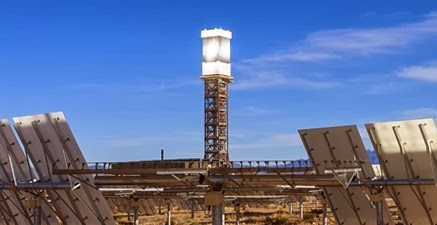
Solar panels stand at the Ivanpah Solar Electric Generating System in the Mojave Desert near Primm, Nevada, U.S., on Monday, March 10, 2014. (Bloomberg via Getty Images)

By Ellen Knickmeyer and John Locher
Associated Press


IVANPAH DRY LAKE, Calif. (AP) — Workers at a state-of-the-art solar plant in the Mojave Desert have a name for birds that fly through the plant's concentrated sun rays — "streamers," for the smoke plume that comes from birds that ignite in midair

Federal wildlife investigators who visited the BrightSource Energy plant last year and watched as birds burned and fell, reporting an average of one "streamer" every two minutes, are urging California officials to halt the operator's application to build a still-bigger version.

The investigators want the halt until the full extent of the deaths can be assessed. Estimates per year now range from a low of about a thousand by BrightSource to 28,000 by an expert for the Center for Biological Diversity environmental group.

The deaths are "alarming. It's hard to say whether that's the location or the technology," said Garry George, renewable-energy director for the California chapter of the Audubon Society. "There needs to be some caution."

The bird kills mark the latest instance in which the quest for clean energy sometimes has inadvertent environmental harm. Solar farms have been criticized for their impacts on desert tortoises, and wind farms have killed birds, including numerous raptors.

"We take this issue very seriously," said Jeff Holland, a spokesman for NRG Solar of Carlsbad, California, the second of the three companies behind the plant. The third, Google, deferred comment to its partners.

The $2.2 billion plant, which launched in February, is at Ivanpah Dry Lake near the California-Nevada border. The operator says it is the world's biggest plant to employ so-called power towers.

More than 300,000 mirrors, each the size of a garage door, reflect solar rays onto three boiler towers each looming up to 40 stories high. The water inside is heated to produce steam, which turns turbines that generate enough electricity for 140,000 homes.

Sun rays sent up by the field of mirrors are bright enough to dazzle pilots flying in and out of Las Vegas and Los Angeles.

Federal wildlife officials said Ivanpah might act as a "mega-trap" for wildlife, with the bright light of the plant attracting insects, which in turn attract insect-eating birds that fly to their death in the intensely focused light rays.

Federal and state biologists call the number of deaths significant, based on sightings of birds getting singed and falling, and on retrieval of carcasses with feathers charred too severely for flight.

Ivanpah officials dispute the source of the so-called streamers, saying at least some of the puffs of smoke mark insects and bits of airborne trash being ignited by the solar rays.

Wildlife officials who witnessed the phenomena say many of the clouds of smoke were too big to come from anything but a bird, and they add that they saw "birds entering the solar flux and igniting, consequently become a streamer."

U.S. Fish and Wildlife officials say they want a death toll for a full year of operation.

Given the apparent scale of bird deaths at Ivanpah, authorities should thoroughly track bird kills there for a year, including during annual migratory seasons, before granting any more permits for that kind of solar technology, said George, of the Audubon Society.

The toll on birds has been surprising, said Robert Weisenmiller, chairman of the California Energy Commission. "We didn't see a lot of impact" on birds at the first, smaller power towers in the U.S. and Europe, Weisenmiller said.

The commission is now considering the application from Oakland-based BrightSource to build a mirror field and a 75-story power tower that would reach above the sand dunes and creek washes between Joshua Tree National Park and the California-Arizona border.

The proposed plant is on a flight path for birds between the Colorado River and California's largest lake, the Salton Sea — an area, experts say, is richer in avian life than the Ivanpah plant, with protected golden eagles and peregrine falcons and more than 100 other species of birds recorded there.

U.S. Fish and Wildlife Service officials warned California this month that the power-tower style of solar technology holds "the highest lethality potential" of the many solar projects burgeoning in the deserts of California.

The commission's staff estimates the proposed new tower would be almost four times as dangerous to birds as the Ivanpah plant. The agency is expected to decide this autumn on the proposal.

While biologists say there is no known feasible way to curb the number of birds killed, the companies behind the projects say they are hoping to find one — studying whether lights, sounds or some other technology would scare them away, said Joseph Desmond, senior vice president at BrightSource Energy.

BrightSource also is offering $1.8 million in compensation for anticipated bird deaths at Palen, Desmond said.

The company is proposing the money for programs such as those to spay and neuter domestic cats, which a government study found kill over 1.4 billion birds a year. Opponents say that would do nothing to help the desert birds at the proposed site.

Power-tower proponents are fighting to keep the deaths from forcing a pause in the building of new plants when they see the technology on the verge of becoming more affordable and accessible, said Thomas Conroy, a renewable-energy expert.

When it comes to powering the country's grids, "diversity of technology ... is critical," Conroy said. "Nobody should be arguing let's be all coal, all solar," all wind, or all nuclear. "And every one of those technologies has a long list of pros and cons."

March 18, 2014

Airplane pilots hit by ‘nearly blinding’ glare from massive California solar facility

Heliostats reflect sunlight onto boilers in towers during the grand opening of the Ivanpah Solar Electric Generating System in the Mojave Desert near the California-Nevada border. (REUTERS/Steve Marcus)
Michael Bastasch
Daily Caller


Airplane pilots cruising over southern California have been complaining about a “nearly blinding” glare emanating from a massive government-funded solar thermal facility.

The Ivanpah solar energy plant in San Bernardino County is the world’s largest solar thermal plant and has 173,500 large mirrors that reflect sunlight onto boilers in three 459-foot towers. A feat of modern engineering — to green energy advocates, but a flying hazard to pilots.

The Federal Aviation Administration’s Aviation Safety Reporting System (ASRS) got two anonymous complaints in August that mentioned a “blinding glare” coming from the Ivanpah solar facility. One complaint came from a Los Angeles air traffic controller and the other from a small transport plane pilot that took off from an airport in Boulder City, Nevada.

“The FAA is aware of potential glare from solar plants and is exploring how to best alert pilots to the issue,” an FAA spokesman told The Daily Caller News Foundation.

Dozens of flights per day fly over or near the Ivanpah solar facility on routes between the Las Vegas area and Southern California. On its initial climb leaving Boulder City airport, the pilot of the small transport plane “experienced a very bright, intense light from three solar complexes which interfered with their ability to scan for traffic,” according to the ASRS filing.

“[T]he Co-pilot and I were distracted and momentarily blinded by the sun reflecting off of mirrors at the solar power plant facility located near the CA-NV border near the town of Primm,” the pilot wrote to ASRS. “This solar power plant which I believe is still under construction consists of three massive circular arrays of thousands of mirrors oriented inward toward a central tower.”

“From the pilot’s seat of my aircraft the brightness was like looking into the sun and it filled about 1/3 of the co-pilots front windshield,” the pilot added. “In my opinion the reflection from these mirrors was a hazard to flight because for a brief time I could not scan the sky in that direction to look for other aircraft.”

“Daily, during the late morning and early afternoon hours we get complaints from pilots of aircraft flying from the northeast to the southwest about the brightness of this solar farm,” wrote the Los Angeles air traffic controller in August.

“On this particular morning, an air carrier complained about the brightness and reiterated that it was ‘nearly blinding,’” the controller continued. “I have no idea what can be done about this situation, but being a passenger on an aircraft that flew through this airspace and saw it for myself, I would say that something needs to be done. It is extremely bright and distracting.”

In August, the Ivanpah solar facility was still being built. During the time of the complaints, the facility’s developer BrightSource Energy “was testing and calibrating the mirror assemblies, called heliostats, but it is unknown if that had anything to do with the reflection,” reports the Press-Enterprise. The Ivanpah facility was brought online last December.

Ivanpah’s co-owner and operator, NRG Energy, was notified of the “blinding” complaints this week and said it would respond within 10 days. The FAA received the complaints last November and the Clark County Department of Aviation was notified of them at the end of January.

BrightSource’s environmental impact study for Ivanpah included mitigation measures for glare issues related to the site’s reflective mirrors. The aviation community actually raised such worries during the environmental review process.

Ivanpah’s environmental impact study found that the solar thermal plant could cause temporary blindness to pilots flying within 3,300 feet of the heliostats, which compromises safety. BrightSource had to develop a heliosat position plan to mitigate the potential harm from Ivanpah’s glare.

“At the right angle, you will get the intensity, which is similar to looking at a car headlight at night. If you were to look away you’d still have that shape in your vision,” Chad Davies, president of Riverside Air Service, told the Press-Enterprise.

“If you see a reflection, you turn your head, you don’t look at it,” said Phil Shallenberger, who regularly flies over the project to refuel his plane. “It’s not going to stay there long. When you move, it goes away.”

March 6, 2014

Enviro Group Sues to Block New Desert Solar Projects Over Threat to Tortoises

Adult desert tortoise with four juveniles. (Lake Mead NRA/Flickr/Creative Commons License)

by Chris Clarke
KCET.org


The environmental activist group Defenders of Wildlife filed suit today to overturn the Interior Department's approval of two large solar projects planned for the Ivanpah Valley in the Mojave Desert south of Las Vegas, saying that the projects were approved without enough consideration of the damage they'd cause the federally Threatened desert tortoise.

The Stateline and Silver State South solar projects, which would straddle the California-Nevada line not far from the Mojave National Preserve, were approved by the Interior Department on February 19. Defenders of Wildlife had previously said it would sue Interior if the projects were approved.

According to the language in Defenders' complaint, the two projects "collectively threaten the survival of the tortoise in the Ivanpah Valley, which, in turn, poses grave risks to the survival and recovery of the entire Mojave population of the Tortoise."

The lawsuit was filed Thursday in the U.S. District Court for the Central District of California.

The Tempe-based firm First Solar would build each of the projects with its proprietary cadmium telluride photovoltaic panels. First Solar would operate Stateline, but it sold Silver State South to the Florida firm NextEra Energy Resources in October 2013. In 2013, the U.S. Fish and Wildlife Service estimated that the two projects would displace or kill as many as 2,115 desert tortoises, many of them hatchlings and juveniles.

Defenders' suit charges that the Interior Department failed to address the cumulative impacts to the tortoise of building both of the plants, with each project's Environmental Impact Statement omitting consideration of the other plant's impact. The group further points out that USFWS issued a Biological Opinion (BiOp) approving Silver State South despite the agency's earlier urging that the plant not be built because it would effectively seal off a critical genetic connectivity corridor for the tortoise.

The group is asking the court to vacate the projects' approval by the Interior Department and send agencies back to square one in the Environmental Impact Statement process.

The Stateline project would convert 1,651 acres of tortoise habitat in California, near the Ivanpah Solar Electric Generating System (ISEGS). Silver State South would occupy 2,388 acres on the Nevada side of the valley. Together with the nearly 4,000-acre ISEGS and the already existing Silver State North project, Stateline and Silver State South would create a band of industrial development across one of the most important migration and connectivity corridors for the desert tortoise, potentially affecting the species' survival into a warming 22nd Century.

"The combined Silver State South and Stateline Solar projects are examples of the kind of renewable energy development that does not take wildlife into account, or properly plan to have the least impact possible on imperiled wildlife," wrote Defenders' Courtney Sexton in a Thursday blog post. "They are a body blow to the threatened tortoises and habitat in the region. The result will essentially be an impenetrable wall of development cutting across the heart of the Ivanpah Valley."

"We don't have to choose between protecting imperiled wildlife and encouraging clean, renewable energy," added Defenders' California director Kim Delfino. "All we have to do is plan smart from the start and move proposed projects to low-conflict areas, something the BLM and the Service failed to do when they approved the Silver State South and Stateline Solar projects in the Ivanpah Valley."

February 19, 2014

Government approves two more big solar projects for the East Mojave

Stateline and Silverstate South projects near existing BrightSource plant.
By David Danelski
Riverside Press-Enterprise

The area around Primm, Nevada, is about to become even more of a hotspot for solar energy.

The Obama administration has endorsed two big projects near the existing Ivanpah solar plant that went online in January. One of the new developments would be in San Bernardino County; the other would be east of Interstate 15 in Nevada, near a smaller plant in operation since 2012.

The approvals, announced Wednesday, Feb. 19, renewed concerns among some environmentalists about the potential loss of wildlife habitat, in view of the dozens of desert tortoises displaced by the Ivanpah project and continuing concern about bird deaths at solar plants.

The Stateline and Silverstate South projects are proposed by Tempe, Ariz.-based First Solar Inc. If both are built, solar energy plants would cover about 13 square miles of public land in the Ivanpah Valley.

Jim Hughes, First Solar chief executive officer, said in a statement that the approval followed five years of collaboration with federal, state and local agencies and other groups.

The two new projects are expected to supply 550 megawatts of clean energy, enough to power about 170,000 homes, using photovoltaic panel technology.

“This milestone validates the environmentally responsible development of utility-scale photovoltaic projects on federally managed lands to achieve federal and state carbon-reduction objectives,” Hughes’ statement said.

The approvals opened old wounds with environmental groups that had opposed the 5.6-square-mile Ivanpah plant.

The developments destroy habitat of the desert tortoise and other wildlife and compromise views from nearby Mojave National Preserve, part of the national parks system, said David Lamfrom, the California desert program manager for the National Parks Conservation Association. Tortoises are protected as a species threatened with extinction.

The solar projects “disconnect two of the most important wildlife linkages in the Mojave,” Lamfrom said. “A swarm of development has amassed upon the Ivanpah Valley, and ill-sited planning continues near our national parks and precious desert landscapes such as the Soda Mountains, Silurian Valley and the Chuckwalla Valley.”

Two other groups — Western Watersheds Project and Defenders of Wildlife — also expressed dismay over the approvals, the Associated Press reported.

A Department of Interior statement said that both projects were reduced in size to lessen damage to desert tortoise habitat. The developer also must protect about 7,200 acres of desert tortoise habitat elsewhere and provide more than $7 million for desert tortoise study and protection efforts.

The Stateline project will cover 2.6 square miles on the California side of the border, near to the existing Ivanpah plant, which uses mirrors to focus energy onto boilers mounted on three, 460-foot towers to make electricity.

Silverstate South will use 3.8 square miles just east of Primm, on the Nevada side of the border and next to the existing Silverstate North, which occupies 600 acres.

February 13, 2014

A Huge Solar Plant Opens, Facing Doubts About Its Future

A field of mirrors at the Ivanpah power plant in California. The plant took almost four years to complete and stretches over more than five square miles of the Mojave Desert. (Jim Wilson/The New York Times)

By DIANE CARDWELL and MATTHEW L. WALD
New York Times


NIPTON, Calif. — The Ivanpah solar power plant stretches over more than five square miles of the Mojave Desert. Almost 350,000 mirrors the size of garage doors tilt toward the sun with an ability to energize 140,000 homes. The plant, which took almost four years and thousands of workers assembling millions of parts to complete, officially opened on Thursday, the first electric generator of its kind.

It could also be the last.

Since the project began, the price of rival technologies has plummeted, incentives have begun to disappear and the appetite among investors for mammoth solar farms has waned. Although several large, new projects have been coming online in recent months — many in the last quarter of 2013 — experts say fewer are beginning construction and not all of those under development will be completed.

“I don’t think that we’re going to see large-scale solar thermal plants popping up, five at a time, every year in the U.S. in the long-term — it’s just not the way it’s going to work,” said Matthew Feinstein, a senior analyst at Lux Research.

“Companies that are supplying these systems have questionable futures. There’s other prospects for renewables and for solar that look a lot better than this particular solution,” he said, including rooftop solar systems that are being installed one by one on businesses and homes.

Executives involved in Ivanpah — a venture among BrightSource Energy, NRG Energy and Google — say that once the facility proves that the technology can work, it will become easier to finance others, especially as repetition brings the cost down.

When BrightSource and other companies asked NRG to invest in a second thermal project, said David Crane, NRG’s chief, he responded: “We’ve got $300 million invested in Ivanpah — let me see that work for a few months and then we’ll decide whether we want to be involved in more.”

At the same time, BrightSource has shifted its focus, pursuing markets overseas like China, South Africa and the Middle East and designing smaller plants involving one tower rather than Ivanpah’s three.

Addressing a tent full of officials and industry executives, including those from the construction giant Bechtel, the engineering and building contractor on the project, David Ramm, BrightSource’s chief executive, acknowledged the risk at the dedication ceremony about 50 miles south of Las Vegas.

“We will have failed as a company if the last project we built was at Ivanpah,” he said. “The challenge for BrightSource going forward, and hopefully some of the partners who worked with us here, is to enable this technology commercially and in multiple locations around the world.”

It is a daunting challenge. The Ivanpah project was conceived in the early days of the Obama administration, when dreams of creating a thriving renewable energy industry were backed by the federal government’s financial support. Ivanpah received a $1.6 billion federal loan guarantee, without which it would not have gone forward, the developers said.

Ernest Moniz, the energy secretary, toured a tower and said the plant was an example of how the loan program — which set off a political maelstrom after the prominent failure of one of its borrowers, the solar panel maker Solyndra — was supposed to work.

“Our job is to kick-start the demonstration of these different technologies to have them available to the private sector,” he told reporters, standing on a tower platform, soaring above a dry lake bed, two huge boilers atop the other towers glowing in the distance like something out of a clean-tech version of “The Lord of the Rings.”

But he acknowledged that solar thermal technology only worked at large scale and in certain locations.

The loan program that financed Ivanpah has now ended, and the underlying economics shifted during its construction as the price of conventional solar panels dropped. It’s a familiar story in government-sponsored energy projects, going back to efforts to make gasoline from coal in the late 1970s, which were doomed by the retreat of oil prices.

And as federal support has waned, so, too, has demand for similar large-scale projects. What’s more, an important tax credit worth 30 percent of the cost is set to decline after 2016.

“There have been some big changes in both the market and policy dynamics since we made our investment that, I think, on balance, are not terribly positive for BrightSource,” said Dan Reicher, executive director of the Steyer-Taylor Center for Energy Policy and Finance at Stanford. Mr. Reicher oversaw an early investment in BrightSource in 2008 when he was director of climate and energy initiatives at Google. (The company went on to invest $168 million in Ivanpah.)

“Clean tech investing is way off,” he said.

Still, experts say, BrightSource’s solar thermal technology — which focuses sunlight from mirrors onto 2,200-ton boilers 339 feet in the air to make steam that drives turbines to produce electricity — may have an advantage over conventional panels, which convert sunlight directly into electricity.

The increase in renewable sources of energy, which produce intermittently, coming into the grid, has also increased the need for other services crucial to reliable operation, services that solar thermal plants could provide. Those needs include the ability to start and stop quickly, at any season or hour, when human operators give the order.

Utilities pay power plants for some of those jobs, and some conventional generating stations earn a significant income, in addition to what they receive for producing energy. Around the country, coal plants — of which there are fewer and fewer — were well suited to that work. And government regulators can simply require utilities operating on the grid to show that they have the ability to accomplish some of those jobs, which industry executives call “ancillary services.”

“In the future, there will be money to be made from technologies and systems that contribute to integrating and balancing renewables on the grid,” said Samuel Thernstrom, the executive director of the Energy Innovation Reform Project, a nonprofit in Washington that evaluates electricity policy. “That’s going to be an increasing issue as the percentage of renewables on the grid increases.”

Ivanpah could stabilize voltage but has little storage, though it does have natural gas backup. At the dedication, Mr. Ramm said that in the future, BrightSource’s boilers would use molten salt to store the heat longer. Last year, Arizona Public Service opened a solar thermal plant, Solana, that lets customers brew their morning coffee with the previous afternoon’s sunshine.

At the California Independent System Operator, the company that manages the grid on a moment-to-moment basis, Stephen Berberich, the president and chief executive, said that “on an apples-to-apples basis, it is more expensive than photovoltaic, but it has a heck of a lot more capabilities than photovoltaic does.”

Another expert, Ron Binz, an energy consultant based in Denver and the former chairman of the Colorado public service commission, said that storage would indeed be needed as intermittent renewables grew. But solar thermal plants were not the only way to meet that need, he said, and a competition would follow. “You can’t look at any element of this without looking at all the others,” he said.

As for the federal loan guarantee program, the government has already changed its approach, looking to emphasize a range of cleaner technologies, especially in fossil fuels and nuclear power.

To that end, Mr. Moniz encouraged the crowd of industry executives to pursue new projects that would qualify for the loan guarantees. “Bring them on,” he said. “We’re ready.”

February 1, 2014

Solar plant powers up, turns on desert show

BrightSource Tower surrounded by mirrors near Ivanpah Dry Lake.
By David Danelski
Orange County Register


Without fanfare, one of the biggest and most controversial solar developments in California has gone online in northeast San Bernardino County, creating a visual spectacle for travelers heading across the Nevada border on Interstate 15.

Meret Uteregges stood at the edge of the Ivanpah Valley early Wednesday afternoon and marveled at the sight below her.

Three arrays of thousands of mirrors blanket more than 5 square miles of the Mojave Desert landscape and focus sunshine on the tops of three towers, each taller than the length of a football field.

The mirror fields and the tower tops, glowing with an intensely bright white light, are proving to be a traffic stopper that dominates the landscape for miles.

“It is like science fiction,” said Uteregges, from Zurich, who stopped on the shoulder of Nipton Road, a few miles south of the solar field, to get a good look. “It is fascinating. I saw it being built a few years ago but didn't know it would be so big.”

The Ivanpah solar energy project was developed by BrightSource Energy Co. – which owns the plants, along with NRG Energy and Google – and now is operated by NRG Solar. It has been operating since the beginning of the year, according to officials with the California Energy Commission.

NRG spokesman Jeff Holland declined to provide details of the startup, saying only that the company in mid-February would publicize its electricity-production debut.

Monthly status reports available on the state Energy Commission's website said that one of the towers went into commercial operation Dec. 30. And a commission spokesman said the other two towers also have been producing power since that date.

The $2.1 billion project is expected to provide enough carbon-free electricity for 140,000 homes through contracts with Southern California Edison and Pacific Gas and Electric. It was supported with some $1.6 billion in federal loan guarantees and has been hailed by President Barack Obama.

Despite the benefits of clean energy, the project drew protests from some environmental and Native American groups. Native Americans said the project disturbed sacred ground in the Ivanpah Valley.

Environmentalists objected because the development consumed 5.6 square miles of desert tortoise habitat, displacing dozens of the reptiles, which have been relocated or are confined to holding pens. Tortoises are listed as a species threatened with extinction.

BrightSource's environmental reviews predicted that about 17 of the reptiles would be displaced. But after construction started in fall 2010, about 125 were captured on the site.

To make up for the lost habitat, BrightSource funded California's acquisition of about 7,200 acres elsewhere in the Mojave Desert.

When operators started testing the towers last year, a new concern emerged: Birds that flew into the heat zones around the towers died from burns. Federal fish and wildlife officials are tracking the bird deaths and taking possession of the carcasses, according to monthly status reports filed with the Energy Commission.

Some passers-by said it makes sense to take advantage of the desert's abundant sunlight.

Mark Tworek of Calgary, Alberta, said he saw the bright solar towers as he crested a hill in Nevada while riding his motorcycle on Nipton Road, southeast of the project.

“It is pretty amazing to see it in operation,” he said, sipping a soda at the Nipton Trading Post.

“With all the sunshine around here, it is a no-brainer.”

January 30, 2014

Ivanpah Solar Project Quietly Goes Online -- Or Does It?

Ivanpah Solar Electric generating System (Photo: torroid/Flickr/Creative Commons License)

by Chris Clarke
Rewire | KCET.ORG


News reports are saying that the world's largest concentrating solar facility went online in California's desert at the beginning of the month. But figures from the state's grid operator suggest that solar thermal power production in California actually cratered for most of the month.

According to a piece by reporter David Danelski on the website of the Riverside Press-Enterprise, the 370-megawatt Ivanpah Solar Electric Generating System near the Mojave National Preserve went online at the beginning of January, starting to feed solar thermal power to California's grid.

Agency documents cited by Danelski do indeed reflect a startup date of December 30, 2013 for the project. But figures from the California Independent System Operator (CaISO), which operates the power grid for most of California, suggest that rather than having an immediate boost in energy entering the state's grid, production by California's concentrating solar thermal power plants actually fell nearly to nothing for most of the month.

The 377-megawatt project, designed and sponsored by BrightSource Energy and owned by BrightSource, NRG Energy, and Google, is being completed by contractor Bechtel on close to 4,000 acres of public land in the Ivanpah Valley south of Las Vegas.

But if Ivanpah has gone online, the state's figures seem not to show and increase in solar energy coming into the grid. CAISO tracks energy entering its grid from various forms of renewable energy and releases those figures in daily Renewables Watch documents. For more than a year, CaISO has been tracking photovoltaic power and solar thermal power in separate categories.

Power entering the grid from solar PV -- the same solar panels you may well have on your roof -- utterly dwarfs that coming from solar thermal plants, where steam generated by concentrated solar heat is used to turn turbines. That's because the state's operating solar thermal plants are few: there's ESolar's five-megawatt Sierra Suntower solar power tower plant outside Lancaster, and about 400 megawatts of generating capacity in less than a dozen parabolic trough facilities owned by Luz in San Bernardino County.

Those concentrating solar facilities put an average of 1,072 megawatt-hours of power into the grid each day in February 2013, to give an example of a winter day production baseline for existing plants.

CaISO doesn't break the figures down by which individual plants produce the power. But with even one of Ivanpah's three 125-megawatt power towers coming online in January, you'd expect to see an immediate jump in daily solar thermal production. Instead, January's records show that solar thermal output tanked. For some time in December 2013, the state's solar thermal output hovered around 500 megawatt-hours per day with peak daily outputs around 99 megawatts -- already significantly lower than February 2013's output.

On January 2, production jumped dramatically to 3,082 megawatt-hours, with a peak of 264 megawatts, which could be consistent with one of Ivanpah's towers firing up and putting power into the grid. But then the next day, the state's solar thermal energy production plummeted to just 40 megawatt-hours, with a peak output of just seven megawatts.

The state's solar thermal power production stayed essentially flat for almost the rest of the month, only this week approaching their December averages.

The red line shows total power production in megawatt-hours, while the blue line shows daily peak outputs in megawatts.

These figures aren't consistent with the world's largest solar thermal power plant going online. They're actually consistent with most of the state's existing solar thermal capacity going down, which happened for quite a bit last January as well. (Winter, with its shorter days and more diffuse sunlight, is a sensible time to conduct maintenance on solar thermal plants. But that's a guess on our part as to why that drop might have happened.)

ReWire has an inquiry into CaISO's public affairs office to see whether there might be some inconsistency in the figures, and they've promised to get back to us.

We also made inquiries with the California Energy Commission to see whether they might explain this apparent contradiction to us, and were referred to the January 17, compliance document cited in the Press-Enterprise. That document does include a reference to the plant's Unit 1 going online on December 30, 2013. Then again, previous compliance reports from last year have mentioned earlier online dates, which have been updated as the construction schedule slipped.

When we asked project designer BrightSource Energy's press spokesperson Jared Blanton whether he could shed any light on the issue Thursday, he replied that all questions about Ivanpah are now being handled by NRG, including the question "why is BrightSource now referring all press questions to NRG?"

NRG has not yet responded to our resulting query. Danelski reports that NRG will have a formal statement on the plant's status in February.

January 23, 2014

The tortoise and the flare: California solar power projects confront habitat impact


Around the country, developers, policymakers and environmentalists are faced with balancing the need for clean energy with protection of the existing landscape. In California's Mojave Desert is one of the world's finest solar power resources, but it's also the habitat of endangered tortoises. Gabriela Quiros of KQED reports.

Transcript

JUDY WOODRUFF: Now the challenges of combating climate change.

This week, the European Union announced it was loosening its strict environmental regulations in the face of economic setbacks. In the U.S., renewable sources of energy like wind and solar have struggled to take hold on a large scale.

As Gabriela Quiros of KQED-San Francisco reports, one major effort to harness the power of the desert sun shows promise, but has had its own effect on the land.

JOSEPH DESMOND, BrightSource Energy: What's that sort of shiny object off in the distance there over a sea of mirrors? That's the first thing you see are the towers from over the mountains, and, as you get a little closer, you begin to see a sense of the scale of how it is designed.

GABRIELA QUIROS, KQED: Three giant towers and three 300,000 mirrors have gone up in California's Mojave Desert one hour south of Las Vegas.

The $2.2 billion Ivanpah solar project is the largest of its kind in the world. It will be able to produce as much electricity as a medium-sized natural gas plant, but without the carbon emissions.

JOSEPH DESMOND: We selected the Ivanpah site because this good sun. The better the sun, the more cost-effective the energy is delivered because you can produce more.

CARL ZICHELLA, Natural Resources Defense Council: Within 200 miles or less of Los Angeles, we have one of the very finest solar resources on the planet. You know, we need to take the carbon out of the world's largest economy and do it in a very short time frame. Large-scale solar in the best locations like the desert are going to be important parts of that.

GABRIELA QUIROS: Ivanpah is one of seven new big solar plants in the state that will be finished by 2014. And solar energy from plants and rooftops will continue to grow.

California utilities are rushing to fulfill a state law that requires them to produce one-third of their electricity from renewable energy by 2020.

CARL ZICHELLA: California was among the very first states to adopt a policy that required utilities to buy a certain percentage of their electricity from renewable energy sources. Now 34 states have adopted similar policies.

GABRIELA QUIROS: Unlike the photovoltaic solar panels you find on rooftops and in some solar plants, Ivanpah uses a technology called concentrating solar thermal. Mirrors reflect sunlight and concentrate it on to boilers filled with water on top of three towers, each as tall as a 45-story building.

The taller the towers, the more mirrors fit on the field. The boiler produces high-pressure steam that powers a turbine at the base of the tower. Just as at any traditional power plant, the turbine produces electricity.

JOSEPH DESMOND: The project itself will on an annual basis serve the equivalent of about 140,000 homes.

GABRIELA QUIROS: One of the shortcomings of solar energy is that it's only available when the sun is shining. But systems in place at some solar plants similar to Ivanpah get around this by storing heat in molten salt for later use.

JOSEPH DESMOND: When you add storage you're essentially making this a power plant just like a natural gas plant, meaning it has the ability to be flexible, controllable and deliver power when it's most valued and most needed on to the grid.

GABRIELA QUIROS: Ivanpah doesn't include storage, but the first U.S. solar plant with storage started delivering electricity in 2013 in Arizona.

Despite the advantages of these large solar plants in the desert, Ivanpah ran into challenges.

ILEENE ANDERSON, Center for Biological Diversity: From the get-go, we knew that the Ivanpah project was located in an area that had fairly high density of desert tortoise in it.

GABRIELA QUIROS: Worried about habitat disruption, the Center for Biological Diversity out of Los Angeles testified against the project. But construction began in 2010.

Desert tortoises are protected under the Endangered Species Act, so the project's developer, BrightSource, based in Oakland, California, asked for a permit to move any tortoises it found on the federal land where it was building the plant.

JOSEPH DESMOND: The initial surveys did not show that there were a lot of desert tortoises.

GABRIELA QUIROS: Surveys conducted during dry years led BrightSource to believe they would find close to 30 tortoises. But the rains came, and 173 tortoises showed up instead.

JOSEPH DESMOND: We stopped construction in one area of the project. What they did is have us take a pause in the area in which they had located the additional tortoises.

GABRIELA QUIROS: The company transferred the tortoises to pens and later moved them back on to wildland; 53 additional tortoises have been born in captivity.

JOSEPH DESMOND: If you take into account the care and monitoring of all the tortoises involved in the program, it works out to be about $55,000 per tortoise.

ILEENE ANDERSON: I think, early on, it was a big rush to get projects on the ground. There hadn't been any planning. There hadn't been any large-scale evaluation of the landscape.

GABRIELA QUIROS: In response, more research is taking place and new policies are being adopted.

Biologists like Ken Nussear from the U.S. Geological Survey are trying to better understand how development might impact animals like desert tortoises.

KEN NUSSEAR, U.S. Geological Survey: Each tortoise has its own channel, and we plug that channel in.

We got tortoises up in this hillside somewhere.

GABRIELA QUIROS: The U.S. Interior Department has identified solar energy zones on public land in six Southwestern states. These 300,000 acres are close to transmission lines and have fewer threatened species.

In California, government agencies and environmental groups are working to identify large tracks in the Mojave Desert suitable for wind and solar plants. This plan would also set aside land for desert species.

ILEENE ANDERSON: We're engaged in that process and very much looking forward to help crafting a good plan that allows for renewable energy development, as well as allowing for good, strong conservation to occur.

KEN NUSSEAR: So this one here is a new burrow. And we just put an address here so we can see not only how many times does he use this same exact place, but which other tortoises are using this place.

I got a position. Here we go, 665-672.

GABRIELA QUIROS: Around the country, developers, policy-makers and environmentalists are faced with the delicate task of balancing the need for clean energy with the need to protect well-loved landscapes.

January 21, 2014

World's biggest solar plant may pave way for smaller-scale renewable future

Vast desert solar farms helping to meet energy targets but environment and wildlife campaigners raise concerns

BrightSource Energy's Ivanpah Solar Electric Generating System in the Mojave Desert. (Photograph: Isaac Brekken/Washington Post)

Lenny Bernstein
Washington Post / Guardian Weekly


Tower One glows so bright against the blue sky that even at mid-afternoon in the Mojave Desert it would be easy to conclude it is designed to illuminate the valley floor below.

In fact, hundreds of thousands of glittering mirrors, carefully arranged across a swath of desert, reflect sunlight on to the tower and two others like it, heating them to 538C and causing the glow. Water in pipes atop the towers turns to steam. The steam spins turbines to generate electricity.

The Ivanpah Solar Electric Generating System will send that power across California, the Golden State, early this year, becoming the largest solar plant in the world to concentrate the sun's rays to produce electricity. Such utility-sized solar plants are beginning to appear across the US, with 232 under construction, in testing or granted permits, many in the south-west and California, says the Edison Electric Institute, which represents utilities. The scale of the largest plants is difficult to imagine in the eastern part of the country, where a relative lack of available open land and unobstructed sunlight have limited solar facilities to perhaps a tenth the size of the West's plants. In the west, ample sun, wide-open spaces, financial incentives, falling costs and state mandates have made big solar plants possible.

"Right now you're seeing the gold rush of renewable [energy] projects coming on line," said Fong Wan, senior vice-president for energy procurement at Pacific Gas and Electric, the big northern California utility that has bought about two-thirds of the electricity the Ivanpah plant will produce.

But even as the largest plants are helping utilities meet state requirements for renewable energy, the appetite for them may be waning, say experts. The next phase of solar development – especially in the east – may feature smaller projects located closer to cities. Environmental groups want regulators to look at sites such as landfills and industrial zones before allowing construction in largely undisturbed environments such as deserts.

"Part of the beauty is that solar is scalable, literally from the back of a cellphone all the way to a million panels in the desert," said Rhone Resch, president and chief executive officer of the Solar Energy Industries Association. "The market is still trying to determine what is the optimal size." The very largest plants, like BrightSource Energy's $2.5bn Ivanpah system and the Topaz Solar Farm, which will produce current with 9m photovoltaic panels, can generate as much electricity as a coal- or natural-gas-fired power plant.

But there is still a long way to go. In 2012, coal and natural gas plants produced 37 % and 30% of US electricity, respectively, according to the US Energy Information Administration, while wind generated 3.5% and solar just 0.1%.

And the road to big solar energy's development has been difficult. Lawsuits against the large plants accuse developers and the federal government of spoiling the fragile desert environment and the habitats of wildlife there. On 13 December, the California energy commission tentatively refused to permit another BrightSource project because of its concerns that super-heated plumes of air from the towers and mirrors might harm birds. A small number of singed dead birds have turned up at Ivanpah, according to media reports.

Ivanpah is a "concentrating solar" thermal plant. The better-known variety – like the flat solar panels on homes – convert sunlight directly into electricity via photovoltaic cells. The price of those panels has dropped so low that those plants are much cheaper to build than facilities that use the sun's heat to turn water to steam. Thermal plants like Ivanpah have advantages – they are more reliable – but their futures may depend on finding some way to store heat so power is available whenever needed.

"The benefit of a thermal solar plant like Ivanpah is it's not subject to the wild swings in production that a [photovoltaic] plant is," said Randy Hickok, senior vice-president of NRG Solar, which holds a majority stake in the project. Another major investor is Google.

Environmental groups, for their part, have sometimes found themselves in the awkward position of choosing between their dual goals of protecting desert species and promoting clean, renewable energy.

The powerful Sierra Club, for example, chose not to side with other, smaller groups that sued the interior department and its bureau of land management to block Ivanpah over the damage they said it would do to the threatened desert tortoise's habitat on federal land. The Sierra Club was not happy about Ivanpah's impact, but it took no position, said Bruce Nilles, director of its Beyond Coal campaign.

"I think they were very misguided," said Michael Connor, California director of the Western Watersheds Project, which lost a bid to halt Ivanpah in federal court but has appealed the decision. "It's all about 'we've got to do something, we've got to get something going here' .. instead of working out strategies [and] alternatives." Ivanpah is undergoing testing, its three 46-storey towers rising out of the vast desert like Bugsy Siegel's Flamingo Hotel in nearby Las Vegas did almost 70 years ago. Motorists regularly pull off interstate 15 at the California-Nevada border to get a better look at the arrays of mirrors on 1,416 hectares around the three towers, and to ask: what exactly is going on here?

The boom was set in motion in 2002, when California told its big electric utilities they would have to generate 20% of the state's electricity from renewable sources such as sun and wind by 2010. In 2011, the state toughened its "renewable portfolio standard" to 33% by 2020. (Thirty states, including Maryland, and the District of Columbia have adopted such requirements. Virginia is among a handful of states that have set "goals" for the use of renewable energy.)

Companies began proposing to build large plants, many of them on federal land in California's sparsely populated deserts. In 2008 they were aided by the eight-year extension of a federal investment tax credit available for renewable energy projects and later by energy department loan guarantees and incentives in the federal economic stimulus package. BrightSource received a $1.6bn loan guarantee that was critical to the project, according to Joseph Desmond, senior vice-president for marketing.

The result is the growth in solar power that is plainly visible in parts of the state as well as in Arizona, Nevada and elsewhere. Pacific Gas and Electric, for example, will provide about 11% of its power from solar by 2020, up from zero a decade earlier, Wan said.

In the early days of the rush, the Bureau of Land Management reviewed plant proposals on an ad hoc basis as developers brought them forward. That resulted in some siting decisions, including Ivanpah's, that environmentalists and conservationists have criticised. In 2012, the agency created 17 solar zones covering 115,000 hectares of federal land in six south-western states, an attempt to steer projects toward areas where environmental review showed the least damage would be done. There are now 19 zones and more than 121,000 hectares of federal land in the programme, according to BLM officials.

"We are in a lot better place," said the Sierra Club's Nilles. "There's a more orderly process in place."

At the Ivanpah plant, an initial survey showed that construction would displace only a small number of desert tortoises, but as work began it became clear that many more were living there. The company has spent $56m to build fences and raise tortoises in its "Head Start" pen, where 55 have been born in captivity and will be fitted with devices that allow biologists to follow them when they are returned to the desert. Though two hatchlings were lost to fire ants, Desmond said that the ancient species' survival rate is much higher under BrightSource's care than it is in the wild. Responded Connor: "That's like arguing it's OK to pave the desert over because we can move all the animals to a zoo."

To mitigate its impact, Ivanpah's owners spent $11.4m to purchase and manage 2,800 hectares of habitat for tortoises and other wildlife in other parts of the state.

There is little argument that the project has brought advanced technology to an area of rock and scrub that is home to a golf course, three casinos, some fast-food restaurants and a few stores. Computers guide 173,500 sets of paired mirrors, or "heliostats", so they can follow the sun for as long as possible each day and generate the maximum amount of heat on the boiler tubes. Eventually, Ivanpah will supply electricity to 140,000 homes.

Robotic devices, controlled by a single person, traverse the rows of heliostats, cleaning the mirrors every couple of months, usually at night, Desmond said. BrightSource, which created the machines, won't show them publicly.

The plant uses air to cool the water that flows through the boiler tubes. As a result, Desmond said, Ivanpah's annual water use is the same as just two holes of the nearby golf course.

This article appeared in Guardian Weekly, which incorporates material from the Washington Post

September 25, 2013

Mojave Desert solar unit connected to electrical grid

Ivanpah Solar, Solar Fields One, Two and Three: A view to the north of Ivanpah Solar under construction. Just out of view to the right is Interstate 15, the Primm Valley Golf Club and the community of Primm, Nevada, June 2013. (Jamey Stillings)

UPI.com

NIPTON, Calif., Sept. 25 (UPI) -- Connecting part of a solar thermal power plant in the California desert to the grid shows how steam impacts renewable energy development, NRG Energy Inc. said.

NRG Energy Inc., a subsidiary of NRG Solar, announced Unit 1 at the Ivanpah solar power facility in the Mojave Desert was connected to the electric power grid for the first time.

NRG said Tuesday the connection was a "major milestone" for a project situated on 3,500 acres of public land in the California desert.

Solar power generated from the Ivanpah solar facility is enough to meet the energy needs of more than 140,000 households. Nearly 400,000 tons of carbon emissions will be removed from the atmosphere each year with the project, the company added.

The project uses solar arrays that track the sun's movement and focuses its energy on steam generation.

NRG started construction of the project in 2010. The company said all three units could double the amount of commercial solar thermal energy operating currently in the United States.

Electricity from Unit 1 is sold to California utility company Pacific Gas & Electric under a 20-year purchase agreement.

July 29, 2013

$2.2 billion Ivanpah solar plant nears completion

An aerial view of the Ivanpah Solar Power Facility with left to right Tower 1, 2 and 3, where heliostats installation is nearly completed. (Courtesy BrightSource Energy)

BROOKE SELF
Desert Dispatch


IVANPAH • The giant Ivanpah solar plant in the Mojave Desert approximately 110 miles east of Barstow and five miles west of the California-Nevada border will soon go online.

Construction on the $2.2 billion project is 95 percent complete and it’s expected to be operational by the end of the year, according to the latest update from the California Energy Commission and an official on the project.

“The California Energy Commission licensed the Ivanpah project in 2010 as part of the Commission’s commitment to support clean renewable energy, reinvigorate the state’s economy and bring jobs to California,” Sandy Louey, a CEC spokeswoman said in a written statement. “The project will help meet the state’s Renewables Portfolio Standard, which requires increasing California’s amount of renewable energy to 33 percent by 2020.”

BrightSource Energy, Google and NRG Energy are all owners of the Ivanpah Solar Electric Generating System, the plant’s official title. Construction on the project is largely being funded by a $1.6 billion loan guarantee by the U.S. Department of Energy, according to BrightSource’s official website.

ISEGS will provide enough energy to power 140,000 homes and will connect to the systems of both Pacific Gas and Electric and Southern California Edison, Jared Blanton, the communications manager for BrightSource confirmed.

“It is the largest solar plant of its kind (under construction) in the world,” Blanton said.

The 377 megawatt project comprises three 459-foot tall towers and 170,000 heliostats, or mirrors, on 5.3 square miles of federal land, according to the BrightSource website. The mirrors will track the sun throughout the day and reflect solar energy to the towers. At each tower the steam emitted and piped from a receiver boiler will power a conventional turbine that generates electricity.

The Ivanpah plant will employ 86 people in permanent operation and maintenance jobs. It took 2,100 workers and support staff to build at the peak of construction. Construction began in October 2010.

July 25, 2013

Mojave Mirrors: World's Largest Solar Plant Ready to Shine

The huge Ivanpah solar plant is part of a push to expand renewable energy on U.S. federal land. The developer took steps to relocate a population of the endangered desert tortoise. (Photograph by Jim West, Alamy)

Josie Garthwaite
For National Geographic


The Ivanpah Valley of the Mojave Desert in California is home to spiky yucca trees, long-nosed leopard lizards, loggerhead shrikes, and a rare species of tortoise—and soon, the largest solar thermal energy plant in the world.

More than six years in the making, the Ivanpah plant is now slated to begin generating power before summer's end. It was designed by BrightSource Energy to use more than 170,000 mirrors to focus sunlight onto boilers positioned atop three towers, which reach nearly 500 feet (150 meters) into the dry desert air. The reflected sunlight heats water in the boilers to make steam, which turns turbines to generate electricity—enough to power more than 140,000 homes.

Scaling Up Solar

At 377 megawatts (MW), Ivanpah's capacity is more than double that of the Andusol, Solnava, or Extresol power stations in southern Spain, which previously were the largest in the world (150 MW each). The 1980s-era SEGS, or Solar Energy Generating System, also in the Mojave, about 100 miles southwest of Ivanpah, has a 354-MW capacity, but it is a collection of nine plants.

Viewed from above, the mirrors seem to angle their faces like enormous silvery blooms craning to the sun. At ground level, the facility stands on a 3,500-acre swath of federal land inhabited by the threatened desert tortoise (Gopherus agassizii). Once found across deserts of the American West, the species now inhabits parts of California, Utah, Arizona, and Nevada. But its numbers have dwindled: Scientists estimate some populations have declined by as much as 90 percent.

Although initial surveys indicated fewer than 20 desert tortoises occupied the Ivanpah project area, more than 150 individuals ended up being found. Biologists working for BrightSource cleared the area, carefully moving tortoises to "nursery pens" adjacent to the site before releasing them to nearby habitat. [See the video below for the story of the process and how they've fared.]

These slow-moving desert reptiles are able to survive a year or more without water and live for as long as 80 years, burrowing underground to keep cool and feasting on wildflowers in the spring. Yet they have proven vulnerable to encroaching human development. "Here's an animal that's been around 200 million years that may be disappearing," said Ed LaRue, a biologist with the Desert Tortoise Council, a nonprofit dedicated to conservation of the desert tortoise in the Southwestern United States and Mexico. "Solar, especially at the level that it's being proposed in the Mojave Desert, is a new threat."

BrightSource and its partners, NRG and Google, received a $1.6 billion federal loan guarantee in April 2011 in support of the project. And it may be only the first of many such developments on public lands in the Golden State. Although several large-scale solar projects in California have sputtered (including two from BrightSource) and technical challenges are considerable, the U.S. Department of the Interior's Bureau of Land Management (BLM) announced a move in early July to prioritize more than 300,000 acres of public lands in six Western states for use by utility-scale solar plants, with nearly half of that acreage in California.

Acting on the heels of President Obama's recent call for federal approval of 10,000 megawatts of renewable energy projects on public lands by 2020, the BLM prohibited mining claims on the 300,000 acres for the next 20 years. Some environmentalists have raised concerns about how fragile desert ecosystems will be altered in the renewable energy drive, but developers and advocates of large-scale clean power say the ultimate goal is to reduce dependence on fossil fuel that is far more harmful to both land and atmosphere.

"We're combining innovative technology with traditional power-block technology to produce carbon-free, reliable renewable power," said Joseph Desmond, senior vice president of marketing for BrightSource. (A power-block facility includes a steam heat exchanger, steam-turbine generator, and the electrical equipment in a substation.) "When you're talking about fossil fuels, you have to factor in the land used for exploration, extraction, processing, and then transportation," he said. "People sometimes forget this is actually a very efficient utilization of a sustainable energy resource."

Ivanpah's developers also addressed concerns about the typically high consumption by solar thermal plants by deploying an air-cooling system that they say reduces water use 90 percent compared to conventional technology.

First of Many?

BrightSource's desert plant is one of the largest projects in California's ambitious push for renewable energy. The state aims to generate 33 percent of its electricity from renewable sources like wind, solar, and geothermal by 2020. Two other solar projects designed for the Ivanpah Valley are now working their way through the approval process: The proposed Stateline and Silver State South projects, both from the company First Solar, would generate 300 megawatts and 350 megawatts, respectively. Further north, a solar farm proposed for construction across 3,000 acres (1,214 hectares) of the Panoche Valley, would generate nearly 400 megawatts—if it can survive legal challenges from environmental groups and clear other hurdles, like signing on a utility to buy the electricity and obtaining federal permits.

"There's a trade-off," said Larry LaPre, a biologist with BLM. "If there were no push toward renewable energy, animals like the desert tortoise and plants like the Joshua tree could be impacted quite a bit [by climate change]." Indeed, the U.S. Fish and Wildlife Service (FWS) cites global climate change and drought as "potentially important long-term considerations" for the desert tortoise's recovery. Rising temperatures and reduced rainfall expected to result from climate change could ravage the species' food supply. At the same time, FWS recognizes that it has not evaluated the potential long-term effects of big renewable energy projects that fragment or isolate desert tortoise conservation areas, possibly "cutting off gene flow between these areas."

And so in the Mojave, the question that divides renewable energy supporters and wildlife advocates is this: Is it a good trade? "There's so much land out here where the biological resources have been compromised," such as old agricultural land and areas on the urban fringe, said LaRue. "I think it would be a great resource if it was just put in the right place."

July 2, 2013

Enviro Group Claims Ivanpah Solar Power comes at Nature’s Expense


CBSLA.com

MOJAVE DESERT — A national parks advocacy group claims that a massive solar power plant being constructed in the Mojave Desert, southwest of Las Vegas, is generating clean renewable energy at the expense of nature.

The Ivanpah Solar Electric Generating System, which will cost $2.2 billion and has taken three years to build, was developed by Oakland-based BrightSource Energy. Its largest investor is New Jersey-based NRG Energy.

Randall Hickok, the senior vice president of NRG Solar—a subsidiary of NRG Energy—said the facility contains three 450-foot towers surrounded by 170,000 heliostat mirrors.

“You are using the sun’s heat, reflected by mirrors, to shine on that boiler, and generate steam. From there on out, it’s just like a regular power plant. Steam turns turbine, turbine turns the generator, you’ve got electricity,” he said.

Hickok said the solar project was constructed in the desert because the area was deemed to be degraded environmentally.

“Environmentally, it is less prone to have wildlife than other locations. It’s located near some high voltage transmission lines. And it’s reasonably close to the freeway, so getting equipment in and out was easier,” he said.

When Ivanpah is fully online by the end of 2013, the plant will be able to generate power for 140,000 households servicing Los Angeles, Las Vegas and, in some cases, Northern California.

The energy is so clean, it’s the equivalent of taking 70,000 cars off the road.

“There are no discharges to the lands. It’s sunshine making steam, and the plant is water-cooled, but it’s a closed system. It’s like a giant radiator in your car,” said Hickok.

While Hickok touts Ivanpah as environmentally friendly, construction on the project was halted in 2011 because 127 desert tortoises needed to be relocated.

“We are supportive, in concept, of the Ivanpah project. We were not supportive of the location. Primarily because of the impacts on national parks, the Mojave National Preserve, which surrounds us right now. And also because of the impacts to the federally-threatened desert tortoise,” said David Lamfrom of the National Parks Conservation Association.

Hickok, however, said they had up to 85 biologists working full-time during the construction period to find the tortoises and get them out of harm’s way.

Lamfrom said there are better places to build a solar plant.

“There are literally millions of acres of disturbed land. There are brownfields, there are mine sites, there are profound opportunities,” he said.

“It takes the desert a tremendously long time to heal. That is one of the reasons we have to make really careful decisions about where we put these projects. Because if you develop a piece of land in the desert, it may not revegetate properly…it may not return to full health for hundreds of years or longer,” added Lamfrom.

To date, 25 solar power projects have been approved by the Obama administration nationwide.

As for the Ivanpah Valley, three other plants are planned. One has gotten approval; two others are waiting for confirmation.

April 15, 2013

Sacrificial Land: Will renewable energy devour the Mojave Desert?

Looking north towards the Ivanpah solar plant's eastern boiler tower in California. (Craig Dietrich)
By Judith Lewis Mernit
High Country News


Over breakfast at the Crowbar Café in Shoshone, Calif., Brian Brown explains to me how he makes a living. Shoshone is a town of 31 in the Mojave Desert near the Nevada border; Brown runs his own business here, the China Ranch Date Farm. In the late summer, he strips offshoots from unproductive palm trees and sells them to landscape designers in Las Vegas; in early fall, Orthodox rabbis descend from New Jersey to procure unopened palm fronds, or lulavim, for Sukkot, the Jewish harvest festival. But in the winter and spring, Brown caters to tourists. They come from faraway places -- the East Coast, Canada, Europe -- drawn by the limitless views and thick, dark nights. So many come from Germany, in fact, that one local restaurant prints a version of its menu in German.

Brown is 58, green-eyed, tall and fit, dressed in striped shirt, jeans and sneakers, his graying hair combed to the side like a small-town mayor's -- conservative in demeanor, forward-thinking in philosophy. Long ago, the ranch belonged to his great-aunt, Vonola Modine, daughter of Ralph Jacobus Fairbanks, who founded Shoshone in 1909, and grandmother of actor Matthew Modine. The property abuts a wet trickle of the Amargosa River and slot canyons where you can bellow out arias and hear your voice echo back in triplicate; it's a popular birding spot for locals and an almost mandatory cool-down hike for expeditioners coming east out of Death Valley National Park. Brown serves them date shakes, date-nut muffins and bags of well-bred Middle Eastern varietals, all much sweeter and softer than typical store-bought Medjools.

A fourth-generation desert native, Brown grew up back when you could do as you pleased in the Mojave: Put up a shack and drill a well; start a family business around a talc deposit; test a nuclear bomb. "I drove dune buggies and dirt bikes everywhere," Brown remembers. "Nobody stopped me, nobody ticketed me." Then came the 1970s, and Brown, like a lot of local residents his age, watched as the federal Bureau of Land Management, empowered by land-protection laws written for a nation caught up in the environmental movement, closed popular off-road routes and evicted elderly couples from cabins they'd built by hand. "They came in like stormtroopers," Brown says, "burning cabins to the ground to restore the land to its natural condition." To this day, he resents the way BLM deputies enforced those laws.

For a long time, Brown and his neighbors reflexively opposed every federal land-management effort, every habitat protection plan, even the very idea of desert conservation. They regarded the landmark 1994 California Desert Protection Act -- which raised Joshua Tree and Death Valley monuments to national park status and established the 1.6 million-acre Mojave National Preserve -- as "something getting pushed through by the Sierra Club and its henchmen."

Over time, however, those laws changed not just the landscape, but the local economy, its culture -- and eventually its longtime residents' minds. If you couldn't mine minerals, graze cattle or sell nail-biting Jeep adventures over desert rocks and dunes, you were left with one option: To serve the people who come for the desert's singular beauty and emptiness -- people willing, as the late desert naturalist Elden Hughes once put it, "to get past the color green."

"We had to figure out what assets we have," Amy Noel, who owns a local hot-springs resort in nearby Tecopa, says. "And we figured out that the greatest asset we have is the desert itself." The Mojave's nowhere-else-on-earth species, its spectacular light play on volcanic mountains, the wetlands that pop up like exotic bird carnivals among the winter sands, became the basis for a new economy. Even the night sky brought tourists: Noel is busiest on the night of the new moon, when astronomers set up a projecting telescope to look at the stars.

And so it was that Brown, along with many other local businesspeople, became a conservationist. In 2004, Brown, his cousin, Susan Sorrells, and a number of other residents founded the nonprofit Amargosa Conservancy, an organization dedicated to "telling the story of the desert," Brown says. He even joined the Sierra Club.

Lately, though, Brown has again begun to worry about federal intervention, only this time moving away from conservation toward industrialization of large tracts of untouched land. Since early 2009, when then-Interior Secretary Ken Salazar fast-tracked renewable energy projects on public land, the Mojave and the adjacent Colorado Desert have been racing toward a radical transformation, unlike anything the locals ever imagined. Large-scale wind and solar projects, each occupying thousands of acres, have already begun to destroy habitat and mar prized views. "I think if we don't set (certain) places aside and say not there, then eventually what we have here will be lost," Brown says. "We're at a historical point where decisions are being made right this minute that will change this place forever."

Brown now finds himself speaking out alongside environmental groups like the National Parks Conservation Association and the Center for Biological Diversity on behalf of a new California Desert Protection Act, which Sen. Dianne Feinstein, D-Calif., introduced in 2009 and again in 2011. The new bill folds in some of the lands left out of the 1994 bill, and would designate two new monuments in the Mojave, expand Death Valley National Park and add several hundred thousands Mojave acres to the wilderness system. It also offers formal protection to off-road vehicle recreation areas, keeping Jeep trails safe from energy development and other interference.

The bill has already died twice in the Senate, and will probably fail again: 2013 does not seem an auspicious year for new environmental laws. But that doesn't mean it's doomed: Feinstein's predecessor, Sen. Alan Cranston, spent eight years working on the 1994 law; after he retired, Feinstein braved local opposition and Senate filibusters to push it through. That kind of patience could pay off again.

But compared with the hundreds of thousands of acres that renewable energy could potentially occupy, the new desert bill protects very little. While it wends its way through the political maze, the Mojave's fate will have been determined; the sacrifice of this land, once protected by its own climatic extremes, is already under way. Whether the remaking of the Mojave yields one small but crucial contribution to the salvation of the whole planet's climate or goes into the annals of energy history as a grand but failed experiment is anyone's guess.

Five years ago this spring, I reported on the first wave of people resisting industrial renewable energy projects in the Mojave -- solar fields covering six or seven square miles, wind farms eight or nine times that size. Over the years, I watched them start nonprofits, launch blogs, lobby the media to tell their stories. When a reporter wrote an unalloyed success story about how big solar in the Mojave would fight climate change and secure U.S. energy independence, the activists filled up the newspaper's comment section with statistics about Germany's rooftop solar, the decline of the threatened desert tortoise whose habitat these projects destroy, the desert's function as a carbon sink.

Mostly, though, opponents testified at public meetings hosted by the BLM as it weighed various projects. Local business people learned to talk like biologists. "Ninety percent of the biota in the desert exist beneath the desert soil," Paul Smith, the owner of the "tiny, tiny" 29 Palms Inn near Joshua Tree National Park, said at one meeting. "So a lot of what you think is a relatively dry environment, without a lot of things growing, is actually a rich biological environment."

None of those efforts could stop the juggernaut. The BLM has approved nine solar projects on 24,000 acres of public land in California and Nevada; several more large wind farms in process will take up tens of thousands of acres. Many more proposals appear as splotches on a map, squeezed between mountains and spread across valleys that few humans have sought to inhabit. Some of the solar plants, all pricey capital investments, will fall to the vagaries of financing; others will fail to secure contracts with utilities. Some wind developers will discover that their proposed locations don't have enough wind.

Still, many more projects will go forward, buoyed by California's mandate to generate 33 percent of its electricity from renewable sources by 2020, and rushed by ephemeral tax incentives. Nor are public-land projects all there is to worry about. On the May morning I met with Brown, he talked about a 500-megawatt installation planned for five square miles of a former ranch near Pahrump, Nev., 15 miles east across a mountain wilderness from Shoshone and Death Valley. Hidden Hills, a concentrating solar thermal plant proposed by Oakland-based BrightSource Energy Inc., will deploy two circles of mirrors, or "heliostats," each two miles wide, to focus sunlight on 750-foot towers, heating fluid inside until it flashes to gas and spins turbines. It will require new transmission through Nevada wilderness, plus natural gas lines to fuel a small start-up generator. Brown expects that infrastructure "will wedge open the door to more," noting that two more projects are on the docket in the Pahrump Valley. "That whole Nevada strip will become a big industrial zone," Brown says. "Nights will be ruined; we'll be looking at tens of thousands of acres of towers."

This desert of varied elevations can swallow grazing allotments, freeways, mines and military installations. Mountains surround it: the Panamints and Sierra to the north, the San Bernardinos and San Gabriels to the south. If you climb Telescope Peak in the Panamints, braving narrow trails above thousands of feet of scree, you can take in both the lowest point in the Lower 48, at Badwater in Death Valley, and the very highest, Mount Whitney in the Sierra. Within the Mojave National Preserve, craggy hills rise to 5,000 feet and descend into gravelly bajadas that explode with pink-and-gold blooms in a good spring. Fog rolls in, snow falls, and summer thunderclouds focus dramatic beams of light. Landscapes that look barren up close take your breath away from great distances.

What the desert's vistas can't absorb are miles of wind turbines and skyscraper-high solar towers, like the ones already standing at BrightSource's Ivanpah Solar Electric Generating Station, the first big public-land solar project, now nearing completion on California's border with Nevada. Situated at the base of the Clark Mountains between segments of the Mojave Preserve, Ivanpah will generate 400 megawatts of electricity to potentially power 140,000 homes. The plant occupies six square miles, or roughly 4,000 acres -- twice the land area of Jackson, Wyo., almost the size of eight-square-mile Ogden, Utah, or the entire city of Redondo Beach, Calif.

Given that the planet's climate is already changing, partly because of carbon emissions from coal plants, we may need scaled-up clean energy to head off catastrophic environmental change. And plenty of people, good environmentalists all, consider Ivanpah a necessary achievement. The Natural Resources Defense Council's director of Western Transmission, Carl Zichella, was on board with Ivanpah from the beginning, back when he held a similar post at the Sierra Club. Local chapters were less gung-ho, but national leaders set out to convince them: Brian Brown remembers Michael Brune, the Sierra Club's national president, showing up at a meeting of the Sierra Club's Desert Committee in early February 2011. "What he said was, basically, the Sierra Club knows there are inappropriate places for solar. Then he launched right into the political speech of saving the planet."

The persuasion, however, worked the other way -- especially after biologists confirmed, in the spring of 2011, that the Ivanpah site was home to many more threatened desert tortoises than the company's surveys had predicted. By the end of that year, even Brune and Zichella agreed that future large-scale solar and wind shouldn't proceed without land and species conservation in mind. Both the Sierra Club and the NRDC filed lawsuits against a solar project in the Mojave that would have interrupted desert bighorn sheep migration; the NRDC also came out against the company's proposal to build a 500-megawatt plant in the central Mojave near the town of Twentynine Palms, a gateway to Joshua Tree National Park.

Barbara Boyle, a Sacramento-based Sierra Club energy policy analyst, says that for most environmental groups, "the focus has really shifted from chipping away at the problem to understanding how we can protect ecosystems on a landscape scale." To that end, the BLM and the Energy Department, staffed up with stimulus money in 2009, pressed forward with a plan to designate certain areas in six Western states as appropriate for renewable energy development. Future developers who choose these sites could move quickly from application to construction, confident that environmental reviews have been completed in advance.

It was, from most perspectives, an honest and vigorous effort to lessen the impact of renewable energy on ecologically sensitive lands. Two areas environmentalists had objected to, one north of Joshua Tree called Iron Mountain, and another around the Pisgah lava field south of the Mojave Preserve, were removed from the proposal's original draft. Other, more appropriate areas -- the West Mojave closer to exurban Los Angeles, the Chocolate Mountains, which abut an Air Force gunnery range -- are being considered as alternatives.

Those zones are not binding; they're only incentives. The agencies have also left 22 million acres open for development -- "roughly 13 times the 138,000 acres BLM predicts will be needed to satisfy the 20-year demand for utility-scale solar power under California's aggressive renewable portfolio (standard)," The Nature Conservancy's Laura Crane pointed out at a public meeting.

Worse, "they came five years too late," says Brendan Cummings, the Center for Biological Diversity's public-lands director. Ivanpah lies outside the zone, as do the many projects clustered around it: First Solar has put up a 60-megawatt photovoltaic field here and plans to build two more, five times the size of the first. Bechtel Corp. has applied for rights to install six square miles of photovoltaic panels a few miles south along spring-fed Soda Lake, in an area California Fish and Wildlife has already identified as bighorn sheep habitat. That project would need only a tiny amount of water, but that tiny amount of water, drawn from the local aquifer, could be the ruin of a small and locally famous fish, the endangered Mojave tui chub, which persists nowhere else on earth but in Soda Lake's small, isolated springs.

"The solar developers say to us, 'You guys always find something,' " Ileene Anderson, a biologist with the Center for Biological Diversity, says with a laugh. "And it's true, we do. Because there is always something."

The day after my breakfast with Brown in Shoshone, I go for a drive with Seth Shteir and David Lamfrom of the National Parks Conservation Association, a group that in the last decade has gone from quiet lobbying to open activism in its determination to protect this desert from renewable development. We plan to visit some of the wild places included in the new desert protection bill, blue pools choked with green reeds on the rugged edges of Death Valley and the variegated mountains farther south, near the Mojave Preserve. Lamfrom, 34, is a dark-haired, southern Florida import with a sharp eye for wildlife; even at night, he's constantly pointing out camouflaged creatures -- a fringed-toed lizard in a sand dune, a coiled Mojave green rattler soaking up the night heat on an asphalt road. Shteir, 45, a fresh-faced, blue-eyed Midwesterner, is like the science guy, backing Lamfrom up with binoculars and facts. In a 4x4 truck rented for the day, we drive up a dirt road to the remains of a 1907 mining camp, where old trash sometimes surfaces. "Sardine cans and whiskey bottles," Lamfrom says, picking up a shard. "Signs of a hard-living crowd."

At sunset, the three of us stand on a high slope and face north toward the Castle Mountains, which look, in essence, like little castles -- castles that were once full of gold. The range and the surrounding area, the 340-square-mile Lanfair Valley, were left out of the original 1994 Mojave Preserve boundaries because, until the end of the last century, gold and silver were still being extracted from the rocks. The desert bill would include them, a prospect that has already scared away developers. "Two solar projects had been proposed for this parcel," Lamfrom says, "but the fact that they were being spoken for by a powerful U.S. senator added a discouraging layer of complexity."

Nothing so far, however, has discouraged San Diego-based Oak Creek Energy from testing the wind resources in these mountains as it considers building here, on one of the few high-elevation grasslands left in the Mojave, and just outside the boundaries of Feinstein's proposal. It's an area thick with Joshua trees –– "a different subspecies than the one you find in the park," Shteir explains. "Those are Yucca brevifolia brevifolia; these are Yucca brevifolia jaegeriana," or "pygmy" yucca. "If you look at the leaves, they're more compact, and the trees have more branches on them." Once they're gone from here, they'll be gone forever.

Nor would Feinstein's bill deter any project on the Nevada side of the border. One of the three desert peaks visible if you look east from the Castle Mountains is a black-and-white batholith known as Spirit Mountain, designated as a "traditional cultural property" in the National Register of Historic Places. To the Native American people who lived here until the federal Department of the Interior pushed them out in the early 20th century, that view wasn't just scenery: It was the seat of all creation, and they believed a clear sight of it was essential to their very survival. In March, Duke Energy of North Carolina won approval to build a wind farm on 19,000 acres between the mountain and the Nevada town of Searchlight.

Lamfrom pilots the truck to the top of the road and parks. We get out. "Look, this is a great view of Spirit," he says, retrieving beers from his backpack for each of us. The beer is slightly warm, but welcome in the dry air. I note from the label that it happens to be German.

"There you go," Lamfrom says. "We give them our open space. They give us their beer."

In 1927, when Brian Brown's great-grandfather, Ralph Fairbanks, homesteaded on 160 acres along the Tonopah and Tidewater Railroad line, he probably expected some of that open space would have filled in by now. He wisely picked a spot where the railroad line crossed the Arrowhead Trail, the first all-weather road between Los Angeles and Salt Lake City. Then he harnessed local springs and established a water stop for motorists in the town of Baker.

During the 1930s, while Hoover Dam was under construction, Fairbanks and his son-in-law, Charles Brown, Brian Brown's grandfather, grew the family business into an all-purpose rest stop and kept it open 24 hours a day, putting every able body in their remnant Mormon clan to work. "It was so isolated, everybody had to stop," Brown says. "You had to get water, you had to pee, you could buy liquor." When Brown's father, Charles Brown Jr., came home from World War II, he spruced the compound up for a new era, with a full-service market, three gas stations and a trailer park.

As I drive to Brown's date ranch in August, I wonder what his great-grandad would think -- watching his descendant argue for less development rather than more, fighting to keep civilization at bay.

My plan is to arrive in Baker at sundown and drive Highway 127 toward Death Valley as the temperature descends from its late-summer three-digit high. When I stop for a falafel at the Mad Greek in Baker, the temperature is 109; 20 miles out of town it rises to 110. Sixty miles later, at 10 p.m., the sensor on the dashboard display ticks up to 114. Irrationally panicked, I pull over the car and get out, forcing myself to walk into this infernal sink where neither man nor beast can survive for long, even at night. The wind blows, hotter than the still air.

A short distance from my car, I spot two figures several hundred feet from the road. I can hear them laughing and talking. One is a woman, and in the light of the waxing gibbous moon I can see that she's blonde. Whatever language they're speaking, it's not English. I imagine their flushed and happy faces, sunburned from the desert day.

When I get to my tidy room at the Shoshone Inn, the temperature has dropped to a tolerable 95, but the woman who checks me in says this is the longest period of extreme heat she's experienced in the 25 years she's lived here. "The climate, you know," she says. "It really is getting hotter. Everywhere."

The next day, balanced in a lift about 30 feet off the ground, I help Brown scour a date tree for red fruit with white flesh, still crisp like an apple. The slightly unripe Hyany dates are prized by the Coptic Christians at a monastery south of here. "The red dates have a symbolic value," Brown says. "The red is for the blood of the Coptic martyrs, the white inside stands for their purity. And the firmness of the date symbolizes their resolve." We tear off whole stems and lay them lengthwise in shallow cardboard boxes.

The work is slow and meditative, leaving lots of time to talk. By 9 a.m. the temperature is pushing 100 degrees. Brown tells me his forebears dealt with the desert heat at night by wrapping themselves in water-soaked sheets, an altogether energy-efficient way of cooling, if not so good for uninterrupted sleep. "When the sheets dried, they'd wake up and wet them down again."

Brown knows the climate is changing. And he wants to believe there are appropriate places for massive wind and solar plants. First, though, he'd like to see rooftops exploited to their full potential in Southern California's sunny cities. He can imagine parking lots covered with solar canopies in the baking west Mojave cities of Palmdale and Lancaster, supplying those Los Angeles exurbs with the kind of "distributed" electricity generation -- electricity generated close to where it's used -- they need to keep their air conditioners running. "I don't understand why these utility companies aren't embracing distributed generation," he says. The simple answer: California's three largest utilities are owned by investors who expect a return. Putting solar panels on rooftops is not how they make money.

Nor is private land such an obvious option anymore. "For years, the conservation community has been saying, 'If you're going to do these things, do them on private land. Make them water-thrifty.' Well, guess what? Hidden Hills would be on private land. And the usage estimate is 140 acre-feet a year, which is pretty low. I struggle with that. Because if they can't do it on private land with a water use of 140 acre-feet a year, are we saying no solar anywhere in the desert?"

In early April, BrightSource Energy asked the California Energy Commission to suspend Hidden Hills' application. Recent hearings about the project had been contentious, with the commission's own staff presenting evidence showing that heliostats could fry birds' wings as they flew through the solar field. Richard Arnold of the Pahrump Paiute Indians had claimed the project would interrupt the sacred Salt Song Trail. Even the Nevada BLM had weighed in, concerned that the plant's water use would deplete the springs that sustain a federally endangered pupfish.

None of those concerns caused BrightSource to pause on Hidden Hills; nor is the project done for. Instead, BrightSource spokesman Keely Wachs said in a statement that the company needs time to develop "more flexible resources," such as solar power with storage.

"Hidden Hills is a good site to deploy solar thermal with storage technology," Wachs wrote, but to change technology now will require new hearings and evidence. In the meantime, the company will focus on a solar-with-storage collaboration with Spanish developer Abengoa. The 500-megawatt Palen Solar Power Project will occupy 5,200 acres, all within the Riverside East solar zone. It is not without controversy: Its two 750-foot towers will be visible from the higher mountains in southeast Joshua Tree National Park.

Later, Brown and I head south to the monastery with our bounty of dates, pausing in the place where I felt the intense heat the night before. It's called the Silurian Valley, where the road descends from a high plateau to a dry lake just a few hundred feet above sea level. It got hotter on the way down, and windier, too, because the 6,000-foot Avawatz Mountains to the west concentrate the breeze in the playa. In the winter, it freezes.

It's here where you can stand on what feels like the edge of the earth and look far into the distance at uninterrupted space, here where I saw the couple I took to be European staring in the dim moonlight at a landscape that looks no different than it did 100, 300, even a thousand years ago. That, however, may soon change: Spanish developer Iberdrola is eying 15,000 acres in the Silurian Valley for a combination wind and solar facility. Fifteen thousand acres is hard to grasp: 23 square miles, sandwiched between the Avawatz Mountains and the Kingston Range -- wilderness areas that would be protected under Feinstein's new desert bill -- and Dumont Dunes, a popular off-road playground. Trucks, towers, construction and new roads; an industrial park where there once was nothing but extremes -- of distance, of heat and cold, of silence.

As of this writing, Feinstein hadn't yet reintroduced her desert bill. Rumor has it that her staff is busy writing up a new provision that will require renewable energy developers to pay into a wildlife habitat mitigation fund instead of finding land to replace lost habitat on their own. The retooling may take some time, and will have little near-term impact: With the state of California having nearly met its renewable energy goals and state and federal incentives close to exhausted, renewable energy development in the desert will probably stall out in the wake of the projects currently under way.

That lull will give us "some breathing space to get future planning right," Brendan Cummings says. He's hoping that California's Desert Renewable Energy Conservation Plan helps both developers and environmentalists figure out where to put large plants when and if demand ramps up again. A state-federal partnership, the conservation plan has brought together private landowners, utilities, municipal governments and environmentalists to determine appropriate places for renewable energy, piecing together private and public parcels where necessary and lining up approvals in advance.

The Sierra Club's Boyle, who's heavily involved, says that a draft plan should be out next fall. "Right now, we're nailing down lists of covered species, biological objectives for keystone species, really getting into the important details," she says. "We're trying to tie the conservation effort to actual biological goals so it has scientific integrity."

Cummings hopes it works. "From a climate perspective," he says, "we want and need more renewable energy projects. If we're going to meaningfully address climate change, the state needs to raise its renewable energy standard from 33 to 50 to even 100 percent. We're an energy-intensive society. So even if these planning processes feel like we're planning for something that's already happened, the time will come again when we need them.

"If we don't," Cummings warns, "we'll have failed on the matter of climate policy. And if we fail on climate policy, we'll have far worse problems than arguing over the viewshed in the Silurian Valley."

In mid-September, a few weeks after my visit to Brown's date farm, my husband and I drive home through thunderstorms that start at the Virgin River Gorge in northwestern Arizona and carry on all the way to the California border. We've just been camping in Utah's Wasatch and Uinta mountains, and hiking around west Yellowstone. But nothing could top the dramatic scene we hit as we cross the Nevada border, where sunlight pierces curtains of rain over painted mountains, storms over the Mojave. We leave the interstate for lunch in the town of Nipton, and stand in line at the local trading post with an effusive electrician, blond and sunburned and well-fed, on lunch break from his wiring job at Ivanpah. "I have work lined up in this state for two years!" he tells me. We buy beers and Fritos to go with our packed leftovers. Then we sit outside at the picnic tables to watch the dramatic sky.

It's a view I used to love, across the Mojave Preserve to its next section, which begins on the other side of the freeway at the Clark Mountains. You can't see the freeway from here; you can't even tell it's there. You can't even detect the cheap circus carnival that is Primm, Nev., with its gaudy roller coaster and fast-food chains, tucked over the border to the north. What you can see, what I see for the first time, are the three towers of the Ivanpah Solar Generating Station, spaced one mile apart, each 500 feet tall, topped with large white frames around empty black spaces. They look like skyscrapers over a small city, built to power a small city -- a city nowhere near here.