Showing posts with label Providence Mountains. Show all posts

June 13, 2017

Mitchell Caverns’ long-awaited reopening postponed

Mitchell Caverns’ reopening has been delayed until October in the eastern Mojave Desert’s Providence Mountains. State park officials had hoped to reopen the remote Providence Mountains State Recreation Area, home to the caverns, in May or June. (COURTESY OF CALIFORNIA STATE PARKS)

By Suzanne Hurt
The Press-Enterprise


Mitchell Caverns’ reopening has been delayed until October due to an ailing septic tank and trail work that’s on hold until summer’s over in the eastern Mojave Desert’s Providence Mountains.

State park officials had hoped to reopen the remote Providence Mountains State Recreation Area, home to the caverns, in May or June.

Spring and fall are high season for the park east of Barstow, which has been closed since January 2011, mainly over water issues.

Now the septic tank serving the visitor center and staff housing, which is getting plugged up due to broken ballasts, must be replaced. An environmental review must be completed and more funding won’t come until the new fiscal year starts July 1, said Russ Dingman, acting superintendent of the state parks’ Tehachapi District.

After temperatures get cooler in September, trail crews will return to reinforce the main trail to the caves and align it with natural topography for better water and erosion control. The cost of the work isn’t known yet.

The caverns are one of two public “show caves” in Southern California and the state park system’s only limestone caves.

July 23, 2012

California state parks director resigns amid $54 million scandal

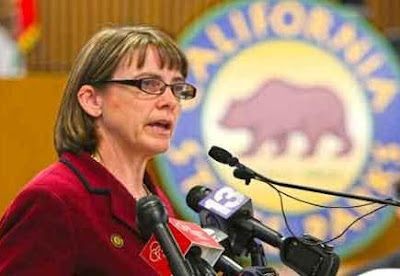
California State Parks Director Ruth Coleman resigned. (AP Photo/Rich Pedroncelli) 
By Matthew Renda
Tahoe Daily Tribune


GRASS VALLEY, Calif. — The director of California's state parks resigned and a deputy was fired Friday after officials learned the department sat on nearly $54 million in surplus money for years, while parks were threatened with closure over budget cuts.

Parks Director Ruth Coleman stepped down, and chief deputy Michael Harris was let go, amid questions about the underreported funds dating back 12 years, according to Clark Blanchard, a spokesman for the secretary of the Natural Resources Agency, which oversees the parks department.

Local officials expressed a mixture of outrage and astonishment at the news that the parks department intended to close 70 parks to save $22 million over two years while reportedly sitting on reserves of more than twice that amount.

“You don't go around coercing community groups and nonprofits to solve your problems while you're sitting on reserves that size,” said Caleb Dardick, executive director of the South Yuba River Citizens League, which has taken a leadership role in raising awareness and funds to keep open two Nevada County parks — Malakoff Diggins State Historic Park and South Yuba River State Park.

In February, Dardick led a contingent of local environmental leaders, conservationists, park advocates and children from Grass Valley Charter school, to hand deliver more than 10,000 petitions to Coleman.

At the time, Coleman praised the contingent, including western Nevada County officials and the children for developing a sustainable plan to keep the park open.

Dardick said those words now ring hollow.

“The state parks staff betrayed the public trust, they betrayed our community and betrayed our children,” he said. “As a sign of good faith, the parks department should immediately restore full services to both parks.”

Alden Olmsted, who has undertaken a comprehensive fundraising effort that encourages people to provide $1 to buckets strategically placed at businesses around the state, said he has long suspected something wrong was afoot.

“Now I know why it was so difficult to try and help the parks system,” Olmsted said.

Olmsted said he repeatedly pressed park officials for specific figures regarding what it would take to keep specific parks open and was repeatedly rebuffed.

“The numbers were erroneous all along,” he said.

Assemblyman Jared Huffman, D-San Rafael, who emerged as a consistent critic of how the parks department conducted the park closure process agreed with Olmsted in a Friday news release.

“As we've dealt with the parks funding crisis, I've repeatedly expressed my concern about the lack of transparency and the fortress mentality at State Parks,” Huffman said. “The only good news I can see from this scandal is that it will bring much-needed transparency, accountability, and a serious ‘reset' to an agency that desperately needs it.”

State Sen. Doug LaMalfa, R-Richvale, joined the chorus of voices in denouncing the fiscal fiasco.

“Though I am happy to discover there is money to keep California's parks open, I am disappointed in the State Parks Director and her staff for concealing money from California's taxpayers while calling for the closure of 70 state parks,” LaMalfa said.

The attorney general's office is investigating and state finance officials will conduct an audit, Blanchard said.

The resignation comes at a time when state lawmakers and park advocates have been trying to find ways to keep most parks open despite ongoing budget cuts. Last month, park officials announced most of the 70 state parks once slated to close would remain open due to various operating agreements.

The Sacramento Bee first reported Coleman's resignation Friday, after inquiring about the possibility of a surplus. In addition, the newspaper reported Sunday about a secret vacation buyout program for employees at department headquarters that cost taxpayers more than $271,000.

State officials said the “hidden assets” that prompted the shake-up were found by new park fiscal staff while the attorney general's office was looking into the unauthorized vacation buyouts.

It's not clear why the accounts weren't properly reported. A preliminary investigation shows the parks department underreported two funds as far back as 2000.

The state parks and recreation fund, which is generated from park fees and rentals, held $20.4 million more than was reported. The off-highway vehicle fund, which is generated from registering ATVs and similar types of vehicles, held $33.5 million more than reported.

Officials said Gov. Jerry Brown accepted Coleman's resignation and has appointed California Natural Resources Agency Undersecretary Janelle Beland as acting interim director of the department.

California operates 279 parks, which include famous beaches to redwood forests. The parks that were at risk of closure got a reprieve last month after the governor signed a bill allocating new funds for the beleaguered parks system for the next year.

The state has also reached agreements with nonprofits, local governments and others to keep 40 parks open at least for a few years.

A large share of nonprofit funding has come from the California State Parks Foundation, a nonprofit arm of the state parks that raises money to support the parks mission.

The foundation has issued $833,000 in grant money over the past two months to help finalize operating agreements, according to the foundation's Director of Communications Jerry Emory.

Emory said the foundation is “shocked and dismayed” at the news of the parks department shake-up, but said the discovery of the funds does not necessarily mean the fiscal crisis has passed.

“The California State Parks' budget has been reduced by 33 percent in the last four years,” he said. “There is still $1.3 billion looming in deferred maintenance — these parks are falling apart.

Nonprofits and community groups will still need to continue to raise the necessary funds to ensure the long-term viability of all 70 parks on the list.

California State Parks recently came to a donor agreement to keep Malakoff Diggins State Historic Park open through the next year.

The agreement involved SYRCL, the Malakoff Diggins Park Association and the Olmsted Park Fund and a reduction of services.

Dardick had planned to meet with Marilyn Linkem, the supervising ranger of the Sierra District next week to finalize the agreement, but it remains unclear on Friday how the news of the underreported funds will impact this agreement.

July 2, 2012

Most Calif. parks escape ax, but not out of woods

by Peter Fimrite
San Francisco Chronicle


California's state parks have emerged almost intact from the vortex of red ink coursing through the state, but officials insist it will take more time, work and a lot more money to save the beleaguered system during the next budget cycle.

Only two of the state's 278 parks will be shut down completely, a far cry from the 70 scheduled last year for closure due to the state's seemingly perpetual budget crisis. But the park system is a long way from being out of the woods. The dozens of agreements recently struck with nonprofits and foundations to run parks are all temporary, meaning the state could be facing more closures next year and the year after.

John Laird, California's secretary for natural resources, said that the park system is ultimately the government's responsibility and that permanent solutions must be found by the Legislature.

"We will probably in some form be looking at what the future of the state parks department is," Laird said. "We're going to have to take a look overall at what the best way is to have a sustainable parks department for the generations to come, and it's something that in some form we will do over" the next year.

As of now, operating agreements have been signed for 40 parks that were originally on the closure list. Twenty-five others, including Candlestick Point State Recreation Area, are in active negotiations with organizations that are prepared to provide security, parking attendants, rangers and other services, Laird said.

5 parks could be cut

Five parks are still on the chopping block: Gray Whale Cove State Beach near Pacifica; Benicia State Recreation Area in Benicia; Zmudowski State Beach near Moss Landing in Monterey County; the California State Mining and Mineral Museum in Mariposa County; and Providence Mountains State Recreation Area in San Bernardino County.

The Providence recreation area has already been closed for months. The mining museum will also be shutting its doors, but officials said it still could be saved. The two beaches will not have any services, but California law requires them to remain open to the public. The Benicia recreation area will remain open with limited services while state park officials work with the city on a long-term solution, park officials said.

The mass closures scheduled for Sunday were averted thanks to a move by the Legislature to spare the parks by giving them $41 million. But Gov. Jerry Brown slashed that funding to $10 million last week. Still, combined with $13 million in redirected bond payments, the funds bought state park officials more time to complete deals with nonprofit organizations, foundations, government agencies, regional park districts, associations and private companies willing to run a park.

"It will give us a path to keep most, if not all, state parks open, and it will help make parks more financially sustainable," Laird said. "I think we are on a path to potentially keep all the state parks open."

The park situation has become a major crisis in California, which is responsible for 1.4 million acres of land, including 280 miles of coastline and 625 miles along lakes and rivers. The state parks, which also include historic buildings, museums and sites, generate billions of dollars in revenue from tourism and have been particularly important to Californians recently as the economy tanked and more people turned to affordable camping vacations as options.

Public outrage over the cuts prompted groups and individuals to begin raising money, including one man who went from park to park with donation buckets. Park prospects improved dramatically after the passage of AB42, introduced by Assemblyman Jared Huffman, D-San Rafael, which smoothed the way for nonprofit groups to take over park operations.

"I think part of this narrative is we have re-energized the people who love parks, and they are stepping up and contributing to these parks in all kinds of ways," said Ruth Coleman, director of California State Parks. "It's a new way of everybody getting involved and protecting these extraordinary resources, and this is going to be the new model for California."

Huffman, chairman of the Assembly Water, Parks and Wildlife Committee, has been a major catalyst in the effort to save park programs. The $13 million infusion of bond money will go into an enterprise fund and be used by the parks department to develop new revenue-generation programs, a scheme first proposed in AB1589, the California State Park Stewardship Act of 2012, introduced by Huffman.

Pay machines in the works

Coleman said her department plans to place solar-powered pay machines in parking lots and at kiosks, so that park visitors can easily use credit and debit cards. Officials are also working on deals with county governments to put up road and parking signs and otherwise encourage people to come into parks and pay instead of parking on county roads and walking in. Diesel generators will be replaced by solar power to cut down on fuel costs, she said, and more backcountry cabins and alternative camping sites will be built for visitors to rent.

Some successful new ventures have already been put in place, she said, including the recent opening of a wine-tasting kiosk at Topanga State Park in Malibu, an annual blues festival at Marshall Gold Discovery State Historic Park in Coloma and a recent Broadway-style production inside the ruins at Jack London State Historic Park for which 400 people paid $40 each.

"There's a lot of different creative ideas that staff have been generating internally already, and with these funds we think we can really push forward and come up with some exciting new developments that will help the department create more of a sustainable enterprise model," Coleman said.

There is, for now, less of a threat that there will be more of the kind of criminal activity that happened earlier this year at the remote Providence recreation area, where vandals smashed windows at the vacant visitors center and stripped copper wiring connected to the lighting system for the park's Mitchell Caverns.

Some people are concerned that California is in the process of selling off its park system to private entities in an attempt to ward off transients, pot growers and vandals, a fear that Huffman said is premature.

"We're trying new things, a lot of which have never been done before, in the nadir of the worst financial crisis since the Great Depression," Huffman said. "We are going to see how that plays out to assess the degree nonprofits can be a solution, but the upwelling of support is a part of why I think we have a very solid chance of saving our parks. Legislators have heard the public, which is playing a huge role in shaping this debate."

February 26, 2012

Shuttered California state parks may be vulnerable to vandalism

Damage to the visitors center and other structures at Mitchell Caverns in the Mojave Desert has officials working to improve plans to protect as many as 70 other California parks scheduled to close in July because of budget cuts.

Kevin Forrester, a superintendent with the California Department of Parks and Recreation, walks inside Mitchell Caverns at Providence Mountains State Recreation Area. Since the remote park's closure, intruders have cut fences, kicked doors off of hinges and shattered windows and display cases at the visitors center. Critics say it might be a harbinger of what's to come when 70 more state parks are closed because of budget cuts. (Irfan Khan / Los Angeles Times / February 22, 2012)

By Louis Sahagun
Los Angeles Times


Reporting from Providence Mountains State Recreation Area, Calif. -- California parks officials closed a gem of the state park system last spring, sadly shuttering Mitchell Caverns, a natural wonder that for eight decades had drawn visitors to this remote spot in the Mojave Desert.

Workers hauled away the precious Native American artifacts and historical documents and locked the gates, assuming the area would sit undisturbed until the state could afford to reopen it.

But several times in the last four months, vandals traveled 16 desolate miles north from Interstate 40 to plunder and damage the park's isolated structures. Their actions left advocates for the caverns angry at the state and have officials working to improve plans to protect as many as 70 other California parks scheduled to close in July because of budget cuts.

The worst damage was to the 78-year-old rock-and-mortar visitors center at Mitchell Caverns, the main attraction of the 5,900-acre Providence Mountains State Recreation Area.

Intruders cut fences, kicked doors off of hinges and shattered windows and display cases. They stole metal signs and survival gear, including hand-held radios, flashlights and binoculars. They also stole diesel-powered generators and ripped out thousands of feet of electrical wire used to illuminate the only natural limestone caverns in the state park system, San Bernardino County sheriff's investigators said.

"What happened at the visitors center is devastating and heartbreaking," said Kathy Weatherman, superintendent of the California Parks and Recreation Department's Tehachapi District. She said the caverns themselves were not damaged. The state is taking steps to try to prevent more destruction, including searching for a full-time caretaker, Weatherman said.

The attacks have heightened concerns about possible vandalism at other state parks scheduled for closure. Those 70 parks are among the least used in the state. They represent one-quarter of the 278 that exist across California but tally just 8% of total visits. Many are in remote areas where they are particularly vulnerable.

Officials are seeking anyone with the clout and funds to keep them from being left unguarded after they are closed. "Now, amid budget constraints, we're looking for ways to get caretakers, guardians, local law enforcement and volunteers to protect these precious places," said Roy Stearns, a spokesman for the California Department of Parks and Recreation.

As with so many cuts in California government spending these days, the hope is that once the budget improves, the state will restore services and amenities that have long made the state a rich place to live. But there are no guarantees, especially because just 13 of the state parks and beaches are financially self-sustaining. Fans of many of the parks scheduled for closure are scrambling to try to find some combination of private funds and volunteerism to keep the gates open, fearing that if they ever close it could be for good.

The Mitchell Caverns visitors center, 220 miles east of Los Angeles, had been the home of the caverns' original owners, Los Angeles businessman Jack Mitchell and his wife, Ida. The couple moved to the desert to open the caverns as a tourist attraction in the 1930s and sold them to the state in 1954. A memorial plaque says the Mitchells wanted the state to preserve the area and the caverns "for future generations to appreciate."

Sue Ellen Patrick, 71, granddaughter of Jack and Ida Mitchell, said of the destruction: "My family feels betrayed because the state didn't do what it promised us, which is protect the caves and the heritage."

State Parks and Recreation Department officials decided to mothball the area last May because of two unrelated events. The park's two rangers retired and the state found serious problems with the water system, said Linda Slater, resource interpreter at the nearby Mojave National Preserve. The state couldn't afford the repairs needed to keep the park open.

After valuables were removed, the property was left unguarded, parks officials said.

"The state locked up the place and then walked away, leaving it wide open to troublemakers," said Dennis Casebier, executive director of the nonprofit Mojave Desert Heritage and Cultural Assn.

Said cattle rancher Rob Blair, 54, who lives within view of Mitchell Caverns: "It's disgusting what's going on out there. These intruders were pretty bold to cut the locks off a state park gate, then tear everything up and steal big-ticket items."

Park officials estimate the damage at $100,000.

Responding to a trespassing call on Feb. 5, sheriff's deputies arrested Christopher Alvarado, 48, of Azusa and Trisha Sutton, 36, of Covina. Deputies said they found stolen items at the couple's campsite near Mitchell Caverns. Alvarado and Sutton were booked on suspicion of burglary, receiving stolen property, possession of a controlled substance and possession of burglary tools, Sheriff's Lt. Ross Tarangle said.

The investigation continues, with police trying to determine whether other people were involved.

Although police reports indicate that a person interviewed at the site said vandals found a key to the cavern gates and destroyed natural features inside, Tarangle said those reports have yet to be confirmed, and parks officials insist they have no evidence the caverns were damaged.

From a distance, the entrance to the caverns resembles two large eyes on a massive rock. Their earliest inhabitants included a Pleistocene ground sloth that stumbled into the darkness 15,000 years ago and left claw marks on a wall. Later, the caverns were blackened with smoke from the fires of Chemehuevi Indians who used them for shelter, storage and ceremonial purposes for at least 500 years.

This week, Kevin Forrester, sector superintendent for the parks department, recalled memories of better times as he walked along a path to the visitors center.

"Look at it now," Forrester said with a sigh. "We've had to board up the windows and weld the doors shut.

"It's going to take a lot of money to bring this place back to life."

May 13, 2009

College group finds Gila monster on field trip

Only 26 other times has a Gila monster been seen in California since 1861

A group from Cuesta on May 2 made only the 27th siting of a gila monster in California since 1861 during a visit to the Providence Mountains in the East Mojave National Preserve. (Ron Ruppert/Blake Andrews)

David Sneed
SanLuisObispo.com/The Tribune


A group of Cuesta College faculty and students made an unusual find during a trip earlier this month to the Mojave National Preserve — a Gila monster, a large and colorful desert lizard.

The group of 21 was traveling May 2 through the Providence Mountains of eastern San Bernardino County to a field station where they were staying when the lizard was spotted alongside an old mining road. Gila monsters are endemic to Arizona and Nevada, but are seldom seen in California.

Prior to the group’s sighting, there had been only 26 individual sightings in California since 1861, and nine of those may be the same animal on different days, said Ron Ruppert, chairman of the college’s biological sciences division.

“This is a rare animal in California,” he said.

Gila monsters are the largest lizard species in the United States and have bright coloring and a venomous bite. The group climbed out of its vans to watch the lizard and photograph it, student Blake Andrews said.

“The contrast between the vibrant orange and the deep black bumps that were scattered in splotches across his back, popped in the sun,” Andrews wrote afterward.

Finding the big lizard turned out to be a highlight of the natural history field trip to the desert. Nursing student Andrea Reddick said that snakes and lizards weren’t something she was particularly interested in, but she described seeing the Gila monster as one of the best experiences she has had.

“Experiencing the sighting of the Gila monster and understanding the rarity of such an occurrence has made me feel ecstatic to have witnessed it and be part of herpetology history,” she wrote.

The group watched the lizard for about 20 minutes before getting in its vans and driving away.

“Its tail was plump, and the lizard looked healthy,” Ruppert recalled. “Estimated length was 14 to 16 inches total length, but no measurements were taken.”

January 10, 2008

Budget slashes impact two desert parks


By JIM MILLER
Sacramento Bureau
Press-Enterprise


Mitchell Caverns walkway

SACRAMENTO - Gov. Schwarzenegger released a spending plan Thursday that would slash money for schools, close several Inland state parks and release thousands of prisoners early to solve an estimated $14.5 billion shortfall over the next 18 months.

Parks Hit

Under governor's budget plan, three of 10 Inland state parks would be closed indefinitely and Mount San Jacinto State Park would lose one of its two campgrounds near Idyllwild.

The desert park closures would be the Salton Sea State Recreation Area on the east side of the desert lake; and Providence Mountains State Recreation Area, known for its Mitchell Caverns, the only limestone caverns in the state park system.

Coleman said the parks would be mothballed until there is enough funding to reopen them. They won't be sold, she said.

Terry Wold, conservation coordinator for the Inland chapter of the Sierra Club, said the proposal would generate widespread criticism from hikers, campers, mountain bikers and equestrians.

"They keep cutting us off more and more," she said. "I don't even know what to say."

Some Republicans were suspicious that the proposal to close the parks, a tiny piece of a $101 billion general fund, is meant to generate support for a tax increase.

"I'm not buying that the sky is falling. The first blush of this may be more politics than practical reality," said Assemblyman John J. Benoit, R-Bermuda Dunes.

December 24, 2007

A local's ornament adorns White House Christmas tree


JASON SMITH
Victorville Daily Press


A close-up of the ornament painted by Steve Brodeur, a wildland fire engine captain in the Mojave National Preserve.

Visitors to the White House this Christmas may notice a small piece of the High Desert among the holiday decorations.

A hand-painted ornament showing scenes inspired by the Mojave National Preserve hangs on the White House Christmas tree along with 346 other ornaments featuring National Parks from across the country.

The Mojave National Preserve ornament, painted on a silver bulb eight-inches in diameter, shows a Joshua tree, cacti and the Providence Mountain range, familiar scenes from the 1.6 million acre park.

Steve Brodeur, a wildland fire captain at the preserve, said he spent more than 20 hours painting the ornament, one dot at a time. He made stencils from tape and practiced on six other bulbs before working on the final piece.

“I’m always sitting around doodling, so it’s nice being able to do a project like this that has to be planned out,” he said.

Brodeur, who never had formal art training, said he was honored to be asked to participate in the project, particularly because some other parks had their ornaments produced by professional artists. He said that he was a little nervous to paint on such a fragile medium, especially because each park was only issued one fiberglass ornament.

“I thought they were made of glass until I dropped mine on the cement and it bounced,” he said.

Brodeur and other artists attended a Nov. 28 reception at the White House to present the ornament with government officials and first lady Laura Bush.

The Mojave ornament was placed on a center branch halfway up the 18-foot high Fraser Fir tree in the Blue Room of the White House.

Cathy Kupper, spokeswoman for the National Park Service in Washington, said that the ornament will become part of the presidential collection and maintained for years to come. She said the first lady chose the “Holiday in the National Parks” theme for this year’s Christmas decorations because she spent considerable time in the parks as a child.

The theme permeates through the East Wing and State Floor of the building. In addition to the ornaments, garlands of painted pine cones and seashells, models of national monuments and paintings of the parks are on display. A 40-inch architecturally accurate white chocolate and gingerbread replica of the White House is displayed in the State Dining Room.

The 300 pound model includes miniature versions of the first family’s pet Scottish Terriers, Barney and Miss Beasley, as well as animals found in the national parks.

“It’s the White House; they really go all out for the holidays,” Kupper said.