February 13, 2014

Federal rules leave drought-stricken California high and dry

Endangered Species Act provides water for fish but not humans

By Damien Schiff and Julie MacDonald
Washington Times


"In this present crisis, government isn’t the solution. Government is the problem.”
With that famous phrase at his 1981 inauguration, Ronald Reagan called out the federal government for over-regulation that helped drive the economy into a ditch. For Californians today experiencing a severe drought, Reagan’s words should once again hit home.

Of course, the weather is the prime culprit. Until a desperately needed storm moved in this past weekend, it had been a dry winter, — and the storm hasn’t compensated for the months without rainfall.

However, the damaging effects have been magnified by destructive regulations. Federal policies under the Endangered Species Act are making things worse, not better.

The scale of “this present crisis” — what Gov. Gov. Jerry Brown warned could be a “mega-drought” — can be seen in some compelling numbers. Seventeen rural communities were put on a watch list for severe water shortages, and for the first time, water agencies serving 25 million people were told they won’t receive any of their allocation from state-run reservoirs.

This past week’s rainfall will help, “but we need more,” as a meteorologist with Golden Gate Weather Services told the San Jose Mercury News.

It’s not surprising that President Obama has scheduled a visit to Fresno this Friday for a firsthand evaluation.

While rationing has been promoted in many communities, and vast areas of farmland have been removed from production, people ought to be asking: Where is the water that should have been saved for a non-rainy day?

Answer: Millions of gallons were diverted from human use because of federal regulations intended to help a tiny fish in the Sacramento-San Joaquin Delta, the delta smelt.

The smelt is listed as “threatened” under the federal Endangered Species Act, and the feds claim it benefits if less water is available to be pumped south to the San Joaquin Valley, Los Angeles and San Diego.

For example, from December 2012 to February 2013 alone, more than 800,000 acre-feet of water that could have been conserved behind dams was allowed to flow to the sea. That water could have provided for the needs of 800,000 families. It could have irrigated 200,000 acres of cropland.

This flushing of torrents of water to the sea is a new practice in California, threatening to make not just the current drought, but every future one, far more painful than necessary.

The trigger for this destructive new policy was the feds’ 2008 “biological opinion” for the smelt, which essentially said people’s needs for water may not even be considered.

Result: The state’s water “treasuries” were raided.

In the era before the Endangered Species Act was controlling California’s water supply, management formulas were calibrated to ensure water for dry times. Like money in the bank, water was husbanded, and deliveries to users were based on fall and winter rainfall and storage from previous years.

Even in what the media calls “the great drought of 1977,” San Joaquin Valley farmers still received a water allocation of 25 percent. Why? Because reservoirs had been used for one of their intended purposes — to capture water that might be needed in the future.

Now, after one dry year, 2012-13, and the current year that’s shaping up as critical unless we get many more storms like this past weekend’s, water users have been told to brace for no deliveries — thanks in significant part to federal biologists pulling the plug on California’s traditional water-storage practices.

The smelt regulations have also been imposing significant taxes on urban users. Southern California’s Metropolitan Water District, which gets much of its water from the delta, raised charges on its scores of member cities and water districts by 20 percent after the smelt biological opinion was first issued.

“The [feds’] environmental decision has impacted the flow of water to Southern California by approximately 35 percent,” a water manager in the Orange County city of Garden Grove told the Orange County Register in 2009. Remember — that was five years before the current drought.

Ironically, while the harms for cities and farms are real, the benefits for the smelt are speculative — as the “biological opinion” concedes. Numerous factors have contributed to the species’ long decline, and holding back water from people has not reversed it.

Let’s not water down the truth: California has suffered not just from a lack of rain, but also from a drought of common sense among federal bureaucrats. Congress is also on the hook for giving Endangered Species Act officials too much leeway, allowing the ignorant or ideological to push destructive agendas.

In a wrongheaded environmental strategy that harms humans without helping the environment, they opened California’s rainy-day reservoirs and deliberately let the precious contents spill away.

Damien Schiff is a principal attorney with the Pacific Legal Foundation. Julie MacDonald is a former deputy assistant secretary for fish and wildlife and parks at the U.S. Interior Department.

A Huge Solar Plant Opens, Facing Doubts About Its Future

A field of mirrors at the Ivanpah power plant in California. The plant took almost four years to complete and stretches over more than five square miles of the Mojave Desert. (Jim Wilson/The New York Times)

By DIANE CARDWELL and MATTHEW L. WALD
New York Times


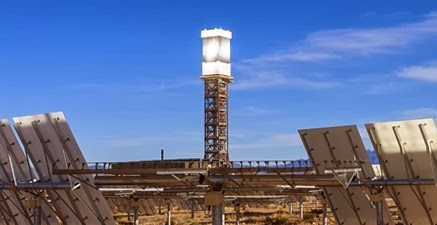
NIPTON, Calif. — The Ivanpah solar power plant stretches over more than five square miles of the Mojave Desert. Almost 350,000 mirrors the size of garage doors tilt toward the sun with an ability to energize 140,000 homes. The plant, which took almost four years and thousands of workers assembling millions of parts to complete, officially opened on Thursday, the first electric generator of its kind.

It could also be the last.

Since the project began, the price of rival technologies has plummeted, incentives have begun to disappear and the appetite among investors for mammoth solar farms has waned. Although several large, new projects have been coming online in recent months — many in the last quarter of 2013 — experts say fewer are beginning construction and not all of those under development will be completed.

“I don’t think that we’re going to see large-scale solar thermal plants popping up, five at a time, every year in the U.S. in the long-term — it’s just not the way it’s going to work,” said Matthew Feinstein, a senior analyst at Lux Research.

“Companies that are supplying these systems have questionable futures. There’s other prospects for renewables and for solar that look a lot better than this particular solution,” he said, including rooftop solar systems that are being installed one by one on businesses and homes.

Executives involved in Ivanpah — a venture among BrightSource Energy, NRG Energy and Google — say that once the facility proves that the technology can work, it will become easier to finance others, especially as repetition brings the cost down.

When BrightSource and other companies asked NRG to invest in a second thermal project, said David Crane, NRG’s chief, he responded: “We’ve got $300 million invested in Ivanpah — let me see that work for a few months and then we’ll decide whether we want to be involved in more.”

At the same time, BrightSource has shifted its focus, pursuing markets overseas like China, South Africa and the Middle East and designing smaller plants involving one tower rather than Ivanpah’s three.

Addressing a tent full of officials and industry executives, including those from the construction giant Bechtel, the engineering and building contractor on the project, David Ramm, BrightSource’s chief executive, acknowledged the risk at the dedication ceremony about 50 miles south of Las Vegas.

“We will have failed as a company if the last project we built was at Ivanpah,” he said. “The challenge for BrightSource going forward, and hopefully some of the partners who worked with us here, is to enable this technology commercially and in multiple locations around the world.”

It is a daunting challenge. The Ivanpah project was conceived in the early days of the Obama administration, when dreams of creating a thriving renewable energy industry were backed by the federal government’s financial support. Ivanpah received a $1.6 billion federal loan guarantee, without which it would not have gone forward, the developers said.

Ernest Moniz, the energy secretary, toured a tower and said the plant was an example of how the loan program — which set off a political maelstrom after the prominent failure of one of its borrowers, the solar panel maker Solyndra — was supposed to work.

“Our job is to kick-start the demonstration of these different technologies to have them available to the private sector,” he told reporters, standing on a tower platform, soaring above a dry lake bed, two huge boilers atop the other towers glowing in the distance like something out of a clean-tech version of “The Lord of the Rings.”

But he acknowledged that solar thermal technology only worked at large scale and in certain locations.

The loan program that financed Ivanpah has now ended, and the underlying economics shifted during its construction as the price of conventional solar panels dropped. It’s a familiar story in government-sponsored energy projects, going back to efforts to make gasoline from coal in the late 1970s, which were doomed by the retreat of oil prices.

And as federal support has waned, so, too, has demand for similar large-scale projects. What’s more, an important tax credit worth 30 percent of the cost is set to decline after 2016.

“There have been some big changes in both the market and policy dynamics since we made our investment that, I think, on balance, are not terribly positive for BrightSource,” said Dan Reicher, executive director of the Steyer-Taylor Center for Energy Policy and Finance at Stanford. Mr. Reicher oversaw an early investment in BrightSource in 2008 when he was director of climate and energy initiatives at Google. (The company went on to invest $168 million in Ivanpah.)

“Clean tech investing is way off,” he said.

Still, experts say, BrightSource’s solar thermal technology — which focuses sunlight from mirrors onto 2,200-ton boilers 339 feet in the air to make steam that drives turbines to produce electricity — may have an advantage over conventional panels, which convert sunlight directly into electricity.

The increase in renewable sources of energy, which produce intermittently, coming into the grid, has also increased the need for other services crucial to reliable operation, services that solar thermal plants could provide. Those needs include the ability to start and stop quickly, at any season or hour, when human operators give the order.

Utilities pay power plants for some of those jobs, and some conventional generating stations earn a significant income, in addition to what they receive for producing energy. Around the country, coal plants — of which there are fewer and fewer — were well suited to that work. And government regulators can simply require utilities operating on the grid to show that they have the ability to accomplish some of those jobs, which industry executives call “ancillary services.”

“In the future, there will be money to be made from technologies and systems that contribute to integrating and balancing renewables on the grid,” said Samuel Thernstrom, the executive director of the Energy Innovation Reform Project, a nonprofit in Washington that evaluates electricity policy. “That’s going to be an increasing issue as the percentage of renewables on the grid increases.”

Ivanpah could stabilize voltage but has little storage, though it does have natural gas backup. At the dedication, Mr. Ramm said that in the future, BrightSource’s boilers would use molten salt to store the heat longer. Last year, Arizona Public Service opened a solar thermal plant, Solana, that lets customers brew their morning coffee with the previous afternoon’s sunshine.

At the California Independent System Operator, the company that manages the grid on a moment-to-moment basis, Stephen Berberich, the president and chief executive, said that “on an apples-to-apples basis, it is more expensive than photovoltaic, but it has a heck of a lot more capabilities than photovoltaic does.”

Another expert, Ron Binz, an energy consultant based in Denver and the former chairman of the Colorado public service commission, said that storage would indeed be needed as intermittent renewables grew. But solar thermal plants were not the only way to meet that need, he said, and a competition would follow. “You can’t look at any element of this without looking at all the others,” he said.

As for the federal loan guarantee program, the government has already changed its approach, looking to emphasize a range of cleaner technologies, especially in fossil fuels and nuclear power.

To that end, Mr. Moniz encouraged the crowd of industry executives to pursue new projects that would qualify for the loan guarantees. “Bring them on,” he said. “We’re ready.”

February 6, 2014

Arizona drought forcing ranchers to sell cattle

Clay Parsons with Marana Stockyards says, "We can't feed our cattle year round hay. It's too expensive. We have to sell the cows."

by John Patrick
KVOA.com


TUCSON - Ongoing drought conditions are forcing cattle ranchers to sell off part of their herds early.

Nearly one million head of cattle in Arizona makes for big business, especially in Pinal County, one of the top counties in the U.S. when it comes to cattle sales.

A normal cattle auction in February at the Marana Stockyards sells off around 500 head of cattle, but due to drought conditions they've seen nearly double that number.

Ruben Rivera, a cattle rancher from Globe, Arizona, was one of the many in town Thursday to unload cattle to be auctioned off. He says the lack of water on his land is making it hard to keep his herd healthy.

"I think it's going to become a problem not only for us but for everyone up there. Everyone is running dry right now," explains Rivera.

As drought conditions drag on the natural pasture that cattlemen depend on is unavailable forcing them to supplement with expensive feed. Clay Parsons with Marana Stockyards says this is one of the main reasons he has seen an increase in numbers at his auctions.

Parsons says, "We can't feed our cattle year round hay. It's too expensive and too cost prohibitive. We have to sell the cows."

According to Parsons, Central Arizona ranchers are selling off about 20% of their herds, but if it doesn't rain soon they will be forced to sell even more.

"We're preparing to have to sell off within the next 60 days. So right now we're looking at a 60 day window. Normally it rains at the golf tournament and the rodeo so we're praying for that," says Parsons.

The nation's cattle population is at a 61 year low so the billion dollar industry is preparing for the long haul when it comes to the drought.

"The drought in Arizona is not only drastic for us now but the future. When you sell of your cow herd you can't just rebuild it in one year," explains Parsons.

It can take years for the animals to breed and grow so in the meantime rancher's trim costs and hope conditions improve.

According to the U.S. Department of Agriculture the price of choice-graded beef has hit an all-time high but Parsons says if the drought persists the market price of beef may rise another 20%.

February 5, 2014

A roaring triumph for public access

Fabio Manno's buggy runs the course of the 4 Wheel Parts Time Trials on Tuesday, February 4, 2014. King of the Hammers event, an off-road race that combines desert racing and rock crawling on Means Dry Lake at Johnson Valley. A last-minute compromise last year saved this event after the military pushed to take this land for training. (KURT MILLER/STAFF PHOTOGRAPHER)

BY DAVID DANELSKI
Riverside Press-Enterprise


JOHNSON VALLEY -- They crawled up almost-vertical boulder piles. They floored it across the flats. Some of them flipped, and at least one rolled and bounced across the desert floor before settling in a burst of flames.

They are competitors in King of the Hammers 2014, an extreme off-road race in the San Bernardino County desert in which rugged terrain is the worthiest adversary. But this year’s event in Johnson Valley is much more than a week-long contest of machines, drivers and nerves — it is a triumph for public access.

More than four years ago, the world’s most formidable force — the U.S. military — announced plans to take over this off-roading mecca as part of a 424,000-acre expansion of the Twentynine Palms Marine Corps Air Ground Combat Center.

The same remote valleys and peaks that make for a challenging race course are a perfect venue for live-fire training exercises for tank battalions, the Marines said.

Many figured the base expansion was a foregone conclusion to be made in the interest of national security. And it would be tough luck for some 200,000 people who hauled their motorcycles, jeeps and four-wheelers each year to Johnson Valley, a designated off-roading area southeast of Barstow and north of the San Bernardino Mountains.

But the off-roaders rallied in force. They signed petitions, attended public meetings, submitted written comments and gained support from elected officials. Environmentalists also wanted the off-road area to stay open, so fewer off-roaders would be tempted to disturb sensitive wildlife habitat elsewhere in the Mojave Desert.

The Department of Defense agreed to a compromise.

Under a law approved by Congress in late December, 99,870 acres will remain part of the Johnson Valley Off-Highway Vehicle Recreation Area, open to the public and under the jurisdiction of the U.S. Bureau of Land Management. The Marines can use about 56,000 acres of the valley for training twice a year, for a total of 60 days.

On Tuesday, Feb. 4, the victory meant that 7,000 people could be there to witness qualifying rounds for the 100-mile-plus King of the Hammers. Organizers expected the crowds to swell beyond 40,000 for the final race on Friday.

VIDEO: Car crashes, flips at King of the Hammers

“It’s just great,” said John Miller, 62, of Running Springs, standing at his dusty campsite with the race roaring in the background. “I am not against the military, but there is a lot of land where they can do their stuff.”

“We’re just getting ready to head up there and watch,” he added. “We have one, two, three generations here,” he added, pointing to himself, his son, Trevor, 38, and his grandson, John, 11, who sat on a 65cc Kawasaki mini-motorcycle.

Trevor Miller said he and his son get to Johnson Valley at least two or three times a year. “It’s always families out here,” he said.

A short ride away, Raul Vega, 33, of Orange, sipped beer from a can as he watched one driver after another attempt to climb a rock-face peak dubbed “The Waterfall.”

“We are happy to see it stay here,” Vega said of the Hammers event. “I took my vacation time to be here. This is one thing I plan for all year.”

His friend Kurtis Magargee, 22, of Yorba Linda, added that participants take care to leave the valley as they found it. Many will spend Saturday, the day after the races, picking up cans and trash. Race organizers have shovel-equipped vehicles ready to scoop up motor oil if it should spill, he added.

Magargee and hundreds of other spectators cheered as one driver attempted to power up The Waterfall, only to slowly roll upside down. It took two vehicles with winches to right the buggy so the trials could resume.

Racer Kevin Sacalas and his co-pilot, Tim Carlson, both of Riverside, had one of the more spectacular crashes. After bumping down a steep hill, they were picking up speed across the flats when their buggy flew out of control and flipped end over end five times before landing in a brief spout of fire. Sacalas wasn’t hurt, and Carlson had only scratches, according to Sacalas’ brother, Robert.

The vehicle, the “Big Ugly,” was a total loss, Robert Sacalas said.

Racers can spend as much as $250,000 to build one of the specialized machines from the ground up, explained driver Crystal Crowder, of Ridgefield, Wash., who was watching this year because her rig needs work.

Just being there was a big win, she said.

“Public land should stay public,” she said. “And this ultimate off-road race is the best in the United States.”

OFF ROADING: Pact mostly preserves Johnson Valley for recreational use

February 4, 2014

Iconic Mojave Joshua trees in race against extinction

Researcher Chris Smith checks blooms to see if field assistant Candace Fallon will be able to introduce Yucca moths to blooms on Joshua trees in the Mojave desert during research on Apr. 07, 2011. The iconic plant of the Mojave Desert also provides a perfect example of what scientists call coevolution. The Joshua Tree and the Yucca moth have developed together and now they depend on each other for reproduction. (JESSICA EBELHAR/LAS VEGAS REVIEW-JOURNAL)

By HENRY BREAN
LAS VEGAS REVIEW-JOURNAL


A century from now, the Mojave Desert’s iconic plant could be pushing its way into new territory or teetering on the brink of extinction.

This spring, a pair of researchers will go looking for clues to the Joshua tree’s fate in a lonesome valley 140 miles north of Las Vegas. And they’re inviting interested “citizen scientists” to join them in their search.

Henderson-based ecologist Todd Esque, from the U.S. Geological Survey, and evolutionary biologist Chris Smith, from Willamette University in Salem, Ore., are offering a four-day course in March called “The Race North: Population Ecology of Joshua Trees In an Era of Climate Change.”

The class will unfold in Tikaboo Valley, near the Lincoln County town of Rachel, where Smith said Joshua trees seem to be “experiencing something of a population boom” at the northern limit of their current range, possibly in response to increasingly warmer, drier conditions to the south.

Such research matters, Esque said, because it could help scientists predict how much of a challenge climate change will pose for Joshua trees and for people. “We’re all in this together,” he said.

“Any time these large climatic events occur, some things blink out and some things survive and create new species,” he said. “If Joshua trees can respond quickly enough and spread their seeds far enough with each jump, they will continue to thrive out there.”

“It’s a population on the move as far as I’m concerned.”

Some computer models predict the Joshua tree could disappear from much of the Mojave Desert, as average temperatures rise and droughts grow longer and more frequent.

Smith said scientists have found evidence that the trees are already fading from parts of Joshua Tree National Park at the southern end of its range.

Tikaboo Valley serves as an ideal “natural laboratory” for studying the species because that’s where the two main varieties of Joshua tree — one from the east, the other from the west — come together and mix.

“It is possible to do a side-by-side comparison of which of the two plants are likely to win ‘The Race North,’ and how the reliance on specialized pollinators might limit their capacity to escape changing climate,” Smith said in an email.

This is his area of expertise. Smith has spent the past decade studying the highly specialized evolutionary bond between the Joshua tree and the tiny moth that pollinates it.

Each spring, yucca moths emerge from the ground to mate and lay eggs in the flowers of Joshua trees in Nevada, California and Arizona. But unlike bees and other insects that inadvertently spread pollen from flower to flower, these moths appear to deliberately pollinate Joshua trees so that the plants will produce seeds that eventually will feed the moth’s caterpillars when they hatch.

Simply put, the Joshua tree would not exist without the plain-looking moth about the length of a pencil eraser, and the moth would not exist without the tree.

Smith is studying how natural selection is involved in shaping this tight relationship between plant and insect — and whether their bond can live through climate change and the tree’s own race for survival. Last year, he received a prestigious, $850,000 grant from the National Science Foundation to continue his research for the next five years at least.

For his part, Esque has spent 10 years trying to produce the first comprehensive understanding of the tree’s life history. Along the way, he has amassed one of the most complete sets of data about where the trees occur and co-authored a study showing that only the largest, oldest Joshuas tend to survive wildfires — a finding Smith called “worrying” since fires have become more common in the Mojave Desert.

This marks the second time Smith has hosted a citizen science expedition to the Tikaboo Valley. He offered a similar class last year, minus the emphasis on climate change.

Registration is now underway for the course, which is being sponsored by the Desert Institute at Joshua Tree National Park in California. It takes place March 21-24 and costs $260, not including food, lodging, supplies and transportation to and from Tikaboo Valley.

Esque said the class will begin with a lecture on “why are we here and why does it matter.” Then the group will divide up into teams and walk the valley with GPS units, measuring trees and collecting genetic samples.

On the final day, Smith, Esque and their students will discuss what the collected data might tell them about the Joshua tree’s march north through Nevada and whether the species can survive long enough to get wherever it’s going.

February 1, 2014

Renewable energy policy enters final act

OPINION

Soda Mountains Solar project map. (BLM)
Written by David Lamfrom
Desert Sun

The renewable energy policy world is filled with government agencies, corporations, conservation groups — and a tyranny of intimidating acronyms. The California desert continues to serve as a petri dish for renewable energy development, which has produced both Dr. Jekyll and Mr. Hyde results, thus far. The stage is set for the next phase in renewable energy planning, and we can’t afford another failed experiment.

The goal of the Desert Renewable Energy Conservation Plan (DRECP), shaped by the state of California, the Department of Interior and dozens of important landowners and stakeholders, is to strike balance between protecting species and spaces, while appropriately furthering renewable energy, including solar, wind and geothermal development.

The DRECP builds upon the massive Solar Programmatic Environmental Impact Statement, (Solar PEIS), which set policy for six western states including California; created solar zones like Riverside East (the country’s largest); and, smartly, reduced the western federal lands open to solar development from 100 million acres to 20 million acres.

It also clarified where projects should be sited and supported planning to protect diverse and, in some cases, endangered species and resources. It eliminated the proposed Iron Mountain solar zone nearby to Joshua Tree National Park, which would have disconnected critical wildlife corridors between that park and protected mountain ranges north.

The DRECP process will refine the Solar PEIS, with a lens on the California desert. While the DRECP is on a larger scale, it is similar to the Coachella Valley Multiple Species Habitat Plan, in its mission to protect critical species and habitats. If approved, the DRECP will be the dominant solar energy guide for at least the next 25-40 years. In short: It’s a big deal that we all need to pay attention to.

At last count, the California desert alone has more than 1 million acres of disturbed lands or previously developed lands that may be more appropriate for solar panels and associated development. Although even on disturbed lands, thoughtful decision-making is still necessary, particularly where species and cultural conflicts lie. Protecting places that neighbor our national parks and other wildlife-rich lands that infuse billions of dollars into our local economies is of utmost importance. We urge Department of the Interior Secretary Sally Jewell to take thoughtful action on this landscape-level conservation plan.

A conservation legacy that fosters recreation and tourism has bloomed over the past 20 years in the California desert. Thoughtful planning is crucial to ensuring its longevity. The draft DRECP is expected to be released for public comment in May.

While conversations between the plan authors and many concerned parties including the National Parks Conservation Association is leading to improvements, poorly sited projects that would harm our national parks and negatively impact desert communities that financially rely on them continue to be considered.

An Eagle Crest pumped storage proposal slurps critical water, is a net energy loser and threatens Joshua Tree National Park. Bechtel’s Soda Mountain solar proposal is a quarter-mile from Mojave National Preserve. Iberdrola’s poorly sited wind and solar proposal would sit on the Old Spanish Trail, just south of Death Valley National Park. And First Solar is seeking approval for yet another poorly sited project in the now infamous Ivanpah Valley.

Dramatic negative impacts to desert tortoises and to Mojave National Preserve through projects like Ivanpah Solar gave a black eye to the renewable energy industry. The DRECP must avoid harmful projects that erode public trust and counter the plan’s purpose. Only by doing so can we ensure a future that we can all take pride in.

David Lamfrom is the senior desert program manager for the National Parks Conservation Association. Email him at dlamfrom@npca.org

Solar plant powers up, turns on desert show

BrightSource Tower surrounded by mirrors near Ivanpah Dry Lake.
By David Danelski
Orange County Register


Without fanfare, one of the biggest and most controversial solar developments in California has gone online in northeast San Bernardino County, creating a visual spectacle for travelers heading across the Nevada border on Interstate 15.

Meret Uteregges stood at the edge of the Ivanpah Valley early Wednesday afternoon and marveled at the sight below her.

Three arrays of thousands of mirrors blanket more than 5 square miles of the Mojave Desert landscape and focus sunshine on the tops of three towers, each taller than the length of a football field.

The mirror fields and the tower tops, glowing with an intensely bright white light, are proving to be a traffic stopper that dominates the landscape for miles.

“It is like science fiction,” said Uteregges, from Zurich, who stopped on the shoulder of Nipton Road, a few miles south of the solar field, to get a good look. “It is fascinating. I saw it being built a few years ago but didn't know it would be so big.”

The Ivanpah solar energy project was developed by BrightSource Energy Co. – which owns the plants, along with NRG Energy and Google – and now is operated by NRG Solar. It has been operating since the beginning of the year, according to officials with the California Energy Commission.

NRG spokesman Jeff Holland declined to provide details of the startup, saying only that the company in mid-February would publicize its electricity-production debut.

Monthly status reports available on the state Energy Commission's website said that one of the towers went into commercial operation Dec. 30. And a commission spokesman said the other two towers also have been producing power since that date.

The $2.1 billion project is expected to provide enough carbon-free electricity for 140,000 homes through contracts with Southern California Edison and Pacific Gas and Electric. It was supported with some $1.6 billion in federal loan guarantees and has been hailed by President Barack Obama.

Despite the benefits of clean energy, the project drew protests from some environmental and Native American groups. Native Americans said the project disturbed sacred ground in the Ivanpah Valley.

Environmentalists objected because the development consumed 5.6 square miles of desert tortoise habitat, displacing dozens of the reptiles, which have been relocated or are confined to holding pens. Tortoises are listed as a species threatened with extinction.

BrightSource's environmental reviews predicted that about 17 of the reptiles would be displaced. But after construction started in fall 2010, about 125 were captured on the site.

To make up for the lost habitat, BrightSource funded California's acquisition of about 7,200 acres elsewhere in the Mojave Desert.

When operators started testing the towers last year, a new concern emerged: Birds that flew into the heat zones around the towers died from burns. Federal fish and wildlife officials are tracking the bird deaths and taking possession of the carcasses, according to monthly status reports filed with the Energy Commission.

Some passers-by said it makes sense to take advantage of the desert's abundant sunlight.

Mark Tworek of Calgary, Alberta, said he saw the bright solar towers as he crested a hill in Nevada while riding his motorcycle on Nipton Road, southeast of the project.

“It is pretty amazing to see it in operation,” he said, sipping a soda at the Nipton Trading Post.

“With all the sunshine around here, it is a no-brainer.”

January 30, 2014

Ivanpah Solar Project Quietly Goes Online -- Or Does It?

Ivanpah Solar Electric generating System (Photo: torroid/Flickr/Creative Commons License)

by Chris Clarke
Rewire | KCET.ORG


News reports are saying that the world's largest concentrating solar facility went online in California's desert at the beginning of the month. But figures from the state's grid operator suggest that solar thermal power production in California actually cratered for most of the month.

According to a piece by reporter David Danelski on the website of the Riverside Press-Enterprise, the 370-megawatt Ivanpah Solar Electric Generating System near the Mojave National Preserve went online at the beginning of January, starting to feed solar thermal power to California's grid.

Agency documents cited by Danelski do indeed reflect a startup date of December 30, 2013 for the project. But figures from the California Independent System Operator (CaISO), which operates the power grid for most of California, suggest that rather than having an immediate boost in energy entering the state's grid, production by California's concentrating solar thermal power plants actually fell nearly to nothing for most of the month.

The 377-megawatt project, designed and sponsored by BrightSource Energy and owned by BrightSource, NRG Energy, and Google, is being completed by contractor Bechtel on close to 4,000 acres of public land in the Ivanpah Valley south of Las Vegas.

But if Ivanpah has gone online, the state's figures seem not to show and increase in solar energy coming into the grid. CAISO tracks energy entering its grid from various forms of renewable energy and releases those figures in daily Renewables Watch documents. For more than a year, CaISO has been tracking photovoltaic power and solar thermal power in separate categories.

Power entering the grid from solar PV -- the same solar panels you may well have on your roof -- utterly dwarfs that coming from solar thermal plants, where steam generated by concentrated solar heat is used to turn turbines. That's because the state's operating solar thermal plants are few: there's ESolar's five-megawatt Sierra Suntower solar power tower plant outside Lancaster, and about 400 megawatts of generating capacity in less than a dozen parabolic trough facilities owned by Luz in San Bernardino County.

Those concentrating solar facilities put an average of 1,072 megawatt-hours of power into the grid each day in February 2013, to give an example of a winter day production baseline for existing plants.

CaISO doesn't break the figures down by which individual plants produce the power. But with even one of Ivanpah's three 125-megawatt power towers coming online in January, you'd expect to see an immediate jump in daily solar thermal production. Instead, January's records show that solar thermal output tanked. For some time in December 2013, the state's solar thermal output hovered around 500 megawatt-hours per day with peak daily outputs around 99 megawatts -- already significantly lower than February 2013's output.

On January 2, production jumped dramatically to 3,082 megawatt-hours, with a peak of 264 megawatts, which could be consistent with one of Ivanpah's towers firing up and putting power into the grid. But then the next day, the state's solar thermal energy production plummeted to just 40 megawatt-hours, with a peak output of just seven megawatts.

The state's solar thermal power production stayed essentially flat for almost the rest of the month, only this week approaching their December averages.

The red line shows total power production in megawatt-hours, while the blue line shows daily peak outputs in megawatts.

These figures aren't consistent with the world's largest solar thermal power plant going online. They're actually consistent with most of the state's existing solar thermal capacity going down, which happened for quite a bit last January as well. (Winter, with its shorter days and more diffuse sunlight, is a sensible time to conduct maintenance on solar thermal plants. But that's a guess on our part as to why that drop might have happened.)

ReWire has an inquiry into CaISO's public affairs office to see whether there might be some inconsistency in the figures, and they've promised to get back to us.

We also made inquiries with the California Energy Commission to see whether they might explain this apparent contradiction to us, and were referred to the January 17, compliance document cited in the Press-Enterprise. That document does include a reference to the plant's Unit 1 going online on December 30, 2013. Then again, previous compliance reports from last year have mentioned earlier online dates, which have been updated as the construction schedule slipped.

When we asked project designer BrightSource Energy's press spokesperson Jared Blanton whether he could shed any light on the issue Thursday, he replied that all questions about Ivanpah are now being handled by NRG, including the question "why is BrightSource now referring all press questions to NRG?"

NRG has not yet responded to our resulting query. Danelski reports that NRG will have a formal statement on the plant's status in February.

A dry winter can lead to fewer petals out in our arid regions

Desert Wildflowers Outlook

Wildflowers from the past near Amboy Crater. (Photo by David McNew/Getty Images)

By Alysia Gray Painter
nbclosangeles.com


DRY DAYS, FEWER FLOWERS: It's a florid fact that can surprise even those who've called California home for years: Our deserts can pop with petals come February and March. There are big, showy springs, following damp winters, like the one in 2005, which saw hotel rooms sold out for weeks on end in and around Death Valley National Park. And there are typical springs, where beautiful pink and yellow buds pop out here and there with welcome regularity.

AND THEN... there is the dry stretch that follows a drier-than-normal winter. Welcome to the spring of 2014, which'll arrive on the heels of one of the toastiest Januarys in memory, at least for a good chunk of the state. This doesn't necessarily bode well for blankets of photo-worthy buds showing up in our deserts, but the show does go on, and surprises do happen. Desert USA, as well as our national and state parks, are keeping tabs on the winter-into-spring blooms, which can shoot up fast and bid farewell just as speedily. Eager to see one of the prettiest and most unusual sights in the driest parts of the Golden State? Then keep a watch...

ON THE DESERT SCENE: Desert USA reported that "some wildflowers are being spotted in the Culp Valley area" of the Anza-Borrego on Tuesday, Jan. 21. And in Joshua Tree National Park? "Some creosote bushes have started to bloom" read a report given on Jan. 21. It's not nearly high wildflower season yet, so don't let the recent dry days dissuade you; you could plan a weekend out among the ocotillo and canyons in March, and if you see flowers, well, then, so much the better. And the next free days in the National Parks? They're well-timed for petal seekers planning to head to Joshua Tree: Feb. 15-17. That's President's Day Weekend, a period when pretty colors typically make a showing around the stark and stunning landscape.

January 28, 2014

Western residents face threat of water rationing as feds reduce water flow

The 13-year-long drought has resulted in Lake Mead's water level falling over 120 feet, thus endangering the primary water supply for Las Vegas.

By Kelly David Burke
FoxNews.com


For years, experts have been warning people in the American West they will have to make do with less water in the future. That dryer future already may have arrived.

This year, for the first time in history, lower flows in the Colorado River have prompted the federal government to reduce the amount of water flowing into Lake Mead reservoir outside Las Vegas. Bureau of Reclamation officials say if the river's level doesn't increase soon, there's a 50 percent chance that by next year, residents in Arizona, southern Nevada and California will have to start rationing water.

"There's a great deal of dependence upon the water supply from the Colorado River," explained Larry Walkoviak, regional director with the Bureau of Reclamation. "There are seven states in the United States, but we also have the Republic of Mexico. So you have more than 30 million people that rely on the use of the water for municipal purposes, agricultural purposes, industrial purposes."

"Las Vegas is literally the canary in the coal mine," said John Entsminger, senior deputy general manager of the Southern Nevada Water Authority. "We're the only major municipal area with our intakes in Lake Mead. As recently as 1999, Lake Mead was completely full, but the [13-year-long] drought we've seen in the 21st century has resulted in Lake Mead going down over 120 feet."

The last two years were the driest in recorded history for the Colorado River. This prompted federal regulators to announce the historic reduction of the amount of water released from Utah's Lake Powell reservoir to Mead.

The reduction will lower the reservoir's level another 20 feet by July.

Entsminger said the arid situation actually may not be unusual for the West. "We know from the paleo-tree ring record that the 20th century was one of the two wettest centuries of the last 1,200 years."

That means a drier West would be expected this century even without climate change projections showing the region becoming hotter and more arid. Add to the equation the fact that the population in the West is one of the fastest growing in the country.

"Demands on the river have been creeping up over the last hundred years now," according to Doug Kenney, director of the Western Water Policy Center at University of Colorado Law School. "You take that demand trend, look at the drought, look at longer-term climate change projections, and all the trends are going in the wrong way."

Kenney said the future will be very challenging but does not necessarily need to be grim.

"We can accommodate more people in the West, but we're going to have to be smart about it. Our cities are going to have to continue on their conservation efforts and we're going to have to talk about how we use water in agriculture (which is) still the single greatest use. Certainly there's a value in doing that but as you go forward do we want our cities going dry while we're growing cattle feed?"

January 27, 2014

How old is the Grand Canyon? Scientific debate rages on

View of the Grand Canyon, Arizona. There's no consensus on how old the canyon is. (Gabriel Bouys / AFP / Getty Images)

Becky Oskin LiveScience
NBC News


The Colorado River took the easy route when it carved the Grand Canyon through Arizona's ruddy sandstones and pastel limestones, a new study claims.

Instead of slicing through thousands of feet of unblemished rock, the Colorado River recycled ancient canyons, at least one of which was 70 million years old, researchers reported Sunday (Jan. 26) in the journal Nature Geoscience.

"I think the Colorado River found low places and paleocanyons and ancient topographies that led to the Grand Canyon," said Karl Karlstrom, lead study author and a geologist at the University of New Mexico in Albuquerque.

The new findings, which rely mainly on reinterpretations of other scientists' work, summarize decades of geologic sleuthing. But the study may do little to resolve the heated debate over the age of the Grand Canyon. For the past year, Karlstrom and others have stridently attacked work published Nov. 29, 2012, in the journal Science that suggested the westernmost Grand Canyon was 70 million years old.

But the debate over the Grand Canyon's age has raged for decades, in part because so much of the canyon's history is missing, carried away by the river. The little that's left means many things to many people. The argument also hinges on how one defines the Grand Canyon. Is there a Grand Canyon without the Colorado River running through it? [Video: Virtual Tour of Grand Canyon]

For Karlstrom, the answer is no. Even though his latest findings jibe with the 2012 Science paper, and he reuses that data, he asserts that the Grand Canyon is less than 6 million years old. He was also affronted by claims that dinosaurs walked on the Grand Canyon. "The Colorado River found a path and carved the entire canyon 5 [million] to 6 million years ago," Karlstrom told LiveScience's OurAmazingPlanet. "I agree our data is not in disagreement, but I had the [National] Park Service call me up and say, 'Is it true that the park is 70 million years old?'"

Assembling the canyon

To prove the point, Karlstrom and his co-authors assembled published geologic evidence, along with four new "cooling ages" in the westernmost canyon. The cooling ages come from apatite crystals, which contain helium-producing uranium. When the apatite is hotter than about 122 degrees Fahrenheit (50 degrees Celsius), helium escapes. As the rocks cool — for instance, when a canyon-carving river removes their cover — the helium stays trapped in the apatite crystals. Measuring the helium is a gauge for how long the rock has been cool, and exposed near the surface.

Karlstrom's group snipped the Grand Canyon into pieces, and then calculated how long ago each segment was carved. Only two of the segments are less than 6 million years old, the age posted on the National Park Service's signage, they found. Here's the breakdown, from east to west:

  • Marble Canyon — Less than 6 million years old
  • Eastern Grand Canyon — A 4,900-foot (1,500 meter) deep canyon carved 25 million years ago along the Kaibab Uplift.
  • Hurricane Canyon — Carved to half its current depth 70 million years ago, flowing north along the Hurricane Fault.
  • Westernmost Grand Canyon — Less than 6 million years old
The 2012 Science study also found a segment between the Hurricane Canyon and the westernmost Grand Canyon was cut to near-modern canyon depths about 70 million years ago.

Rebecca Flowers, lead author of the Science study, said she was interested to see the unusually young ages for the westernmost Grand Canyon, close to where both her group and Karlstrom's team had discovered 70-million-year-old cooling ages.

"Given the consistency of our combined helium data sets and the reproducibility of those results throughout this 35-mile [55 kilometers] section of the westernmost canyon, it will take a bit more time to understand fully why their interpretations are so different from ours and why they conclude that the erosion history varied so dramatically within this short reach of the canyon," Flowers, a geochemist at the University of Colorado, Boulder, said in an email interview.

Why is it there?

The Colorado River first emerged from the Rocky Mountains some 11 million years ago, according to old river gravels. So another huge puzzle remains: Where did the river flow before the Grand Canyon formed, and why did it finally end up in the Grand Canyon?

"To me, the greatest remaining mystery is how this got connected into a canyon," said Joel Pederson, a geomorphologist at the University of Utah, who was not involved in the study.

For now, here's Karlstrom's big picture: About 6 million years ago, something prompted the Colorado River to shift gears and head southwest. That event could have been a lake flood, climate change or subtle shift prompted by erosion. Whatever happened, the Colorado River grabbed its chance, cutting through the ancient rocks lining the gorge (up to 1.8 billion years old at the bottom) and bursting through to the Gulf of California.

Pederson agrees that Karlstrom's reanalysis won't resolve the Grand Canyon age debate, especially because geochemists can continue to debate how the cooling ages are interpreted.

"You have two groups of people who can take the same samples from the same results and come to really different conclusions," Pederson told LiveScience's OurAmazingPlanet. "That's the key battle."

But while the arguments will continue to play out in scientific journals and conferences, the big picture is getting clearer.

Long before anyone ever measured helium in apatite, geologists had discovered the Grand Canyon's ancestors, the paleocanyons that came before today's stunning vermillion walls were breached. First discovered in the 1950s, the history of these older canyons is now being refined and revised by scientists like Flowers and Karlstrom, with modern geochemical techniques.

"We now know there are parts of the Grand Canyon that are using ancient paleocanyons to a greater extent than we previously thought," Pederson said.

And geologists continue more old-fashioned detective work, tramping across the desert plateau in search of undiscovered clues about the Colorado River's history.

"There are a lot of ideas out there, but I don't think we're all in agreement yet," Karlstrom said.

January 25, 2014

Colorado River flow cut sharply across Southwest due to drought

Glen Canyon Dam.
By Miriam Raftery
East County Magazine


(San Diego’s East County) – For the first time ever, the U.S. Bureau of Reclamation has ordered that supplies of water from the Colorado River and Glen Canyon Dam be slashed.

The Colorado River is the most important water source for the Southwest-- and it accounts for about 60 percent of San Diego County’s water supply. It’s under increasing pressure from a growing population in southwestern cities amid extended dry conditions.

"This is the worst 14-year drought period in the last hundred years," said Upper Colorado Regional Director Larry Walkoviak in a Bureau of Reclamation press release.

The federal government will cut water released from Glen Canyon Dam at Lake Powell by 750,000 acre-feet this year—enough water to supply three quarters of a million homes.

Even with that reduction, the Colorado River will still be 9% below the 8.23 million acre feet that has customarily been supplied to Lake Mead for use in turn in California, Nevada, Arizona and Mexico under the Colorado River Compact of 1922 and other agreements.

Water levels at Lake Powell have dropped 35 feet in the past year alone. Last August, Lake Powell was at just 45% of its capacity – and since then the water level has fallen at an alarming rate of one foot every six days.

San Diego water officials have been working to develop alternative water supplies including local projects such as the Carlsbad Desalination plant now under construction, but the steep cuts in our region’s largest water supply – the Colorado River –will put the squeeze on local water users and emphasizes the importance of conserving water, our region’s most precious resource.

January 23, 2014

The tortoise and the flare: California solar power projects confront habitat impact


Around the country, developers, policymakers and environmentalists are faced with balancing the need for clean energy with protection of the existing landscape. In California's Mojave Desert is one of the world's finest solar power resources, but it's also the habitat of endangered tortoises. Gabriela Quiros of KQED reports.

Transcript

JUDY WOODRUFF: Now the challenges of combating climate change.

This week, the European Union announced it was loosening its strict environmental regulations in the face of economic setbacks. In the U.S., renewable sources of energy like wind and solar have struggled to take hold on a large scale.

As Gabriela Quiros of KQED-San Francisco reports, one major effort to harness the power of the desert sun shows promise, but has had its own effect on the land.

JOSEPH DESMOND, BrightSource Energy: What's that sort of shiny object off in the distance there over a sea of mirrors? That's the first thing you see are the towers from over the mountains, and, as you get a little closer, you begin to see a sense of the scale of how it is designed.

GABRIELA QUIROS, KQED: Three giant towers and three 300,000 mirrors have gone up in California's Mojave Desert one hour south of Las Vegas.

The $2.2 billion Ivanpah solar project is the largest of its kind in the world. It will be able to produce as much electricity as a medium-sized natural gas plant, but without the carbon emissions.

JOSEPH DESMOND: We selected the Ivanpah site because this good sun. The better the sun, the more cost-effective the energy is delivered because you can produce more.

CARL ZICHELLA, Natural Resources Defense Council: Within 200 miles or less of Los Angeles, we have one of the very finest solar resources on the planet. You know, we need to take the carbon out of the world's largest economy and do it in a very short time frame. Large-scale solar in the best locations like the desert are going to be important parts of that.

GABRIELA QUIROS: Ivanpah is one of seven new big solar plants in the state that will be finished by 2014. And solar energy from plants and rooftops will continue to grow.

California utilities are rushing to fulfill a state law that requires them to produce one-third of their electricity from renewable energy by 2020.

CARL ZICHELLA: California was among the very first states to adopt a policy that required utilities to buy a certain percentage of their electricity from renewable energy sources. Now 34 states have adopted similar policies.

GABRIELA QUIROS: Unlike the photovoltaic solar panels you find on rooftops and in some solar plants, Ivanpah uses a technology called concentrating solar thermal. Mirrors reflect sunlight and concentrate it on to boilers filled with water on top of three towers, each as tall as a 45-story building.

The taller the towers, the more mirrors fit on the field. The boiler produces high-pressure steam that powers a turbine at the base of the tower. Just as at any traditional power plant, the turbine produces electricity.

JOSEPH DESMOND: The project itself will on an annual basis serve the equivalent of about 140,000 homes.

GABRIELA QUIROS: One of the shortcomings of solar energy is that it's only available when the sun is shining. But systems in place at some solar plants similar to Ivanpah get around this by storing heat in molten salt for later use.

JOSEPH DESMOND: When you add storage you're essentially making this a power plant just like a natural gas plant, meaning it has the ability to be flexible, controllable and deliver power when it's most valued and most needed on to the grid.

GABRIELA QUIROS: Ivanpah doesn't include storage, but the first U.S. solar plant with storage started delivering electricity in 2013 in Arizona.

Despite the advantages of these large solar plants in the desert, Ivanpah ran into challenges.

ILEENE ANDERSON, Center for Biological Diversity: From the get-go, we knew that the Ivanpah project was located in an area that had fairly high density of desert tortoise in it.

GABRIELA QUIROS: Worried about habitat disruption, the Center for Biological Diversity out of Los Angeles testified against the project. But construction began in 2010.

Desert tortoises are protected under the Endangered Species Act, so the project's developer, BrightSource, based in Oakland, California, asked for a permit to move any tortoises it found on the federal land where it was building the plant.

JOSEPH DESMOND: The initial surveys did not show that there were a lot of desert tortoises.

GABRIELA QUIROS: Surveys conducted during dry years led BrightSource to believe they would find close to 30 tortoises. But the rains came, and 173 tortoises showed up instead.

JOSEPH DESMOND: We stopped construction in one area of the project. What they did is have us take a pause in the area in which they had located the additional tortoises.

GABRIELA QUIROS: The company transferred the tortoises to pens and later moved them back on to wildland; 53 additional tortoises have been born in captivity.

JOSEPH DESMOND: If you take into account the care and monitoring of all the tortoises involved in the program, it works out to be about $55,000 per tortoise.

ILEENE ANDERSON: I think, early on, it was a big rush to get projects on the ground. There hadn't been any planning. There hadn't been any large-scale evaluation of the landscape.

GABRIELA QUIROS: In response, more research is taking place and new policies are being adopted.

Biologists like Ken Nussear from the U.S. Geological Survey are trying to better understand how development might impact animals like desert tortoises.

KEN NUSSEAR, U.S. Geological Survey: Each tortoise has its own channel, and we plug that channel in.

We got tortoises up in this hillside somewhere.

GABRIELA QUIROS: The U.S. Interior Department has identified solar energy zones on public land in six Southwestern states. These 300,000 acres are close to transmission lines and have fewer threatened species.

In California, government agencies and environmental groups are working to identify large tracks in the Mojave Desert suitable for wind and solar plants. This plan would also set aside land for desert species.

ILEENE ANDERSON: We're engaged in that process and very much looking forward to help crafting a good plan that allows for renewable energy development, as well as allowing for good, strong conservation to occur.

KEN NUSSEAR: So this one here is a new burrow. And we just put an address here so we can see not only how many times does he use this same exact place, but which other tortoises are using this place.

I got a position. Here we go, 665-672.

GABRIELA QUIROS: Around the country, developers, policy-makers and environmentalists are faced with the delicate task of balancing the need for clean energy with the need to protect well-loved landscapes.

January 21, 2014

World's biggest solar plant may pave way for smaller-scale renewable future

Vast desert solar farms helping to meet energy targets but environment and wildlife campaigners raise concerns

BrightSource Energy's Ivanpah Solar Electric Generating System in the Mojave Desert. (Photograph: Isaac Brekken/Washington Post)

Lenny Bernstein
Washington Post / Guardian Weekly


Tower One glows so bright against the blue sky that even at mid-afternoon in the Mojave Desert it would be easy to conclude it is designed to illuminate the valley floor below.

In fact, hundreds of thousands of glittering mirrors, carefully arranged across a swath of desert, reflect sunlight on to the tower and two others like it, heating them to 538C and causing the glow. Water in pipes atop the towers turns to steam. The steam spins turbines to generate electricity.

The Ivanpah Solar Electric Generating System will send that power across California, the Golden State, early this year, becoming the largest solar plant in the world to concentrate the sun's rays to produce electricity. Such utility-sized solar plants are beginning to appear across the US, with 232 under construction, in testing or granted permits, many in the south-west and California, says the Edison Electric Institute, which represents utilities. The scale of the largest plants is difficult to imagine in the eastern part of the country, where a relative lack of available open land and unobstructed sunlight have limited solar facilities to perhaps a tenth the size of the West's plants. In the west, ample sun, wide-open spaces, financial incentives, falling costs and state mandates have made big solar plants possible.

"Right now you're seeing the gold rush of renewable [energy] projects coming on line," said Fong Wan, senior vice-president for energy procurement at Pacific Gas and Electric, the big northern California utility that has bought about two-thirds of the electricity the Ivanpah plant will produce.

But even as the largest plants are helping utilities meet state requirements for renewable energy, the appetite for them may be waning, say experts. The next phase of solar development – especially in the east – may feature smaller projects located closer to cities. Environmental groups want regulators to look at sites such as landfills and industrial zones before allowing construction in largely undisturbed environments such as deserts.

"Part of the beauty is that solar is scalable, literally from the back of a cellphone all the way to a million panels in the desert," said Rhone Resch, president and chief executive officer of the Solar Energy Industries Association. "The market is still trying to determine what is the optimal size." The very largest plants, like BrightSource Energy's $2.5bn Ivanpah system and the Topaz Solar Farm, which will produce current with 9m photovoltaic panels, can generate as much electricity as a coal- or natural-gas-fired power plant.

But there is still a long way to go. In 2012, coal and natural gas plants produced 37 % and 30% of US electricity, respectively, according to the US Energy Information Administration, while wind generated 3.5% and solar just 0.1%.

And the road to big solar energy's development has been difficult. Lawsuits against the large plants accuse developers and the federal government of spoiling the fragile desert environment and the habitats of wildlife there. On 13 December, the California energy commission tentatively refused to permit another BrightSource project because of its concerns that super-heated plumes of air from the towers and mirrors might harm birds. A small number of singed dead birds have turned up at Ivanpah, according to media reports.

Ivanpah is a "concentrating solar" thermal plant. The better-known variety – like the flat solar panels on homes – convert sunlight directly into electricity via photovoltaic cells. The price of those panels has dropped so low that those plants are much cheaper to build than facilities that use the sun's heat to turn water to steam. Thermal plants like Ivanpah have advantages – they are more reliable – but their futures may depend on finding some way to store heat so power is available whenever needed.

"The benefit of a thermal solar plant like Ivanpah is it's not subject to the wild swings in production that a [photovoltaic] plant is," said Randy Hickok, senior vice-president of NRG Solar, which holds a majority stake in the project. Another major investor is Google.

Environmental groups, for their part, have sometimes found themselves in the awkward position of choosing between their dual goals of protecting desert species and promoting clean, renewable energy.

The powerful Sierra Club, for example, chose not to side with other, smaller groups that sued the interior department and its bureau of land management to block Ivanpah over the damage they said it would do to the threatened desert tortoise's habitat on federal land. The Sierra Club was not happy about Ivanpah's impact, but it took no position, said Bruce Nilles, director of its Beyond Coal campaign.

"I think they were very misguided," said Michael Connor, California director of the Western Watersheds Project, which lost a bid to halt Ivanpah in federal court but has appealed the decision. "It's all about 'we've got to do something, we've got to get something going here' .. instead of working out strategies [and] alternatives." Ivanpah is undergoing testing, its three 46-storey towers rising out of the vast desert like Bugsy Siegel's Flamingo Hotel in nearby Las Vegas did almost 70 years ago. Motorists regularly pull off interstate 15 at the California-Nevada border to get a better look at the arrays of mirrors on 1,416 hectares around the three towers, and to ask: what exactly is going on here?

The boom was set in motion in 2002, when California told its big electric utilities they would have to generate 20% of the state's electricity from renewable sources such as sun and wind by 2010. In 2011, the state toughened its "renewable portfolio standard" to 33% by 2020. (Thirty states, including Maryland, and the District of Columbia have adopted such requirements. Virginia is among a handful of states that have set "goals" for the use of renewable energy.)

Companies began proposing to build large plants, many of them on federal land in California's sparsely populated deserts. In 2008 they were aided by the eight-year extension of a federal investment tax credit available for renewable energy projects and later by energy department loan guarantees and incentives in the federal economic stimulus package. BrightSource received a $1.6bn loan guarantee that was critical to the project, according to Joseph Desmond, senior vice-president for marketing.

The result is the growth in solar power that is plainly visible in parts of the state as well as in Arizona, Nevada and elsewhere. Pacific Gas and Electric, for example, will provide about 11% of its power from solar by 2020, up from zero a decade earlier, Wan said.

In the early days of the rush, the Bureau of Land Management reviewed plant proposals on an ad hoc basis as developers brought them forward. That resulted in some siting decisions, including Ivanpah's, that environmentalists and conservationists have criticised. In 2012, the agency created 17 solar zones covering 115,000 hectares of federal land in six south-western states, an attempt to steer projects toward areas where environmental review showed the least damage would be done. There are now 19 zones and more than 121,000 hectares of federal land in the programme, according to BLM officials.

"We are in a lot better place," said the Sierra Club's Nilles. "There's a more orderly process in place."

At the Ivanpah plant, an initial survey showed that construction would displace only a small number of desert tortoises, but as work began it became clear that many more were living there. The company has spent $56m to build fences and raise tortoises in its "Head Start" pen, where 55 have been born in captivity and will be fitted with devices that allow biologists to follow them when they are returned to the desert. Though two hatchlings were lost to fire ants, Desmond said that the ancient species' survival rate is much higher under BrightSource's care than it is in the wild. Responded Connor: "That's like arguing it's OK to pave the desert over because we can move all the animals to a zoo."

To mitigate its impact, Ivanpah's owners spent $11.4m to purchase and manage 2,800 hectares of habitat for tortoises and other wildlife in other parts of the state.

There is little argument that the project has brought advanced technology to an area of rock and scrub that is home to a golf course, three casinos, some fast-food restaurants and a few stores. Computers guide 173,500 sets of paired mirrors, or "heliostats", so they can follow the sun for as long as possible each day and generate the maximum amount of heat on the boiler tubes. Eventually, Ivanpah will supply electricity to 140,000 homes.

Robotic devices, controlled by a single person, traverse the rows of heliostats, cleaning the mirrors every couple of months, usually at night, Desmond said. BrightSource, which created the machines, won't show them publicly.

The plant uses air to cool the water that flows through the boiler tubes. As a result, Desmond said, Ivanpah's annual water use is the same as just two holes of the nearby golf course.

This article appeared in Guardian Weekly, which incorporates material from the Washington Post

January 19, 2014

Water dowsing is nothing to shake a stick at

Locating underground water by use of
a forked stick is 
is referred to variously
as dowsing, witching or divining.
By Marc Simmons
Santa Fe New Mexican


Locating underground water by use of a forked stick is a practice that has been known and used for centuries. Indeed, a European scholar named Georgius Agrocola published a treatise on the subject as early as 1530.

The process is referred to variously as dowsing, witching or divining. People who practice it are called dowsers or water witches.

When I was a boy growing up in a rural area east of Dallas, everyone in our neighborhood dowsed for water as a matter of course. When we needed a new well, my father went into the peach orchard and cut a green stick in the shape of a Y.

With each hand he grasped a branch of the Y firmly and holding the point level, parallel to the ground, he walked around our pasture. At one spot, the fork seemed to twist in his hand and aim downward.

He passed the peach branch to each member of the family in turn and we all got the same result. The fork seemed to have a mind of its own; the pull was unmistakable. We drilled and got water at 30 feet.

Years passed before I discovered that water dowsing was considered superstitious nonsense by most people. I was even more surprised to learn that those who believed in it thought that dowsing was a special and mysterious gift limited to a few.

The truth is, the stick will perform for practically everybody, skeptic and non-skeptic alike. Often I've placed a dowsing fork in a scoffer’s hands and watched the amazement spread across his face as the branches twisted in his hands.

Like aspirin, dowsing works whether you believe in it or not.

Some persons do seem to be more sensitive to dowsing than others, and a few of them become specialists locating wells for a fee. A good dowser is usually able to predict at what depth you will strike water.

An elderly gentleman who lived a few miles from me charged $50. I've heard of famous dowsers operating on the eastern plains of New Mexico who got more.

Attempts to explain dowsing in scientific terms have made little headway. One book says the forked stick “operates on the principle of opposed atoms in the path of the earth’s magnetic field radiating their own field pattern traceable with the stick under pressure.”

I’ll leave it to others to explain what that means and to say whether there is anything to it.

After years of searching, I have been unable to run up any reference that would show the Hispanic settlers of colonial New Mexico had knowledge of dowsing. Most of their domestic water was dipped from streams or irrigation ditches. Occasionally, they had dug wells in valleys where the water table was shallow.

In 1880 when the railroad reached Albuquerque, Anglos, who founded New Town, two miles east of the old plaza, dug wells in their backyards. They had no need for dowsing either, because water could be found just two or three feet below the surface.

In a shallow hole, they inserted a wooden barrel with the bottom knocked out to serve as casing. Water seeped in and provided a plentiful source for an entire family.

I suspect that dowsing was introduced in New Mexico by Anglo emigrants from the East who took up farms on the plains and in the Pecos and Rio Grande valleys during the late 19th and early 20th centuries. But the practice was not widespread,, and today there are many residents who have never heard of it.

No guarantees go with dowsing, and my words here should not necessarily be taken as a recommendation. But if you are planning a well, you might as well select a spot that dowsing shows to be a good one.

Drillers usually can’t help you anyway since many of them will proclaim that water is found everywhere, at some depth. But I have seen too many dry holes bored in New Mexico to believe that.

So, until something better comes along, I will stick with the age-old dowsing method. And besides, it’s a lot of fun. Try it some time if you get the chance.

Now in semi-retirement, author Marc Simmons wrote a weekly history column for more than 35 years. The New Mexican is publishing reprints from among the more than 1,800 columns he produced during his career.

January 12, 2014

Nevada Farm Bureau, counties allege feds mismanage wild horses


By Daniel Arkin -- NBC News/Associated Press

Two Nevada organizations have filed a lawsuit alleging that federal government has mismanaged wild horses, causing damage to rangelands — and the animals themselves.

The Nevada Farm Bureau Federation and the Nevada Association of Counties named three defendants in their lawsuit filed Dec. 30 in U.S. District Court: Interior Secretary Sally Jewell, the Interior Department and the Bureau of Land Management (BLM).

The groups say the BLM should "destroy" horses that are judged unadoptable rather than keeping them in crowded ranches, the Elko Daily Free Press newspaper reported. The BLM, for its part, has opposed the sale of horses for slaughter.

The agency has removed close to 100,000 horses from the Western range over the past 10 years, citing a federal law that mandates the protection of "the natural ecological balance" on public lands and the removal of "excess" horses.

A record number of wild horses – almost 50,000 – are now living in captivity, far more than the 32,000 left on the range, according to the BLM.

When contacted by the Associated Press on Sunday, BLM spokeswoman Celia Boddington declined to comment on the lawsuit.

January 5, 2014

Colorado River Drought Forces a Painful Reckoning

To help the Colorado, federal authorities this year will for the first time reduce the water flow into Lake Mead, the nation’s largest reservoir, created by Hoover Dam. (im Wilson/The New York Times)

By MICHAEL WINES
New York Times


LAKE MEAD, Nev. — The sinuous Colorado River and its slew of man-made reservoirs from the Rockies to southern Arizona are being sapped by 14 years of drought nearly unrivaled in 1,250 years.

The once broad and blue river has in many places dwindled to a murky brown trickle. Reservoirs have shrunk to less than half their capacities, the canyon walls around them ringed with white mineral deposits where water once lapped. Seeking to stretch their allotments of the river, regional water agencies are recycling sewage effluent, offering rebates to tear up grass lawns and subsidizing less thirsty appliances from dishwashers to shower heads.

But many experts believe the current drought is only the harbinger of a new, drier era in which the Colorado’s flow will be substantially and permanently diminished.

Reclamation officials say there is a 50-50 chance that by 2015, Lake Mead’s water will be rationed to states downstream. That, too, has never happened before.

“If Lake Mead goes below elevation 1,000” — 1,000 feet above sea level — “we lose any capacity to pump water to serve the municipal needs of seven in 10 people in the state of Nevada,” said John Entsminger, the senior deputy general manager of the Southern Nevada Water Authority.

Since 2008, Mr. Entsminger’s agency has been drilling an $817 million tunnel under Lake Mead — a third attempt to capture more water as two higher tunnels have become threatened by the lake’s falling level. In September, faced with the prospect that one of the tunnels could run dry before the third one was completed, the authority took emergency measures: still another tunnel, this one to stretch the life of the most threatened intake until construction of the third one is finished.

These new realities are forcing a profound reassessment of how the 1,450-mile Colorado, the Southwest’s only major river, can continue to slake the thirst of one of the nation’s fastest-growing regions. Agriculture, from California’s Imperial Valley to Wyoming’s cattle herds, soaks up about three-quarters of its water, and produces 15 percent of the nation’s food. But 40 million people also depend on the river and its tributaries, and their numbers are rising rapidly.

The labyrinthine rules by which the seven Colorado states share the river’s water are rife with potential points of conflict. And while some states have made huge strides in conserving water — and even reducing the amount they consume — they have yet to chart a united path through shortages that could last years or even decades.

“There is no planning for a continuation of the drought we’ve had,” said one expert on the Colorado’s woes, who asked not to be identified to preserve his relationship with state officials. “There’s always been within the current planning an embedded hope that somehow, things would return to something more like normal.”

Unfortunately, the Colorado during most of Lake Mead’s 78-year history was not normal at all.

Studies now show that the 20th century was one of the three wettest of the last 13 centuries in the Colorado basin. On average, the Colorado’s flow over that period was actually 15 percent lower than in the 1900s. And most experts agree that the basin will get even drier: A brace of global-warming studies concludes that rising temperatures will reduce the Colorado’s average flow after 2050 by five to 35 percent, even if rainfall remains the same — and most of those studies predict that rains will diminish.

Already, the drought is upending many of the assumptions on which water barons relied when they tamed the Colorado in the 1900s.

The Colorado basin states tried in the 1920s to stave off future fights over water by splitting it, 50-50, between the upper-basin states of Utah, New Mexico, Colorado and Wyoming and the lower-basin states of Arizona, Nevada and California.

In fact, the deal underestimated how much water the fast-growing lower-basin states would need. During most of the wet 20th century, however, the river usually produced more than enough water to offset any shortage.

Now, the gap between need and supply is becoming untenable.

Lake Mead currently stands about 1,106 feet above sea level, and is expected to drop 20 feet in 2014. A continued decline would introduce a new set of problems: At 1,075 feet, rationing begins; at 1,050 feet, a more drastic rationing regime kicks in, and the uppermost water intake for Las Vegas shuts down. At 1,025 feet, rationing grows more draconian; at 1,000 feet, a second Las Vegas intake runs dry.

Lake Powell is another story. There, a 100-foot drop would shut down generators that supply enough electricity to power 350,000 homes.

The federal Bureau of Reclamation’s 24-month forecasts of water levels at Powell and Mead do not contemplate such steep declines. But neither did they foresee the current drought.

“We can’t depend on history to project the future anymore,” Carly Jerla, a geological hydrologist and the reclamation bureau’s Colorado River expert, said in an interview. The drought could end tomorrow, she said — or it could drag on for seven more years.

That raises questions that the states are just beginning to sort out.

The river’s upper-basin states are worried that they might have to curb their consumption to meet their obligations downstream. But the thorniest problems are in the lower basin, where a thicket of political and legal deals has left Arizona holding the bag should the Colorado River continue to diminish.

In the 1960s, California’s legislators demanded first dibs on lower-basin water as a condition of supporting federal legislation to build the Central Arizona Project, a vast web of canals irrigating that state’s farms and cities. Should rationing begin in 2015, Arizona would sacrifice a comparatively small fraction of its Colorado River allotment, while California’s supply would remain intact.

Painful as that would be, though, it could get worse: Should Mead continue to fall, Arizona would lose more than half of its Colorado River water before California lost so much as a drop.

That would have a cascading effect. The Central Arizona Project would lose revenue it gets from selling water, which would raise the price of water to remaining customers, leading farmers to return to pumping groundwater for irrigation — exactly what the Central Arizona Project was supposed to prevent.

“By going back to the pumps, you’ll have made the decision that agriculture will no longer be an industry in central Arizona,” David Modeer, the project’s general manager, said in an interview.

Even Californians doubt Arizona would stand for that, but no successor to the 1960s agreement is in place. And California has a vital interest in holding on to its full allotment of water. The Southern California region using Colorado water is expected to add six million people to the existing 19 million in the next 45 years, and its other water source — the Sierra Nevada to the north — is suffering the same drought and climate problems as the Colorado basin.

“The basic blueprint of our plan calls for a reliable foundation that we then build upon, and that reliable foundation is the Colorado River and Northern California water,” said Jeffrey Kightlinger, the general manager of the Metropolitan Water District of Southern California. “To the extent we lose one of those supplies, I don’t know that there is enough technology and new supplies to replace them.”

There may be ways to live with a permanently drier Colorado, but none of them are easy. Finding more water is possible — San Diego is already building a desalination plant on the Pacific shore — but there are too few sources to make a serious dent in a shortage.

That leaves conservation, a tack the lower-basin states already are pursuing. Arizona farmers reduce runoff, for example, by using laser technology to ensure that their fields are table flat. The state consumes essentially as much water today as in 1955, even as its population has grown nearly twelvefold.

Working to reduce water consumption by 20 percent per person from 2010 to 2020, Southern California’s Metropolitan Water District is recycling sewage effluent, giving away high-efficiency water nozzles and subsidizing items like artificial turf and zero-water urinals.

Southern Nevada’s water-saving measures are in some ways most impressive of all: Virtually all water used indoors, from home dishwashers to the toilets and bathtubs used by the 40 million tourists who visit Las Vegas each year, is treated and returned to Lake Mead. Officials here boast that everyone could take a 20-minute shower every day without increasing the city’s water consumption by a drop.

Moreover, an intensive conservation program slashed the region’s water consumption from 2002 to 2012, even as the area added 400,000 residents.

Even after those measures, federal officials say, much greater conservation is possible. Local officials say they have little choice.

“The era of big water transfers is either over, or it’s rapidly coming to an end,” said Mr. Entsminger, the southern Nevada water official. “It sure looks like in the 21st century, we’re all going to have to use less water.”

Mohave County may join tortoise coalition

A wild desert tortoise photographed during the summer of 2009 east of the Hualapai Mountains. (JC AMBERLYN/Miner)

Kim Steele
Kingman Daily Miner


KINGMAN - The Mohave County Board of Supervisors has been asked to consider joining forces with other counties to push for the removal of the desert tortoise from the endangered species list.

The Board recently received a letter from Steve Sisolak, a member of the Clark County Board of County Commissioners, which includes Las Vegas, seeking to gauge interest among the 12 counties affected by the desert tortoise's protected status. Those counties include three in Nevada, one in Utah, one in Arizona and seven in California.

The Board will consider Sisolak's request during a meeting at 9:30 a.m. today in the Mohave County Administration Building, 700 W. Beale St.

Officials from the U.S. Fish and Wildlife Service couldn't be reached for comment.

"It's been more than 20 years since the desert tortoise was listed as endangered and as far as I know, the federal government hasn't saved any," said Mohave County Supervisor Buster Johnson, District 3. "They keep placing restrictions on us, but they won't share any of their information. I'm all for saving the desert tortoise, but they've got to tell us something. Right now, we've got nothing that shows anything they're doing is helping them."

In his letter, Sisolak noted that Clark County has been a dedicated partner in the protection, conservation and recovery of the desert tortoise since it was added to a list of endangered species on an emergency basis in 1989 by the U.S. Fish and Wildlife Service. Sisolak said Clark County has done its part to minimize and mitigate impacts from urban development on the tortoise, spending about $16 million since 2001.

"Clark County has watched patiently as the federal government has spent more than $100 million on tortoise recovery efforts but is unable to report what progress, if any, has been made towards the recovery and delisting of the desert tortoise," wrote Sisolak. "If the FWS and federal land management agencies had properly invested the $100 million available and implemented effective recovery actions since 1989, the tortoise would presumably be on the cusp of recovery."

Sisolak added the FWS suggests that in order to recover the tortoise, it has to measure stable or increasing populations for a generation of tortoises, which is about 25 years. Instead, Sisolak wrote, the FWS released a revised recovery plan in 2011 that suggests it will take another $159 million and another 25 years to recover and delist the tortoise.

With virtually no progress to report in the first 25 years, questioned Sisolak, why would anyone have confidence that after another quarter of a century and $159 million, the results would be any different? Sisolak said the FWS estimates there are 295,000 tortoises across the 26,000 mile area of the 12 counties, and based on that number, it would seem reasonable that FWS declare the desert tortoise recovered and remove it from the list of federally threatened and endangered species.

Johnson said Mohave County has been forced to make adjustments to accommodate the desert tortoise, although he wasn't sure of the financial impact of those changes over the years. Mohave County Administrator Michael Hendrix also couldn't put a price tag on how much the county has spent. Johnson said the cost for Mohave County has been much less than that of the counties in Utah, Nevada and California, which have more tortoises.

Johnson also is chairman of the Quadstate Local Government Authority, which is composed of counties from Arizona, Utah, Nevada and California. It provides a multi-county voice on federal natural resource management and public land issues primarily in the Mojave Desert region, including the desert tortoise.

Mohave County restrictions have included placing special fencing around various areas to keep the tortoises away. Also, cattle in the north end of the county were moved to keep them from stepping on the tortoises. That caused other problems, said Johnson, because the cattle ate invasive grasses there, and after their removal, those grasses overran the species eaten by the tortoises.

Also, the county is banned from doing road grading during tortoise mating and breeding season because it may endanger them. And Johnson said Mohave County has been forced to hire turtle herders from time to time to keep them off the roads.