Showing posts with label Marine Corps Air Ground Combat Center Twentynine Palms. Show all posts

April 14, 2017

Marines move imperiled desert tortoises out of harm’s way
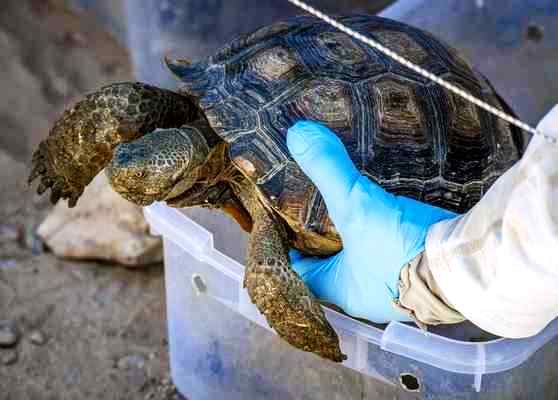
Biologists work with the USMC, BLM, the California and US Fish & Wildlife Services to relocate about 1,100 to 1,500 Desert Tortoises from the Bessemer Mine area of Johnson Valley in Twentynine Palms Marine Corps Air Ground Combat Center Wednesday. PHOTO BY ERIC REED

By David Danelski
The Press-Enterprise


Wildlife biologist Scott Welch looked out over the Mojave Desert and readied for action when he heard a distant helicopter flying in.

Just seconds after the aircraft landed, he and two others began loading it with plastic storage bins containing desert tortoises captured at an expansion area of the U.S. Marines Corps training base at Twentynine Palms.

They carefully packed 26 of the imperiled reptiles — one or two per bin — onto cargo carriers on the helicopter that looked like oversized saddlebags.

And within minutes, the tortoises were flying toward a safer haven of the recently created Mojave Trails National Monument — about 25 miles away from the crushing treads of tanks, the boots of soldiers and the blasts of bombs.

Operation Desert Tortoise was in its fifth day. As of Wednesday morning, 266 of the animals had been moved out of the Johnson Valley, about 30 miles northwest of Yucca Valley.

Before the end of the month, the Marines, working with about 125 wildlife biologists expect to have moved 1,156 tortoises, with a focus on clearing transportation corridors and other areas expected to be most disturbed by live-ammunition training missions.

It’s part of a multi-year, $50 million-plus tortoise relocation and study program at the base that was OK’d by the U.S. Fish and Wildlife Service following a 2013 vote by Congress to add about 88,000 acres in Johnson Valley to the combat center.

For the Marines, the expansion will allow them to hold longer and more-involved live-ammunition desert training missions to prepare Marines to intervene in global hot spots, such as the Middle East, should it be necessary. Such training is expected to start this summer.

For the tortoise, a species listed as threatened with extinction, it means the loss of more than a hundred square miles of quality habitat, as evidenced this year by robust blooms of yellow desert dandelions and other annual plants that are their primary food source.

The resources of the U.S. Defense Department were put to work to minimize harm to the tortoises, said Brian Henen, an ecologist for the Marine Corps Air Ground Combat Center at Twentynine Palms.

Analysis and field work for the move began more than two years ago. Scores of specially trained biologists have methodically walked the valley and fitted each tortoise they found with radio transmitters, so the animals could be gathered for this month’s move. It’s the largest tortoise move yet in the Mojave Desert.

The five areas of public land around the base that are receiving the animals were carefully chosen for their quality habitat and their distances from human habitation, Henen said.

Tortoises that lived near each other are being released in similar proximity in the recipient areas to preserve their social structure.

“We are moving them in groups. We are trying to sustain the similarity and the structure of their origin,” said Henen, standing by a makeshift medical checkup station for the tortoises.

There, Peter Praschag, a world-renowned tortoise and turtle expert from Austria, was working with veterinarian Shannon DiRuzzo to screen tortoises for signs of disease and other health issues.

A large male dubbed MC-2013 appeared frightened by the checkup and voided the water stored in his bladder, called a coelomic cavity. This was a serious matter, because a tortoise may get only one or two chances a year to get a good drink of water.

So Praschag used a syringe to carefully refill the animal’s coelomic cavity with a saline solution of water.

The work of the biologists won’t be finished until long after the last load of tortoises are flown out this month. Henen explained that the biologists will return frequently during the next four years to search for any reptiles that may have been left behind. They expect to move another 300 tortoises during that time.

The plans also include tracking and studying the relocated tortoises, as well as those already in the recipient area, for as long as 30 years. For this research, three groups of 225 tortoises — relocated ones, those already there and an unaffected control group — will be fitted with transmitters to track their movements and survival rates.

Biologists hope that the knowledge gained from this research will help the species recover.

But the loss of more than 100 square miles of prime habitat is still harmful to the tortoises, which has faced declines since the 1970s, prompting its 1990 listing under the Endangered Species Act, said Ileene Anderson, a biologist with the Tucson-based Center for Biological Diversity.

“It is going to be a big hit on the species,” she said.

She said it is not known if the public property outside the base will have enough food and other resources for both residents and newcomers to survive, and that wildlife biologists don’t know for sure why tortoises numbers have dropped in those areas.

She’s also worried that the tortoises may try to find their way back to their birthplaces in the base expansion areas.

But the U.S. Fish and Wildlife Service (FWS) determined in January that moving the tortoises from the Johnson Valley won’t jeopardize the survival of the species.

Scott Hoffman, who was observing the relocation effort for the FWS, said the species may benefit in the long run.

“Yes, we are losing habitat. But are we are using the relocated tortoises to supplement the populations in the critical habitat areas,” said Hoffman, referring to some of the recipient areas.

March 2, 2017

Federal officials OK desert tortoise transfer

Marines wait for a desert tortoise - endangered and protected from harm or harassment by federal law - to move off the road during an operation at Marine Corps' Air Ground Combat Center at Twentynine Palms, Calif., on April 4, 2008. Federal authorities have approved a plan to move nearly 1,500 desert tortoises from the base. (REED SAXON/AP)

By David Danelski
The Press-Enterprise
San Bernardino Sun


Federal land management and defense officials have signed off on plans by the U.S Marine Corps to move as many as 1,500 desert tortoises from a Twentynine Palms military base in the coming weeks.

With the approvals, the largest tortoise relocation effort ever the Mojave Desert is on track to occur toward the end of this month or in April after the slumbering reptiles emerge from their underground burrows, where they spend the winter months.

The move, however, cannot occur before March 21, which is the deadline for anyone to appeal the approvals from the Navy and Bureau of Land Management, said Chris Otahal, a wildlife biologist for the BLM’s Barstow field office.

The move would clear about 88,000 acres of land in the Johnson Valley for expanded live ammunition training. Congress voted in 2013 to add this land to the west side of the Marine Corps Air Ground Combat Center at Twentynine Palms.

The tortoises will be flown by helicopter to BLM lands mostly west and north of the Marine base.

The timing depends on the weather, but tortoises in the Mojave Desert usually leave their burrows by late March or early April so they can feast on wildflowers and other annual plants that are abundant after the winter rains.

Since the desert tortoises are listed as threatened with extinction, the Marines had to consult with the U.S. Fish and Wildlife Service, which found earlier this year that the move would not jeopardize the survival of the species.

This winter’s wet weather makes conditions more favorable for the move, increasing the tortoises’ chances of survival, Otahal said.

There will be more plant life for the displaced tortoises to eat, reducing competition for food with the tortoises already living on the BLM land. Also there will be more rabbits and other animals for coyotes to eat, which will make those predators less interested in tortoises.

“It’s much better for the tortoises when we have more food resources,” Otahal said.

The Marines had planned to move the animals last spring, but the operation was delayed a year after the Tucson-based Center for Biological Diversity filed a legal notice that argued that required environment analysis was lacking. The government then did more study, including assessing the impacts on wildlife on the BLM lands that will receive the displaced tortoises.

Ileene Anderson, a Los Angeles-based biologist for the center, said the move will be devastating to the species. The tortoises would lose some 136 square miles of quality habitat. What’s more, the displaced animals will move to BLM lands where species is in decline, she said.

“This is the largest translocation of tortoises in the Mojave Desert, and they’re moving them to areas where tortoises are dying off and we don’t know why,” Anderson said.

March 31, 2016

Tortoise a road block for Marines

Twentynine Palms Marine Corps Air Ground Combat Center expansion area in Lucerne Valley.

By DAVID DANELSKI
Press-Enterprise


An adult desert tortoise weighs about 12 pounds and can take days to travel a mile, yet the reptiles have managed to get one of most formidable forces on earth – the United States Marine Corps – to reconsider a large training mission.

The Marines plan to conduct live ammunition training in August, using tanks and other heavy weaponry at their Air Ground Combat Center at Twentynine Palms.

To prevent harming about 1,400 tortoises living in this stretch of the Mojave Desert, the military now plans to limit operations in its combat center expansion area in the Johnson Valley northwest of Landers.

The Marines had hoped to airlift the reptiles this spring to federally managed habitat land near Barstow to get them safely out of the way.

But military officials and federal land mangers recently announced that the relocation can’t proceed until they analyze how the move would affect tortoises and other wildlife already living in the recipient areas.

The spring move was canceled shortly after an environmental group, the Center for Biological Diversity, filed a legal challenge to it. Desert Tortoises are protected by the Endangered Species Act because they are listed as threatened with extinction.

Marine Capt. Justin E. Smith, a spokesman for Twentynine Palms, said by email that the extend of the use of 88,000-acre Johnson Valley expansion has not been determined, but training “will not negatively impact the desert tortoise species.”

The Marines “will comply with all environmental management requirements.”

Brian Croft, a biologist with the U.S. Fish and Wildlife Services, said he expects to talk with the Marines about how to avoid harming tortoises. The Marines, for example, may keep tanks and other motorized vehicles on designated roadways when traveling through tortoise areas.

The August training will be a large-scale, live-ammunition operation involving three battalions operating in extreme desert heat in real world warfare conditions, said Smith’s email. Last year’s exercises included troops from Canada and the United Kingdom.

The Johnson Valley has traditionally been an off-road-vehicle recreation area managed by the federal Bureau of Land Manage. But in late 2013, Congress added the valley to the Air Ground Combat Center.

Marine and BLM officials will hold a public meeting to discuss the Johnson Valley situation from 10 a.m. to noon Saturday, April 2, at the Lucerne Valley Community Center in Lucerne.

March 16, 2016

Military's tortoise relocation plan in jeopardy

The Marines were gearing up to move the reptiles to Bureau of Land Management habitat areas near Barstow to protect them from live-fire exercises

Twentynine Palms Marine Corps Air Ground Combat Center expansion area in Lucerne Valley.

By DAVID DANELSKI
Press-Enterprise


The military has scrapped plans to move more than 1,400 protected desert tortoises from an expansion area at the Marine Corps Air Ground Combat Center Twentynine Palms to BLM-managed habitat land this spring.

The Marines were gearing up to move the reptiles to Bureau of Land Management habitat territory near Barstow, so that the 88,000-acre Johnson Valley expansion area could be used this summer for live ammunition training.

A base spokesman said in an email Wednesday, March 16, that he is still trying to determine how the decision will affect the training plans.

The plan called for the tortoises to be moved as early as this month. To reduce stress on the animals, they were to be flown by helicopter to the Ord-Rodman Critical Habitat Unit, an area managed by the BLM southeast of Barstow. But the manager of the BLM’s Barstow Field Office, and Marines both sent emails Wednesday confirming that the move won’t be this spring.

The emails did not explain why the move was canceled.

But the postponement comes a week after environmentalists with the Center for Biological Diversity filed a legal challenge to the planned move. And it comes a day after a U.S. Fish and Wildlife Service official said the agency had not yet approved a required relocation plan.

Meanwhile, time was running out to get the tortoises moved before the military exercises – if they do end up being held. The animals are threatened with extinction.

Marine Corps officials had said they wanted to relocate the desert tortoises while the weather was cooler.
Hotter temperature puts more stress on them, making them less likely to survive the move, officials have previously said.

Last week, the Tucson-based Center for Biological Diversity filed a notice of intent to sue the BLM, contending that the agency had failed to fully examine how the move might harm desert tortoises and other wildlife.

Ileene Anderson, a biologist with the center, said in an email that she’s pleased the tortoises will stay put, at least for now, allowing more time for analysis.

“BLM is wise to do a full analysis of the impacts of having desert tortoises from the Marine base moved onto the public lands that they manage,” her email said.

She said she was concerned that the moves could spread a respiratory disease that afflicts tortoises.

On Tuesday, March 15, Brian Croft, a wildlife biologist for the U.S. Fish and Wildlife Service said the agency was still working on a relocation plan and a revised biological opinion about the move. The service must approve both documents before the move can occur.

“There are still some big hurdles to go over,” Croft said.

Also on Tuesday, Marine Corps Capt. Justin E. Smith said a date for the move will be announced once the relocation plan is finalized. The military also plans to study how the animals adapt to their new environment.

This research “will aid in gaining more information in the efforts to recover the population of the desert tortoise,” Smith said in an email.

“We remain steadfast in keeping with our obligation to serve as good stewards of the environment,” he said.

March 8, 2016

Tortoise relocations challenged

Desert tortoises, such as this adult photographed near the Ivanpah Valley, are listed as threatened with extinction. The Marine Corps plans to move more than 1,100 of them from 88,000 acres in the Johnson Valley, northwest of Landers, to protect them from live fire exercises planned for this summer. (STAN LIM)

BY DAVID DANELSKI
Press-Enterprise


An environmental group filed a legal challenge Tuesday, March 8, to the military’s plans to move more than 1,400 protected desert tortoises out of an expansion area at the Marine Corps Air Ground Combat Center at Twentynine Palms.

The Center for Biological Diversity filed a notice of intent to sue, contending that federal agencies have failed to fully examine how the move might harm the Mojave Desert tortoises as required under the Endangered Species Act. Such a notice is required before a lawsuit may be filed in federal court.

Tortoises are listed as threatened with extinction, but the Marines say they have to move them from 88,000 acres in the Johnson Valley to protect the reptiles from live ammunition training exercises planned for this summer.

The center argues that studies have shown that half of the tortoises will perish within three years of being moved in part because they haven’t found or dug underground burrows that give them shelter and protection from coyotes and other predators.

Military officials could not be reached Tuesday, but last week Walter J. Christensen, head of the training center’s conservation branch, and Marine Corps Lt. Col. Timothy B. Pochop, director of natural resources and environmental affairs at the training center, said the Marines are taking great care and expect most of the animals to survive.

Using helicopters will reduced stress from travel, and military officials are choosing release sites that are less likely to be prowled by coyotes, they said. And individuals from the same social groups will be placed near one another.

Most of the animals will be moved to federal land southeast of Barstow known as the Ord-Rodman Critical Habitat Unit, which is overseen by the federal Bureau of Land Management.

Ileene Anderson, a biologist with the center, said the group has seen no evidence that the military has analyzed impacts to tortoises and other wildlife already living in the critical habitat area, which has a limited amount of food, water and other resources.

Such an analysis is required under the National Environmental Policy Act, she said.

“This massive translocation proposal is being rushed through the process this spring without fully considering how it may affect the already declining tortoise population in the western Mojave,” said Anderson. “What we should be doing is recovering this population, not pushing it closer to extinction.”

The move has not yet been approved by the U.S. Fish and Wildlife Service, which still needs to sign off on the relocation plan and an analysis that showed that the move would not jeopardize the survival of the species, said Brian Croft, a biologist with the wildlife service.

Military officials want to start moving the tortoises as early as this month while the weather is still cool. The relocation is expected to take a team of about 100 biologists as long as two to four weeks to complete.

Croft said such a move should be done by mid-May – before it gets too hot for the reptiles to be above ground. The tortoises survive the desert’s harsh climate by spending the hottest and coldest months in their subterranean burrows.

The planned move stems from a 2013 decision by Congress to expand the Marine Corps Air Ground Combat Center to enhance live ammunition training operations deemed necessary for national security.

Taxpayers to shell out $50M for Marines to evacuate 1,200 Mojave tortoises

The tortoises are in the way of the Marines' planned expansion of a combat training grounds. (US Marine Corps)

Foxnews.com

Taxpayers will be forking over $50 million to have the Marines remove nearly 1,200 tortoises from future training grounds in the Mojave Desert, but similar efforts in the past have proven disastrous, say environmentalists.

The desert tortoises, already under stress from drought, disease and human interference, will be airlifted later this month from 130,000 acres surrounding the Corps' Air Ground Combat Center. The center is undergoing an expansion to facilitate live fire and maneuver training for full-scale Marine Expeditionary Brigade-sized elements.

"This spring, the Marine Corps will translocate approximately 1,180 desert tortoises in order to safeguard the animals coming from lands newly acquired through an NDAA-mandated (National Defense Authorization Act) land withdrawal that supports Marine Corps-mandated training requirements," base spokesman Capt. Justin Smith wrote in an e-mail to the Desert Sun.

The area slated for expansion is in prime tortoise habitat, and the number of breeding adults has dropped by about 50 percent over the last decade, according to a recent survey by federal biologists.

Some environmentalists are against the pricey effort to relocate the tortoises, which can stress the animals and leave them vulnerable to dehydration, predators and human interaction, they said.

"I wish the U.S. Fish and Wildlife Service would get some backbone and say it can't permit another tortoise translocation by the military," Glenn Stewart, a biologist and member of the board of directors of the Desert Tortoise Council conservation group, told the Los Angeles Times. "The situation makes us feel like we'll have to write off California's Mojave population."

In 2008, the Army moved 670 tortoises from its National Training Center near Barstow to new homes in the western Mojave. That $8.6 million effort proved disastrous when it was learned that a large percentage of them died within a year, many eaten by coyotes.

Brian Henen, a biologist and head of the Marine Corps' translocation effort, told the Times the project's ample budget and commitment to monitor the tortoises for 30 years "demonstrates how much we care about this species."

The plan, approved by the U.S. Fish and Wildlife Service, will utilize 100 biologists who will capture 900 adult tortoises and put transmitters on them before releasing them on nearby public lands. Another 235 hatchlings raised in pens at the base also will be relocated once they are strong enough to survive on their own. The project will take an estimated two to four weeks to complete, officials said.

The Combat Center raises the hatchlings in its 6-acre Tortoise Research and Captive Rearing Site, which is operated jointly with UCLA.

The desert tortoise is classified as a threatened species because its numbers have declined rapidly over the past few decades due to predators and disease. Soft shells leave young tortoises vulnerable to predators ranging from ants and ground squirrels to ravens and coyotes.

May 9, 2014

Marines, off-roaders compromise over area near Twentynine Palms

Trails used by off-road vehicles go through Johnson Valley west of the Twentynine Palms Marine combat training base. For a decade, the Marine Corps and off-roaders have argued about who should be able to use the area. (Don Bartletti / Los Angeles Times)

by TONY PERRY
Los Angeles Times


A near decade-long dispute between the Marine Corps and off-road vehicle enthusiasts over a rocky patch of desert west of the base at Twentynine Palms has ended in a compromise brokered by Congress.

Neither side got all it wanted in the tussle over the nearly 200,000 acres of forbidding Johnson Valley -- a place of rugged beauty that off-roaders say is virtually without peer for their sport. The Marines say the same about their training needs.

As included in the 2014 defense bill signed by President Obama, approximately 43,000 acres of Johnson Valley will be for recreational use only, 79,000 acres will be for the Marine Corps, and 53,000 acres will be shared between the off-roaders and the Marines.

Just how that sharing will be accomplished has yet to be decided.

"Generally we're pleased," said Steve Egbert, a Tulare pig farmer and president of the 6,000-member California Assn. of Four-Wheel Drive Clubs, one of several off-road organizations involved in the issue.

"As long as it works out the way the bill intends, we can live with that," Egbert said Friday. "We would have preferred something different. But this is probably the best we can get."

Maj. Gen. David Berger, commanding general of the base at Twentynine Palms, said that without the additional training area, Marines would not be able to train effectively to fight at the brigade-level.

With the additional area, he said, Marines will "learn to fight the way [they're] actually going to fight in a conflict, at that size level."

For the off-roaders, the annual King of the Hammers race, billed as the toughest desert race in the nation, drawing more than 20,000 spectators and participants, will continue, although its course will have to be redrawn slightly, officials said.

At a public meeting this week in Yucca Valley, Bureau of Land Management field manager Katrina Symons said the arrangement calling for the Marines and off-road community to share part of Johnson Valley is the first of its kind.

About the only thing that comes close is an agreement that allows the public to use the beach near Vandenberg Air Force Base except when the base is launching a missile or satellite, officials said.

The Johnson Valley plan allows the Marines to use the shared area for two 30-day stretches a year for combat training. Just when those 30-day stretches will be has yet to be decided, BLM officials said.

The off-roaders had posted a petition on the White House website calling for Congress to turn down the Marine Corps bid to annex the Johnson Valley land: "The Marines current expansion plan is unnecessary and fiscally irresponsible. Expanding the world's largest Marine base will cost taxpayers millions."

The petition gained 29,456 supporters.

In response, a post by a deputy under-secretary of defense said that while the military places a "high value" on community relations, lack of the Johnson Valley area for training would force the Marines to "rely on classroom instructions and simulation which cannot provide realistic and practical experience."

The Marine Corps has long insisted that it needs additional land at the 640,000-acre base at Twentynine Palms for large-scale, live-fire training exercises including infantry and air power.

Sen. Dianne Feinstein (D-Calif.) and Rep. Paul Cook (R-Apple Valley), a retired Marine colonel, worked to bring the two sides together.

After the bill was signed by Obama, Cook said that the agreement "ensures public safety, while also balancing the training needs of the Marine Corps with the rights of the off-road community."

While the Marine Corps had issues of national defense on their side, the off-roaders talked of their impact on the local economy: an estimated $71 million annually.

The area set aside exclusively for the public will be known as the Johnson Valley Off-Highway Vehicle Area and is nearly as large as the Imperial Sand Dunes at Glamis in the Imperial Valley, Cook noted.

The area includes topographic features that draw off-roaders and others: Spooners, Aftershock, Sunbonnet, the Rockpile and more.

For the shared area, training is not set for anytime soon. It will probably take at least 18 months for the Marine Corps to resolve three iron-ore mining claims and also to receive approval from the Federal Aviation Administration and complete an environmental review involving how to protect the desert tortoise.

March 4, 2014

Off-roaders’ battle over Johnson Valley recreation area ends

The Johnson Valley Off-Highway Vehicle
Recreation Area hosts the famous
“King of the Hammers” Race. (SEMA)
Staff Report
Tire Business

TWENTYNINE PALMS, Calif. — After a six-year battle over the future of the Johnson Valley Off-Highway Vehicle (OHV) Recreation Area in the Southern California desert, the issue finally has been settled.

After a consistent grassroots effort by the Specialty Equipment Market Association (SEMA) and other partner organizations, a legislative solution was finally reached to create a dedicated OHV recreation area and provide land for military training exercises, as well.

As explained by SEMA’s Action Network (SAN), “The issue was simple—how to expand the adjoining Marine Corps Air Ground Combat Center at Twentynine Palms while preserving recreation access to 189,000 acres at Johnson Valley.

“The Marines needed the additional land to simulate brigade-level expeditionary force movements and the Johnson Valley topography seemed ideal for training purposes.”

SEMA said the debate “reached a crescendo in 2013,” and a decision required Congressional approval.

Under a provision included within the 2014 National Defense Authorization Act (NDAA) signed into law last December, 79,000 acres of Johnson Valley has been transferred to the Twentynine Palms military base. Simultaneously, the law created the “Johnson Valley Off-Highway Vehicle Recreation Area,” providing federal protection to over 96,000 acres established in 1980 for OHV recreation by the state of California.

It is the first time an OHV area has been provided national recognition, according to the SAN. Twice a year, 53,000 acres of the OHV area will be provided to the Marine Corps for 30 days of military training exercises, it explained, noting no dud-producing ordnance will be used at that time in order to assure safety and continued OHV access to the area.

“The SAN commends Rep. Paul Cook, R-Calif., for the instrumental role he has played in reaching a reasonable shared-use solution,” said SAN Director Colby Martin. “We joined with a number of other organizations representing the off-road community to support this provision that addresses the nation’s military training needs while providing access for responsible recreational activities.

“We consider this ground-breaking provision a positive result for both the OHV community and the United States Marine Corps.”

The recreation area will continue to be controlled by the U.S. Bureau of Land Management (BLM). SEMA said it contains a unique mix of open desert, dry lake beds and formidable rock-crawling formations that attracts four-wheeler enthusiasts from around the world.

The area hosts the famous “King of the Hammers” Race, which drew more than 50,000 people to the 2013 event. The BLM estimates that Johnson Valley generates more than $71 million annually for local economies—an amount that will continue to grow, SEMA said.

Rep. Paul Cook, in a statement, said “the agreement preserves California’s most important off-road recreation area for future generations.

“After years in which off-roaders have lived in fear of the closure of Johnson Valley, this permanently ends the threat of base expansion into off-road areas.”

Prior to being elected to Congress in 2012, he served a 26-year career in the Marine Corps before retiring as a colonel. SEMA said Rep. Cook has lived for years in the area that includes Johnson Valley and the Twentynine Palms base and represented those communities in the California state legislature before his election to Congress.

The SAN said it worked collaboratively with the Off-Road Business Association (ORBA); California Motorized Recreation Council (CMRC); Motorcycle Industry Council (MIC); and Americans for Responsible Recreational Access (ARRA).

CMRC includes ORBA; California Association of 4 Wheel Drive Clubs (Cal4Wheel); California Off-Road Vehicle Association (CORVA); American Motorcyclist Association National (AMA); AMA District 36; AMA District 37 Off-Road; San Diego Off-Road Coalition (SDORC); American Sand Association (ASA); and California-Nevada Snowmobile Association (CNSA).

February 5, 2014

A roaring triumph for public access

Fabio Manno's buggy runs the course of the 4 Wheel Parts Time Trials on Tuesday, February 4, 2014. King of the Hammers event, an off-road race that combines desert racing and rock crawling on Means Dry Lake at Johnson Valley. A last-minute compromise last year saved this event after the military pushed to take this land for training. (KURT MILLER/STAFF PHOTOGRAPHER)

BY DAVID DANELSKI
Riverside Press-Enterprise


JOHNSON VALLEY -- They crawled up almost-vertical boulder piles. They floored it across the flats. Some of them flipped, and at least one rolled and bounced across the desert floor before settling in a burst of flames.

They are competitors in King of the Hammers 2014, an extreme off-road race in the San Bernardino County desert in which rugged terrain is the worthiest adversary. But this year’s event in Johnson Valley is much more than a week-long contest of machines, drivers and nerves — it is a triumph for public access.

More than four years ago, the world’s most formidable force — the U.S. military — announced plans to take over this off-roading mecca as part of a 424,000-acre expansion of the Twentynine Palms Marine Corps Air Ground Combat Center.

The same remote valleys and peaks that make for a challenging race course are a perfect venue for live-fire training exercises for tank battalions, the Marines said.

Many figured the base expansion was a foregone conclusion to be made in the interest of national security. And it would be tough luck for some 200,000 people who hauled their motorcycles, jeeps and four-wheelers each year to Johnson Valley, a designated off-roading area southeast of Barstow and north of the San Bernardino Mountains.

But the off-roaders rallied in force. They signed petitions, attended public meetings, submitted written comments and gained support from elected officials. Environmentalists also wanted the off-road area to stay open, so fewer off-roaders would be tempted to disturb sensitive wildlife habitat elsewhere in the Mojave Desert.

The Department of Defense agreed to a compromise.

Under a law approved by Congress in late December, 99,870 acres will remain part of the Johnson Valley Off-Highway Vehicle Recreation Area, open to the public and under the jurisdiction of the U.S. Bureau of Land Management. The Marines can use about 56,000 acres of the valley for training twice a year, for a total of 60 days.

On Tuesday, Feb. 4, the victory meant that 7,000 people could be there to witness qualifying rounds for the 100-mile-plus King of the Hammers. Organizers expected the crowds to swell beyond 40,000 for the final race on Friday.

VIDEO: Car crashes, flips at King of the Hammers

“It’s just great,” said John Miller, 62, of Running Springs, standing at his dusty campsite with the race roaring in the background. “I am not against the military, but there is a lot of land where they can do their stuff.”

“We’re just getting ready to head up there and watch,” he added. “We have one, two, three generations here,” he added, pointing to himself, his son, Trevor, 38, and his grandson, John, 11, who sat on a 65cc Kawasaki mini-motorcycle.

Trevor Miller said he and his son get to Johnson Valley at least two or three times a year. “It’s always families out here,” he said.

A short ride away, Raul Vega, 33, of Orange, sipped beer from a can as he watched one driver after another attempt to climb a rock-face peak dubbed “The Waterfall.”

“We are happy to see it stay here,” Vega said of the Hammers event. “I took my vacation time to be here. This is one thing I plan for all year.”

His friend Kurtis Magargee, 22, of Yorba Linda, added that participants take care to leave the valley as they found it. Many will spend Saturday, the day after the races, picking up cans and trash. Race organizers have shovel-equipped vehicles ready to scoop up motor oil if it should spill, he added.

Magargee and hundreds of other spectators cheered as one driver attempted to power up The Waterfall, only to slowly roll upside down. It took two vehicles with winches to right the buggy so the trials could resume.

Racer Kevin Sacalas and his co-pilot, Tim Carlson, both of Riverside, had one of the more spectacular crashes. After bumping down a steep hill, they were picking up speed across the flats when their buggy flew out of control and flipped end over end five times before landing in a brief spout of fire. Sacalas wasn’t hurt, and Carlson had only scratches, according to Sacalas’ brother, Robert.

The vehicle, the “Big Ugly,” was a total loss, Robert Sacalas said.

Racers can spend as much as $250,000 to build one of the specialized machines from the ground up, explained driver Crystal Crowder, of Ridgefield, Wash., who was watching this year because her rig needs work.

Just being there was a big win, she said.

“Public land should stay public,” she said. “And this ultimate off-road race is the best in the United States.”

OFF ROADING: Pact mostly preserves Johnson Valley for recreational use

December 16, 2013

Johnson Valley: Deal will have Marines, public sharing access

There were many twists and turns leading up to the compromise between off-roaders and the U.S. Marine Corps over access to Johnson Valley. (Pirate 4X4)

Written by K Kaufmann
The Desert Sun


A nudge from Sen. Dianne Feinstein, D-Calif., may have helped seal a compromise between off-roaders and the U.S. Marine Corps, ensuring that more than half of Johnson Valley’s 188,000 acres of prime off-roading trails and desert vistas will remain open to the public most of the year.

Rep. Paul Cook, R-Yucca Valley, recently announced the deal that would limit an expansion of the Marine Corps Air Ground Combat Center at Twentynine Palms into the valley to 88,130 acres and create a federally designated off-roading area on the remaining 99,690 acres.

Located in the high desert about 20 miles north of Yucca Valley, Johnson Valley is an off-roading mecca known worldwide for its mix of dry lake beds, open desert and rock-crawling trails — called the Hammers — where custom-built vehicles with massive tires fight their way up hills littered with rocks and large boulders.

But the same terrain that draws off-roaders and its location due west of the combat center also made it prime real estate for the Marines. The Corps has been working for years to expand the base at Twentynine Palms to allow for live-fire combat training exercises it has said are critical for its post-Mideast role as a streamlined expeditionary force.

Its plan for the valley, which the U.S. Navy approved earlier this year, would have appropriated more than 103,000 acres of the off-roading area for training at the base, plus another 43,000 acres that off-roaders would be allowed to use 10 months a year.

The deal, part of the National Defense Authorization Act the House passed late Thursday, would also allow the Marines to use 56,439 acres of the off-roading area for combat training up to 60 days a year but limits the kind of live ammunition that can be fired during combat exercises.

A Senate vote on the bill could occur sometime this week, said Matthew Groves, Cook’s legislative counsel.

While labeling the deal a victory, off-roaders also said the land the Marines will take includes some of the region’s most popular trails and isolated, back-valley areas.

“The trail systems we fought so hard for are still there,” said Larry McRae, an avid off-roader and president of Poison Spyder of Banning, a company that builds custom “armor” for the Jeeps and other off-road vehicles that batter themselves against the rocks in the Hammers.

“There’s a lot of open desert that’s been taken. What it takes away is some of the exploration opportunities. A lot of people enjoy the trail-making process.”

“Saying we lose 70-80,000 acres and calling that a win is tough,” said Dave Cole, co-founder of King of the Hammers, a week-long off-road racing event that yearly draws tens of thousands of visitors and significant tourist dollars to surrounding high desert communities.

The area going to the Marines also contains about 85 percent of the 112-mile course that was used for the King of the Hammers in 2013, he said. While the 2014 event, set for Jan. 31-Feb. 8, should not be affected by the Marines’ move into the valley, Cole said a new course on the remaining land will have to be developed for future races.

Residents of the small community of Johnson Valley, located across the highway from the off-roading area, also have mixed feelings about the deal. Many already experience noise and rattling windows during training exercises at the base, including recent combat exercises that ended Monday.

“I’m glad the Hammers were saved,” said Jim Hanley, 74, a Marine vet who served in Lebanon in the 1970s. “The shared use — it will bring the noise closer to us. The other night I thought something had hit the house, the noise was so bad.”

Keeping residents and off-roaders safe, while ensuring the Marines could train, were the issues allowing Cook, a retired Marine colonel, and Feinstein to find common ground during a recent meeting.

Feinstein had previously pushed the Corps to find a way to share the valley with off-roaders, representatives from her Washington office said.

The Corps also cited safety in their reasons for accepting the compromise.

“We feel this course of action is the best balance for military and recreational use of the land,” Capt. Maureen Krebs, a Marine spokeswoman, wrote in an email response to questions from The Desert Sun.

“Safety is a high priority for the Marine Corps and we want to ensure that both Marines and recreational users stay safe throughout the year.”

Many details of how the shared-use arrangement will play out are still to be determined, but Johnson Valley will not be the first time the Marines have shared land for recreational use, Krebs said.

The Marines share 45,000 acres of Toiyabe National Forest in Nevada, where they conduct mountain warfare training, and hunting and fishing are allowed on a number of bases across the country, she said.

December 11, 2013

Marines, offroaders reach compromise on Johnson Valley

Detailed final Johnson Valley OHVRA map available here.

by K Kaufmann
The Desert Sun


It’s not often a bunch of off-roaders can wrestle the U.S. Marine Corps to a compromise, but that seems to be exactly what’s happened as U.S. Rep. Paul Cook, R-Yucca Valley, on Wednesday announced a deal on Johnson Valley that allows both the Marines to conduct live ammo training in the region, but still preserves more than half of its 188,000 acres for off-roading and other recreation for 10 months a year.

Located in the high desert about 20 miles north of Yucca Valley, the disputed land has been an almost sacred site for the off-roading community, known worldwide for its unique mix of wide open desert and rock-crawling trails – dubbed the Hammers – where drivers in custom-built four-wheelers bump and grind their way up hills strewn with massive boulders.

A yearly week of racing called the King of the Hammers draws tens of thousands of visitors to the area, turning the valley floor into an encampment called Hammertown, which is half Coachella and half “Road Warrior.” The 2014 Hammers is scheduled for Jan. 31-Feb. 8, and event organizers have said the deal will keep the race rolling for years to come.

The off-roaders and the Marines have been in a standoff for a couple of years over whether the Corps would take over more than half of valley, 103,618 acres, for expanded training exercises involving three tank battalions, helicopters and a whole lot of live ammunition. The Marines argued such training exercises would be critical to their post-Mideast evolution into a streamlined expeditionary force, and nowhere else offered the land they needed.

Off-roaders are generally a patriotic bunch, lots of former military, but the threat to Johnson Valley sparked a determined opposition, backed up by the multimillion-dollar offroading industry. The Marines attempted a compromise, offering with a 43,049-acre shared use area, including the Hammers, open to off-roaders 10 months a year.

The remaining section of the valley, open to off-roaders year round would have been all but separate from the shared use area, connected by only a narrow corridor of land.

High desert communities, led by Yucca Valley, also got behind the off-roaders, noting that the King of the Hammers and other off-roading events in Johnson Valley meant full hotels and a boost for small businesses in the region. Residents of the small community of Johnson Valley, located across the highway from the off-roading area, have also opposed the expansion, mostly because current training exercises on the base already set their windows and furniture shaking.

A map of the deal announced Wednesday cuts the Marines back to 88,000 acres covering the north central and east sections of the valley. The off-roaders get a total of about 100,000 acres starting in the southeast corner of the region and curving up to the northwest, including a 56,000-acre shared-use area the Marines will be able to use for training for two months a year, again with limited types of ammunition.

Cook, a Vietnam veteran and retired Marine colonel, emerged as the mediator between the two camps earlier this year, after a visit to the 2013 King of the Hammers.

He authored a bill in the House, passed with bipartisan support and inserted in the Defense Authorization Act, that would have kept the whole valley under the jurisdiction of the Burea of Land Management, with the Marines allowed to train twice a year, but not allowed to use what is called dud-producing ammunition, that is bullets larger than a certain caliber.

Meanwhile, the Marines got their plan through a first hearing in the Senate Committee on Energy and Natural Resources on Nov. 14.

What happened between then and Wednesday is unclear. Cook’s release announcing the deal contains congratulatory quotes from all the stakeholders but no details of how the deal was struck.

November 20, 2013

Off-roaders would lose land to Marines in Senate bill

Johnson Valley
By Courtney Vaughn
Hi-Desert Star

JOHNSON VALLEY — A bill in the U.S. Senate is helping to push along the Navy’s request to expand military training grounds into Johnson Valley and Wonder Valley.

Last week, the Military Land Withdrawals Act cleared the Senate’s Energy and Natural Resources Committee. The legislation now heads to the Senate before it goes to the House of Representatives.

The bill would allow the military to use public lands in Johnson Valley and Wonder Valley, as well as land in Imperial and Riverside counties and Montana for military training exercises.

Military: Land is needed for training

As proposed, the bill would set aside 154,663 acres of land in San Bernardino County for training. That includes a 36,755-acre shared-use area between the military and public in Johnson Valley.

It would also give the Secretary of the Interior the authority to close public lands when deemed necessary for military or public safety or national security.

The Department of the Navy and local Marine Corps representatives have repeatedly said the extra land is necessary to conduct training exercises that can’t be done at the Marine Corps Air Ground Combat Center as it exists today.

“The training conducted would be tailored to suit a Marine Expeditionary Brigade-level unit, comprised of about 15,000 Marines,” Capt. Justin Smith, public affairs officer at the combat center, said via email. “Essentially, the training would be customized to ensure components of the unit would begin at different locations, spread apart by distance and terrain, with the purpose being to merge upon a single objective. The benefits of having a base that will allow for this type of training are unprecedented.”

Smith said having the extra land would allow Marines to train as they fight, rather than relying on classroom instruction and simulations.

Smith said the land chosen wasn’t the Navy’s preferred alternative, but it was carved out in response to public feedback.

Locally, the base expansion would bar public access to more than half of the area currently designated for off-road-vehicle use in Johnson Valley. As a compromise, the Navy designated a shared-use area, which allows for training exercises two months out of the year and gives the Secretary of the Navy management authority over the area during that those times. The Secretary of Interior would manage the shared lands for the rest of the year.

Earlier this year, Congressman Paul Cook suggested an alternative strategy for the base expansion. His recommended alternatives weren’t included in the Senate bill, which could become part of the National Defense Authorization Act.

“If that should happen, the House version of the NDAA contains Congressman Cook’s wording to protect Johnson Valley, and it will contradict the Senate’s version, which will contain the Marines’ request for Johnson Valley,” Dawn Rowe, a representative with Cook’s office, stated via email.

“If these two bills contain language that conflicts with each other, both houses of Congress must convene a conference committee to resolve the conflict.”

Under the Senate bill, an Exclusive Military Use Area would be created within the Morongo Basin, divided into four areas: about 103,000 acres to the west of the Marine Corps Air Ground Combat Center; another 21,000 acres south of MCAGCC; and two other areas, each about 300 square meters, inside the boundaries of the shared-use area.

The Department of the Navy would have access to the public lands for combined-arms live fire and maneuver training.

‘How much worse is it going to be?’

The military proposal has been met by heavy resistance within the Basin. Off-road-vehicle enthusiasts say the move infringes on public lands in Johnson Valley that are vital to recreation.

Johnson Valley is the nation’s largest ORV recreation area.

Residents in Johnson Valley fear noise during training periods and loss of revenue from the ORV community.

“I can sit here in my living room and I’m literally looking at where they’re gonna be training,” Betty Munson, a longtime Johnson Valley resident and vice president of the Homestead Valley Community Council, said Tuesday.

Munson characterized the land swap as “another disaster” for her community and the ORV recreation areas.

She said she and her distant neighbors already hear and feel the vibrations of ordnance training in Twentynine Palms, which rattle the house and scare her animals.

“How much worse is it going to be?” she said Tuesday, sighing at the thought of her future in the homestead cabin her family owns.

“It never occurred to us that something would happen to the Johnson Valley recreation area because as far as we were concerned, it had been set aside for ORV use,” Munson said. “We’ve been shut out of every other part of California.”

She said what’s most disturbing to her is that the Senate bill has been called “non-controversial” by legislators, yet more than 40,000 public comments were logged in the plan’s Environmental Impact Report.

June 14, 2013

Johnson Valley plan passes House

Johnson Valley OHV area is popular with off-road vehicle enthusiasts and hosts large off-road racing events throughout the year. (FILE PHOTO: DAILY PRESS)

Kris Reilly, City Editor
Victorville Daily Press


WASHINGTON • Paul Cook scored another victory Friday in his quest to save a popular off-roading area from a military takeover.

Cook, R-Yucca Valley, announced in a news release that his plan to create the Johnson Valley National Off-Highway Vehicle Area passed the U.S. House of Representatives as part of the National Defense Authorization Act.

The NDAA passed the House by a vote of 315-107 and will now move to the Senate. If passed by the Senate, the bill will reach the President’s desk for approval.

“... Johnson Valley is essential to the off-highway recreational vehicle community,” Cook said in the release. “The end goal is to ensure that the NDAA still has this Johnson Valley language in it when it reaches the President’s desk later this year. A lot can happen as the NDAA moves through the Senate, so it’s essential for supporters of my proposal to let Senators know how important it is to protect Johnson Valley for recreational use.”

The Johnson Valley OHV area is a vast expanse of desert east of Lucerne Valley. The site is popular with off-road vehicle enthusiasts and hosts large off-road racing events throughout the year.

The U.S. Marine Corps has its sights set on a westward expansion of its base in Twentynine Palms to establish a vast training area. The plan would permanently close a large portion of the OHV area and leave a small section for joint use by the Marines and the public.

Cook’s proposal would designate the Johnson Valley OHV area as a national recreation area, thereby severely limiting the Marines’ proposed expansion. Marine Corps activities would be permitted twice annually and could not include any explosives that could be left behind without detonating.

Cook is a former Marine who was awarded a Bronze Star and two Purple Hearts.

February 28, 2013

Off-roaders, military wage a dirty battle

Some are up in arms after the Marine Corps says it wants to take a stretch of wilderness for training.

Marines train with an Abrams tank at the Air Ground Combat Center in Twentynine Palms in February. The Marines are seeking to claim 103,600 acres of the Johnson Valley Off-Highway Vehicle recreation area in Lucerne Valley. (CPL. SARAH DIETZ, U.S. MARINE CORPS)

By SUSAN CARPENTER
ORANGE COUNTY REGISTER


Wayne Raimey sped over a sandy wash, leaving plumes of dust in his wake, as his family and friends idled on their ATVs. For the better part of a Saturday, the six had roamed the Johnson Valley Off-Highway Vehicle area north of Big Bear, enjoying unencumbered landscape that stretched to the horizon as they rode machines that climb rocks and skid through the sand with ease.

Raimey, who lives in Santa Ana, used to quad closer to home, but he started visiting Johnson Valley because "It's just so much easier going," he said. "You can ride for a while without seeing anybody. It's more open. It's more free."

But that is likely to change.

Spanning 188,000 acres, Johnson Valley is the country's largest off-highway vehicle area. Under a plan the Secretary of the Navy announced in February, however, 103,600 of its acres would be absorbed by the Marine Corps Air Ground Combat Center in Twentynine Palms for live-ammunition training; 43,000 acres would be shared by the Marines and the off-road community; and the remaining 41,400 acres would be designated as a Johnson Valley National Recreation Area.

The plan, which needs Congressional approval to take effect, has inspired a rare coalition among ordinarily disparate off-road groups, who have hired a Washington, D.C., lobbyist to fight on their behalf.

"We're not opposed to the Marines being able to meet their training objectives," said Jeff Knoll, co-founder of the annual King of the Hammers off-road race in Johnson Valley and member of the California Motorized Recreational Council.

The coalition of eight off-road groups collected 28,303 signatures in 30 days and sent them to the White House to protest the base expansion one day before the Secretary of the Navy published its Record of Decision to take over the majority of Johnson Valley.

"We're asking them to use this area under a permit like any other event would. Just don't absorb it into the base," said Knoll, who estimates the Johnson Valley OHV area draws between 300,000 and 1 million visitors each year.

The Marines' plan would reduce the amount of such land in California by about half, Knoll said.

The proposed land division, known as Alternative Six, was one of a half dozen proposals the Marines considered to expand the 935-square-mile Combat Center at Twentynine Palms. Despite being the largest Marine Corps base in the country, just 40 percent of the property is available for training due to terrain and wildlife issues, said Twentynine Palms spokesman Capt. Nicholas Mannweiler.

He said the Johnson Valley land is needed to conduct training operations involving tens of thousands of Marines using aircraft, tanks and heavy weapons, such as laser-guided bombs, missiles and artillery that can travel as far 14 miles.

Some have questioned the need for such training when the Iraq War ended in 2009 and combat operations in Afghanistan will be terminated next year. According to Mannweiler, the training that will take place in Johnson Valley has nothing to do with either war. The training is preparation for future conflicts that are likely to include assaults on land and water and may involve the global supply of oil, half of which is shipped "through strategic choke points that a hostile country could block off," he said.

"This land expansion is needed to support the men and women asked to go into harm's way to handle situations that could have very severe effects on our nation, our well being and our way of life if not handled appropriately," Mannweiler said. "The best way to support those Marines is to provide them with tough, realistic training."

The battle for Johnson Valley began in August 2008, when the Marines first filed an application with the Bureau of Land Management to add the OHV area to the Twentynine Palms base. That application has its roots in a 2004 U.S. Navy study that reported none of the country's military bases was spacious enough to support large-scale live ammunition training.

The Marines are legally obligated by the National Environmental Protection Act to look at adjacent lands when expanding.

"If you go to the west toward Johnson Valley, you've got open terrain, no major infrastructure obstacles," Mannweiler said.

The largest military base in the country, Fort Irwin in the Mojave Desert, was suggested as an option by the off-road community, but it wasn't available for expansion for multiple reasons. Logistically, it would have required shutting down a portion of I-10 and I-40 for two months annually so the Marines could move 15,000 troops and 8,000 vehicles.

Under the plan now pending Congressional approval, the northern and western areas of the Johnson Valley OHV area would be permanently closed to the public due to the weaponry involved in the training, much of which contain fuses that could potentially malfunction and injure or kill civilians if accidentally run over with off-road vehicles, Mannweiler said.

The smaller Shared Use Area would be open to off-roaders 10 months out of the year and closed during the two months the Marines use the land to shoot machine guns and rifles that don't have fuses and can be cleaned up when the exercises are complete, Mannweiler added.

The Shared Use Area was created in response to 20,000 comments the Marines received from the public.

It is now up to Congress to pass legislation authorizing the land transfer, which could take place as early as next year, with live-ammunition training in the former off-road area taking place in 2015.

February 14, 2013

Twentynine Palms Base closer to expanding into Johnson Valley

U.S. Marine Corps wants to acquire most of the Johnson Valley area used for popular off-road rock crawling sports to expand its Twentynine Palms training center.


By Mark Muckenfuss
Press-Enterprise


The U.S. Marine Corps has finalized a decision to annex 168,000 acres — including most of the Johnson Valley off-road recreation area — to its huge desert warfare training center near Twentynine Palms.

The only remaining obstacle to the expansion is action by Congress. Officials hope the addition will be included in the Defense Authorization Act for the coming fiscal year.

On Wednesday, Feb. 13, the Department of the Navy — parent agency of the Marine Corps — announced that it had signed a record of decision after studying various expansion proposals for six years, weighing the impacts and taking more than 19,000 public comments.

Much of that comment came from off-road vehicle enthusiasts who say the plan would kick them out of one of the last and best places to ride in the desert. Marine officials have said the expansion is necessary so that it can run maneuvers with three battalions simultaneously.

Of the 168,000 acres, 147,000 are currently public land maintained by the U.S. Bureau of Land Management. The remaining 21,000 acres are privately owned.

Four-wheelers and motorcyclists say the open access in Johnson Valley allows them to drive for miles over open desert without having to worry about staying on trails. The area also includes rock-crawling terrain that draws some of the world’s best drivers. Most famously it is known as the site of the King of the Hammers, an annual race — held last weekend — that draws more than 30,000 people.

“It’s a wide-open area,” said Eric Anderson, 43, an off-road driver from Apple Valley. “This is one of the only places left where we can go forever, and we have such a large area that the impact is kind of minimized.”

Environmental studies of the Marine base expansion evaluated six options. The Navy adopted option six, which would permanently close 125,000 acres. Another 43,000 acres in Johnson Valley would be closed two months of the year when for annual large-scale military maneuvers. About 20,000 acres of Johnson Valley would remain open to the public full time.

Base officials have said they need the space in order to conduct simulated battles — with air support — for a Marine expeditionary brigade, an attack force of 15,000 troops. Such maneuvers, they said, require three corridors through which troops can advance. Currently, the base has only two such corridors.

The plan would also enlarge the base’s air space, which extends far beyond the physical boundaries of the combat center.

With the drawdown of troops in Afghanistan, and the changing nature of warfare, some people have questioned the need for such large operations. Opponents of the expansion said Marine officials have other options. Among the six options is one that would add land on the eastern edge of the base instead of Johnson Valley, which is on the west.

Off-roader George Biddlecomb, 45, of Rancho Cucamonga is a past president of the Inland Empire 4 Wheelers.

“I think we have a good shot at turning the Marines eastbound,” Biddlecomb said. “It would keep live fire off the public lands.”

On Thursday, the off-roading community filed a petition with the White House opposing the westward expansion. The petition reportedly had 27,000 signatures. The White House has said it will respond to any petition with more than 25,000 signatures. The Obama administration has not yet taken a position on the base expansion.

However, the president recently signed into law the National Defense Authorization Act for Fiscal Year 2013. Included in the bill is a provision, referred to as the Bartlett Amendment, that requires the Marine Corps to present, among other information, a study of the economic impact of the base expansion at Twentynine Palms.

Capt. Nicholas Mannweiler, spokesman for the base, said the required report has been filed with Congress.

“The economic impact is kind of the center (issue) right now,” said David Cole, whose Lake Arrowhead company Ultra4 Racing, organizes the King of the Hammers. “The Marines have not really answered any questions that were proposed in the Bartlett Amendment.”

Cole said he invests $500,000 in the race each year. He estimated this year’s crowd between 35,000 and 40,000. There is no other place in the United States, he said, that offers a 105-mile course combining open terrain as well as rock crawling. If the land is lost, his event, which just completed its seventh year, will cease to exist

“We want the Marines to be trained as well as they can be trained,” he said. “But they’ve already identified (an alternate) training area that meets all their requirements. We’re fighting for the public to recreate on the desert. I don’t care about the race. I can go get a job again. We just want to make sure our grandkids can still come out her and recreate.”

September 22, 2012

Decision delayed on expansion of Marine base at Twentynine Palms

Johnson Valley, west of the Marine Corps Air Ground Combat Center at Twentynine Palms. (Don Bartletti / Los Angeles Times)

Los Angeles Times

The Navy and Marine Corps have delayed a decision on a controversial proposal to expand the Marine base at Twentynine Palms to include parts of Johnson Valley, a popular spot with off-road vehicle enthusiasts.

The Marine Corps says the acreage is needed to allow for large-scale live-fire training exercises for up to three battalions converging on the same target.

But off-roaders say that expanding the base into Johnson Valley could destroy its use for jeeps, motorcycles, dune buggies, ATVs, "rock-crawlers" and other vehicles. Johnson Valley is the site of the annual King of the Hammers race, billed as the toughest desert race in the nation.

The Marine Corps has offered a compromise that allow would off-road use of the area during parts of the year. Still, an environmental impact report done for the Marine Corps drew more than 1,000 comments in a month, many highly negative.

The Navy and Marine Corps had hoped to have a decision by October, but that deadline has now been pushed to November or December in order to provide time to review the comments, the Marine Corps announced Friday.

The land is controlled by the Bureau of Land Management. The expansion plan would be included in the annual defense budget, which would allow members of Congress to have a say.

August 2, 2012

Navy prefers Johnson Valley for Marine base growth


By Kurt Schauppner
Hi-Desert Star


MCAGCC — The final environmental statement for a proposed expansion of the Marine Corps Air Ground Combat Center suggests growing the installation by about 146,667 acres to the west and 21,304 acres to the south.

If approved, the plan would close 57 percent of the Johnson Valley Off-Highway Vehicle Area to the public.

The alternative also foresees damage to the local desert tortoise population.

The intent of the preferred alternative, according to the Department of the Navy report, is to allow the Marines to train on a large scale while providing restricted public access to a portion of the acquired public lands in Johnson Valley.

It allows for two Marine Expeditionary Brigade training exercises, lasting 24 days each, every year.

The 146,667 acres of Johnson Valley property included in the proposed expansion would be divided into two sections.

The larger section, 108,530 acres, would be exclusively for military use. Marine expeditionary brigades would use the land for exercises and live-fire training. In some cases, they would use ordnance with explosive charges.

The smaller section, 38,137 acres, would be open for restricted public access when training is not taking place. During exercise periods, about 60 days a year, the section would be closed to public use.

Only weaponry that does not have an explosive charge would be used in this area.

Two locations within the restricted public access area, each measuring 984 feet by 984 feet, would be permanently closed to the public year-round.

The Navy document notes this plan would cause significant impacts to land use, recreation and air space that can’t be mitigated.

The military’s training program is not compatible with the federal government’s Johnson Valley OHV Area Management Plan, the environmental statement acknowledges.

Training activities also could cause the deaths of between 645 and 3,769 desert tortoises over the life of the project; between 503 and 834 of those would be in the acquisition study areas, the report noted.

It called the deaths of the tortoises, a species designated as threatened by the federal government, “significant and unmitigatable.”

Johnson Valley residents fire back

The Homestead Valley Community Council sent packages with protest letters to 19 federal legislators opposing the Marine base expansion into Johnson Valley.

“Two months for air-ground combat, 10 months for public access not workable,” is the headline on a news release the council issued about its campaign.

The council is a group representing the community associations in Johnson Valley, Landers, Yucca Mesa and Flamingo Heights.

“We think shared use of Johnson Valley between the military and the public is doomed to end in the closure of this immense land to public use, due to the very size of it and cost of managing it,” the letter reads.

San Bernardino County Supervisors Neil Derry and Brad Mitzelfelt wrote their own letter urging the Navy to expand the base eastward, into the Wonder Valley area, rather than in Johnson Valley.

The Homestead Community Council asks legislators to urge the Navy to follow the board’s recommendation: “Please heed Supervisors Mitzelfelt and Derry where they urge base expansion to the east, not into Johnson Valley.”

The council has opposed the base’s westward expansion for several years. A 2009 resolution warns a loss of off-roading access will lead to more illegal riding and take money from businesses whose customers are off-roaders.

June 18, 2011

Off-roaders and Marines in contention for rugged desert

The Corps wants to expand its Twentynine Palms base for major combat exercises, but civilians fear the loss of a popular recreational area.

Off-road vehicles stir up dust in Johnson Valley, where the Marine Corps wants to extend its Twentynine Palms base to accommodate major combat exercises. (John Herrick/CRAWL Magazine)

By Tony Perry
Los Angeles Times


Reporting from Twentynine Palms — Rough and rocky, Johnson Valley is considered the perfect place to test the mettle of men and their machines.

An estimated 200,000 people a year flock to the desert valley for recreational pursuits: hiking, camping, rock-hounding, star-gazing and a new sport called "geocaching," a treasure hunt using GPS technology. Moviemakers use the desert floor for chase scenes.

But the valley has gained its greatest acclaim in recent years as an untamed, unregulated venue for off-road vehicles. Off-roaders take their Jeeps, motorcycles, dune buggies, ATVs, "rock crawlers" and other souped-up vehicles over, around and through the rills and hills and rocks.

The annual King of the Hammers race, billed as the toughest desert race in the nation, draws more than 20,000 participants and spectators.

"There's not another place in the country where we could hold our race," said Dave Cole, one of the race organizers. "This is our Daytona 500."

The Marine Corps, whose Twentynine Palms base is directly adjacent to Johnson Valley, also likes the valley's challenging terrain — for similar yet different reasons.

The Marine Corps would like to include the land inside the boundaries of its Air-Ground Combat Center as a training area for large-scale, live-fire exercises where three battalions could simultaneously practice assaulting a fixed location. The land is controlled by the federal Bureau of Land Management.

Johnson Valley would give the Marine Corps a large-scale training capability it lacks at any of its bases, according to Marine brass. Even in a budget-tightening season when other projects are being dropped or trimmed, the Marine Corps has allocated $60 million for the expansion project.

Gen. James Amos, the commandant, considers the expansion "absolutely essential to providing the requisite training area for preparing Marines to meet the challenges of the future security environment."

The off-roaders look at the valley and see an exciting, irreplaceable place for their sport. Amos looks at the valley and sees a place to provide training that will enhance the "survivability" of Marines in combat.

The off-roaders and the merchants who depend on all the recreationalists are not going down without a fight. When the Marines opened up their expansion proposal for public review in May, more than 25,000 responses were received.

The Marines have offered a compromise: the heart of the Johnson Valley racing area would be available 10 months a year and closed for two months when a major exercise is planned.

But expansion skeptics feel that the dual-use idea would be withdrawn as soon as the first civilian wanders innocently or defiantly into the midst of Marine training or is hurt by ordnance left when the training is over.

The dispute features two sides that, philosophically, are aligned. Both believe in living life on the edge, facing down danger in the desert.

The Marine Corps sent a color guard to this year's King of the Hammers. Off-duty Marines have their own desert racing team. And expansion opponents, many of them military veterans, feel a twinge at opposing the Marines during a time of war.

"It's going to have a devastating effect on recreation," said Ray Pessa, a Yucca Valley activist. "National defense comes first, and if they say they need it, so be it. But I'm not sure they've looked at all the alternatives."

The Marines agree there are other expansion alternatives on the eastern and southern edges of the base but insist that none is as good as Johnson Valley on the west.

The final environmental impact statement is set for completion in early January. The Department of Navy's decision on which, if any, alternative to select is scheduled for April, in time for the issue to be sent to Congress for inclusion in the defense appropriations bill.

Beyond the effect on off-roaders and business owners, Betty Munson, with the Johnson Valley Improvement Assn., sees a loss of the freedom that lures people to the austere and often blisteringly hot desert.

"Johnson Valley is all that is left of the California desert where you can travel without any restrictions, go camping without a fee, go anywhere, any time," Munson said. "There's a lot of freedom out there that people won't have anymore."

Ninety percent of Marines deploying to Afghanistan come to the Twentynine Palms base for live-fire and other training called Mojave Viper. A re-created Afghan village has 1,500 buildings and is populated by up to 1,000 Afghan "role players." Marines are also taught to detect and dodge roadside bombs, the Taliban weapon of choice. Training is continuously tweaked to include lessons learned from the battlefield.

But what the base lacks is space to have three battalions converging on an "enemy" location.

Although the Twentynine Palms base is sprawling — 600,000 acres, compared to 125,000 acres at Camp Pendleton — there are various impediments to having a simultaneous live-fire exercise involving three battalions on the move. Among those impediments are federally protected tortoises.

The tortoise issue annoys the off-roaders. If there were more tortoises in Johnson Valley, that would probably kill the idea of annexing it to the base, said Cole, who loves Johnson Valley so much that he was married on one of its promontories.

"If I was having a tortoise race, that would be seen as valuable," said Cole. "But I'm having a people race, and that's not seen as valuable."

The Marine Corps has been studying expansion of Twentynine Palms for nearly a decade, with each study coming to much the same conclusion: Johnson Valley is the best alternative.

Under the Marine Corps' preferred alternative plan, 108,530 acres of Johnson Valley would be permanently closed to the public. An additional 38,137 acres would be open 10 months a year.

Although the issue involves federally managed land, members of California's Off-Highway Motor Vehicle Recreation Commission toured Johnson Valley in late May and, after hearing testimony from all sides, sent a letter to the Marine Corps saying it could not support the expansion plan.

Commission members suggested that the Marines look at sharing one of the spacious bases in California or Nevada belonging to other branches of the military, possibly the Army's Ft. Irwin, the Navy's China Lake, or Edwards Air Force Base. The Marines say that such an agreement would be overly expensive and impractical for a variety of reasons.

Daphne Greene, deputy director of California State Parks, said the Marines are to be complimented for seeking off-roaders' opinions and looking for a compromise. But the inclusion of Johnson Valley in the expansion plan would be too great a loss of a natural asset that Californians have long enjoyed, she said.

"We wouldn't let the Marines take over Yosemite," Greene said.

May 18, 2011

Marines invade Johnson Valley


JUDI BOWERS
Big Bear Grizzly


Johnson Valley -- Off-road and outdoor enthusiasts are doing their best to prevent losing the largest open area in the country to the Marine Corps.

Johnson Valley is thousands of acres bordered by the San Bernardino Mountains, Lucerne Valley, Yucca Valley and the Twentynine Palms Marine Corps Air Ground Combat Center. The Marine Corps states that Twentynine Palms is the only location in the country with the potential to expand the land area to meet training requirements for marine expeditionary brigades.

What that means is taking over approximately 168,000 acres of open land now known as the Johnson Valley Off-Highway Vehicle Area.

“I don’t like it,” says Quinn Thomas, owner of All J Jeep products in Big Bear Lake. The off-road enthusiast says there are serious safety concerns with the proposal as well as the significant loss of recreation land. “There aren’t many places left to go,” Thomas says.

May 26 is the end of the public comment period on the draft environmental impact statement. Thomas and other off-road and outdoor recreational enthusiasts are among the thousands who have submitted comments and urge others to do the same. Ray Pessa of Yucca Valley, who is a member of the Friends of Giant Rock, says the Marine Corps expansion will have a huge impact on the off-roading community. Friends of Giant Rock is an off-roading club in the high desert.

Alternative 6 is the preferred option by the Marine Corps. It leaves about 80,000 acres for recreational uses, according to information provided by the Marine Corps. About 44 percent of the land is available 10 months of the year.

The proposal calls for closing a majority of Johnson Valley permanently for use by the Marine Corps. Another section on the north side remains open while another parcel on the south corner will be used by the Marines about 48 days a year. The remainder of the time it will be available to the public.

That has Pessa and Thomas concerned. They question how the public knows there is nothing left behind from the live-fire exercises. They want guarantees no live ordinance is left before the public uses the area.

Additionally, there is no barrier between the public and Marine land, Pessa says. Fences are set up to protect wildlife, but not the public he says.

Pessa says he is also concerned that once an area is taken away, even though it’s promised to be a shared use, the public won’t get it back. He says off-road and other recreation activities will be crammed into a smaller area, which will lead to injuries and accidents.

More than 90 percent of the Marines that deploy to combat train in Twentynine Palms. Marines must train at a high state to be ready to respond to crises anywhere in the world. The expansion would provide space for a full scale exercise to be conducted twice a year for 24 continuous days during each cycle.

Pessa is torn. “I want them to have the best training they can get,” Pessa says of the Marine Corps. He would prefer the expansion went east instead of west as proposed.

Alternative 3 is preferred by off-road enthusiasts, which expands the base to the east, but was rejected in favor of Alternative 6. After several scoping meetings held in 2008-09, the Marine Corps responded by developing Alternative 6.

Comments on the Draft EIS are due by May 26. Comments can be made online at www.marines.mil/unit/29palms/las. A copy of the EIS is available online, along with maps and other information on the proposal.

Pessa says Johnson Valley is the largest public land area still open to the public. It’s a true wilderness, where you can go get lost and experience the desert. “I hate to lose it,” Pessa says.

February 25, 2011

MOJAVE DESERT: Military seeks OHV area for exercises

By DAVID DANELSKI
The Press-Enterprise


The military wants to expand its Twentynine Palms training grounds to take in more than two-thirds of the popular Johnson Valley off-road recreation area southeast of Barstow, according to U.S. Marine Corps documents released Friday.

Under the Marines' preferred plan to expand the Marine Corps Air Ground Combat Center, the military would control 146,667 acres in the Johnson Valley that now is a designated off-highway vehicle recreation area. The valley draws tens of thousands of off-road enthusiasts each year.

The 932-square-mile combat center also could add another 21,304 acres at its southeast corner, northeast of Twentynine Palms.

The proposal is among six alternatives being considered by the military to prepare troops for desert and urban warfare.

All but one alternative involves taking most of the 189,000-acre Johnson Valley OHV area.

The disclosures contained in the 941-page environmental study fit with earlier statements by Marine Corps officials. Military officials at Twentynine Palms did not return a call Friday.

Lt. Col. James McArthur said in an interview in late 2008 that Marine officials had determined that the Johnson Valley is best for live-fire exercises and maneuvers because it provides a natural extension of training corridors on the base.

The expansion is needed, the military has said, so that Marines have enough space for three battalions to maneuver simultaneously using live ammunition accompanied by air support. Each battalion would have about 1,000 Marines aided by other troops performing command and logistics duties.

Ray Pessa, a Yucca Valley resident who builds dune buggies, said the preferred plan is not a complete loss to off-roaders.

He was part of a group that met with military officials and explained the importance of the Johnson Valley to various groups, including hikers, campers, wind sailors and rocket clubs.

The preferred plan would allow public access on 38,137 acres in the southeast part of Johnson Valley for about 10 months each year. That would allow the popular "King of the Hammers" four-wheel-drive rock-crawler race to continue, he said. The annual event attracts about 8,000 people, Pessa said.

Still, 108,530 acres of the Johnson Valley would be for military use only, including the Rock Pile and Bessemer Mine Road areas.

"I am not in a position to argue with the military," Pessa said. "If the U.S. Marines say they need that area, then they do."

Pessa added that off-roaders also are being pushed from public land because of new wildlife protections.

"All over the country, public lands are being taken away," he said.

The military's environmental impact statement will be open to public comments through May 26. It can be viewed at www.marines.mil/unit/29palms/las. Comments can be mailed to Naval Facilities Engineering Command, Southwest, Attention: Twentynine Palms EIS Project Manager, 1220 Pacific Highway, San Diego, CA 92132-5190.

The Marines will host public meetings on April 12, 13, and 14 in Joshua Tree, Ontario and Victorville, respectively.

The military's news release did not state when a final decision is expected.