Showing posts with label Mojave Trails National Monument. Show all posts

February 2, 2019

A monumental flight over Mojave Trails

Mojave Desert Land Trust aerial tour shows splendor of national monument whose status could be reassessed

Amboy Crater is a significant geological feature of the Mojave Trails National Monument. Last week, the Mojave Desert Land Trust hosted an aerial tour as part of the third anniversary of the monument. [James Quigg, Daily Press]

By Matthew Cabe
Victor Valley Daily News


PALM SPRINGS —
Storm clouds hovered over the city and patches of rain fell from above the nearby San Jacinto Mountains, but two Mojave Desert Land Trust officials arrived at the international airport here last week ready for a celebration.

Staff at the Joshua Tree-based nonprofit recently completed plans to commemorate the upcoming third anniversary of Mojave Trails, Sand to Snow and Castle Mountains national monuments.

All three were established Feb. 12, 2016, by former President Barack Obama through use of the Antiquities Act. Combined, they encompass nearly 1.8 million acres in the Mojave, Colorado and Sonoran deserts.

To offer a comprehensive view, MDLT partnered with the nonprofit EcoFlight for a series of flyovers within the Mojave Trails National Monument, which boasts 1.6 million acres and is the largest national monument in the 48 contiguous states, according to MDLT Communications Director Jessica Dacey.

Shortly before 10 a.m. Tuesday, Dacey and MDLT Education Coordinator Adam Henne briefed a group of passengers that included a Daily Press reporter and photographer.

“You get a bit of a buzz when you go up there,” Dacey said. “Especially coming from this angle ... you start to understand the seamlessness between the parks.”

Tuesday’s flight traveled first above Joshua Tree National Park, then over Sheep Hole Pass, which served as the Cessna 210′s entrance into Mojave Trails.

For Dacey and others, part of the monument’s importance is its function as a wildlife corridor connecting the national park and the Mojave National Preserve, the more than 1.5-million-acre swath of National Park Service land between interstates 15 and 40.

Within the monument, the Cady Mountains serve as one of the best areas in the Mojave Desert to see bighorn sheep, according to MDLT.

The North American population of the muscular animal with curved horns was once estimated in the millions. By 1900, human encroachment diminished bighorn sheep numbers to several thousand, National Wildlife Federation statistics show. Conservation efforts have since brought those numbers up to nearly 8,000.

Bonanza Spring, located near the monument’s northern border, is the only wetland for 1,000 square miles. Like the Cady Mountains, the spring is also home to bighorns and 70 bird species.

Dacey said the habitat connectivity created with the monument’s establishment allows many animals to roam, helps increase their populations and protects plant life they need to survive.

There are also unique historical and cultural aspects to the monument’s significance, she said.

Mojave Trails is home to the longest undeveloped section of U.S. Route 66. Preservation of the “Mother Road,” according to the World Monuments Fund, would equal positive economic effects like “sustainable tourism.”

The monument also includes some of the best-preserved sites from the World War II-era Desert Training Center where, under the command of Gen. George S. Patton, more than a million troops were trained on 18,000 square miles for desert combat in North Africa.

Deep within the vast expanse visible through the Cessna’s starboard-side windows, another geographical feature appeared, albeit inconspicuously from 2,500 feet above the desert floor.

The Cadiz Dunes Wilderness spans nearly 20,000 acres in the heart of the monument. The dunes appear to “hum in the wind,” Dacey told passengers.

“I think they’re more majestic than the Kelso Dunes in the Preserve,” she said.

Bruce Gordon, who piloted the Cessna, nodded in agreement from behind his aviators. Gordon founded EcoFlight in 2002 to advocate for environmental protection via programs and aerial visuals that expand public awareness of wild lands.

He couldn’t help but take his hands off the Cessna’s yoke to capture photographs of the pristine topography below. He used the 80-minute flight to share his own knowledge of the region.

Several concerns were noted, as well.

One, MDLT contends, is Cadiz Inc.’s planned water project, which would pull 50,000-acre-feet of water a year from an ancient aquifer beneath the Mojave Desert. The water would later be sold in Southern California.

Cadiz owns roughly 34,000 acres within Mojave Trails, Dacey said. Company officials have said the pumping would not harm the environment. Rather, the project would conserve surplus water lost to evaporation at nearby dry lakes.

Cadiz’s research maintains that Bonanza Spring would not be impacted by pumping. Other research published in 2018 called the company’s findings into question and said the project would threaten Bonanza Spring, according to MDLT, which funded some of the research.

Cadiz CEO and President Scott Slater has stated the company is confident of no interconnection between groundwater and water levels in Bonanza Spring, the company’s website shows.

MDLT officials say the project could harm the bighorns that use Bonanza Spring. Dacey said a pipeline for the project has not yet been constructed.

Gordon navigated the plane toward Amboy Crater, situated about three miles southwest of Roy’s Motel and Cafe. At 80,000 years old, Amboy is “North America’s youngest volcano,” Dacey said.

MDLT is one of several environmental groups working to secure Mojave Trails’ status, which Dacey said is “in limbo.”

In April 2017, President Donald Trump issued an executive order directing Interior Department Secretary Ryan Zinke — who resigned his post last month — to review national monuments of at least 100,000 acres that have been designated since 1996.

Trump’s goal was to determine whether the monuments needed reduction or elimination. Mojave Trails was subsequently included for review. Trump called the monuments, particularly Bear Ears National Monument in Utah, a “massive federal land grab.”

An initial report released in December 2017 included changes to 10 monuments. That same month, Trump signed proclamations that scaled back Bear Ears, as well as Grand Staircase-Escalante National Monument. In doing so, he declared, “Public lands will once again be for public use.”

Mojave Trails has not been altered, but Dacey said it’s never officially been declared safe.

When the monument was established, a management plan had to be drawn up by this month. That process was halted amid the Interior Department’s review. MDLT is part of a coalition working on a community proposal for a management plan. Dacey said the expectation is for it to guide future planning for Mojave Trails.

In 2016, visitors to Joshua Tree National Park more than doubled to over 2.5 million, prompting Park Superintendent David Smith to declare it was being “loved to death.” Dacey said attendance now is well over 3 million per year.

Amid the rise in popularity, as well as a massive clean-up effort underway in the damaged park following the partial federal government shutdown, groups are hoping to increase awareness of places like Mojave Trails as alternative destinations.

The question MDLT wants people to ask is, “What do these other public lands have to offer?” Dacey said.

From overhead, the answer seems simple enough.

August 24, 2017

Review of monuments’ designation justified

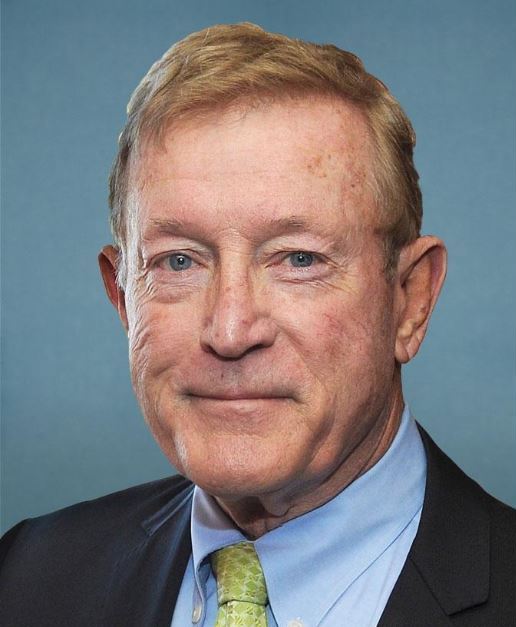
Rep. Paul Cook, R-Apple Valley,
represents the High Desert in
the House of Representatives.
OPINION

By Rep. Paul Cook
Desert Dispatch


As you might recall, former President Obama unilaterally designated two monuments in our area despite significant local opposition, doing so through misuse of the Antiquities Act. The creation of a Mojave Trails monument has been debated for some time, and a local consensus was reached on its boundary. Still, after colluding with special interest groups and performing a single fly-over in an airplane, Obama created a much larger monument and did so without a public meeting or public comment. He created another monument, Castle Mountains, out of thin air by that same abusive process.

You might also have heard attack ads against me and President Trump, implying that we seek to destroy these monuments. (They neglect to mention that I support fully a third monument, Sand to Snow.) If you’re skeptical of their message, you should be. It’s a complete lie on multiple levels. My position on Mojave Trails has never changed: The President should abide by the bipartisan boundaries established in my desert bill and Senator Feinstein’s desert bill. My position on Castle Mountains has never changed: no monument should be created without public input.

Anyone or any entity supporting Obama’s abuse of the Antiquities Act is supporting the dirty closed-door politics that Washington, D.C. has given us for too long. We shouldn’t accept the absurd notion that a single politician should determine the fate of your livelihood, community, and region without your input — that somehow he knows best. Furthermore, opposing Obama’s abuse of the Antiquities Act does not mean opposition to protecting public lands.

I support smart conservation, with monuments created through a thorough public vetting process. That’s why I introduced desert legislation in 2015 (HR 3668) and again in 2017 (HR 857), because we deserve a sensible approach to conservation that includes input from Congress and the public. While drafting these bills, I’ve worked with countless stakeholders — including the aforementioned environmental groups and other environmental groups with better integrity — to ensure that land protections meet the demands of local economies, recreationalists, and conservationists. This resulted in significant support locally.

The county of Inyo and cities of Apple Valley, Banning, Barstow, Big Bear Lake, Hesperia, Twentynine Palms, and Yucca Valley endorsed my proposal because it protected public access to Mojave Trails. I even mailed a survey to tens of thousands of households in my district to see if a monument or a less restrictive designation was preferred for Mojave Trails. A plurality of the 2,500 survey responses supported a less restrictive designation (47% to 44%).

Instead of protecting the 965,000 acres of Mojave Trails as addressed in Feinstein’s legislation and my own, Obama drew a staggering 1.6 million-acre boundary. To make matters worse, Obama created the Castle Mountains National Monument to stop a mining project that environmental extremists have long despised. In fact, the actual Castle Mountains — an interesting topographical feature — could have been protected without drawing the boundary so large as to prevent the mining operation. In both cases, Obama used the Antiquities Act to circumvent public scrutiny.

That’s why President Trump asked Department of the Interior Secretary Ryan Zinke to issue recommendations on modifying Mojave Trails and Castle Mountains national monuments. It’s ironic that these extreme environmental groups and their Congressional advocates claim there was a “backroom” deal between Trump and mining companies in determining the fate of these monuments — ironic because a backroom deal occurred between these environmental groups and Obama in creating the monuments. I believe a Freedom of Information Act request would prove my statement true, because some members of these same groups insinuated such collusion in speaking to my staff. Moreover, Zinke’s review allowed for public comment; Obama’s actions did not.

No one side should have free reign in the discussion of public land use, but we haven’t seen a balanced approach in decades. Had Obama and his special-interest supporters chosen good public process in determining these monuments, the Trump administration would not be reviewing their misdeeds. Obama threw 553.5 million acres of public land into national monuments, nearly twice as much as all previous presidents combined. We should never assume one person in government, given that much power, has acted properly in every case. No presidential action is above review.

August 23, 2017

5 California National Monuments Are Among 27 Up For Axing

Snow on the Providence Mountains can happen a few times every winter, Mojave National Preserve, Mojave Desert of San Bernardino County, California. (COURTESY OF THE NATIONAL PARK SERVICE)

KPBS
Associated Press


Five California national monument areas may be axed or downsized by the Trump Administration on Thursday. They are among 27 national monuments established or expanded by presidents since 1996 that Trump in an executive order asked Interior Secretary Ryan Zinke to review. Here's a quick look at the state's areas that could lose some or all of their protected status.

Mojave Trails National Monument

This huge swath of Mojave Desert north of Joshua Tree National Park is by far the largest of California's six national monuments up for elimination, and also the most recently designated. President Barack Obama gave the status to 1.6 million acres of desert land in February, 2016. it contains ancient lava flows, spectacular sand dunes, ancient Native American trading routes and World War II-era training camps. It also contains the largest remaining undeveloped stretch of historic Route 66.

San Gabriel Mountains National Monument

The 346,000-acre mountain area is some of the nation's most visited wilderness. More than 15 million people live within a 90-minute drive of the mountains northeast of Los Angeles. It was designated by Obama in person in October, 2014 and came in a wave of similar moves by the president, who would use national-monument status to protect millions of acres of public lands around the country in his last years in office. The move brought criticism from California Congressmen and others who said the president was overstepping his authority.

Giant Sequoia National Monument

President Bill Clinton created this national monument in 2000, setting aside 328,000 acres of land in Tulare County where the giant sequoia grows naturally. The move added to the areas already safeguarded in Sequoia, Kings Canyon and Yosemite national parks. The decision was praised by environmentalists but scorned by loggers. In announcing his decision, Clinton marveled at the resilience of a partially charred tree that had been struck by lightning decades ago. "Look how deep the burn goes," he said. "These giant sequoias clearly are the work of the ages. They grow taller than the Statue of Liberty, broader than a bus."

Berryessa Snow Mountain National Monument

This area 50 miles west of Sacramento was given national monument status by Obama just over two years ago. The monument, consisting of 330,000 acres of public lands, extends from Berryessa Peak and other areas in Napa, Yolo, and Solano counties through Lake, Colusa, and Glenn counties to the eastern boundary of the Yuki Wilderness in Mendocino County. It is home to threatened and endangered plant and wildlife species including northern spotted owls.

Carrizo Plain National Monument

Far less visited is this area in San Luis Obispo County, which is known for its remoteness and silence. The national monument created by Clinton in 2001 consists of 204,000 acres of grasslands between San Luis Obispo and Bakersfield. It includes Painted Rock, a horseshoe-shaped sandstone monolith with red ocher etchings of horned figures and geometric shapes drawn by American Indians.

Tommy Hough, president of San Diego County Democrats for Environmental Action, said that if this protected land is removed, other monuments could be targeted.

“The precedent that could be set here is terrible, and it doesn’t just potentially affect Cabrillo National Monument,” Hough said. “These are some of the most special places in the U.S., these have been identified in some cases decades ago, to be preserved as is.”

August 16, 2017

One California desert national monument is safe — but another is still in jeopardy

Sand to Snow National Monument includes the Devil's Playground area just west of Highway 62, which is populated by many species of cacti. (Photo: Jay Calderon/The Desert Sun)

Sammy Roth
The Desert Sun


The Trump administration won't shrink or eliminate Sand to Snow National Monument near Palm Springs, Interior Secretary Ryan Zinke said Wednesday — but elsewhere in the California desert, Mojave Trails National Monument may still be on the chopping block.

Zinke has been reviewing 22 national monuments created or expanded by presidents Barack Obama and Bill Clinton, with plans to submit final recommendations to President Donald Trump by next week. Sand to Snow is the sixth monument for which Zinke has said he'll recommend no changes, following Canyons of the Ancients in Colorado, Craters of the Moon in Idaho, Grand Canyon-Parashant in Arizona, Hanford Reach in Washington and Upper Missouri River Banks in Zinke's home state of Montana.

"The land of Sand to Snow National Monument is some of the most diverse terrain in the West, and the monument is home to incredible geographic, biologic and archaeological history of our nation," Zinke said in a statement.

President Obama created Sand to Snow National Monument using his authority under the Antiquities Act in early 2016, protecting 154,000 acres that stretch from the desert floor near Palm Springs to the peak of Mount San Gorgonio. The monument helps link San Bernardino National Forest, the San Jacinto Mountains and Joshua Tree National Park, connecting a diverse array of ecosystems and protecting a wildlife corridor traversed by mountain lions, bighorn sheep and desert tortoises, among other species.

Obama designated two other monuments in the California desert at the same time as Sand to Snow: the 1.6-million-acre Mojave Trails monument, which surrounds historic Route 66 between Mojave National Preserve and Joshua Tree National Park, and Castle Mountains National Monument, which fills in a 21,000-acre gap in the preserve.

Obama established the three monuments to protect those places from mining, solar and wind farms and others forms of development, after legislative efforts in Congress failed.

Monument bills introduced by Sen. Dianne Feinstein, a Democrat, never reached a vote. Neither did legislation written by GOP Rep. Paul Cook, which would have created the Sand to Snow monument and offered a lesser level of protection to Mojave Trails.

Both monuments were swept up by Trump's April 2017 executive order, which called for Zinke to make recommendations to Trump on 22 land-based monuments by August 24. But Sand to Snow has been relatively non-controversial, even among opponents of Obama's designation. In a letter to Zinke last month, 17 House Republicans — including Cook, who represents the High Desert — recommended no changes to Sand to Snow.

High Desert residents cheered Zinke's decision not to alter the national monument.

Real estate agent Karen Lowe, who serves as secretary of the Morongo Valley Chamber of Commerce, said local businesses and residents spent nearly a decade lobbying for Sand to Snow, which encircles Morongo Valley. Local leaders expect the monument to boost tourism as the National Park Service adds infrastructure and promotes the site.

"When we finally got the monument, we were so excited. And now to find out that it's going to remain unchanged — it's just great news for Morongo Valley," Lowe said.

April Sall lives in the tiny High Desert community of Pioneertown and is a member of the board of directors of the Wildlands Conservancy, a conservation group. She called Zinke's decision not to reduce Sand to Snow National Monument a "good start," but said Sand to Snow and Mojave Trails didn't need to be reviewed in the first place.

"Both the desert monuments were very strongly vetted, and we had a real groundswell of support. And it was a grassroots campaign that really started with the community members wanting to protect that landscape from industrial energy development," Sall said. "People were stoked that their voice mattered and they got to protect this place, so the fact that it went under review, with no justified reason...was a bit of a dark shadow."

Mojave Trails National Monument may have a different fate.

The 17 House Republicans who wrote to Zinke, including Cook and two other Californians, urged him to shrink Mojave Trails. In their letter, they said Obama's Mojave Trails designation could prevent future expansion of some mining operations, although they acknowledged it doesn't affect existing mining rights within the monument.

Mojave Trails supporters are worried changes to the monument's boundaries could clear the way for Cadiz Inc.'s controversial plan to pump groundwater from a Mojave Desert aquifer and sell it to Southern California cities. Cadiz's land is surrounded by the monument. Conservation groups say the project would remove more groundwater from the underground aquifer than nature puts back in, harming plants and animals in the monument and in nearby Mojave National Preserve — a claim the company disputes.

It's not clear Trump has the legal authority to eliminate monuments established by previous presidents, but several presidents have reduced the size of monuments. In their letter to Zinke, the 17 congressional Republicans called for Trump to eliminate nine monuments and shrink 14 others, arguing that previous presidents have overstepped their authority by using the 1906 Antiquities Act to protect huge swaths of federal land.

"No one person should be able to unilaterally lock up millions of acres of public land from multiple-use with the stroke of a pen. Local stakeholders deserve to have a voice on public land-use decisions that impact their livelihoods," they wrote to Zinke.

Critics, though, say Trump's monument review is designed to benefit oil and gas, mining, timber and other industries that hope to extract more resources from public lands. If Trump tries to revoke any monument protections, conservation groups are likely to sue.

Responding to Zinke's announcement Wednesday that he won't recommend changes to Sand to Snow, Aaron Weiss — a spokesperson for the Center for Western Priorities, a Denver-based conservation advocacy group — said Zinke's latest decision "makes it clear he is not using any legitimate criteria to evaluate our national monuments."

"This charade has gone on long enough," Weiss said in a statement. "The secretary himself admits Sand to Snow is 'home to [the] incredible geographic, biologic, and archaeological history of our nation,' which is true of every single monument he's threatening. Ryan Zinke needs to stop playing reality show games with our public lands."

July 14, 2017

Rescind new monuments


Letters to the Editor

By Jim Bagley, Twentynine Palms
Hi-Desert Star


If I had told you 40 years ago that Joshua Tree National Monument would start charging fees to let you in, it would cost you $25 just to visit, and if you had an annual pass the Park Service would demand you show a valid photo ID to use it like some totalitarian country demanding “papers” from you to enter, you would’ve said that’s an outrageous concept. But in 2017 that is exactly the reality of where we are.

Most of the monument has been converted into wilderness, numerous roads open during my lifetime have all been closed, every road now has a lockable gate and any new lands that have added to the now “park” don’t include any new campgrounds or facilities, it just added more closed areas made inaccessible to historic, sensible public access.

Now we have the Mojave Trails National Monument and all the other political monuments across America that President Obama rushed to create before his administration was out of office. How is implementing a one-sided mandate without open participation and bipartisan consensus reflecting the fairness of the American character Mr. Obama so copiously lectured us about? The zealous environmentalist who called upon Obama to use his power to cut to the public out of any longterm management policies cheered him on and boisterously celebrated having their own way.

President Trump is now taking the initiative to include everybody in the discussion about our public lands by asking for a review and direct public input on all recent large-scale Antiquities Act orders. What a revolutionary concept, actually asking for public input instead dictating one party vision with executive action.

The same people who fought to cut the public out of the discussion and off the public lands are crying foul and organizing protests against the review. Wow, how shocking the elitists are self-righteously offended that other people (undoubtedly the deplorables) with another point of view should be heard.

The Secretary of the Interior should recommend these politically created monuments be rescinded in the interest of the highest and best use of our American public lands. We should have an inclusive honest, open discussion about the best long-range management for the Mojave Desert. Let’s include a re-examination of the political wilderness areas that were closed under the fervent parochial effort in 1994 of the California Desert Protection Act. If recreation as an economic goal is a part of the monument strategy, we should restore reasonable access to closed historic roads and campsites for tourism and let the locals enjoy these special places again.

Let’s start with absolute transparency. The folks who created the maps for the Obama monuments excluding the public should clearly identify themselves. Take ownership of your agenda and disclose to the public exactly who had influence in Obama administration. I want to have a say in what happens too! Obama did not ask for public participation.

If making “monuments for everyone” is truly the goal, then everyone should be included cooperatively in the formation of public lands policy. President Obama’s misuse of the Antiquities Act to exclude the public from an open, transparent process to make decisions on the American landscape is offensive. If there is legitimate widespread support for the monuments, why not the let the public democratic process work and send any new land use designations to Congress and get bipartisan consensus?

I have been locked out of too many wonderful places once open to everyone by intolerant, discriminatory, partisan land use policies. In the future I do not want to be forced to pay a government fee to visit Amboy, just because it is in one of Obama’s monuments.

July 12, 2017

Rep. Cook signs support of national monument reduction


By Charity Lindsey
Victorville Daily Press


Republican Congressman Paul Cook recently signed a letter to the Department of the Interior recommending the reduction of some national monuments, despite nonprofit efforts to preserve their boundaries and designations.

In a June 30 letter to DOI Secretary Zinke signed by Cook and 16 other members of congress from western states, lawmakers claim that the “misuse of this outdated 1906 Act has jeopardized the daily activities, livelihoods and traditions of local communities,” including energy development, wildfire prevention efforts and recreational activities like hunting and fishing.

The letter provides an analysis of the 27 monuments currently under the DOI’s review, recommending a reduction of the Mojave Trails National Monument and the San Gabriel Mountains National Monument, much to the discontent of the Mojave Desert Land Trust (MDLT), whose representatives claim Cook “has not communicated with his constituents” about the Executive Order.

“It is outrageous that Rep. Cook would go behind the backs of his constituents to argue that one of our Mojave Monuments be diminished,” MDLT Executive Director Danielle Segura said. “The Mojave Desert Land Trust has invested in this landscape for over a decade, and worked alongside many diverse local groups, to create this monument. Rep. Cook couldn’t even wait until the public had commented before trying to strip protections on land important to the local community.”

But in a statement to the Daily Press Tuesday, Cook said that as a government official, “I don’t submit public comments, as this is the domain of the public.”

″Once the letter was submitted, it was published on the Western Caucus website and made available for anyone to view,” Cook said. “To assert that this was done in secret is laughable at best. In fact, my staff sent a link to this letter directly to the staff of the Mojave Desert Land Trust the same day it was sent to Secretary Zinke.”

MDLT has collected more than 1,250 comments focused specifically on the importance of the monuments in the Mojave. The Desert Defenders campaign comment period began May 10, two weeks after the executive order, which impacts four sites affecting San Bernardino County: The San Gabriel Mountains, Mojave Trails, Castle Mountains and Sand to Snow national monuments.

Mojave Trails is located between interstates 15 and 40 and partially surrounds the Mojave National Preserve. While San Gabriel was designated in October 2014, the others were all established in February of last year.

Cook noted that the letter recognized the local support for the Sand to Snow National Monument, which the congress members requested no changes to.

“On the other hand, the former President nearly doubled the total size of the Mojave Trails National Monument from any of the previous proposals,” Cook said. “This was accomplished without any public comment. This letter simply recognizes the illegitimacy of this action and asks that President Trump follow the publicly debated boundaries while rolling back the former President’s overreach.”

The San Bernardino County Board of Supervisors also sent a letter to the Department of the Interior on May 31, stating its position “that any national monument designations should go through the legislative process, rather than by Presidential Proclamation under The Antiquities Act.”

July 6, 2017

Bill would curb massive Cadiz desert water project

Cadiz Inc. plans to pump the Mojave Desert aquifer and transport that water to Southern California communities. (Jay Calderon/The Desert Sun)

By DAVID DANELSKI
The Press-Enterprise


The battle over plans by a Los Angeles company to sell water pumped from aquifers underneath Mojave Desert conservation areas heated up again this week when state legislation was amended to require a new round of state reviews.

The legislation’s new language, by Assemblywoman Laura Friedman, D-Glendale, would stop major pumping until state land and wildlife officials determined that groundwater extractions would not harm wildlife or cultural resources.

The legislation is in response to the Cadiz desert water project that has been prioritized by the Trump administration.

Cadiz officials called the legislation a flawed attempt to further delay the project.

Cadiz wants to pump groundwater from wells on land its owns in the Cadiz Valley that is surrounded by the Mojave Trails National Monument. These wells would draw water from connected aquifers below the Cadiz, Bristol and Fenner valleys that supply springs within the monuments as well as the Mojave National Preserve.

The water would be piped more than 40 miles across federal lands along a railroad right of way to the Colorado River Aqueduct. It would then be ferried to water customers in suburban Southern California.

The project has been staunchly opposed by environmental groups and other desert advocates, including Sen. Dianne Feinstein, D-Calif., who sponsored the California Desert Protection Act of 1994 that created the Mojave National Preserve and protected 69 wilderness areas between the Mexican border and the town of Bishop.

If it passes the Legislature and is signed by Gov. Jerry Brown, the new state law also would be called the California Desert Protection Act.

Contacted by cell phone, Friedman, a first-year legislator, said her aim is to conserve the water below the desert conservation areas that wildlife depends upon.

“This is the water that supports the desert’s ecosystem, and it is vitally important,” she said.

The law would prohibit taking groundwater from a large swath of the Mojave unless the State Lands Commission, working with the state Department of Fish and Wildlife, finds that pumping “will not adversely affect the natural or cultural resources of those federal and state lands,” the bill says.

Friedman said the Cadiz project could go forward under the law if the new state reviews find it does no harm.

The Cadiz company issued a statement Thursday, July 6, that contends the legislation is designed “to further delay the Cadiz Water Project” by using a “gut and amend” legislative process, which is “universally condemned.” (The original bill, AB 1000, pertained to water meter standards.)

The company’s statement said the project was previously reviewed under state environmental disclosure laws and “found to have no adverse impacts on the environment.” Those reviews were done about 17 years ago.

The Cadiz project would “create a safe, sustainable water supply for 400,000 people,” as well as about “$1 billion economic activity and close to 6,000 jobs,” the company statement added.

The Santa Margarita Water District in southern Orange County plans to buy between 5,000 to 10,000 acre-feet a year, said district spokesman Jim Leach. In all, the project would pump as much as 50,000 acre-feet a year, depending on how the water tables are affected by the extraction, he said.

“We are really disappointed,” Leach said. “We see this legislation as a roadblock to delay the project.”

But Feinstein and other critics maintain the Cadiz project is unsustainable.

In May, the senator released a letter from the U.S. Geological Survey that said a 2000 analysis by the agency found that the Cadiz, Bristol and Fenner basins naturally recharged water at rates of 2,000 to 10,000 acre-feet a year — just a fraction the rate water would be pumped out of these basins.

The Trump administration has made moves favorable to the project. In April, it rescinded a 2014 policy directive that was used to find in 2015 that Cadiz needed to obtain a federal right of way permit and thus had to complete comprehensive environmental studies before it could build a water pipeline in the railroad right of way.

The Trump transition team also put Cadiz on a list of priority projects.

“If the federal government is not going to do these environmental reviews, the state has a responsibility to do them,” Friedman said.

April 14, 2017

Marines move imperiled desert tortoises out of harm’s way

Biologists work with the USMC, BLM, the California and US Fish & Wildlife Services to relocate about 1,100 to 1,500 Desert Tortoises from the Bessemer Mine area of Johnson Valley in Twentynine Palms Marine Corps Air Ground Combat Center Wednesday. PHOTO BY ERIC REED

By David Danelski
The Press-Enterprise


Wildlife biologist Scott Welch looked out over the Mojave Desert and readied for action when he heard a distant helicopter flying in.

Just seconds after the aircraft landed, he and two others began loading it with plastic storage bins containing desert tortoises captured at an expansion area of the U.S. Marines Corps training base at Twentynine Palms.

They carefully packed 26 of the imperiled reptiles — one or two per bin — onto cargo carriers on the helicopter that looked like oversized saddlebags.

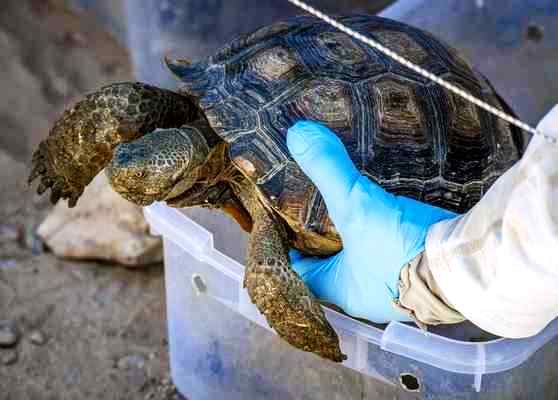
And within minutes, the tortoises were flying toward a safer haven of the recently created Mojave Trails National Monument — about 25 miles away from the crushing treads of tanks, the boots of soldiers and the blasts of bombs.

Operation Desert Tortoise was in its fifth day. As of Wednesday morning, 266 of the animals had been moved out of the Johnson Valley, about 30 miles northwest of Yucca Valley.

Before the end of the month, the Marines, working with about 125 wildlife biologists expect to have moved 1,156 tortoises, with a focus on clearing transportation corridors and other areas expected to be most disturbed by live-ammunition training missions.

It’s part of a multi-year, $50 million-plus tortoise relocation and study program at the base that was OK’d by the U.S. Fish and Wildlife Service following a 2013 vote by Congress to add about 88,000 acres in Johnson Valley to the combat center.

For the Marines, the expansion will allow them to hold longer and more-involved live-ammunition desert training missions to prepare Marines to intervene in global hot spots, such as the Middle East, should it be necessary. Such training is expected to start this summer.

For the tortoise, a species listed as threatened with extinction, it means the loss of more than a hundred square miles of quality habitat, as evidenced this year by robust blooms of yellow desert dandelions and other annual plants that are their primary food source.

The resources of the U.S. Defense Department were put to work to minimize harm to the tortoises, said Brian Henen, an ecologist for the Marine Corps Air Ground Combat Center at Twentynine Palms.

Analysis and field work for the move began more than two years ago. Scores of specially trained biologists have methodically walked the valley and fitted each tortoise they found with radio transmitters, so the animals could be gathered for this month’s move. It’s the largest tortoise move yet in the Mojave Desert.

The five areas of public land around the base that are receiving the animals were carefully chosen for their quality habitat and their distances from human habitation, Henen said.

Tortoises that lived near each other are being released in similar proximity in the recipient areas to preserve their social structure.

“We are moving them in groups. We are trying to sustain the similarity and the structure of their origin,” said Henen, standing by a makeshift medical checkup station for the tortoises.

There, Peter Praschag, a world-renowned tortoise and turtle expert from Austria, was working with veterinarian Shannon DiRuzzo to screen tortoises for signs of disease and other health issues.

A large male dubbed MC-2013 appeared frightened by the checkup and voided the water stored in his bladder, called a coelomic cavity. This was a serious matter, because a tortoise may get only one or two chances a year to get a good drink of water.

So Praschag used a syringe to carefully refill the animal’s coelomic cavity with a saline solution of water.

The work of the biologists won’t be finished until long after the last load of tortoises are flown out this month. Henen explained that the biologists will return frequently during the next four years to search for any reptiles that may have been left behind. They expect to move another 300 tortoises during that time.

The plans also include tracking and studying the relocated tortoises, as well as those already in the recipient area, for as long as 30 years. For this research, three groups of 225 tortoises — relocated ones, those already there and an unaffected control group — will be fitted with transmitters to track their movements and survival rates.

Biologists hope that the knowledge gained from this research will help the species recover.

But the loss of more than 100 square miles of prime habitat is still harmful to the tortoises, which has faced declines since the 1970s, prompting its 1990 listing under the Endangered Species Act, said Ileene Anderson, a biologist with the Tucson-based Center for Biological Diversity.

“It is going to be a big hit on the species,” she said.

She said it is not known if the public property outside the base will have enough food and other resources for both residents and newcomers to survive, and that wildlife biologists don’t know for sure why tortoises numbers have dropped in those areas.

She’s also worried that the tortoises may try to find their way back to their birthplaces in the base expansion areas.

But the U.S. Fish and Wildlife Service (FWS) determined in January that moving the tortoises from the Johnson Valley won’t jeopardize the survival of the species.

Scott Hoffman, who was observing the relocation effort for the FWS, said the species may benefit in the long run.

“Yes, we are losing habitat. But are we are using the relocated tortoises to supplement the populations in the critical habitat areas,” said Hoffman, referring to some of the recipient areas.

April 4, 2017

Feinstein fumes as Trump team waives environmental review for Mojave water project

Scott Slater, CEO of the Cadiz water project, stands near a basin at the project site near Needles, California, Slater and Cadiz have recently gotten a big boost by a Trump administration decision that relieves the project of a federal environmental review requirement. (Noaki Schwartz AP)

BY STUART LEAVENWORTH
Sacramento Bee


WASHINGTON -- The Trump administration has handed a big boost to a private water venture in Southern California, angering California’s senior senator, Democrat Dianne Feinstein, who said the decision could “destroy pristine public land” in the Mojave Desert.

In a little-noticed memorandum issued last month, the Department of Interior’s Bureau of Land Management effectively relieved the Cadiz water project of the requirement to undergo a federal environmental review, which the company had sought to avoid. The decision greatly boosts the prospects for Cadiz, which wants to tap water from under the Mojave and sell it to thirsty water districts in Southern California.

“The detrimental impact this project would have on the California desert is irreversible,” Feinstein said in a statement. “Rather than allow a proper environmental review, the Trump administration wants to open the door for a private company to exploit a natural desert aquifer and destroy pristine public land purely for profit.”

Cadiz responded that its project has undergone multiple environmental reviews, including a California Environmental Quality Act review that survived court challenges.

Feinstein’s “opposition has done a disservice to thousands of Californians who will benefit from this public-private partnership – a project which will deliver new, reliable water without any adverse environmental impacts,” Cadiz CEO Scott Slater said in a statement.

As noted in a Feb. 8 story by McClatchy, Cadiz has seen its fortunes rise since Trump was elected. Its stock price has more than doubled since Trump’s victory, apparently because investors believe the venture will fare better now than it did when Barack Obama was in office. Slater, the company’s CEO, is a water lawyer affiliated with the Denver-based firm Brownstein, Hyatt, Farber, Schreck, an influential lobbying force in Washington.

One remaining hurdle for Cadiz is building a 43-mile pipeline necessary for shipping its water to potential customers. Prior to 2015, Cadiz assumed it could use an existing railroad right-of-way for the pipeline and do so without a costly and time-consuming federal review. Yet two years ago, the California office of the U.S. Bureau of Land Management reversed a 2009 determination and required Cadiz to seek a permit to build the pipeline.

Over the last two years, Cadiz has been lobbying Congress to overturn the BLM decision and pass legislation that would relieve it and other companies of permitting requirements on railroad right of ways. On March 1, two California lawmakers – Democrat Tony Cardenas and Republican Tom McClintock – joined 16 other congressional representatives in a letter to Interior Secretary Ryan Zinke, asking him to rescind the BLM decision and relieve the project of a federal review.

In a March 29 memorandum, Zinke’s Interior Department did just that, rescinding the 2015 decision signed by Timothy Spisak, acting assistant director for BLM’s Division of Energy, Minerals, and Realty Management.

Feinstein is the author of the 1994 California Desert Protection Act, which established the Death Valley and Joshua Tree national parks and the Mojave National Preserve. She has long opposed Cadiz, which has struggled for 15 years to get traction on different versions of its water project.

Feinstein points to analyses by the National Park Service and U.S. Geological Survey to argue that Cadiz would withdraw more water – 50,000 acre feet each year – than nature could provide to recharge the desert aquifer.

“The Trump administration has once again put corporate profits ahead of the public’s interest,” Feinstein said in her statement. “In a blatant attempt to muscle the Cadiz water project through, the administration is completely undermining federal oversight of railroad rights-of-way.”

Cadiz rejects those claims, asserting that more recent analyzes have found that the company’s proposed groundwater withdrawals pose no threat to the desert’s flora and faunta.

“Senator Feinstein regrettably relies on outdated, 17-year old data inconsistent with presently known facts as foundation to oppose a project which will safely and sustainably create new water for 400,000 people, has broad bipartisan community support, will generate 5,900 new jobs, and will drive nearly $1 billion in economic growth,” Slater said late Tuesday.

Feinstein, who sits on the Senate Appropriations Committee, has used her position before to block Cadiz and other developments she has deemed detrimental to the Mojave Desert. Whether she can again is not clear, but she pledged Tuesday to “fight this latest effort to push the Cadiz water project through.”

Trump administration boosts huge Mojave Desert water-pumping project

Environmentalists say the Cadiz project would rob the desert of the water that plants and wildlife need to survive.

A pumping station designed to help Cadiz project researchers understand how quickly water seeps into the earth is shown in this June 2015 file photo. (JOSHUA SUDOCK, STAFF FILE PHOTO)

By DAVID DANELSKI
Riverside Press-Enterprise


The Trump administration has removed a major roadblock to plans by a Santa Monica company to pump ancient groundwater from below the Mojave Desert and sell it to urban areas of Southern California.

The federal Bureau of Land Management has rescinded a 2015 administrative finding that Cadiz, Inc. needed to obtain a federal right of way permit and thus had to complete comprehensive environmental studies before it could build a water pipeline within 43 miles of railroad right of way owned by the Arizona & California Railroad.

The move follows a January decision by the Trump transition team to put Cadiz on a list of priority infrastructure projects, and a state appellate court’s rejection last year of a lawsuit filed by environmental groups challenging the project.

The $225 million Cadiz Valley Water Conservation, Recovery and Storage Project still needs approval from the powerful Metropolitan Water District to use the Colorado River Aqueduct to ferry the water to urban Southern California.

Cadiz company officials said in statement that they are pleased with the Trump administration’s decision. The statement said they have always believed “the BLM’s 2015 evaluation was contrary to law and policy.”

In 2008, Cadiz entered into a lease agreement with the railroad company to build a pipeline in between the wells it owns in the Mojave Desert area, west of Needles and south of Interstate 40, to the Colorado River, using the railroad’s right of way over federal land.

From the river area, the water could be ferried to urban Southern California using the aqueduct and reservoir system operated by the Metropolitan Water District.

“Our discussions are continuing about what would be required before they can put water in the Colorado River Aqueduct,” said water district spokesman Bob Muir.

In 2002, the water district’s board voted down an earlier version of the Cadiz project that also needed to use the aqueduct.
The project is staunchly opposed by environmental and desert advocates, who say it would rob the desert of the water that plants and wildlife need to survive.

“Many of the springs and seeps are going to dry up because of groundwater extraction,” said Ileene Anderson, a biologist with the Center for Biological Diversity.

She is particularly concerned that the pumping would harm the Mojave National Preserve and recently created Mojave Trails National Preserve [sic].

Sen. Dianne Feinstein, D-Calif., said in a statement that the new administration was muscling through the project without proper reviews. Feinstein is an ardent desert supporter who authored the California Desert Protection Act that created the preserve and other protections more than 20 years ago.

“The Trump administration wants to open the door for a private company to exploit a natural desert aquifer and destroy pristine public land purely for profit,” her statement said.

“The administration is completely undermining federal oversight of railroad rights-of-way. “

February 8, 2017

California water venture tied to Trump sees prospects rise after years of setbacks


BY STUART LEAVENWORTH
Sacramento Bee


WASHINGTON -- Until Donald Trump won the presidency, prospects looked bleak for Cadiz, a California company that has struggled for years to secure federal permits to transform Mojave Desert groundwater into liquid gold.

With the change of administration, a new day is dawning. In December, the National Governors Association circulated a preliminary list of infrastructure projects provided by the Trump transition team, and Cadiz’s was on the list. The company’s stock price rose on that news, part of a trend that has seen Cadiz’s valuation more than double – to roughly $14 a share – since the election.

Cadiz has worked hard to raise its profile among consultants compiling lists of possible infrastructure projects, says Scott Slater, CEO for the company.

But what has really helped Cadiz is its deep connections to Washington. Slater is part of a Denver law firm – Brownstein, Hyatt, Farber, Schreck – whose attorneys have long lobbied the Interior Department, with some serving inside of it. One of those is Brownstein’s David Bernhardt, who served as Interior’s solicitor during George W. Bush’s presidency, helped Trump during the transition and is a candidate to return to Interior in a top job. He’s also been a lobbyist for the powerful Westlands Water District in California’s Central Valley.

In an interview, Slater said Cadiz still faced hurdles but the project’s future looked brighter than it did a few months ago. “The dynamics have changed,” said Slater, noting that Republicans now control the White House in addition to both houses of Congress.

Slater and his law firm have a lot riding on Cadiz’s success. According to an SEC filing last year, the Brownstein firm stands to earn 200,000 shares of Cadiz stock if the company meets milestones for completing the project and selling water. Brownstein has already earned 200,000 shares for its involvement with the company — a stock portfolio that is sure to appreciate in value if Cadiz can overcome permitting obstacles.

Numerous businesses are hoping to cash in on Trump’s interest in infrastructure. Two weeks ago, McClatchy was the first to report on a list of infrastructure projects that, according to the National Governors Association, the Trump transition team had given the group. Cadiz’s was one of two private California water projects on the list; the other was a desalination project south of Los Angeles.

While Trump is a supporter of traditional public works – touting the need for “new roads, highways, bridges, airports, tunnels and railways” during his inaugural address – fiscal hawks and some GOP leaders are leery of new federal funding for infrastructure. That political calculus has created openings for private infrastructure projects seeking regulatory relief, especially if they have connections. Cadiz’s project falls into both of those categories.

The brainchild of a British financier, Keith Brackpool, Cadiz is a publicly traded company with a stock price that has gyrated for a decade and a half. The company owns 45,000 acres in the Mojave Desert, where it hopes to extract water from an aquifer to sell to thirsty water districts in Southern California.

Fifteen years ago, the company’s stock price approached $200 a share, in part because Brackpool was close to then-Gov. Gray Davis of California, and investors apparently assumed that Cadiz had the political juice to make its project a reality. Yet Cadiz ran into opposition from the Metropolitan Water District of Southern California, which started questioning the company’s financial resources, and also from environmentalists, who feared the project could further dry up the Mojave, a national preserve. By 2011, Cadiz’s stock price had dropped below $10.

That’s when Slater came aboard. An expert in California water law, he became president of Cadiz in 2011 and rose to become CEO two years later. Through Slater’s Brownstein firm and other firms, Cadiz also stepped up its advocacy efforts on Capitol Hill, spending $3.4 million in lobbying from 2011 to 2016, according to a tabulation by the Center for Responsive Politics.

Slater has helped the company win several legal victories. In 2016, California’s 4th District Court of Appeal upheld six lower-court decisions in favor of Cadiz, putting to rest further state court litigation against the company’s environmental impact report.

Yet the company remains blocked by an unexpected 2015 Interior Department decision. That year, the California office of the U.S. Bureau of Land Management, an Interior agency, reversed a 2009 determination that the Cadiz project needed no federal permits. Cadiz had long believed that it could use an existing railroad right of way to build a 43-mile pipeline to transfer its water to potential buyers, and do so without a federal permit.

The BLM ruling opened up the possibility of an uncertain multi-year federal review, frightening potential investors and sending the company’s stock price down to the $4 range.

Slater said in an interview that Cadiz was urging the new administration to rescind the BLM decision, “accelerating our path by removing some of the underbrush.” Cadiz also wants Congress to pass legislation to make clear its intent on how the BLM should handle decisions involving railroad rights of way. The issue is of concern to legislators outside of California, said Slater, because the 2015 BLM decision potentially could affect use of all railroad rights of way in the West.

Matt Lee-Ashley, a former Interior Department official, said that what Cadiz was doing was typical during a White House transition. “Anytime an administration turns over, anyone who had a project with an unfavorable ruling will try to make another run at it,” said Lee-Ashley, who worked in Interior during the Obama administration and now is public lands director at the Center for American Progress, a liberal advocacy group.

Yet even though Cadiz has new friends in a Trump administration, it may not be enough to counter the company’s most formidable foe: U.S. Sen. Dianne Feinstein, the California Democrat who wrote the Desert Protection Act of 1994 and has long been the Mojave’s guardian. She has the ear of ranchers and conservationists who fear that Cadiz’s pumping project could damage the desert’s range lands and ecosystems.

Cadiz disputes those claims, arguing that it will be withdrawing only water – enough to supply 100,000 homes yearly – that would otherwise evaporate from lake beds in the desert. So far, however, Cadiz has been unable to win over California’s senior senator, who succeeded this year in persuading President Barack Obama to create three new national monuments in the Mojave, totaling more than 1.3 million acres.

Things could also get complicated if David Bernhardt, Slater’s colleague at the Brownstein firm, takes a top job at Interior. Brownstein’s 250 lawyers represent scores of clients, and the firm runs a political action committee that has given more than $513,000 to federal candidates and members of Congress since 2014.

According to a recent report in Energy and Environmental News, Bernhardt is a front-runner to serve as deputy to Ryan Zinke, a Montana congressman who is Trump’s interior secretary nominee.

Late last year, Bernhardt withdrew his registration as a lobbyist. If he moved back to Interior, Bernhardt would have to recuse himself from Interior issues involving his former clients, including Westlands.

But it’s less clear whether he’d have to recuse himself from matters involving other Brownstein clients, of which there are many. Attempts by McClatchy to obtain White House clarification were unsuccessful.

Also unclear is how Cadiz’s project ended up on a list of “emergency and national security priority projects” distributed to the National Governors Association and reported by McClatchy. Slater suspects that Cadiz rose on someone’s radar after he made several presentations at infrastructure conferences last year, including one hosted by CG/LA Infrastructure Inc., a national consulting firm. CG/LA is headed by Norman F. Anderson, an infrastructure expert who has ties to Dan Slane, a real estate developer from Ohio who has been helping the Trump administration with transition work.

Anderson couldn’t be reached for comment, but in a telephone interview on Tuesday, Slane said he had met with Cadiz’s CEO and thought it had a worthy project.

“That’s one where they just need some help from us on the permitting side,” said Slane, adding that he thought the Trump administration “could help with expediting permitting.”

August 16, 2016

The Pipeline and the Short Seller

Emails show a federal regulator shared non-public information with an investor.

Water gushes into a pilot spreading basin on Cadiz Inc. property in California's Mojave Desert in 2002. (PHOTO: ZUMA PRESS)

OPINION
Wall Street Journal

Trust in Washington has hit a historic low, and one reason is the sense that government regulators favor some people over others. Consider an email trail that reveals how a federal employee shared inside information about regulatory approval with a short seller.

The emails concern a water pipeline in California that is stuck in regulatory limbo. The story begins in 1998, when the Los Angeles-based land management company Cadiz Inc. began plans to develop a groundwater bank on private land overlying a watershed in the Mojave Desert. Cadiz proposed building an underground pipeline along the Arizona & California Railroad’s right-of-way to transport 50,000 acre-feet of water annually to Southern California.

The Department of Interior’s longstanding policy allowed railroads to run power, telephone and fiber optics lines along their rights-of-way without a federal permit, thus expediting environmental review. However, in November 2011, after Cadiz had modified its plan to reduce environmental opposition, Interior at the insistence of California Sen. Dianne Feinstein revised its policy to limit the use of railroad rights-of-way granted in 1875 to “activities that derive from or further a railroad purpose.”

The Cadiz pipeline was the only project subject to the new rules. Cadiz spent several years and $12 million reconfiguring the pipeline to “further a railroad purpose,” proposing the likes of hydro-turbines, power safety systems and automated fire suppression. None of Cadiz’s compromises satisfied regulators.

On Oct. 2, 2015, the Bureau of Land Management (BLM) informed congressional staff—who tipped off Cadiz—of an imminent adverse ruling. A letter circulated by the bureau noted that the pipeline “does not derive from or further a railroad purpose” because the fire suppression system was “an uncommon industry practice,” among other complaints. The kicker was that the ruling could not be appealed because it “is not a final agency decision.” Thus the pipeline would have to undergo a formal environmental review. Ms. Feinstein has attached riders to every Interior appropriations bill since 2008 barring a review.

Within a week of the BLM ruling, Cadiz’s stock plummeted 65%. Yet one Cadiz investor had inside information that could have allowed him to make a killing. Emails obtained through a Freedom of Information Act request by Cadiz reveal that BLM realty specialist Erik Pignata (who oversaw the Cadiz review from the Sacramento bureau) shared non-public information with Cadiz investor Thomas McGannon of Whetstone Capital Advisors. Cadiz provided the emails to us.

***

Whetstone, based in Mission Woods, Kansas, describes itself as “a value oriented long/short investment fund.” Mr. McGannon told the Kansas City Business Journal in May 2014 that “when we put a short into the Whetstone portfolio, it’s because we’ve done research on a specific company and think that for one reason or another the value of that company is declining and the stock price is likely to decline over time as well.” That strategy would certainly fit with Mr. McGannon’s research into Cadiz with the help of the BLM’s Mr. Pignata.

Mr. McGannon declined to say if or how he traded Cadiz shares and sent us this statement: “Our research over a five year period led us to believe that there was an investment opportunity presented by Cadiz’s stated business plan, which appeared contrary to information that was publicly available. We did not seek nor obtain any material non-public information regarding the Cadiz Water Project.”

Yet the emails suggest that Mr. McGannon sure was interested in regulatory decisions about Cadiz. The Pignata-McGannon email trail that we’ve seen begins with Mr. McGannon following up on a FOIA request in September 2014 soliciting information about the bureau’s review. Mr. Pignata referred documents related to the request to the bureau’s FOIA officer. This should have closed their communication since government employees aren’t supposed to disclose non-public information to third parties outside of the FOIA process that could benefit private interests.

***

Mr. McGannon continued to probe Mr. Pignata about the project’s regulatory prospects. “Does the green line go through BLM lands?” Mr. McGannon asked in a Sept. 9, 2014 email, referring to a map of the Cadiz project. “I was mostly just curious if an alternate route along the green line would require BLM approval.” Mr. Pignata responded later that day that the alternative route “almost certainly” does.

On Feb. 19, 2015, Mr. McGannon inquired if there has been “any movement on the project discussions since we last spoke?” Mr. Pignata replied: “No, we are formulating our evaluation with DOI legal staff.” The emails suggest the two chatted repeatedly over the phone.

On June 4 Mr. McGannon emailed “great to catch up” along with a link to a blog post “Strong Sell On Project Failure, Insider Enrichment, And Bankruptcy, Price Target $0” that eviscerated Cadiz. On September 23 Mr. McGannon asked if there was “any news likely this week?” Mr. Pignata replied: “I have a briefing w/ the almost-highest people in my agency tomorrow . . . No pressure or anything.” Mr. McGannon cheered him on: “You got it man!”

A week later, Mr. McGannon inquired into when an adverse ruling would be finalized: “Wont [sic] it be great when I don’t bother you anymore.” Mr. Pignata replied: “I have a feeling Cadiz, Inc. isn’t going anywhere . . . so you’ll get to keep bugging me.” Several of Mr. Pignata’s emails suggest an animus toward the Cadiz project.

On October 1, Mr. Pignata assured his hedge-fund pen pal that the BLM determination would “for sure” be “signed tomorrow.” Mr. McGannon rejoiced: “Maybe one of these days ill [sic] get to buy you a beer or something as a thank you.” BLM made its ruling the next day.

Cadiz disclosed on October 5 that it had been briefed by a congressional office that an adverse ruling might be imminent. The company says the bureau did not respond to its email requests for confirmation. Cadiz’s share price tumbled by nearly two-thirds. A short seller who bet against the stock and had advance knowledge of the outcome could have made significant gains.

There are numerous chronological gaps in the emails between Messrs. Pignata and McGannon, which suggests there may be more documents the government hasn’t turned over. Mr. Pignata declined comment beyond an email saying he had complied with the FOIA request. A spokesperson for the Bureau of Land Management says the agency recently became aware of the Pignata-McGannon communications and has referred the matter to the Department of Interior’s Office of the Inspector General.

House Oversight Committee Chairman Jason Chaffetz has sent a letter to the Bureau of Land Management soliciting more information about the correspondence. The bureau should explain whether Mr. Pignata’s communications comport with a 1990 executive order forbidding government employees from improperly using non-public government information to further a private interest.

June 7, 2016

Forget it, Jake: It's Cadiz

The entrance to the Cadiz property | Photo: Chris Clarke

Emily Green
KCET.com


Commentary: Just when it seems that a water grab with the shorthand name of “Cadiz” can’t get any stranger, it can. In May, an appellate court in Orange County affirmed that a suburban water company in Orange County is the rightful municipal steward for a privately run groundwater mining operation 200 miles away in the Mojave, and that its central purpose of exporting desert water for sale to Southern California cities qualifies as “conservation.”

The court might as well have told us that, yes, it's checked, the wolf in the bonnet is our grandmother.

If there is good news in the down-is-up and up-is-down world of what is now known as the "Cadiz Valley Conservation, Recovery and Storage Project," it’s that late last year, public land managers rejected the speculators’ claim to exemption from federal environmental review. Adding to this, an edgy blog run by hedge fund managers argues the company is on the brink of collapse. Those bloggers say they’re “shorting” Cadiz, market speak for betting on its collapse. In the course of what is now Cadiz’s 22-year-bid for water, not a drop has been exported from the desert, but millions of dollars raised by the company still flowed back to the founder — who can now be found running the racetrack at Santa Anita Park.

My, what sharp teeth he has.

It's fitting, somehow, that for many years the public face of Cadiz was a British bon vivant with a history of hoarding politicians so compulsively that House of Cards might reject the script for a Cadiz episode as too improbable. Various accounts in the Wall Street Journal, New York Times and London Guardian have Keith Brackpool arriving in the US while still in his twenties in 1988 or '89, as head of the North American operations of a British food multinational Albert Fisher PLC. Big title, short tenure. Brackpool quit in 1992 after it was discovered that he had what the Guardian described as a multi-million dollar share in a direct competitor. It wasn't just any competitor, either, but a subsidiary of Polly Peck, Britain's answer to Enron.

It was all completely innocent according to representatives for Fisher, but the CEO who sent Brackpool to the US soon lost his job and the company that had once been a profitable if modest British greengrocery firm became the very poster company for 80s overexpansion. As Fisher reversed trajectory into a decade-long plummet toward bankruptcy, its share price reportedly dropping from roughly $2 to 4 cents, Brackpool turned west, toward California, lured by rumors of an ocean of untapped groundwater roughly 180 miles east of Los Angeles in California’s Mojave Desert. What one of his company's annual reports would soon describe as a mother lode of water lying in a 1,400-square-mile "horseshoe-shaped mountainous catchment area known as the Cadiz Valley" had already attracted speculators, but no one with Brackpool's brio and recklessness.

Sure enough, NASA satellite images did suggest that water briefly pooled in the Cadiz Valley during scant winter rains. Moreover, as was long understood by hydrologists and pretty much anyone familiar with the place, the ground underneath the Mojave can indeed be full of water. Only pressure from desert aquifers keeps the Mojave's seeps and springs flowing. And these startling fonts of water in such a dry place support such an astonishing array of plants and animals that in the early 1990s, almost simultaneously as Brackpool began buying acres in the Cadiz Valley, Senator Dianne Feinstein shepherded the California Desert Protection Act through Congress and to Bill Clinton’s desk. This act created the Mojave National Preserve, granting greater legal protection to the plants and animals very near Brackpool's horseshoe.

Wait a second. He was growing grapes for the prince?

Cadiz's water right was agricultural, so Brackpool’s young company began leasing a small patch of its holdings in the Mojave to citrus and table grape operation. Then, to the amazement of onlookers, it bought up the biggest ag operation in Riverside County. The New York Times described Cadiz's purchase of Sun World International farms and packing operations as a “mouse-swallowing-the-elephant sort of deal.”

The acquisition gave him such unlikely ag-cred that, in 1999, Brackpool was in talks with a Saudi royal, Alwaleed Bin Talal, about Cadiz running a grape farm in Egypt’s Nile delta. Behind lavish showmanship, however, nothing had changed from 1996, when, after the New York Times observed that Cadiz's farm side lost money, Brackpool replied, “The real long-term play is water."

Only the location of the Cadiz Valley, 40 miles from the Colorado River Aqueduct, made a "long play" plausible. To get his water to the canal operated by the Metropolitan Water District of Southern California and carrying Southern California's municipal water supply from the Colorado River to cities such as Los Angeles, Brackpool needed two key things: A pipeline to carry water from his wells and clearance to blend that water with the rest of the water in the aqueduct.

By 2000, environmental impact reviews were in process for what had evolved on the drawing board into plans for The Cadiz Valley Groundwater Storage Project. The pump-and-dump logic of getting water out of the ground and into the So Cal municipal supply was still the heart of the project, but the scope had come to include a savings bank side. Under this, Metropolitan could wheel in any surplus it might have from the Colorado, infiltrate it into Cadiz ground where it would be safe from evaporation, then pull it out when needed. This “aquifer storage and recovery” side was intensely fashionable at the time, and would give the project a high conservation-value sheen as it approached environmental review.

Because Cadiz’s pipeline would cross Department of Interior land, the project triggered not only state but also federal scrutiny. Metropolitan would be the lead agency for the state review, the Bureau of Land Management lead for the federal environmental impact statement. Federal participation meant Cadiz sustainability claims would be reviewed by the best desert hydrologists in the country, the US Geological Survey.

The local water might kill you and there's not enough of it.

Among the USGS observations about Cadiz’s storage and export project as proposed to Metropolitan: Mojave groundwater is prone to high levels of the carcinogen Chromium VI. Beyond a now "Erin Brockovich"-sized question suddenly hanging over the idea that a Cadiz Valley was a good place to store drinking water, the USGS suspected that it could take 15 times longer than Cadiz claimed for desert rains to replenish the groundwater the company pumped.

Pumping too much groundwater too fast might dry out the springs of what, since 1994, had become part of America's revered National Park system. The USGS proffered a pumping plan that would protect the Mojave National Preserve, but this time Metropolitan balked. What if damage from pumping was detected before it had even paid off the tens of millions it would cost to build Brackpool’s pipeline?

This is the juncture when friends with influence should have helped Keith Brackpool. Nobody greased more palms than Cadiz. Gray Davis received hundreds of thousands of dollars and rides in airplanes. Former speaker of the Assembly Antonio Villaraigosa got tens of thousands, and Cadiz never neglected the bottomless wants of San Bernardino County Supervisors. But when Cadiz needed their clout the most, there was the LA Times giving over its premier slot, the Sunday Report, to diagramming his generosity.

In 2002, Metropolitan left Cadiz at the altar.

Cadiz scrambled for new financing as Sun World went bankrupt. So much for growing grapes for the prince. As if to reassure shareholders, Cadiz filed a breach of promise suit against Metropolitan that would cost the water district’s ratepayers another $1 million. A pincer movement attempt to take over Met from within by seating an ally as general manager failed. The “long play” looked played out when up popped Susan Kennedy, a former Public Utilities Commissioner whom Cadiz had paid $10,000 a month for “consulting” the previous year.

Behold Arnold Schwarzenegger's new chief of staff.

With Kennedy’s help and ex-officio endorsements of the project from the governor, Cadiz stock roared back on the NASDAQ.


"I miss that English guy."
-- KPCC radio host Larry Mantle, after interviewing Keith Brackpool's replacement, lawyer Scott Slater, for the first time.

Bruised by yet more LA Times articles dwelling on his cash trails to politicians and even a guilty plea for security trading fraud back in London, Brackpool became a silent chairman. Late in 2008, a disarmingly boyish-looking water lawyer named Scott Slater stepped forward as the face of Cadiz 2.0.

The new, Slater-era strategy: don't argue with the USGS about safe yield estimates. Rather, lock them out. Then repeat unchallenged rent-a-science that Cadiz had paid private consultants to put on charts and graphs. This went, roughly, Cadiz pumps will not harm the basin. Nay, they’ll be good for it, yes good for it! Cadiz will capture water that would otherwise just evaporate!

Moreover, this time around, the company would be running a pipeline to the aqueduct along a railroad easement held by the Arizona & California Railroad and would not need a federal right of way, or to waste taxpayer money on a federal environmental review. Rather than frame it as Cadiz ducking the best expert scrutiny, the company emphasized efficiency. Think of all the money that Cadiz could save the taxpayer by eliminating US Geological Survey review! As for a new state environmental review, there was no getting around it. Cadiz needed a new lead public agency for to get its water into municipal infrastructure. Replacing the former “lead agency” Metropolitan would be tough. If the largest water wholesaler outside of Reclamation thought the project too expensive and fraught, who could replace it?

San Bernardino County was the obvious lead agency. It’s home to the Cadiz Valley and its supervisors were already well lubed with campaign donations by the company. A Cadiz press release even flirted with the notion. Only Slater knows if he passed on the County because he sensed a coming public corruption scandal that would embroil the county assessor and two supes and put a stink over all of California east of Interstate 5. For whatever reason, Slater kept looking.

Huntington Beach-based environment lawyer Debbie Cook thinks she knows how Cadiz ultimately lighted on Santa Margarita Water District, a south Orange County water company serving 150,000 people compared to Metropolitan’s 19 million. It was led by one of Slater’s cronies, she argued in a scathing Voice of OC commentary. With generous help from Slater’s team, the Santa Margarita Water District conducted a new environmental impact report, reviewed the report, then certified the report. And so it became lead agency of a water project 200 miles away with no other qualification to tackle a project of this scope other than its general manager knew Scott Slater. As icing, an Orange County judge affirmed the water district’s standing as lead agency in May.

Put my 401K on No Regrets in the third.

Slater and Cadiz were on a roll until April 2015, when a little known hedge fund blog called Seeking Alpha argued that federal review was inevitable and put a “strong sell” on Cadiz. So began a shareholder lawsuit against Cadiz. Call it ankle biting by a pseudonymous blogger, or insight by the rare, sharp financial analyst who does his or her homework. Either way, six months later, Seeking Alpha was proved right about one thing: The Bureau of Land Management wrote Cadiz rejecting the railroad gambit. The Santa Margarita self-certification under state review would not be enough. The project would have to undergo a federal review if Cadiz wanted to run a pipeline across federal land. Then, last February, the screws tightened yet again when the president declared yet more land around Cadiz to be part of a new Mojave Trails National Monument.

After issuing an indignant barrage of tweets condemning the BLM decision, then marshaling a stage army of outraged congressional reps, Slater is currently circling in protest mode. Time will tell if he can muster some kind of congressional exemption or if he’ll sue the federal government. Whatever he does, again it’s hail Mary time for Cadiz as Seeking Alpha doubled down on its junk rating, calling the company “worth $0 intrinsically.”

If Cadiz goes bankrupt, the shareholders already made poorer by repeated stock dilutions may be hit hard. (Cue to check where any mutual funds might have parked your 401K). But, as far as the directors stand, going bust could scarcely happen to a bunch of richer, better remunerated players. Seeking Alpha calculates that over the years more than $47 million of hundreds of millions raised for the company went to compensating insiders. Brackpool came out of the shadows after parlaying a 2009 appointment by Schwarzenegger to California Horse Racing Board into part ownership and a management post at Santa Anita Park in LA County. He’s now most often found in the sports pages commenting, say, on a recent redesign of the “Chandelier Room.”

One of the major companies buying up Cadiz debt is a Wall Street investment firm Water Asset Management. A ProPublica profile earlier this year found it systematically buying up agricultural water rights around the West to redirect the flows to cities. This is chastening for anyone who imagines that a Cadiz bankruptcy alone would protect the Mojave National Preserve from dewatering by the project, or keep the Cadiz Valley’s Chromium VI out of public drinking water.

“Let's say Cadiz does go bankrupt,” said one of three analysts interviewed on the condition of anonymity for this piece. “What’s to stop Water Asset Management from hiring Scott Slater? Or what's to stop President Trump from appointing Scott Slater Secretary of the Interior?”

Forget it, Jake. It’s Cadiz.

May 7, 2016

A lost gem? New Mojave Trails monument rules appear to bar rock hunting

Norbert Bernhardt, 61, of Santa Ana, holds a specimen of agate he collected at what is now Mojave Trails National Monument. (Louis Sahagun / Los Angeles TImes)

Louis Sahagun
Los Angeles Times

President Obama's proclamation of a new national monument he designated in California's Mojave Desert has rockhounds worried they are no longer welcome on public lands with a reputation for prime gem and mineral specimens.

The proclamation ensures public access for utilities, cattle ranching, hiking, camping, backpacking, hunting, fishing, rock climbing, bicycling, bird watching and other outdoor recreational activities in Mojave Trails National Monument, which encompasses 1.6 million acres of federal land along a 105-mile stretch of old Route 66 between Ludlow and Needles.

The one thing visitors apparently can't do in mineral hot spots, including Afton Canyon, the Cady Mountains and Lavic, is take a rock a home.

That's because the proclamation does not include "rock hunting" as a desired use, and ends with an admonition: "Warning is hereby given to all unauthorized persons not to appropriate, injure, destroy, or remove any feature of the monument and not to locate or settle upon any of the lands thereof."

Now, members of California's relatively small and aging gem and mineral community fret that the loss of access to hunting grounds within a few hours' drive of Los Angeles could hasten the demise of hobbyists who for generations have ventured out into the desert with shovels, picks and hammers to collect agate, jasper, opal, chalcedony and quartz crystals for noncommercial purposes.

"It's an outrage and unfair that the only activity forbidden in this new national monument is our hobby," said Kim Erbe, a member of the board of directors of the California Federation of Mineralogical Societies Inc. "People have been collecting rocks and minerals in that area for over a century."

"It's a mess," said John Martin, webmaster at the American Lands Access Association, Inc., a nonprofit representing the rockhounding interests of 325 gem & mineral clubs and societies across the nation. "We're seeking clarification on this matter, and we want it in writing."

The U.S. Bureau of Land Management, which operates the new monument, and U.S. Sen. Dianne Feinstein, who spent two decades campaigning for the creation of Mojave Trails and two adjacent monuments, have sent out conflicting signals about the proclamation's intent.

Maria Thi Mai, a spokeswoman for the land management bureau in Sacramento, said her agency "appreciates the rock hunters' passion and concern, but we wouldn't be in the public service business if we said it was OK to ignore the president's proclamation."

"So, we're asking for their patience," she added, "as we develop a formal management plan that will finalize what is allowed and what the limitations will be in the new national monument."

Mike Ahrens, a field manager for the bureau's office in Needles, Calif., agreed, up to a point. "We recognize that there is a problem for rock hunters with regard to the language in the proclamation," he said. "I'm pushing for some kind of an interim action that would allow rock hunting to continue until a management plan is worked out."

Developing a management plan will require the bureau to mediate compromises among all those who want access to the land while also planning a balanced and sustainable future for it — a contentious process expected to take at least 18 months to complete.

Feinstein's office has added to the confusion by insisting that the proclamation's warning against removal of "any feature of this monument" refers to cultural and historic items, not rocks.

Steve Duncan, a longtime member of the Searchers Gem & Mineral Society, is among those trying to make sense of it all.

"Before President Obama designated the new monument, Sen. Feinstein told me personally that she would ensure that rock collecting would be allowed in them," he said. "After the designation, when I asked her office why we'd been left out of the proclamation, they responded with a form letter."

Designation of Mojave Trails, Sand to Snow and Castle Mountains National Monuments was requested by Feinstein. Unable to gain momentum on her California Desert Conservation and Recreation Act last year, Feinstein asked Obama to act unilaterally to create the monuments overlapping biological zones between roughly Palm Springs and the Nevada border.

The designations, which did not come with funding, were supported by groups including the nonprofit National Parks Conservation Assn., the Sierra Club, Defenders of Wildlife, the Center for Biological Diversity and the Mojave Desert Land Trust.

On Thursday, hundreds of people from those groups and others gathered in a scenic desert canyon, about 15 miles northwest of Palm Springs, to celebrate the monuments and their access to public activities such as hunting, camping and hiking.

Interior Secretary Sally Jewell, the keynote speaker, said in an interview that she was unaware of the controversy over whether rocks can be removed from Mojave Trails. However, "we are thinking more these days about the long-term preservation of the assets in public lands," she said.

That kind of talk worries people who find joy in lugging a few bucketfuls of rocks home to be cut and polished with lapidary equipment. Some are turned into pendants, bolo ties, rings, bookends and colorful spheres. Others wind up in glass display cases, or in schoolrooms.

Take Jim Peterson, 82, and Norbert Bernhardt, 61, both of Santa Ana, whose fascination with rock specimens is reflected in their homes. Boxes of rocks are piled high, and drawers and shelves overflow with collections drawn on decades of journeys to remote corners of the Mojave.

Immediately after Obama's designation, Peterson and Bernhardt headed out to the Cady Mountains in a pickup truck loaded with hammers, aluminum ladders and plastic buckets.

Their destination was a cliff face lined with a feature Bernhardt described as "a nice vein of gorgeous agate."

"We figured we had little to lose before that place would be closed to rock collecting," Bernhardt recalled with a sheepish smile. "So, we went out there and filled a few buckets with red, green, pink, blue, white and clear specimens."

Bernhardt triumphantly held up a silver-dollar sized rock encrusted with tiny blue crystals and said, "This is what I'm talking about."

March 29, 2016

House Republicans open probe of new California national monuments


By Carolyn Lochhead
SF Gate


WASHINGTON — House Republicans opened an investigation Tuesday into President Obama’s designation of three new national monuments in the California desert that protect more than 1.8 million acres of public land, along with six other monuments Obama has designated since January 2015.

The California desert monuments almost doubled the amount of land that Obama has set aside under the 1906 Antiquities Act, setting a new record for presidential land designations, three committee chairmen wrote in a letter to Interior Secretary Sally Jewell and Christy Goldfuss, managing director of the White House Council on Environmental Quality.

“The broad and frequent application of the Antiquities Act raises questions about the lack of transparency and consultation with local stakeholders,” wrote Jason Chaffetz, chairman of the House Oversight Committee; Rob Bishop, chairman of the House Natural Resources Committee; and Hal Rogers, chairman of the House Appropriations Committee.

Request for documents

The letters request “all documents and communications referring to or relating to the selection or designation of national monuments under the Antiquities Act” from January 2009 to the present, the letter said, setting a deadline of 5 p.m. April 12. Neither the Oversight Committee nor the White House responded to a request for comment.

The Antiquities Act gives the president power to create national monuments on public lands. Republican President Herbert Hoover used the law to establish Death Valley as a monument in 1933 just before he left office, and his successor, Democrat Franklin D. Roosevelt, designated Joshua Tree as a monument under the act in 1936.

Obama invoked the Antiquities Act on Feb. 7 to declare the Mojave Trails, Sand to Snow and Castle Mountains national monuments in the California desert, acting at the direct behest of Sen. Dianne Feinstein, D-Calif., a longtime champion of the Mojave Desert.

The monuments link wildlife corridors and preserve the last open stretch of historic Route 66, which was under threat of solar and wind development in 2008 until Feinstein stepped in with proposed legislation to protect the areas. The Bureau of Land Management allows mining, grazing, energy and other development on the federal lands under its jurisdiction; the monument designations prohibit such uses.

Feinstein made the request after more than six years of work on a desert conservation bill that Republicans refused to entertain.

The Democrat defended the monuments, saying she and her staff “held hundreds of hours of meetings with the full range of desert stakeholders,” including “environmental groups, local and state government officials, off-highway recreation enthusiasts, cattle ranchers, mining interests, the Defense Department, wind- and solar-energy companies, public utilities, Native American tribes, local residents and many others.”

Feinstein said the Antiquities Act “allows the president to protect ‘historic landmarks, historic and prehistoric structures, and other objects of historic or scientific interest.’ Anyone who has been to the California desert knows that it has all these things and is certainly qualified for protection under the law.”

Activists frustrated

The GOP charges of lack of transparency and local consultation flabbergasted desert activists who helped Feinstein draw the boundaries of her legislation, which Obama then borrowed.

“I put probably 20,000 miles on my car — just my car — going around the desert for the last 10 years” talking with people about protecting the lands, said Jim Conkle, a retired Marine who championed the inclusion of Route 66. Conkle said the letters from Chaffetz and Bishop, who represent districts in Utah, and Rogers, from Kentucky, suggest that “we were land grabbers, but we didn’t take any more land than was already under the stewardship of BLM anyway.”

David Lamfrom, California desert program director for the National Parks Conservation Association, said he “worked on the ground building support (for the monuments) for at least the last seven years.”

“I really think it was a nonpartisan effort, and there was general agreement throughout the desert that this was the appropriate response,” he said.

David Myers, executive director of the Wildlands Conservancy, the California nonprofit that was instrumental in protecting the monument lands from real estate speculators, said he thinks the investigation is mainly intended as a warning shot from Utah Republicans to the White House over a potential designation of a 1.9-million-acre Bears Ears national monument in southern Utah.

“There isn’t a monument in U.S. history that has had more participation from the private sector,” Myers said.