Showing posts with label desert tortoises. Show all posts

March 29, 2018

Forget Punxsutawney Phil: Vegas has own forecaster

It isn’t springtime here till this desert tortoise leaves his burrow

MOJAVE MAX has been announcing the end of winter in Las Vegas since 2000, but his public relations team is still working on raising his profile. This year he emerged on March 23 to declare the arrival of springtime. (Springs Preserve)

David Montero
Los Angeles Times


Mojave Max, the desert tortoise in Las Vegas who marks the arrival of spring each year when he emerges from his burrow, has always existed in the long shadow of Punxsutawney Phil — the ultimate case of a big star in a small market.

It's Phil who nabs the national headlines and knowing nods from high-profile news anchors when he is yanked out on Feb. 2 to let the nation know how much longer winter will last.

The groundhog from Pennsylvania has always hogged the limelight when it comes to weather prognostication — a Goliath among all creatures great and small. Even this story, which is about Mojave Max, starts off about Phil. See how it is?

The rodent's public relations team wasn't overly impressed when it heard Mojave Max had emerged from his burrow last Friday to declare the start of spring in Las Vegas.

"Ever heard of Mojave Max?" I asked Katie Donald, the executive director of the Groundhog Club in Punxsutawney.

"I'm sorry, I haven't," Donald said.

"Are you aware of other animals that do, um, seasonal work?" I asked.

"We're aware of few," Donald said. "There's a lobster in Maine — I can't think of his name. And there's a few imitator groundhogs in the Pennsylvania area that we don't acknowledge."

(The lobster is Passy Pete, by the way, and he predicts if summer will last another six weeks by opening a scroll with a claw. Forecast: It might be boiling hot, Pete. Beware.)

But Pete is in Maine, a far-flung state that is famous mostly for Stephen King, lighthouses and lobster rolls. There's also Mojave Maxine, a desert tortoise at the Living Desert in Palm Desert. She emerged from her burrow Jan. 31.

So, how is it that Mojave Max — a desert tortoise in a city that is internationally iconic and draws the biggest stars to its 24-hour spotlight — isn't much known beyond the Clark County line?

"We're working on that," concedes Dawn Barraclough, a spokeswoman for Springs Preserve, where Mojave Max lives.

Around 1994, as part of the Desert Conservation Program's effort to bring attention to the desert tortoise's threatened species status, one was identified in the area and moved to the Red Rock Canyon visitor center. He was named Mojave Max.

The resident desert tortoise, about the size of a football, has been identifying seasonal changes publicly since 2000. when the first Mojave Max emergence contest was held. When Max emerged from his burrow, the biologists would note that it signaled the start of spring in the area.

It was more low key back then — especially by Vegas standards — as the Las Vegas Strip was on the cusp of going big with resorts like Bellagio that brought in rare white tigers and dancing fountains. If Punxsutawney Phil were ever to move to Vegas, he'd probably have his own residency at a casino.

Max, seemingly, would prefer his residency to remain a dirt hole.

Heather Green, a spokeswoman for the county who works for the Desert Conservation Program, said the earliest that Mojave Max has emerged from his burrow in his years as a seasonal forecaster is Feb. 14. The latest is April 17.

Last year, biologists decided it was better for Max to not be bothered at Red Rock Canyon anymore, and he retired to a quieter life. But the tradition still carried on with a new Mojave Max — a 14-year-old desert tortoise living in captivity at Springs Preserve. In showbiz parlance, a casting change. Roger Moore in for Sean Connery. (In James Bond fashion, Max currently lives with four female tortoises on 15 acres of open space at Springs Preserve.)

Max's profile has also been raised on social media, where the tortoise has a Twitter account.

"Yep! It seemed like a good day to EMERGE!! My official emergence date and time: March 23, 2018 at 11:11 am! SPRING HAS SPRUNG," the tweet from @MojaveMax read.

Green said that, unlike Punxsutawney Phil, Max is allowed to dictate the seasonal change rather than being yanked out of a hut on a predetermined day, the way Phil has been marking Groundhog Day for more than 130 years.

Donald said Phil's track record is unblemished.

"He's been right 100% of the time," she said.

Time magazine did an analysis of Phil's accuracy and it revealed he was actually correct only about 36% of the time. This year, a warrant was issued for Phil's arrest by the Monroe County Sheriff's Office in Pennsylvania for deception — claiming that winter has continued longer than the six additional weeks predicted by the groundhog. Phil's publicity team argued that the warrant was a misguided attempt to blame the messenger rather than Mother Nature.

It should be noted that Mojave Max has never been subject to an arrest warrant.

Phil's club also steadfastly sticks to the lore centered around the groundhog's age. Donald said that because of a special elixir administered every few years, the same Phil has been doing prognostications for the past 132 years. Donald will not budge on this point, even though a groundhog's lifespan typically doesn't exceed eight years.

Green said desert tortoises live between 50 and 80 years. And Max doesn't have to drink an elixir, either. Just water.

But with a long lifespan, Mojave Max could have this gig for quite a while. A Vegas residency with the staying power of a Wayne Newton, Liberace or Celine Dion.

April 14, 2017

Marines move imperiled desert tortoises out of harm’s way

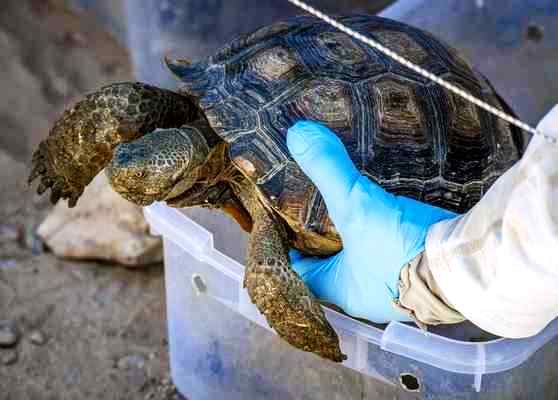
Biologists work with the USMC, BLM, the California and US Fish & Wildlife Services to relocate about 1,100 to 1,500 Desert Tortoises from the Bessemer Mine area of Johnson Valley in Twentynine Palms Marine Corps Air Ground Combat Center Wednesday. PHOTO BY ERIC REED

By David Danelski
The Press-Enterprise


Wildlife biologist Scott Welch looked out over the Mojave Desert and readied for action when he heard a distant helicopter flying in.

Just seconds after the aircraft landed, he and two others began loading it with plastic storage bins containing desert tortoises captured at an expansion area of the U.S. Marines Corps training base at Twentynine Palms.

They carefully packed 26 of the imperiled reptiles — one or two per bin — onto cargo carriers on the helicopter that looked like oversized saddlebags.

And within minutes, the tortoises were flying toward a safer haven of the recently created Mojave Trails National Monument — about 25 miles away from the crushing treads of tanks, the boots of soldiers and the blasts of bombs.

Operation Desert Tortoise was in its fifth day. As of Wednesday morning, 266 of the animals had been moved out of the Johnson Valley, about 30 miles northwest of Yucca Valley.

Before the end of the month, the Marines, working with about 125 wildlife biologists expect to have moved 1,156 tortoises, with a focus on clearing transportation corridors and other areas expected to be most disturbed by live-ammunition training missions.

It’s part of a multi-year, $50 million-plus tortoise relocation and study program at the base that was OK’d by the U.S. Fish and Wildlife Service following a 2013 vote by Congress to add about 88,000 acres in Johnson Valley to the combat center.

For the Marines, the expansion will allow them to hold longer and more-involved live-ammunition desert training missions to prepare Marines to intervene in global hot spots, such as the Middle East, should it be necessary. Such training is expected to start this summer.

For the tortoise, a species listed as threatened with extinction, it means the loss of more than a hundred square miles of quality habitat, as evidenced this year by robust blooms of yellow desert dandelions and other annual plants that are their primary food source.

The resources of the U.S. Defense Department were put to work to minimize harm to the tortoises, said Brian Henen, an ecologist for the Marine Corps Air Ground Combat Center at Twentynine Palms.

Analysis and field work for the move began more than two years ago. Scores of specially trained biologists have methodically walked the valley and fitted each tortoise they found with radio transmitters, so the animals could be gathered for this month’s move. It’s the largest tortoise move yet in the Mojave Desert.

The five areas of public land around the base that are receiving the animals were carefully chosen for their quality habitat and their distances from human habitation, Henen said.

Tortoises that lived near each other are being released in similar proximity in the recipient areas to preserve their social structure.

“We are moving them in groups. We are trying to sustain the similarity and the structure of their origin,” said Henen, standing by a makeshift medical checkup station for the tortoises.

There, Peter Praschag, a world-renowned tortoise and turtle expert from Austria, was working with veterinarian Shannon DiRuzzo to screen tortoises for signs of disease and other health issues.

A large male dubbed MC-2013 appeared frightened by the checkup and voided the water stored in his bladder, called a coelomic cavity. This was a serious matter, because a tortoise may get only one or two chances a year to get a good drink of water.

So Praschag used a syringe to carefully refill the animal’s coelomic cavity with a saline solution of water.

The work of the biologists won’t be finished until long after the last load of tortoises are flown out this month. Henen explained that the biologists will return frequently during the next four years to search for any reptiles that may have been left behind. They expect to move another 300 tortoises during that time.

The plans also include tracking and studying the relocated tortoises, as well as those already in the recipient area, for as long as 30 years. For this research, three groups of 225 tortoises — relocated ones, those already there and an unaffected control group — will be fitted with transmitters to track their movements and survival rates.

Biologists hope that the knowledge gained from this research will help the species recover.

But the loss of more than 100 square miles of prime habitat is still harmful to the tortoises, which has faced declines since the 1970s, prompting its 1990 listing under the Endangered Species Act, said Ileene Anderson, a biologist with the Tucson-based Center for Biological Diversity.

“It is going to be a big hit on the species,” she said.

She said it is not known if the public property outside the base will have enough food and other resources for both residents and newcomers to survive, and that wildlife biologists don’t know for sure why tortoises numbers have dropped in those areas.

She’s also worried that the tortoises may try to find their way back to their birthplaces in the base expansion areas.

But the U.S. Fish and Wildlife Service (FWS) determined in January that moving the tortoises from the Johnson Valley won’t jeopardize the survival of the species.

Scott Hoffman, who was observing the relocation effort for the FWS, said the species may benefit in the long run.

“Yes, we are losing habitat. But are we are using the relocated tortoises to supplement the populations in the critical habitat areas,” said Hoffman, referring to some of the recipient areas.

April 3, 2017

Long-Living Tortoises Roam Protected Portion of Mojave Desert

Desert tortoise
By Renee Eng
Spectrum News

CALIFORNIA CITY, Calif. — In the Mojave Desert, it’s not uncommon to see rabbits or even rattlesnakes slithering around but one reptile that’s harder to spot is the desert tortoise. But it turns out there are plenty of them in a protected area just an hour north of Palmdale, outside of California City. It’s called the Desert Tortoise Natural Area.

Video

“They are a long-lived species,” explained Jillian Estrada, preserve manager and conservation coordinator for the Desert Tortoise Preserve Committee.

“They can live more than 100 years in captivity. We actually see several tortoises out here that were initially tagged in the early 70s as part of a long-term study.”

We spotted one male tortoise that Estrada estimates is at least 40 to 50 years old. Her work with the DTPC focuses on protecting the long-lived reptile in the natural area.

“It’s about 39.5 square miles so just over 250,000 acres,” said Estrada.

The property was set up in the 1970s with the Bureau of Land Management and is filled with about 1,000 tortoises.

“They have inhabited the Mojave Desert for millions of years,” described Estrada. “They have been part of this ecosystem. They are specially adapted to survive here.”

But their survival is threatened by human settlements and a raven population that’s grown by 1500 percent over the last 30 years.

“They’re generalists, they’ll eat anything,” said Estrada. “They eat baby tortoises, adult tortoises, baby birds. They will eat lizards.”

A generous appetite threatening baby tortoises that don’t have a fully formed hard shell. It can be easy for predators, especially ravens, to peck through their brittle shells.

“As the mortality rate of juveniles has increased, in large part due to raven predation, we’re not seeing as many females surviving to reproductive age,” said Estrada.

The reproductive age for female tortoises is about 15 years old. However, the raven threat remains as those birds are protected under the Migratory Bird Act.

Tortoises that do survive, visitors can spot in the protected area but they cannot touch them. The animal – which is California’s state reptile – is protected at both the state and federal level.

Desert tortoises also hide out for about half the year.

“From late fall to early spring, about five to six months out of the year these guys are hibernating, which for these guys is called brumation,” said Estrada

When they’re not brumating, tortoises will dig shallow burrows, coming out to look for food. Visitors can learn more about their habits at an interpretive kiosk or explore four guided trails that total about 3.5 miles.

There’s also a full-time naturalist on-site from the middle of March to early-June to lead hikes and teach visitors about these gentle creatures.

The Desert Tortoise Natural Area is open daily from 8 a.m. to 5 p.m. and is free to the public.

March 2, 2017

Federal officials OK desert tortoise transfer

Marines wait for a desert tortoise - endangered and protected from harm or harassment by federal law - to move off the road during an operation at Marine Corps' Air Ground Combat Center at Twentynine Palms, Calif., on April 4, 2008. Federal authorities have approved a plan to move nearly 1,500 desert tortoises from the base. (REED SAXON/AP)

By David Danelski
The Press-Enterprise
San Bernardino Sun


Federal land management and defense officials have signed off on plans by the U.S Marine Corps to move as many as 1,500 desert tortoises from a Twentynine Palms military base in the coming weeks.

With the approvals, the largest tortoise relocation effort ever the Mojave Desert is on track to occur toward the end of this month or in April after the slumbering reptiles emerge from their underground burrows, where they spend the winter months.

The move, however, cannot occur before March 21, which is the deadline for anyone to appeal the approvals from the Navy and Bureau of Land Management, said Chris Otahal, a wildlife biologist for the BLM’s Barstow field office.

The move would clear about 88,000 acres of land in the Johnson Valley for expanded live ammunition training. Congress voted in 2013 to add this land to the west side of the Marine Corps Air Ground Combat Center at Twentynine Palms.

The tortoises will be flown by helicopter to BLM lands mostly west and north of the Marine base.

The timing depends on the weather, but tortoises in the Mojave Desert usually leave their burrows by late March or early April so they can feast on wildflowers and other annual plants that are abundant after the winter rains.

Since the desert tortoises are listed as threatened with extinction, the Marines had to consult with the U.S. Fish and Wildlife Service, which found earlier this year that the move would not jeopardize the survival of the species.

This winter’s wet weather makes conditions more favorable for the move, increasing the tortoises’ chances of survival, Otahal said.

There will be more plant life for the displaced tortoises to eat, reducing competition for food with the tortoises already living on the BLM land. Also there will be more rabbits and other animals for coyotes to eat, which will make those predators less interested in tortoises.

“It’s much better for the tortoises when we have more food resources,” Otahal said.

The Marines had planned to move the animals last spring, but the operation was delayed a year after the Tucson-based Center for Biological Diversity filed a legal notice that argued that required environment analysis was lacking. The government then did more study, including assessing the impacts on wildlife on the BLM lands that will receive the displaced tortoises.

Ileene Anderson, a Los Angeles-based biologist for the center, said the move will be devastating to the species. The tortoises would lose some 136 square miles of quality habitat. What’s more, the displaced animals will move to BLM lands where species is in decline, she said.

“This is the largest translocation of tortoises in the Mojave Desert, and they’re moving them to areas where tortoises are dying off and we don’t know why,” Anderson said.

July 22, 2016

Mojave Desert at stake in far-reaching federal energy plan


By Carolyn Lochhead
San Francisco Chronicle


In its final months, the Obama administration is racing to complete a far-reaching environmental initiative that could forever alter one of the wildest places left in California.

A giant energy plan for the Mojave Desert attempts to reconcile two contradictory goals: fast-tracking big solar and wind installations across 10 million acres of public lands to reduce carbon emissions and slow climate change, and preserving the region’s natural beauty and ecological integrity.

Solar and wind developers say they will need broad expanses of public land to build their big installations. But scientists say those large-scale developments will permanently scar the desert landscape, destroy native plants and wildlife, and, to top it off, may not do for the environment what they were intended to do.

More than seven years in the making, the joint state-federal Desert Renewable Energy Conservation Plan is driven by President Obama’s promise to install 20,000 megawatts of renewable energy on federal land, and by the state’s ambitious new effort to get half of California utilities’ electricity from renewable sources by 2030.

The administration’s goal is to deliver the equivalent of nearly a quarter of California’s current daily electrical generating capacity. That’s enough to provide power to 3.28 million homes, according to solar industry estimates.

The plan attempts to correct mistakes made early in the Obama administration, when the California desert was opened to large-scale solar development by the Bureau of Land Management, the current plan’s chief architect, without taking into account the broader environmental impacts on the desert. Unlike the National Park Service, whose mission is conservation, the bureau encourages multiple use of public lands, including mining, hunting, recreation, logging, grazing, oil and gas drilling, and renewable energy production.

The bureau’s plan is to set aside 388,000 acres, or more than 600 square miles, of public land in the Mojave for renewable energy development and make another 842,000 acres available if needed. In all, nearly 2,000 square miles of desert could be developed.

The plan also sets aside 5 million acres, or 7,812 square miles, for conservation.

Administration officials are expected to sign off on the plan this summer. After that, only litigation or an act of Congress could prevent it from going forward. While the state is a partner in the effort, only federal land will be developed.

The California desert plan is “an environmental story in the United States that hasn’t received the attention that it’s owed,” said Rebecca Hernandez, an earth systems scientist at UC Davis. It “has really gone under the radar.”

Outside its three national parks at Death Valley, Joshua Tree and the Mojave National Preserve, the desert has been long considered a scrub wasteland. For decades it’s been a repository for sprawling military bases, off-road vehicle playgrounds and booming desert cities, divided by three interstate highways. It’s been mined and grazed for a century and a half. And with a solar intensity that rivals the Sahara, the California desert is now seen as a natural place for renewable energy development.

Despite these human incursions, the desert remains one of the most intact ecosystems in the continental United States.

Scientists have come to understand that the desert is a major carbon sink, whose ancient, deeply rooted plants are a slow-motion machine for drawing carbon from the air and burying large stores of it underground in stable form.

They have shown that deeply rooted desert plants suck huge amounts of carbon from the air and bury it in the earth, where it interacts with soil calcium to form the white desert crusts known as caliche. When these soils and plants are disturbed, this natural process of carbon sequestration is disrupted.

In other words, critics say, building big solar and wind plants on undisturbed desert soils to fight climate change could backfire.

“Globally there’s probably about as much carbon bound up in (desert soil) as there is in the atmosphere,” said soil biologist Michael Allen, director of UC Riverside’s Center for Conservation Biology and a pioneer in studying desert carbon sequestration. “It’s a very large pool.”

Opposition to the administration’s plan also comes from the solar industry. In a last-ditch effort to make changes, industry groups warned in a memo this month that the initiative will make it “impossible” to achieve the administration’s climate goals — including those that came out of last year’s landmark Paris climate accord — because it leaves too little public land available for development.

“California is home to the best solar radiance in the world,” said Shannon Eddy, executive director of the Large-Scale Solar Association, and the Bureau of Land Management “is on the threshold of locking it off against development in perpetuity.”

Environmental groups that support the administration’s plan fear the desert will be under significant threat from solar development without the government’s protection of 5 million acres.

Without such protection, said Kim Delfino, California program director for Defenders of Wildlife, “the public lands will yet again be the place a lot of these large projects go.”

The plan was designed to avoid a repeat of actions taken in the Obama administration’s early days, when it handed $50 billion in subsidies to renewable energy developers as part of the economic stimulus that followed the 2008 crash. The initiative set off a desert land rush by those hoping to cash in on the government money and the vast tracts of available public land, which in turn overwhelmed federal agencies, causing them to approve projects without considering their broader environmental impacts.

“The state and the federal permitting agencies were scrambling to do a good job of analyzing projects in the desert on a site-by-site basis, but without the benefit of a broader plan that would help us really begin to see the big picture of how these different projects might together affect the desert environment,” said Karen Douglas, a member of the California Energy Commission who has taken a leading role for the state in the current plan.

One project that environmentalists point to as an epic mistake is BrightSource Energy’s solar-power farm at Ivanpah (San Bernardino County), built to provide power for Pacific Gas and Electric Co. Constructed just north of the Mojave National Preserve on 6 square miles with $1.6 billion in federal loans and $600,000 in tax credits, the plant has fallen short of its production goals.

Construction turned up many more endangered desert tortoises than expected, and thousands of birds have been incinerated in the light beams that reflected off the plant’s nearly 350,000 mirrors to three 45-story-tall towers. The plant has burned so much natural gas that it has needed to buy carbon credits to comply with the state’s greenhouse gas emissions program. BrightSource, an Oakland firm, says the plant has vastly improved its solar power output this year.

With the new plan, the administration is trying to look at entire landscapes when planning for renewable energy. In a speech in April, Interior Secretary Sally Jewell said the effort would “determine where it makes sense to develop, where it makes sense to protect the natural resources, and where we can accomplish both.”

Barbara Boyle, head of the Sierra Club’s “Beyond Coal” campaign, called the plan “a really important milestone ... that looks at the big picture of development and conservation.”

“We take a very pragmatic view of this, recognizing that some development is going to happen in this desert, and it’s not going to be possible to stop it all,” Boyle said. “We are pushing as hard we possibly can to put it in the least damaging places and to limit how much is done.”

Three factors are driving the push for large-scale solar and wind development: a law passed by the California Legislature last fall requiring half the energy provided by utilities to come from renewable energy sources within 14 years; the Obama administration’s targeting of public lands for such renewables; and Congress’ decision in December to continue a lucrative solar tax credit.

But common sentiment among local environmental activists, business leaders, county officials and scientists living in the desert is that solar should come from panels on the rooftops of homes and businesses where electricity demand is. Putting solar on rooftops would encourage more small-scale advances in renewable energy production and reduce the need for sprawling desert projects, they say.

“If the state of California was really smart, they would do a Google search and look at all of the parking lots and rooftops in Southern California — the Walmarts, the Targets, the humongous shopping center areas,” said Chuck Bell, head of the pro-business Lucerne Valley Economic Development Association, who joined local environment activists to protest the desert plan.

Hernandez, the UC Davis scientist, worked with Stanford University researchers on a study last year that found that rooftop and other solar systems in developed areas “could meet the state of California’s energy consumptive demand three to five times over.”

“When you have so many other places that are already disturbed, especially across the whole of California, it just doesn’t make sense to destroy any remaining natural habitat we still have left intact,” said Hernandez, whose joint study was published in the journal Nature Climate Change.

But Douglas, the California Energy Commission member, insists the state needs large-scale renewable energy to provide reliable electricity, and the desert so far has been instrumental to building the capacity to do that.

“Rooftop is a really important part of the portfolio,” Douglas said. “It will get more important, and it is getting more important, but we have big goals. Large-scale projects, they also get you scale. They are located in areas with very good resources, and when they come online they can increase our renewable energy generation as part of our statewide portfolio very quickly.”

In its planning, the Bureau of Land Management said rooftops are outside of the agency’s authority and that its orders were to evaluate renewable energy projects only “on federally administered land.” Planners focused solely on the desert.

Rex Parris is the Republican mayor of Lancaster (Los Angeles County) in the western Mojave. His focus on renewable energy has resulted in the placement of solar panels over parking lots, on city buildings, schools and even the city’s baseball stadium. He wants to make Lancaster the first city to require solar panels on all new housing. His aim, he said, is twofold: to battle climate change and save money.

He invited a Chinese company to manufacture electric buses in Lancaster, which, under his leadership, also bought the city’s streetlights from Southern California Edison when the utility refused to switch the bulbs to LED lights. Parris is pushing large-scale solar installations on some of Antelope Valley’s 56 square miles of abandoned alfalfa fields.

There’s no reason to bulldoze desert wilderness, the mayor said. Gesturing to his city of 150,000 people, he said, “We have the land here.”