Showing posts with label relocation. Show all posts

February 13, 2014

A Huge Solar Plant Opens, Facing Doubts About Its Future

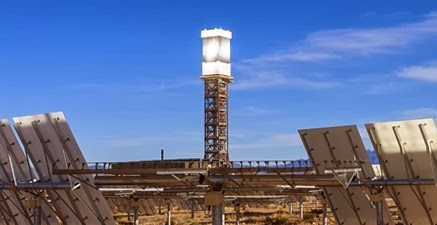
A field of mirrors at the Ivanpah power plant in California. The plant took almost four years to complete and stretches over more than five square miles of the Mojave Desert. (Jim Wilson/The New York Times)

By DIANE CARDWELL and MATTHEW L. WALD
New York Times


NIPTON, Calif. — The Ivanpah solar power plant stretches over more than five square miles of the Mojave Desert. Almost 350,000 mirrors the size of garage doors tilt toward the sun with an ability to energize 140,000 homes. The plant, which took almost four years and thousands of workers assembling millions of parts to complete, officially opened on Thursday, the first electric generator of its kind.

It could also be the last.

Since the project began, the price of rival technologies has plummeted, incentives have begun to disappear and the appetite among investors for mammoth solar farms has waned. Although several large, new projects have been coming online in recent months — many in the last quarter of 2013 — experts say fewer are beginning construction and not all of those under development will be completed.

“I don’t think that we’re going to see large-scale solar thermal plants popping up, five at a time, every year in the U.S. in the long-term — it’s just not the way it’s going to work,” said Matthew Feinstein, a senior analyst at Lux Research.

“Companies that are supplying these systems have questionable futures. There’s other prospects for renewables and for solar that look a lot better than this particular solution,” he said, including rooftop solar systems that are being installed one by one on businesses and homes.

Executives involved in Ivanpah — a venture among BrightSource Energy, NRG Energy and Google — say that once the facility proves that the technology can work, it will become easier to finance others, especially as repetition brings the cost down.

When BrightSource and other companies asked NRG to invest in a second thermal project, said David Crane, NRG’s chief, he responded: “We’ve got $300 million invested in Ivanpah — let me see that work for a few months and then we’ll decide whether we want to be involved in more.”

At the same time, BrightSource has shifted its focus, pursuing markets overseas like China, South Africa and the Middle East and designing smaller plants involving one tower rather than Ivanpah’s three.

Addressing a tent full of officials and industry executives, including those from the construction giant Bechtel, the engineering and building contractor on the project, David Ramm, BrightSource’s chief executive, acknowledged the risk at the dedication ceremony about 50 miles south of Las Vegas.

“We will have failed as a company if the last project we built was at Ivanpah,” he said. “The challenge for BrightSource going forward, and hopefully some of the partners who worked with us here, is to enable this technology commercially and in multiple locations around the world.”

It is a daunting challenge. The Ivanpah project was conceived in the early days of the Obama administration, when dreams of creating a thriving renewable energy industry were backed by the federal government’s financial support. Ivanpah received a $1.6 billion federal loan guarantee, without which it would not have gone forward, the developers said.

Ernest Moniz, the energy secretary, toured a tower and said the plant was an example of how the loan program — which set off a political maelstrom after the prominent failure of one of its borrowers, the solar panel maker Solyndra — was supposed to work.

“Our job is to kick-start the demonstration of these different technologies to have them available to the private sector,” he told reporters, standing on a tower platform, soaring above a dry lake bed, two huge boilers atop the other towers glowing in the distance like something out of a clean-tech version of “The Lord of the Rings.”

But he acknowledged that solar thermal technology only worked at large scale and in certain locations.

The loan program that financed Ivanpah has now ended, and the underlying economics shifted during its construction as the price of conventional solar panels dropped. It’s a familiar story in government-sponsored energy projects, going back to efforts to make gasoline from coal in the late 1970s, which were doomed by the retreat of oil prices.

And as federal support has waned, so, too, has demand for similar large-scale projects. What’s more, an important tax credit worth 30 percent of the cost is set to decline after 2016.

“There have been some big changes in both the market and policy dynamics since we made our investment that, I think, on balance, are not terribly positive for BrightSource,” said Dan Reicher, executive director of the Steyer-Taylor Center for Energy Policy and Finance at Stanford. Mr. Reicher oversaw an early investment in BrightSource in 2008 when he was director of climate and energy initiatives at Google. (The company went on to invest $168 million in Ivanpah.)

“Clean tech investing is way off,” he said.

Still, experts say, BrightSource’s solar thermal technology — which focuses sunlight from mirrors onto 2,200-ton boilers 339 feet in the air to make steam that drives turbines to produce electricity — may have an advantage over conventional panels, which convert sunlight directly into electricity.

The increase in renewable sources of energy, which produce intermittently, coming into the grid, has also increased the need for other services crucial to reliable operation, services that solar thermal plants could provide. Those needs include the ability to start and stop quickly, at any season or hour, when human operators give the order.

Utilities pay power plants for some of those jobs, and some conventional generating stations earn a significant income, in addition to what they receive for producing energy. Around the country, coal plants — of which there are fewer and fewer — were well suited to that work. And government regulators can simply require utilities operating on the grid to show that they have the ability to accomplish some of those jobs, which industry executives call “ancillary services.”

“In the future, there will be money to be made from technologies and systems that contribute to integrating and balancing renewables on the grid,” said Samuel Thernstrom, the executive director of the Energy Innovation Reform Project, a nonprofit in Washington that evaluates electricity policy. “That’s going to be an increasing issue as the percentage of renewables on the grid increases.”

Ivanpah could stabilize voltage but has little storage, though it does have natural gas backup. At the dedication, Mr. Ramm said that in the future, BrightSource’s boilers would use molten salt to store the heat longer. Last year, Arizona Public Service opened a solar thermal plant, Solana, that lets customers brew their morning coffee with the previous afternoon’s sunshine.

At the California Independent System Operator, the company that manages the grid on a moment-to-moment basis, Stephen Berberich, the president and chief executive, said that “on an apples-to-apples basis, it is more expensive than photovoltaic, but it has a heck of a lot more capabilities than photovoltaic does.”

Another expert, Ron Binz, an energy consultant based in Denver and the former chairman of the Colorado public service commission, said that storage would indeed be needed as intermittent renewables grew. But solar thermal plants were not the only way to meet that need, he said, and a competition would follow. “You can’t look at any element of this without looking at all the others,” he said.

As for the federal loan guarantee program, the government has already changed its approach, looking to emphasize a range of cleaner technologies, especially in fossil fuels and nuclear power.

To that end, Mr. Moniz encouraged the crowd of industry executives to pursue new projects that would qualify for the loan guarantees. “Bring them on,” he said. “We’re ready.”

February 1, 2014

Solar plant powers up, turns on desert show

BrightSource Tower surrounded by mirrors near Ivanpah Dry Lake.
By David Danelski
Orange County Register


Without fanfare, one of the biggest and most controversial solar developments in California has gone online in northeast San Bernardino County, creating a visual spectacle for travelers heading across the Nevada border on Interstate 15.

Meret Uteregges stood at the edge of the Ivanpah Valley early Wednesday afternoon and marveled at the sight below her.

Three arrays of thousands of mirrors blanket more than 5 square miles of the Mojave Desert landscape and focus sunshine on the tops of three towers, each taller than the length of a football field.

The mirror fields and the tower tops, glowing with an intensely bright white light, are proving to be a traffic stopper that dominates the landscape for miles.

“It is like science fiction,” said Uteregges, from Zurich, who stopped on the shoulder of Nipton Road, a few miles south of the solar field, to get a good look. “It is fascinating. I saw it being built a few years ago but didn't know it would be so big.”

The Ivanpah solar energy project was developed by BrightSource Energy Co. – which owns the plants, along with NRG Energy and Google – and now is operated by NRG Solar. It has been operating since the beginning of the year, according to officials with the California Energy Commission.

NRG spokesman Jeff Holland declined to provide details of the startup, saying only that the company in mid-February would publicize its electricity-production debut.

Monthly status reports available on the state Energy Commission's website said that one of the towers went into commercial operation Dec. 30. And a commission spokesman said the other two towers also have been producing power since that date.

The $2.1 billion project is expected to provide enough carbon-free electricity for 140,000 homes through contracts with Southern California Edison and Pacific Gas and Electric. It was supported with some $1.6 billion in federal loan guarantees and has been hailed by President Barack Obama.

Despite the benefits of clean energy, the project drew protests from some environmental and Native American groups. Native Americans said the project disturbed sacred ground in the Ivanpah Valley.

Environmentalists objected because the development consumed 5.6 square miles of desert tortoise habitat, displacing dozens of the reptiles, which have been relocated or are confined to holding pens. Tortoises are listed as a species threatened with extinction.

BrightSource's environmental reviews predicted that about 17 of the reptiles would be displaced. But after construction started in fall 2010, about 125 were captured on the site.

To make up for the lost habitat, BrightSource funded California's acquisition of about 7,200 acres elsewhere in the Mojave Desert.

When operators started testing the towers last year, a new concern emerged: Birds that flew into the heat zones around the towers died from burns. Federal fish and wildlife officials are tracking the bird deaths and taking possession of the carcasses, according to monthly status reports filed with the Energy Commission.

Some passers-by said it makes sense to take advantage of the desert's abundant sunlight.

Mark Tworek of Calgary, Alberta, said he saw the bright solar towers as he crested a hill in Nevada while riding his motorcycle on Nipton Road, southeast of the project.

“It is pretty amazing to see it in operation,” he said, sipping a soda at the Nipton Trading Post.

“With all the sunshine around here, it is a no-brainer.”

April 15, 2013

Sacrificial Land: Will renewable energy devour the Mojave Desert?

Looking north towards the Ivanpah solar plant's eastern boiler tower in California. (Craig Dietrich)
By Judith Lewis Mernit
High Country News


Over breakfast at the Crowbar Café in Shoshone, Calif., Brian Brown explains to me how he makes a living. Shoshone is a town of 31 in the Mojave Desert near the Nevada border; Brown runs his own business here, the China Ranch Date Farm. In the late summer, he strips offshoots from unproductive palm trees and sells them to landscape designers in Las Vegas; in early fall, Orthodox rabbis descend from New Jersey to procure unopened palm fronds, or lulavim, for Sukkot, the Jewish harvest festival. But in the winter and spring, Brown caters to tourists. They come from faraway places -- the East Coast, Canada, Europe -- drawn by the limitless views and thick, dark nights. So many come from Germany, in fact, that one local restaurant prints a version of its menu in German.

Brown is 58, green-eyed, tall and fit, dressed in striped shirt, jeans and sneakers, his graying hair combed to the side like a small-town mayor's -- conservative in demeanor, forward-thinking in philosophy. Long ago, the ranch belonged to his great-aunt, Vonola Modine, daughter of Ralph Jacobus Fairbanks, who founded Shoshone in 1909, and grandmother of actor Matthew Modine. The property abuts a wet trickle of the Amargosa River and slot canyons where you can bellow out arias and hear your voice echo back in triplicate; it's a popular birding spot for locals and an almost mandatory cool-down hike for expeditioners coming east out of Death Valley National Park. Brown serves them date shakes, date-nut muffins and bags of well-bred Middle Eastern varietals, all much sweeter and softer than typical store-bought Medjools.

A fourth-generation desert native, Brown grew up back when you could do as you pleased in the Mojave: Put up a shack and drill a well; start a family business around a talc deposit; test a nuclear bomb. "I drove dune buggies and dirt bikes everywhere," Brown remembers. "Nobody stopped me, nobody ticketed me." Then came the 1970s, and Brown, like a lot of local residents his age, watched as the federal Bureau of Land Management, empowered by land-protection laws written for a nation caught up in the environmental movement, closed popular off-road routes and evicted elderly couples from cabins they'd built by hand. "They came in like stormtroopers," Brown says, "burning cabins to the ground to restore the land to its natural condition." To this day, he resents the way BLM deputies enforced those laws.

For a long time, Brown and his neighbors reflexively opposed every federal land-management effort, every habitat protection plan, even the very idea of desert conservation. They regarded the landmark 1994 California Desert Protection Act -- which raised Joshua Tree and Death Valley monuments to national park status and established the 1.6 million-acre Mojave National Preserve -- as "something getting pushed through by the Sierra Club and its henchmen."

Over time, however, those laws changed not just the landscape, but the local economy, its culture -- and eventually its longtime residents' minds. If you couldn't mine minerals, graze cattle or sell nail-biting Jeep adventures over desert rocks and dunes, you were left with one option: To serve the people who come for the desert's singular beauty and emptiness -- people willing, as the late desert naturalist Elden Hughes once put it, "to get past the color green."

"We had to figure out what assets we have," Amy Noel, who owns a local hot-springs resort in nearby Tecopa, says. "And we figured out that the greatest asset we have is the desert itself." The Mojave's nowhere-else-on-earth species, its spectacular light play on volcanic mountains, the wetlands that pop up like exotic bird carnivals among the winter sands, became the basis for a new economy. Even the night sky brought tourists: Noel is busiest on the night of the new moon, when astronomers set up a projecting telescope to look at the stars.

And so it was that Brown, along with many other local businesspeople, became a conservationist. In 2004, Brown, his cousin, Susan Sorrells, and a number of other residents founded the nonprofit Amargosa Conservancy, an organization dedicated to "telling the story of the desert," Brown says. He even joined the Sierra Club.

Lately, though, Brown has again begun to worry about federal intervention, only this time moving away from conservation toward industrialization of large tracts of untouched land. Since early 2009, when then-Interior Secretary Ken Salazar fast-tracked renewable energy projects on public land, the Mojave and the adjacent Colorado Desert have been racing toward a radical transformation, unlike anything the locals ever imagined. Large-scale wind and solar projects, each occupying thousands of acres, have already begun to destroy habitat and mar prized views. "I think if we don't set (certain) places aside and say not there, then eventually what we have here will be lost," Brown says. "We're at a historical point where decisions are being made right this minute that will change this place forever."

Brown now finds himself speaking out alongside environmental groups like the National Parks Conservation Association and the Center for Biological Diversity on behalf of a new California Desert Protection Act, which Sen. Dianne Feinstein, D-Calif., introduced in 2009 and again in 2011. The new bill folds in some of the lands left out of the 1994 bill, and would designate two new monuments in the Mojave, expand Death Valley National Park and add several hundred thousands Mojave acres to the wilderness system. It also offers formal protection to off-road vehicle recreation areas, keeping Jeep trails safe from energy development and other interference.

The bill has already died twice in the Senate, and will probably fail again: 2013 does not seem an auspicious year for new environmental laws. But that doesn't mean it's doomed: Feinstein's predecessor, Sen. Alan Cranston, spent eight years working on the 1994 law; after he retired, Feinstein braved local opposition and Senate filibusters to push it through. That kind of patience could pay off again.

But compared with the hundreds of thousands of acres that renewable energy could potentially occupy, the new desert bill protects very little. While it wends its way through the political maze, the Mojave's fate will have been determined; the sacrifice of this land, once protected by its own climatic extremes, is already under way. Whether the remaking of the Mojave yields one small but crucial contribution to the salvation of the whole planet's climate or goes into the annals of energy history as a grand but failed experiment is anyone's guess.

Five years ago this spring, I reported on the first wave of people resisting industrial renewable energy projects in the Mojave -- solar fields covering six or seven square miles, wind farms eight or nine times that size. Over the years, I watched them start nonprofits, launch blogs, lobby the media to tell their stories. When a reporter wrote an unalloyed success story about how big solar in the Mojave would fight climate change and secure U.S. energy independence, the activists filled up the newspaper's comment section with statistics about Germany's rooftop solar, the decline of the threatened desert tortoise whose habitat these projects destroy, the desert's function as a carbon sink.

Mostly, though, opponents testified at public meetings hosted by the BLM as it weighed various projects. Local business people learned to talk like biologists. "Ninety percent of the biota in the desert exist beneath the desert soil," Paul Smith, the owner of the "tiny, tiny" 29 Palms Inn near Joshua Tree National Park, said at one meeting. "So a lot of what you think is a relatively dry environment, without a lot of things growing, is actually a rich biological environment."

None of those efforts could stop the juggernaut. The BLM has approved nine solar projects on 24,000 acres of public land in California and Nevada; several more large wind farms in process will take up tens of thousands of acres. Many more proposals appear as splotches on a map, squeezed between mountains and spread across valleys that few humans have sought to inhabit. Some of the solar plants, all pricey capital investments, will fall to the vagaries of financing; others will fail to secure contracts with utilities. Some wind developers will discover that their proposed locations don't have enough wind.

Still, many more projects will go forward, buoyed by California's mandate to generate 33 percent of its electricity from renewable sources by 2020, and rushed by ephemeral tax incentives. Nor are public-land projects all there is to worry about. On the May morning I met with Brown, he talked about a 500-megawatt installation planned for five square miles of a former ranch near Pahrump, Nev., 15 miles east across a mountain wilderness from Shoshone and Death Valley. Hidden Hills, a concentrating solar thermal plant proposed by Oakland-based BrightSource Energy Inc., will deploy two circles of mirrors, or "heliostats," each two miles wide, to focus sunlight on 750-foot towers, heating fluid inside until it flashes to gas and spins turbines. It will require new transmission through Nevada wilderness, plus natural gas lines to fuel a small start-up generator. Brown expects that infrastructure "will wedge open the door to more," noting that two more projects are on the docket in the Pahrump Valley. "That whole Nevada strip will become a big industrial zone," Brown says. "Nights will be ruined; we'll be looking at tens of thousands of acres of towers."

This desert of varied elevations can swallow grazing allotments, freeways, mines and military installations. Mountains surround it: the Panamints and Sierra to the north, the San Bernardinos and San Gabriels to the south. If you climb Telescope Peak in the Panamints, braving narrow trails above thousands of feet of scree, you can take in both the lowest point in the Lower 48, at Badwater in Death Valley, and the very highest, Mount Whitney in the Sierra. Within the Mojave National Preserve, craggy hills rise to 5,000 feet and descend into gravelly bajadas that explode with pink-and-gold blooms in a good spring. Fog rolls in, snow falls, and summer thunderclouds focus dramatic beams of light. Landscapes that look barren up close take your breath away from great distances.

What the desert's vistas can't absorb are miles of wind turbines and skyscraper-high solar towers, like the ones already standing at BrightSource's Ivanpah Solar Electric Generating Station, the first big public-land solar project, now nearing completion on California's border with Nevada. Situated at the base of the Clark Mountains between segments of the Mojave Preserve, Ivanpah will generate 400 megawatts of electricity to potentially power 140,000 homes. The plant occupies six square miles, or roughly 4,000 acres -- twice the land area of Jackson, Wyo., almost the size of eight-square-mile Ogden, Utah, or the entire city of Redondo Beach, Calif.

Given that the planet's climate is already changing, partly because of carbon emissions from coal plants, we may need scaled-up clean energy to head off catastrophic environmental change. And plenty of people, good environmentalists all, consider Ivanpah a necessary achievement. The Natural Resources Defense Council's director of Western Transmission, Carl Zichella, was on board with Ivanpah from the beginning, back when he held a similar post at the Sierra Club. Local chapters were less gung-ho, but national leaders set out to convince them: Brian Brown remembers Michael Brune, the Sierra Club's national president, showing up at a meeting of the Sierra Club's Desert Committee in early February 2011. "What he said was, basically, the Sierra Club knows there are inappropriate places for solar. Then he launched right into the political speech of saving the planet."

The persuasion, however, worked the other way -- especially after biologists confirmed, in the spring of 2011, that the Ivanpah site was home to many more threatened desert tortoises than the company's surveys had predicted. By the end of that year, even Brune and Zichella agreed that future large-scale solar and wind shouldn't proceed without land and species conservation in mind. Both the Sierra Club and the NRDC filed lawsuits against a solar project in the Mojave that would have interrupted desert bighorn sheep migration; the NRDC also came out against the company's proposal to build a 500-megawatt plant in the central Mojave near the town of Twentynine Palms, a gateway to Joshua Tree National Park.

Barbara Boyle, a Sacramento-based Sierra Club energy policy analyst, says that for most environmental groups, "the focus has really shifted from chipping away at the problem to understanding how we can protect ecosystems on a landscape scale." To that end, the BLM and the Energy Department, staffed up with stimulus money in 2009, pressed forward with a plan to designate certain areas in six Western states as appropriate for renewable energy development. Future developers who choose these sites could move quickly from application to construction, confident that environmental reviews have been completed in advance.

It was, from most perspectives, an honest and vigorous effort to lessen the impact of renewable energy on ecologically sensitive lands. Two areas environmentalists had objected to, one north of Joshua Tree called Iron Mountain, and another around the Pisgah lava field south of the Mojave Preserve, were removed from the proposal's original draft. Other, more appropriate areas -- the West Mojave closer to exurban Los Angeles, the Chocolate Mountains, which abut an Air Force gunnery range -- are being considered as alternatives.

Those zones are not binding; they're only incentives. The agencies have also left 22 million acres open for development -- "roughly 13 times the 138,000 acres BLM predicts will be needed to satisfy the 20-year demand for utility-scale solar power under California's aggressive renewable portfolio (standard)," The Nature Conservancy's Laura Crane pointed out at a public meeting.

Worse, "they came five years too late," says Brendan Cummings, the Center for Biological Diversity's public-lands director. Ivanpah lies outside the zone, as do the many projects clustered around it: First Solar has put up a 60-megawatt photovoltaic field here and plans to build two more, five times the size of the first. Bechtel Corp. has applied for rights to install six square miles of photovoltaic panels a few miles south along spring-fed Soda Lake, in an area California Fish and Wildlife has already identified as bighorn sheep habitat. That project would need only a tiny amount of water, but that tiny amount of water, drawn from the local aquifer, could be the ruin of a small and locally famous fish, the endangered Mojave tui chub, which persists nowhere else on earth but in Soda Lake's small, isolated springs.

"The solar developers say to us, 'You guys always find something,' " Ileene Anderson, a biologist with the Center for Biological Diversity, says with a laugh. "And it's true, we do. Because there is always something."

The day after my breakfast with Brown in Shoshone, I go for a drive with Seth Shteir and David Lamfrom of the National Parks Conservation Association, a group that in the last decade has gone from quiet lobbying to open activism in its determination to protect this desert from renewable development. We plan to visit some of the wild places included in the new desert protection bill, blue pools choked with green reeds on the rugged edges of Death Valley and the variegated mountains farther south, near the Mojave Preserve. Lamfrom, 34, is a dark-haired, southern Florida import with a sharp eye for wildlife; even at night, he's constantly pointing out camouflaged creatures -- a fringed-toed lizard in a sand dune, a coiled Mojave green rattler soaking up the night heat on an asphalt road. Shteir, 45, a fresh-faced, blue-eyed Midwesterner, is like the science guy, backing Lamfrom up with binoculars and facts. In a 4x4 truck rented for the day, we drive up a dirt road to the remains of a 1907 mining camp, where old trash sometimes surfaces. "Sardine cans and whiskey bottles," Lamfrom says, picking up a shard. "Signs of a hard-living crowd."

At sunset, the three of us stand on a high slope and face north toward the Castle Mountains, which look, in essence, like little castles -- castles that were once full of gold. The range and the surrounding area, the 340-square-mile Lanfair Valley, were left out of the original 1994 Mojave Preserve boundaries because, until the end of the last century, gold and silver were still being extracted from the rocks. The desert bill would include them, a prospect that has already scared away developers. "Two solar projects had been proposed for this parcel," Lamfrom says, "but the fact that they were being spoken for by a powerful U.S. senator added a discouraging layer of complexity."

Nothing so far, however, has discouraged San Diego-based Oak Creek Energy from testing the wind resources in these mountains as it considers building here, on one of the few high-elevation grasslands left in the Mojave, and just outside the boundaries of Feinstein's proposal. It's an area thick with Joshua trees –– "a different subspecies than the one you find in the park," Shteir explains. "Those are Yucca brevifolia brevifolia; these are Yucca brevifolia jaegeriana," or "pygmy" yucca. "If you look at the leaves, they're more compact, and the trees have more branches on them." Once they're gone from here, they'll be gone forever.

Nor would Feinstein's bill deter any project on the Nevada side of the border. One of the three desert peaks visible if you look east from the Castle Mountains is a black-and-white batholith known as Spirit Mountain, designated as a "traditional cultural property" in the National Register of Historic Places. To the Native American people who lived here until the federal Department of the Interior pushed them out in the early 20th century, that view wasn't just scenery: It was the seat of all creation, and they believed a clear sight of it was essential to their very survival. In March, Duke Energy of North Carolina won approval to build a wind farm on 19,000 acres between the mountain and the Nevada town of Searchlight.

Lamfrom pilots the truck to the top of the road and parks. We get out. "Look, this is a great view of Spirit," he says, retrieving beers from his backpack for each of us. The beer is slightly warm, but welcome in the dry air. I note from the label that it happens to be German.

"There you go," Lamfrom says. "We give them our open space. They give us their beer."

In 1927, when Brian Brown's great-grandfather, Ralph Fairbanks, homesteaded on 160 acres along the Tonopah and Tidewater Railroad line, he probably expected some of that open space would have filled in by now. He wisely picked a spot where the railroad line crossed the Arrowhead Trail, the first all-weather road between Los Angeles and Salt Lake City. Then he harnessed local springs and established a water stop for motorists in the town of Baker.

During the 1930s, while Hoover Dam was under construction, Fairbanks and his son-in-law, Charles Brown, Brian Brown's grandfather, grew the family business into an all-purpose rest stop and kept it open 24 hours a day, putting every able body in their remnant Mormon clan to work. "It was so isolated, everybody had to stop," Brown says. "You had to get water, you had to pee, you could buy liquor." When Brown's father, Charles Brown Jr., came home from World War II, he spruced the compound up for a new era, with a full-service market, three gas stations and a trailer park.

As I drive to Brown's date ranch in August, I wonder what his great-grandad would think -- watching his descendant argue for less development rather than more, fighting to keep civilization at bay.

My plan is to arrive in Baker at sundown and drive Highway 127 toward Death Valley as the temperature descends from its late-summer three-digit high. When I stop for a falafel at the Mad Greek in Baker, the temperature is 109; 20 miles out of town it rises to 110. Sixty miles later, at 10 p.m., the sensor on the dashboard display ticks up to 114. Irrationally panicked, I pull over the car and get out, forcing myself to walk into this infernal sink where neither man nor beast can survive for long, even at night. The wind blows, hotter than the still air.

A short distance from my car, I spot two figures several hundred feet from the road. I can hear them laughing and talking. One is a woman, and in the light of the waxing gibbous moon I can see that she's blonde. Whatever language they're speaking, it's not English. I imagine their flushed and happy faces, sunburned from the desert day.

When I get to my tidy room at the Shoshone Inn, the temperature has dropped to a tolerable 95, but the woman who checks me in says this is the longest period of extreme heat she's experienced in the 25 years she's lived here. "The climate, you know," she says. "It really is getting hotter. Everywhere."

The next day, balanced in a lift about 30 feet off the ground, I help Brown scour a date tree for red fruit with white flesh, still crisp like an apple. The slightly unripe Hyany dates are prized by the Coptic Christians at a monastery south of here. "The red dates have a symbolic value," Brown says. "The red is for the blood of the Coptic martyrs, the white inside stands for their purity. And the firmness of the date symbolizes their resolve." We tear off whole stems and lay them lengthwise in shallow cardboard boxes.

The work is slow and meditative, leaving lots of time to talk. By 9 a.m. the temperature is pushing 100 degrees. Brown tells me his forebears dealt with the desert heat at night by wrapping themselves in water-soaked sheets, an altogether energy-efficient way of cooling, if not so good for uninterrupted sleep. "When the sheets dried, they'd wake up and wet them down again."

Brown knows the climate is changing. And he wants to believe there are appropriate places for massive wind and solar plants. First, though, he'd like to see rooftops exploited to their full potential in Southern California's sunny cities. He can imagine parking lots covered with solar canopies in the baking west Mojave cities of Palmdale and Lancaster, supplying those Los Angeles exurbs with the kind of "distributed" electricity generation -- electricity generated close to where it's used -- they need to keep their air conditioners running. "I don't understand why these utility companies aren't embracing distributed generation," he says. The simple answer: California's three largest utilities are owned by investors who expect a return. Putting solar panels on rooftops is not how they make money.

Nor is private land such an obvious option anymore. "For years, the conservation community has been saying, 'If you're going to do these things, do them on private land. Make them water-thrifty.' Well, guess what? Hidden Hills would be on private land. And the usage estimate is 140 acre-feet a year, which is pretty low. I struggle with that. Because if they can't do it on private land with a water use of 140 acre-feet a year, are we saying no solar anywhere in the desert?"

In early April, BrightSource Energy asked the California Energy Commission to suspend Hidden Hills' application. Recent hearings about the project had been contentious, with the commission's own staff presenting evidence showing that heliostats could fry birds' wings as they flew through the solar field. Richard Arnold of the Pahrump Paiute Indians had claimed the project would interrupt the sacred Salt Song Trail. Even the Nevada BLM had weighed in, concerned that the plant's water use would deplete the springs that sustain a federally endangered pupfish.

None of those concerns caused BrightSource to pause on Hidden Hills; nor is the project done for. Instead, BrightSource spokesman Keely Wachs said in a statement that the company needs time to develop "more flexible resources," such as solar power with storage.

"Hidden Hills is a good site to deploy solar thermal with storage technology," Wachs wrote, but to change technology now will require new hearings and evidence. In the meantime, the company will focus on a solar-with-storage collaboration with Spanish developer Abengoa. The 500-megawatt Palen Solar Power Project will occupy 5,200 acres, all within the Riverside East solar zone. It is not without controversy: Its two 750-foot towers will be visible from the higher mountains in southeast Joshua Tree National Park.

Later, Brown and I head south to the monastery with our bounty of dates, pausing in the place where I felt the intense heat the night before. It's called the Silurian Valley, where the road descends from a high plateau to a dry lake just a few hundred feet above sea level. It got hotter on the way down, and windier, too, because the 6,000-foot Avawatz Mountains to the west concentrate the breeze in the playa. In the winter, it freezes.

It's here where you can stand on what feels like the edge of the earth and look far into the distance at uninterrupted space, here where I saw the couple I took to be European staring in the dim moonlight at a landscape that looks no different than it did 100, 300, even a thousand years ago. That, however, may soon change: Spanish developer Iberdrola is eying 15,000 acres in the Silurian Valley for a combination wind and solar facility. Fifteen thousand acres is hard to grasp: 23 square miles, sandwiched between the Avawatz Mountains and the Kingston Range -- wilderness areas that would be protected under Feinstein's new desert bill -- and Dumont Dunes, a popular off-road playground. Trucks, towers, construction and new roads; an industrial park where there once was nothing but extremes -- of distance, of heat and cold, of silence.

As of this writing, Feinstein hadn't yet reintroduced her desert bill. Rumor has it that her staff is busy writing up a new provision that will require renewable energy developers to pay into a wildlife habitat mitigation fund instead of finding land to replace lost habitat on their own. The retooling may take some time, and will have little near-term impact: With the state of California having nearly met its renewable energy goals and state and federal incentives close to exhausted, renewable energy development in the desert will probably stall out in the wake of the projects currently under way.

That lull will give us "some breathing space to get future planning right," Brendan Cummings says. He's hoping that California's Desert Renewable Energy Conservation Plan helps both developers and environmentalists figure out where to put large plants when and if demand ramps up again. A state-federal partnership, the conservation plan has brought together private landowners, utilities, municipal governments and environmentalists to determine appropriate places for renewable energy, piecing together private and public parcels where necessary and lining up approvals in advance.

The Sierra Club's Boyle, who's heavily involved, says that a draft plan should be out next fall. "Right now, we're nailing down lists of covered species, biological objectives for keystone species, really getting into the important details," she says. "We're trying to tie the conservation effort to actual biological goals so it has scientific integrity."

Cummings hopes it works. "From a climate perspective," he says, "we want and need more renewable energy projects. If we're going to meaningfully address climate change, the state needs to raise its renewable energy standard from 33 to 50 to even 100 percent. We're an energy-intensive society. So even if these planning processes feel like we're planning for something that's already happened, the time will come again when we need them.

"If we don't," Cummings warns, "we'll have failed on the matter of climate policy. And if we fail on climate policy, we'll have far worse problems than arguing over the viewshed in the Silurian Valley."

In mid-September, a few weeks after my visit to Brown's date farm, my husband and I drive home through thunderstorms that start at the Virgin River Gorge in northwestern Arizona and carry on all the way to the California border. We've just been camping in Utah's Wasatch and Uinta mountains, and hiking around west Yellowstone. But nothing could top the dramatic scene we hit as we cross the Nevada border, where sunlight pierces curtains of rain over painted mountains, storms over the Mojave. We leave the interstate for lunch in the town of Nipton, and stand in line at the local trading post with an effusive electrician, blond and sunburned and well-fed, on lunch break from his wiring job at Ivanpah. "I have work lined up in this state for two years!" he tells me. We buy beers and Fritos to go with our packed leftovers. Then we sit outside at the picnic tables to watch the dramatic sky.

It's a view I used to love, across the Mojave Preserve to its next section, which begins on the other side of the freeway at the Clark Mountains. You can't see the freeway from here; you can't even tell it's there. You can't even detect the cheap circus carnival that is Primm, Nev., with its gaudy roller coaster and fast-food chains, tucked over the border to the north. What you can see, what I see for the first time, are the three towers of the Ivanpah Solar Generating Station, spaced one mile apart, each 500 feet tall, topped with large white frames around empty black spaces. They look like skyscrapers over a small city, built to power a small city -- a city nowhere near here.

September 20, 2012

Environmentalists Split Over Tortoise Treatment at Solar Farms

BrightSource Energy Inc. is caring the desert tortoises as they are found while biologists prepare new homes for them elsewhere in the desert, Joseph Desmond, senior vice president says. (BrightSource Energy Inc.)

By Ken Wells
Bloomberg News


It’s a 106-degree Fahrenheit day in the Mojave Desert. Heat devils dance off chocolate-hued Clark Mountain on the horizon. Air-conditioned cars zip along Interstate 15 toward Las Vegas. And inside a chain-link pen covered to keep out predators are scores of rare, threatened, sand-colored desert tortoises.

Their captivity helps show how complicated it is to combat climate change without collateral damage. The foot-long (30- centimeter) creatures are being removed from their burrows for a project to harvest solar energy in the California desert. Trucks groan down sunbaked roads, cranes pivot with 750-pound (340- kilogram) mirrors and mechanical post-pounders drive steel pylons into the packed desert floor, destroying their habitat.

Construction of such large-scale green-energy projects has splintered environmental groups. When concern over global warming was at a peak, national organizations such as the Sierra Club and the Natural Resources Defense Council threw their support behind industrial-scale wind and solar installations on public land. Now some smaller conservationist groups object to what they consider an environmentally destructive gold rush.

“Of course we need to do solar, but it should go on rooftops or in appropriate places, not the pristine desert,” says April Sall, director of the Wildlands Conservancy in Oak Glen, California, operator of the state’s largest nonprofit preservation system. “We need to tackle warming -- but not forget that there are other things at stake.”

Priorities Clash

The Mojave solar project embodies the clash of environmental priorities. The $2.2 billion installation being built by closely held BrightSource Energy (BRSE) Inc. of Oakland, California, is designed to power 140,000 homes without emitting greenhouse gases. But it threatens the tortoises. That’s why the Western Watersheds Project conservationist group of Hailey, Idaho, sued to stop it in a Los Angeles U.S. court.

The 120-year-old Sierra Club, which calls itself “America’s largest and most influential” environmental group, also lobbied for changes to the project’s design to protect the tortoises. Yet the 1.4 million-member organization chose not to try to block the plant, says Barbara Boyle, a Sierra green energy specialist.

“Ultimately, we need to jump-start renewables to combat climate change, and large-scale solar has to play a big part in that,” Boyle says. However, as it became clear the project was rooting out many more tortoises than projected and as some California chapters urged action, the organization joined a coalition that sued the Department of the Interior in March to block another long-planned Mojave solar project that it says threatens wildlife.

Climate Change

Similar disputes are playing out elsewhere and show a growing concern among green groups and willingness to block large-scale solar and wind projects when the cost to wildlife and habitat seem to outweigh the benefits of fighting climate change. A surge in supplies of cheap, clean-burning natural gas has also begun to undercut demand for more costly green energy.

The green backlash against sacrificing habitat and wildlife to curb global warming parallels polls finding that the public rates climate change low on a menu of environmental problems and has doubts whether it can be fixed. In a March Gallup survey, the issue ranked last among seven environmental concerns, with just 30 percent saying they worried about it “a great deal.”

A Washington Post-Stanford University poll in July found that while most Americans believe the earth is warming, 60 percent said little could be done to stop it, and more than 70 percent opposed energy taxes to address it.

26 Projects

Including the Mojave project that is relocating desert tortoises, the Interior Department has accelerated construction approval for 26 large-scale solar plants on public lands since 2009, including nine that it cleared in August. The Obama administration has steered $9 billion in stimulus funds from the 2009 American Recovery and Reinvestment Act to 23,000 solar and large-scale wind installations, according to the Department of Energy.

Conservationist and Native American groups sued to halt five other Mojave solar projects. The organizations argue that federal and state authorities conducted inadequate environmental reviews and failed to consult with tribes on sacred sites. The Bureau of Land Management, the solar companies and the state deny the allegations.

Dozens more solar plants could arise across the American desert West. A July BLM plan allocates 285,000 public acres to 17 solar zones. An additional 19 million acres -- an area almost the size of West Virginia -- may be approved for solar projects. The goal is to produce 23,700 megawatts, enough to power 7 million homes, according to the BLM. Solar power now provides less than 1 percent of U.S. electricity, amounting to 5,700 megawatts, or enough for about 1 million households.

Abandoned Mines

Conservationists say it is wrongheaded to rip up the public desert and destroy wildlife habitat when millions of already- degraded acres are available. The Environmental Protection Agency last year identified 80,000 to 250,000 abandoned mine sites that could be used for solar and other renewable energy projects, according to Janine Blaeloch, director of the Seattle- based Western Lands Project, a watchdog group.

“This is the ritual privatization of public lands, turning our deserts into permanent industrial zones that will utterly transform the sites upon which these solar plants are placed,” Blaeloch says. “Even if they are dismantled in 50 years, the desert will be unable to restore itself.”

While the Interior Department won’t comment on pending litigation, it says the allocation of public desert for solar projects balances the needs of developers with conservation.

Ancient Lake

The designated zones “have high solar resources, access to existing or planned transmission, and low resource conflicts,” said Interior Secretary Ken Salazar in an e-mailed statement. “The blueprint guides development away from important cultural and biological resources and establishes best practices to ensure the most environmentally responsible development.”

BrightSource is building on 3,471 acres leased from the BLM, an ancient patch of dry lake bed in an area of the Mojave known as the Ivanpah Valley. At the October 2010 groundbreaking, former California Republican Governor Arnold Schwarzenegger called the desert “miles and miles of a gold mine” that would help the state reach its goal generating a third of its power from renewable sources by 2020.

Solar Contracts

The Ivanpah Solar Electricity Generating System is BrightSource’s first plant. Others are on the drawing board. The company has 14 long-term contracts to sell solar power to Pacific Gas & Electric (PCG) Co. and Southern California Edison. BrightSource’s largest shareholders are Alstom Power Inc. with 18 percent; VantagePoint Capital Partners, 25 percent; and Morgan Stanley, 10 percent, according to a 2011 filing with the Securities and Exchange Commission.

Investors in Ivanpah include Google Inc. with $168 million and NRG Energy Inc. (NRG), $300 million. It received $1.6 billion in federal loan guarantees, according to the company.

When completed next June, Ivanpah will be the largest solar installation of its kind, with 173,500 heliostats, or arrays of solar mirrors. They are arranged in concentric circles like worshipers around three 45-story towers. Computer controllers will rotate the heliostats to focus the sun’s rays on boilers atop the towers, creating 1,000-degree Fahrenheit (538-degree Celsius) steam to drive electric turbines.

Gila Monsters

This technology, known as concentrating solar power, or CSP, takes up less space and obstructs less ground than arrays of photovoltaic panels, which convert sunlight directly into electricity. CSP also requires less water for cleaning.

However, the pivoting mirrors -- 10.5 by 7.5 feet, mounted 5 feet above the desert floor -- generate levels of heat unfriendly to birds and other animals. Construction -- involving trucks, graders, pile drivers and cranes -- and later cleaning of mirrors and pruning of shrubbery make the area uninhabitable for desert tortoises.

The reptiles, which can live a century and don’t start reproducing until they are 12 years old, have been on state and federal threatened species lists for more than two decades. They eat cacti, grasses and wildflowers and hibernate in burrows in the winter. The mortality rate is 98 percent for hatchlings in the wild, and the species is preyed upon by ravens, foxes, badgers, Gila monsters and fire ants.

Saving Tortoises

The Bureau of Land Management estimated the project would kill or dislocate about 38 tortoises. Construction had barely begun two years ago, though, when so many tortoises turned up that work was halted for a reassessment. By the end of June, the count was 144, 67 of them juveniles. The BLM found that many more could be uprooted or harmed as the project proceeds.

Thus Western Watersheds sued in federal court to halt Ivanpah. Last month, California’s Ninth Circuit Court of Appeals upheld a Los Angeles federal district judge’s decision denying a preliminary injunction to stop the work. Other motions on the case are still before the district judge.

“Putting solar power plants in sensitive areas filled with tortoises and other endangered species doesn’t address warming at all,” says Michael Connor, the group’s California director. Those areas need to be preserved “if we are going to retain any kind of resiliency in the face of climate change.”

BrightSource has no desire to harm tortoises, says Joseph Desmond, senior vice president. The company is caring for them as they are found while biologists prepare new homes elsewhere in the desert, he says.

$56 Million

U.S. and California wildlife experts have been using the discovery of so many tortoises to study how to move a species that hasn’t historically been agreeable to relocation. The effort has resulted in successfully placing all but 19 of them in new habitats.

The captives, meanwhile, produced 53 new hatchlings. Desmond says Ivanpah will result in a net increase of tortoises. BrightSource estimates it has spent $56 million caring for and relocating the tortoises.

At California’s Wildlands Conservancy, the director Sall was one of the first to object to U.S. plans for turning over public desert to solar companies. She discovered two years ago that 50,000 acres the Conservancy bought and deeded to the BLM for conservation had been placed on the list of solar sites, she says. While the land has since been removed, other Conservancy- donated lands could be thrown open to solar development as part of the additional 19 million public acres that the BLM said could be granted variances for solar development.

‘No Sense’

“The idea now that these lands could be plucked out for industrial solar, even though there are plenty of degraded options, makes no sense whatsoever,” Sall says.

Sall expected to find allies in the Sierra Club and the Natural Resources Defense Council, longtime advocates of wild lands and endangered species -- and she says she eventually did.

“But the early message coming from the national staffs of these groups was that ‘We need massive solar in the West,’” Sall says. “But it was a message that didn’t include ’on appropriately sited lands.’” This signaled that solar companies needn’t worry about environmental objections, she says.

That wasn’t the intention when the big national groups decided to back large-scale renewable power on public lands, officials of the organizations say. The idea originated in 2006 when the Bush administration instructed the BLM to prepare a list of suitable federal property for solar and other renewable leases.

Increased Urgency

“Back then, the federal position was that you could put solar pretty much anywhere you wanted to,” says the Sierra Club’s Boyle. The Obama administration “has been able to ameliorate that, but it’s a long way to go from a free-for-all to smart planning.”

At the same time, new data have reinforced evidence of climate change while some strategies to combat it have foundered. According to the National Oceanic and Atmospheric Administration, 2011 followed a three-decade trend of rising temperatures, and this July was the warmest in recorded history.

Yet legislation to create an American carbon trading system and cap on greenhouse-gas emissions died in the Senate in 2010. An effort last year at the global climate talks in Durban, South Africa, to adopt a new, binding global climate agreement was a “failure,” according to the environmental group Greenpeace.

Disputes Continue

The big green groups may have erred initially in not pressing federal officials harder to protect environmentally sensitive areas, says Helen O’Shea, a solar-siting specialist with the NRDC. Still, she says she sees marked improvement in the BLM’s recent revision dropping hundreds of thousands of acres of environmentally sensitive lands that the green groups said were inappropriate for solar development.

The disputes probably won’t end soon. In March, the Sierra Club joined the NRDC and Defenders of Wildlife in suing federal court to stop a 663.5-megawatt photovoltaic project called Calico Solar on 4,600 acres of BLM land in the Mojave. The installation was proposed by closely held, Dublin-based NTR Plc’s Tessera Solar, which later sold its interest to closely held K Road Power Holdings LLC of New York City.

“Utility-scale solar development on Bureau lands may rapidly accelerate habitat loss, habitat fragmentation, destruction of wildlife corridors, and population isolation for desert tortoise in this region,” the Sierra Club said in its complaint. The suit is pending.

February 25, 2012

Mojave solar-power project sacrifices the desert for the Earth

Industrial-scale solar development is well under way in California's Mojave Desert, where more than 3,500 acres of public land are being covered with BrightSource Energy's Ivanpah solar-power project. In the fight against climate change, the Mojave is about to take one for the team.


BrightSource Energy's Ivanpah solar-power-plant construction site is bathed with the light from sunrise as cranes loom over the Mojave Desert and crews work to build one of facility's giant "power towers." (MARK BOSTER / MCCLATCHY NEWSPAPERS)

By Julie Cart
Los Angeles Times


IVANPAH VALLEY, Calif. — Construction cranes rise like storks 40 stories above the Mojave Desert. In their midst, the "power tower" emerges, wrapped in scaffolding and looking like a multistage rocket.

Clustered nearby are hangar-size assembly buildings, looming berms of sand and a chain mail of fencing that will enclose more than 3,500 public acres. Moorings for 173,500 mirrors — each the size of a garage door — are spiked into the desert floor. Before the end of the year, they will become six square miles of gleaming reflectors, sweeping from Interstate 15 to the Clark Mountains along California's eastern border.

BrightSource Energy's Ivanpah solar-power project will soon be a humming city with 24-hour lighting, a wastewater-processing facility and a gas-fired power plant. To make room, BrightSource has mowed down a swath of desert plants, displaced dozens of animal species and relocated scores of imperiled desert tortoises, a move some experts say could kill up to one-third of the reptiles.

Despite its behemoth footprint, the Ivanpah project has slipped easily into place, unencumbered by lasting legal opposition or public outcry from California's environmental community.

The public got its chance to comment at scores of open houses, but the real political horse trading took place in meetings involving solar developers, federal regulators and leaders of some of the nation's top environmental organizations.

Away from public scrutiny, they crafted a united front in favor of utility-scale solar development, often making difficult compromises.

"I have spent my entire career thinking of myself as an advocate on behalf of public lands and acting for their protection," said Johanna Wald, a veteran environmental attorney with the Natural Resources Defense Council. "I am now helping facilitate an activity on public lands that will have very significant environmental impacts. We are doing it because of the threat of climate change. It's not an accommodation; it's a change I had to make to respond to climate."

That unusual collaboration — along with generous federal subsidies and allotments of public land — has sparked a wholesale remodeling of the American desert.

Industrial-scale solar development is well under way in California, Nevada, Arizona, New Mexico, Colorado and Utah. The federal government has furnished more public property to this cause than it has for oil and gas exploration in the past decade: 21 million acres, more than the area of Los Angeles, Riverside and San Bernardino counties put together.

If only a few of the proposed projects are built, hundreds of square miles of wild land will be scraped clear. Several thousand miles of power-transmission corridors will be created.

The desert will be scarred, and no amount of mitigation will repair it, according to scores of federal and state environmental reviews.

"The scale of impacts that we are facing, collectively across the desert, is phenomenal," said Dennis Schramm, former superintendent at neighboring Mojave National Preserve. "The reality of the Ivanpah project is that what it will look like on the ground is worse than any of the analyses predicted."

In the fight against climate change, the Mojave Desert is about to take one for the team.

Not cheap energy

For decades, America's Western deserts have been dusty storehouses for government scrap, a lode for minerals, a staging ground for tanks and military maneuvers.

But the thrum of industry is afoot, bringing Space Age technology and a sense of urgency.

The BrightSource solar plant stands as an exclamation point in the desert.

The $2 billion plant is an amalgam of gadgetry designed to wring the maximum energy from the sun. Computers continually focus the field of mirrors to a center tower filled with water, which will heat to more than 1,000 degrees. The resulting steam drives an array of turbines capable of generating 370 megawatts, enough to power roughly 140,000 homes during peak hours.

Capturing a free and clean source of energy is not cheap. Solar is the Cadillac of energy, with capital costs and other market factors making it three times more expensive than natural gas or coal.

Ratepayers' bills will be up to 50 percent higher for renewable energy, according to an analysis from the consumer advocate branch of the state Public Utilities Commission.

What has opened the way for such a costly source of energy is the dramatic turn in federal policy. As early as 2005, the Bush administration established generous programs to reward renewable-energy developers. The Obama administration sweetened the pot, offering $45 billion in federal tax credits, guaranteed loans and grants.

On the state level, then-Gov. Arnold Schwarzenegger freed large solar plants from property taxes and handed out $90 million in exemptions from sales and use taxes. Under Gov. Jerry Brown, the state invested more than $70 million in clean-energy research last year, paid for by a ratepayer surcharge.

The money has sparked a land rush echoing the speculative booms in mining, railroad construction and oil and gas on Western federal land.

One of the first firms out of the gate was Oakland-based BrightSource Energy, which received $1.6 billion in federally guaranteed loans in addition to hundreds of millions in private investment.

By taking advantage of the available government subsidies, shrewd solar developers can get taxpayers to cover close to 80 percent of a multibillion-dollar project. The rest comes from investors, attracted by what amounts to a tax shelter.

Federal and state officials have used job creation to partly justify their subsidy of solar companies. During the two to three years of a solar plant's construction, most new jobs will go to union tradesmen. But after a plant is built, employment opportunities are limited.

BrightSource's Ivanpah facility is expected to employ 1,000 workers at the height of construction, but that will shrink to 86 full-time maintenance and facility workers once it is up and running.

"What troubles me is that the public has bought the whole solar expansion hook, line and sinker because it's 'renewable,' " Schramm said. "The public would be up in arms if someone was building Disneyland next to a national park."

The environmental cost

Larry LaPre, the Bureau of Land Management's wildlife biologist for much of the Mojave, said some aspects of the project have been carefully considered and painstakingly done. Other approaches, however, are "complete nonsense," among them BrightSource's experimental approach of shearing the tops of desert plants so they fit under elevated solar mirrors. The company calls it "gentle mowing."

"To get another barrel cactus, even a small one, takes 100 years," he said, driving around the Ivanpah construction site. LaPre peered through the windshield and ticked off what living things might be left after the developers finish.

"The birds are already gone. They're outta there," he said. The site "will have plants, short plants, and it will have mice and kangaroo rats and some lizards. That's it. Maybe some more common birds. The insects are an unknown, because you could have massive losses of pollinators because you have all these insects getting burned in the mirrors."

Mainstream environmental groups, including the Sierra Club, the Wilderness Society, Defenders of Wildlife and the Natural Resources Defense Council, have been largely mute, having traded the picket line for a seat at the table when development plans were drawn.

The Center for Biological Diversity, one of the nation's most aggressively litigious environmental groups, has not challenged the Ivanpah project. It signed a confidential agreement not to oppose the project in exchange for concessions for the desert tortoise, mandating that BrightSource buy land elsewhere for conservation.

Some 24 environmental groups signed statements largely supporting the aims of solar developers.

Federal officials, solar companies and environmental groups argue that the urgency brought on by climate change has forced difficult trade-offs.

"We did the best we could," Interior Secretary Ken Salazar said.

December 29, 2009

74 wild horses caught in first day of controversial roundup

Associated Press
Silicon Valley Mercury News


WINNEMUCCA, Nev. — The Bureau of Land Management captured 74 mustangs in northern Nevada on the first day of a two-month roundup expected to relocate about 2,500 wild horses to other lands.

BLM spokeswoman JoLynn Worley said Tuesday that there were no reported problems with the horses on the first day of the capture on Monday, with officials using helicopters to corral the animals from a mountain range about 100 miles north of Reno.

The capture was suspended on Tuesday because of heavy snow.

The plan has come under fire from advocates who question whether the roundup is necessary or humane.

Protests of the roundup are planned Wednesday in Chicago, Denver and San Francisco.

The federal agency says it needs to move the horses to control the population in an 850-square-mile area of public and private lands.

November 11, 2008

BLM aims to tame cost of caring for wild horses

The BLM hosted a wild horse adoption last year in Herriman. The agency cares for growing numbers of animals in captivity and in the wild. (Scott G. Winterton, Deseret News)

By Lee Davidson
Deseret News


To protect Utah rangelands from overgrazing, the U.S. Bureau of Land Management removes 300 to 400 wild horses and burros a year, but it is able to adopt out only 250 of them. The agency will not destroy the rest for fear of public outcry — so it cares for escalating numbers of them in captivity.

The U.S. Government Accountability Office said Monday such practices throughout the West have reached a crisis point, where BLM officials now manage "almost the same number of animals off the range as they do in the wild."

It says the agency must either destroy or sell for slaughter thousands of the horses in captivity — or run out of money to care for horses in the wild, where neglect could increase horse deaths from effects of drought or starvation.

"BLM decided not to destroy excess unadoptable animals (beginning in 1982) ... because of public dismay," when it killed 47 horses the previous year, said the GAO, a research arm of Congress.

Because of that, the BLM now cares for just over 30,000 wild horses and burros in captivity. The GAO said the BLM manages about 33,100 horses and burros in the wild in the West — or just a bit more than it now has in captivity.

In Utah, the BLM estimates about 3,100 wild horses and burros are on open ranges. Gus Warr, BLM lead in Utah for its wild horse and burro program, says short-term holding facilities in Herriman, Delta and Gunnison currently hold 1,300 animals total, while others have been transferred to long-term holding facilities elsewhere to seek adoption.

The GAO noted that the cost of caring for the animals in captivity has grown from about half of the wild horse and burro program's costs in 2000 to two-thirds of its total in 2007.

Costs of caring for animals in captivity climbed from $7 million in 2000 to nearly $21 million last year.

"BLM must now choose between either managing the range to prevent overpopulation or exercise one or both or its other options — destroying animals or selling them without limitation" on such things as allowing them to be slaughtered for meat or used as rodeo bucking stock, the GAO said.

It added that the BLM finally "is considering euthanizing about 2,300 horses from short-term holding. ... In addition, they are considering selling without limitation (thus allowing slaughter for meat) about 8,000 animals from both short- and long-term holding."

In response, the BLM issued a written statement that it concurs with the GAO report and its findings — but said it has made no final decisions about euthanizing horses or allowing their slaughter. It said no such decision will be made until after its National Wild Horse and Burro Advisory Board meets next week in Reno.

Besides slaughter or expensive continued care in captivity of horses, the GAO said the BLM and Congress might consider some alternatives not now allowed by law.

For example, GAO said several state directors of wild horse programs suggest giving tax deductions or one-time lump sum incentives to ranchers to care for unwanted wild horses. "Implementing tax deductions would likely require changes in tax law," the GAO said.

It also said that the law governing wild horses now "does not allow BLM to relocate wild horses and burros to areas of public lands where they were not found when the act was passed. To date, BLM has not sought the legislative changes that would make these suggestions possible" — even though some BLM officials have offered it as a partial solution.