Showing posts with label Johnson Valley. Show all posts

April 14, 2017

Marines move imperiled desert tortoises out of harm’s way
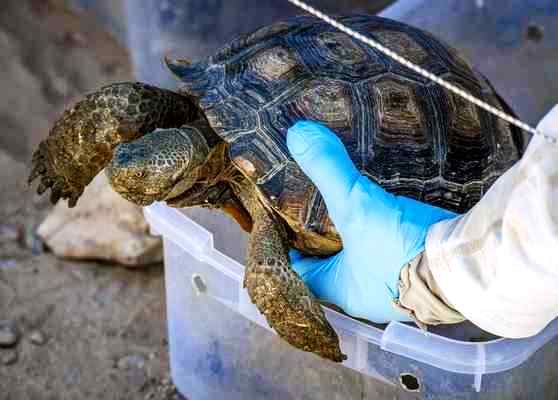
Biologists work with the USMC, BLM, the California and US Fish & Wildlife Services to relocate about 1,100 to 1,500 Desert Tortoises from the Bessemer Mine area of Johnson Valley in Twentynine Palms Marine Corps Air Ground Combat Center Wednesday. PHOTO BY ERIC REED

By David Danelski
The Press-Enterprise


Wildlife biologist Scott Welch looked out over the Mojave Desert and readied for action when he heard a distant helicopter flying in.

Just seconds after the aircraft landed, he and two others began loading it with plastic storage bins containing desert tortoises captured at an expansion area of the U.S. Marines Corps training base at Twentynine Palms.

They carefully packed 26 of the imperiled reptiles — one or two per bin — onto cargo carriers on the helicopter that looked like oversized saddlebags.

And within minutes, the tortoises were flying toward a safer haven of the recently created Mojave Trails National Monument — about 25 miles away from the crushing treads of tanks, the boots of soldiers and the blasts of bombs.

Operation Desert Tortoise was in its fifth day. As of Wednesday morning, 266 of the animals had been moved out of the Johnson Valley, about 30 miles northwest of Yucca Valley.

Before the end of the month, the Marines, working with about 125 wildlife biologists expect to have moved 1,156 tortoises, with a focus on clearing transportation corridors and other areas expected to be most disturbed by live-ammunition training missions.

It’s part of a multi-year, $50 million-plus tortoise relocation and study program at the base that was OK’d by the U.S. Fish and Wildlife Service following a 2013 vote by Congress to add about 88,000 acres in Johnson Valley to the combat center.

For the Marines, the expansion will allow them to hold longer and more-involved live-ammunition desert training missions to prepare Marines to intervene in global hot spots, such as the Middle East, should it be necessary. Such training is expected to start this summer.

For the tortoise, a species listed as threatened with extinction, it means the loss of more than a hundred square miles of quality habitat, as evidenced this year by robust blooms of yellow desert dandelions and other annual plants that are their primary food source.

The resources of the U.S. Defense Department were put to work to minimize harm to the tortoises, said Brian Henen, an ecologist for the Marine Corps Air Ground Combat Center at Twentynine Palms.

Analysis and field work for the move began more than two years ago. Scores of specially trained biologists have methodically walked the valley and fitted each tortoise they found with radio transmitters, so the animals could be gathered for this month’s move. It’s the largest tortoise move yet in the Mojave Desert.

The five areas of public land around the base that are receiving the animals were carefully chosen for their quality habitat and their distances from human habitation, Henen said.

Tortoises that lived near each other are being released in similar proximity in the recipient areas to preserve their social structure.

“We are moving them in groups. We are trying to sustain the similarity and the structure of their origin,” said Henen, standing by a makeshift medical checkup station for the tortoises.

There, Peter Praschag, a world-renowned tortoise and turtle expert from Austria, was working with veterinarian Shannon DiRuzzo to screen tortoises for signs of disease and other health issues.

A large male dubbed MC-2013 appeared frightened by the checkup and voided the water stored in his bladder, called a coelomic cavity. This was a serious matter, because a tortoise may get only one or two chances a year to get a good drink of water.

So Praschag used a syringe to carefully refill the animal’s coelomic cavity with a saline solution of water.

The work of the biologists won’t be finished until long after the last load of tortoises are flown out this month. Henen explained that the biologists will return frequently during the next four years to search for any reptiles that may have been left behind. They expect to move another 300 tortoises during that time.

The plans also include tracking and studying the relocated tortoises, as well as those already in the recipient area, for as long as 30 years. For this research, three groups of 225 tortoises — relocated ones, those already there and an unaffected control group — will be fitted with transmitters to track their movements and survival rates.

Biologists hope that the knowledge gained from this research will help the species recover.

But the loss of more than 100 square miles of prime habitat is still harmful to the tortoises, which has faced declines since the 1970s, prompting its 1990 listing under the Endangered Species Act, said Ileene Anderson, a biologist with the Tucson-based Center for Biological Diversity.

“It is going to be a big hit on the species,” she said.

She said it is not known if the public property outside the base will have enough food and other resources for both residents and newcomers to survive, and that wildlife biologists don’t know for sure why tortoises numbers have dropped in those areas.

She’s also worried that the tortoises may try to find their way back to their birthplaces in the base expansion areas.

But the U.S. Fish and Wildlife Service (FWS) determined in January that moving the tortoises from the Johnson Valley won’t jeopardize the survival of the species.

Scott Hoffman, who was observing the relocation effort for the FWS, said the species may benefit in the long run.

“Yes, we are losing habitat. But are we are using the relocated tortoises to supplement the populations in the critical habitat areas,” said Hoffman, referring to some of the recipient areas.

March 31, 2016

Tortoise a road block for Marines

Twentynine Palms Marine Corps Air Ground Combat Center expansion area in Lucerne Valley.

By DAVID DANELSKI
Press-Enterprise


An adult desert tortoise weighs about 12 pounds and can take days to travel a mile, yet the reptiles have managed to get one of most formidable forces on earth – the United States Marine Corps – to reconsider a large training mission.

The Marines plan to conduct live ammunition training in August, using tanks and other heavy weaponry at their Air Ground Combat Center at Twentynine Palms.

To prevent harming about 1,400 tortoises living in this stretch of the Mojave Desert, the military now plans to limit operations in its combat center expansion area in the Johnson Valley northwest of Landers.

The Marines had hoped to airlift the reptiles this spring to federally managed habitat land near Barstow to get them safely out of the way.

But military officials and federal land mangers recently announced that the relocation can’t proceed until they analyze how the move would affect tortoises and other wildlife already living in the recipient areas.

The spring move was canceled shortly after an environmental group, the Center for Biological Diversity, filed a legal challenge to it. Desert Tortoises are protected by the Endangered Species Act because they are listed as threatened with extinction.

Marine Capt. Justin E. Smith, a spokesman for Twentynine Palms, said by email that the extend of the use of 88,000-acre Johnson Valley expansion has not been determined, but training “will not negatively impact the desert tortoise species.”

The Marines “will comply with all environmental management requirements.”

Brian Croft, a biologist with the U.S. Fish and Wildlife Services, said he expects to talk with the Marines about how to avoid harming tortoises. The Marines, for example, may keep tanks and other motorized vehicles on designated roadways when traveling through tortoise areas.

The August training will be a large-scale, live-ammunition operation involving three battalions operating in extreme desert heat in real world warfare conditions, said Smith’s email. Last year’s exercises included troops from Canada and the United Kingdom.

The Johnson Valley has traditionally been an off-road-vehicle recreation area managed by the federal Bureau of Land Manage. But in late 2013, Congress added the valley to the Air Ground Combat Center.

Marine and BLM officials will hold a public meeting to discuss the Johnson Valley situation from 10 a.m. to noon Saturday, April 2, at the Lucerne Valley Community Center in Lucerne.

March 16, 2016

Military's tortoise relocation plan in jeopardy

The Marines were gearing up to move the reptiles to Bureau of Land Management habitat areas near Barstow to protect them from live-fire exercises

Twentynine Palms Marine Corps Air Ground Combat Center expansion area in Lucerne Valley.

By DAVID DANELSKI
Press-Enterprise


The military has scrapped plans to move more than 1,400 protected desert tortoises from an expansion area at the Marine Corps Air Ground Combat Center Twentynine Palms to BLM-managed habitat land this spring.

The Marines were gearing up to move the reptiles to Bureau of Land Management habitat territory near Barstow, so that the 88,000-acre Johnson Valley expansion area could be used this summer for live ammunition training.

A base spokesman said in an email Wednesday, March 16, that he is still trying to determine how the decision will affect the training plans.

The plan called for the tortoises to be moved as early as this month. To reduce stress on the animals, they were to be flown by helicopter to the Ord-Rodman Critical Habitat Unit, an area managed by the BLM southeast of Barstow. But the manager of the BLM’s Barstow Field Office, and Marines both sent emails Wednesday confirming that the move won’t be this spring.

The emails did not explain why the move was canceled.

But the postponement comes a week after environmentalists with the Center for Biological Diversity filed a legal challenge to the planned move. And it comes a day after a U.S. Fish and Wildlife Service official said the agency had not yet approved a required relocation plan.

Meanwhile, time was running out to get the tortoises moved before the military exercises – if they do end up being held. The animals are threatened with extinction.

Marine Corps officials had said they wanted to relocate the desert tortoises while the weather was cooler.
Hotter temperature puts more stress on them, making them less likely to survive the move, officials have previously said.

Last week, the Tucson-based Center for Biological Diversity filed a notice of intent to sue the BLM, contending that the agency had failed to fully examine how the move might harm desert tortoises and other wildlife.

Ileene Anderson, a biologist with the center, said in an email that she’s pleased the tortoises will stay put, at least for now, allowing more time for analysis.

“BLM is wise to do a full analysis of the impacts of having desert tortoises from the Marine base moved onto the public lands that they manage,” her email said.

She said she was concerned that the moves could spread a respiratory disease that afflicts tortoises.

On Tuesday, March 15, Brian Croft, a wildlife biologist for the U.S. Fish and Wildlife Service said the agency was still working on a relocation plan and a revised biological opinion about the move. The service must approve both documents before the move can occur.

“There are still some big hurdles to go over,” Croft said.

Also on Tuesday, Marine Corps Capt. Justin E. Smith said a date for the move will be announced once the relocation plan is finalized. The military also plans to study how the animals adapt to their new environment.

This research “will aid in gaining more information in the efforts to recover the population of the desert tortoise,” Smith said in an email.

“We remain steadfast in keeping with our obligation to serve as good stewards of the environment,” he said.

November 27, 2015

Dianne Feinstein’s Million-Acre Land Grab Falters

Sen. Dianne Feinstein (D-CA) (J. Scott Applewhite, AP)
by Chriss W. Street
Breitbart News Network


Three months after Breitbart News and others outed Sen. Dianne Feinstein's (D-CA) backdoor effort to freeze development on over one million acres of California dessert by having President Obama declare the area subject to the Antiquities Act of 1906, her efforts are going down in flames as Congressional Republicans are moving to ban the Antiquities designation.

Feinstein’s seven-year quest to convince Congress to sequester over 1,560 square miles of the Mojave Desert into three new national monuments under her proposed "Desert Conservation and Recreation Act” has gone nowhere. Feinstein has argued that the area she wants designated as ‘Mojave Trails, Sand to Snow and Castle Mountains’ is home to mountain lions, the California desert tortoise and bighorn sheep. But the real effort is to ban off-roaders, hunters and miners.

The Senator had faced opposition from an unusual coalition of sustainable energy developers, wilderness advocates, off-road vehicle users, military bases, energy companies and American Indian tribes. By trying to circumvent Congress through artificially tying up the property with a phony search for non-existent artifacts, she has incensed Republicans and upset many Democrats, who worry about future Presidential actions.

U.S. Rep. Paul Cook (R-CA), whose district covers the area Feinstein wants restricted, complained at a Congressional hearing in September that the Antiquities Act “sets in motion a Washington-based management plan that can sharply curtail recreational and economic activities. I’m deeply concerned that outreach efforts to the public have been hasty and inadequate.”

Cook, a retired U.S. Marine Colonel who won a Bronze Star and has two Purple Hearts from combat duty in the Vietnam War, has said that when he heard about Feinstein’s backdoor efforts, his number one goal was to stop Presidential action.

Cook is a staunch military supporter and sits on the powerful Armed Services, Veterans,’ and Foreign Services Committees. The military is a substantial user of the terrain that Feinstein wants walled off. Because the area contains the remnants of General George Patton’s World War II training camps, national security interests have been lobbying Cook to lead the opposition against Feinstein’s Congressional end run.

The California Chamber of Commerce and the California Taxpayers Association both oppose the Antiquities designation and have given Cook perfect 100 percent ratings for each year since he was first elected in 2007. They have lobbied the congressman to oppose any executive order by President Barack Obama regarding the area.

On October 1, 2015, Congressman Cook introduced HR 3668, the California Minerals, Off-Road Recreation, and Conservation Act (CMORCA). He described the bill as “a balanced approach to protecting, managing, and using our desert and forest areas in San Bernardino and Inyo Counties.” But the bill also bans designating the area under the Antiquities Act.

Cook’s bill creates would create a National Monument, but also opens 100,000 acres to mining, and designates Johnson Valley and five more off-highway vehicle areas as “National OHV recreation areas.”

The new designation would ban commercial development in those areas if the Secretary of the Interior determines the development is incompatible with the purpose of the bill. But the bill sets up the opportunity for development to be approved in a future Republican administration.

Although Senator Feinstein has continually claimed that desert residents are “overwhelmingly in favor” of the three monument designations she is pushing for, the City of Twentynine Palms, the City of Banning, and the San Gorgonio Pass Regional Water Alliance quickly signed on as supporters of Rep. Cook’s CMORCA.

Environmentalists have been shocked by the rising support for the CMORCA bill, which they call part of a a “radical anti-public-lands agenda” by House Natural Resources Committee Republicans, representing a “neo-sagebrush rebellion that appears to be emerging in certain Western states.”

The Rep. Cook’s California Minerals, Off-Road Recreation, and Conservation Act is expected to have its first House Natural Resources Committee hearing as early as December 9.

April 3, 2014

Cook continues Johnson Valley legislative efforts

Jose Quintero
Desert Dispatch


WASHINGTON • Rep. Paul Cook took another step this week toward permanently protecting the Johnson Valley Off-Highway Vehicle Recreation Area by introducing a bill that would give the land a special federal designation.

Cook, R-Apple Valley, announced in a news release Thursday that he had introduced H.R. 4371, which would make Johnson Valley the first national off-highway vehicle recreation area.

Cook, who represents the High Desert in the 8th Congressional District, announced last year that he had helped engineer a compromise that would save nearly 100,000 acres of the off-roading area, including the famed Hammer trails.

A portion of Johnson Valley is explicitly designated for off-highway vehicle use under last year’s deal negotiated with the Marine Corps. Cook, a retired Marine, says federally designating the area will ensure continued off-road access. Cook says the designation might seem like a small change, but it’s an important step to keeping the land under the authority of the Bureau of Land Management.

“It will show that Johnson Valley is of national significance, raising its profile for economic purposes and within the federal government, which owns the land,” Cook stated in the release.

The BLM estimates that Johnson Valley currently generates more than $71 million annually for local economies, according to the release. The King of the Hammers race alone draws an estimated 30,000 people to Johnson Valley each year.

“I’m proud to have been a part of the national campaign to save Johnson Valley last year,” Cook stated. “Johnson Valley is a national treasure and this bill formally recognizes it as such.”

December 16, 2013

Johnson Valley: Deal will have Marines, public sharing access

There were many twists and turns leading up to the compromise between off-roaders and the U.S. Marine Corps over access to Johnson Valley. (Pirate 4X4)

Written by K Kaufmann
The Desert Sun


A nudge from Sen. Dianne Feinstein, D-Calif., may have helped seal a compromise between off-roaders and the U.S. Marine Corps, ensuring that more than half of Johnson Valley’s 188,000 acres of prime off-roading trails and desert vistas will remain open to the public most of the year.

Rep. Paul Cook, R-Yucca Valley, recently announced the deal that would limit an expansion of the Marine Corps Air Ground Combat Center at Twentynine Palms into the valley to 88,130 acres and create a federally designated off-roading area on the remaining 99,690 acres.

Located in the high desert about 20 miles north of Yucca Valley, Johnson Valley is an off-roading mecca known worldwide for its mix of dry lake beds, open desert and rock-crawling trails — called the Hammers — where custom-built vehicles with massive tires fight their way up hills littered with rocks and large boulders.

But the same terrain that draws off-roaders and its location due west of the combat center also made it prime real estate for the Marines. The Corps has been working for years to expand the base at Twentynine Palms to allow for live-fire combat training exercises it has said are critical for its post-Mideast role as a streamlined expeditionary force.

Its plan for the valley, which the U.S. Navy approved earlier this year, would have appropriated more than 103,000 acres of the off-roading area for training at the base, plus another 43,000 acres that off-roaders would be allowed to use 10 months a year.

The deal, part of the National Defense Authorization Act the House passed late Thursday, would also allow the Marines to use 56,439 acres of the off-roading area for combat training up to 60 days a year but limits the kind of live ammunition that can be fired during combat exercises.

A Senate vote on the bill could occur sometime this week, said Matthew Groves, Cook’s legislative counsel.

While labeling the deal a victory, off-roaders also said the land the Marines will take includes some of the region’s most popular trails and isolated, back-valley areas.

“The trail systems we fought so hard for are still there,” said Larry McRae, an avid off-roader and president of Poison Spyder of Banning, a company that builds custom “armor” for the Jeeps and other off-road vehicles that batter themselves against the rocks in the Hammers.

“There’s a lot of open desert that’s been taken. What it takes away is some of the exploration opportunities. A lot of people enjoy the trail-making process.”

“Saying we lose 70-80,000 acres and calling that a win is tough,” said Dave Cole, co-founder of King of the Hammers, a week-long off-road racing event that yearly draws tens of thousands of visitors and significant tourist dollars to surrounding high desert communities.

The area going to the Marines also contains about 85 percent of the 112-mile course that was used for the King of the Hammers in 2013, he said. While the 2014 event, set for Jan. 31-Feb. 8, should not be affected by the Marines’ move into the valley, Cole said a new course on the remaining land will have to be developed for future races.

Residents of the small community of Johnson Valley, located across the highway from the off-roading area, also have mixed feelings about the deal. Many already experience noise and rattling windows during training exercises at the base, including recent combat exercises that ended Monday.

“I’m glad the Hammers were saved,” said Jim Hanley, 74, a Marine vet who served in Lebanon in the 1970s. “The shared use — it will bring the noise closer to us. The other night I thought something had hit the house, the noise was so bad.”

Keeping residents and off-roaders safe, while ensuring the Marines could train, were the issues allowing Cook, a retired Marine colonel, and Feinstein to find common ground during a recent meeting.

Feinstein had previously pushed the Corps to find a way to share the valley with off-roaders, representatives from her Washington office said.

The Corps also cited safety in their reasons for accepting the compromise.

“We feel this course of action is the best balance for military and recreational use of the land,” Capt. Maureen Krebs, a Marine spokeswoman, wrote in an email response to questions from The Desert Sun.

“Safety is a high priority for the Marine Corps and we want to ensure that both Marines and recreational users stay safe throughout the year.”

Many details of how the shared-use arrangement will play out are still to be determined, but Johnson Valley will not be the first time the Marines have shared land for recreational use, Krebs said.

The Marines share 45,000 acres of Toiyabe National Forest in Nevada, where they conduct mountain warfare training, and hunting and fishing are allowed on a number of bases across the country, she said.

December 11, 2013

Marines, offroaders reach compromise on Johnson Valley

Detailed final Johnson Valley OHVRA map available here.

by K Kaufmann
The Desert Sun


It’s not often a bunch of off-roaders can wrestle the U.S. Marine Corps to a compromise, but that seems to be exactly what’s happened as U.S. Rep. Paul Cook, R-Yucca Valley, on Wednesday announced a deal on Johnson Valley that allows both the Marines to conduct live ammo training in the region, but still preserves more than half of its 188,000 acres for off-roading and other recreation for 10 months a year.

Located in the high desert about 20 miles north of Yucca Valley, the disputed land has been an almost sacred site for the off-roading community, known worldwide for its unique mix of wide open desert and rock-crawling trails – dubbed the Hammers – where drivers in custom-built four-wheelers bump and grind their way up hills strewn with massive boulders.

A yearly week of racing called the King of the Hammers draws tens of thousands of visitors to the area, turning the valley floor into an encampment called Hammertown, which is half Coachella and half “Road Warrior.” The 2014 Hammers is scheduled for Jan. 31-Feb. 8, and event organizers have said the deal will keep the race rolling for years to come.

The off-roaders and the Marines have been in a standoff for a couple of years over whether the Corps would take over more than half of valley, 103,618 acres, for expanded training exercises involving three tank battalions, helicopters and a whole lot of live ammunition. The Marines argued such training exercises would be critical to their post-Mideast evolution into a streamlined expeditionary force, and nowhere else offered the land they needed.

Off-roaders are generally a patriotic bunch, lots of former military, but the threat to Johnson Valley sparked a determined opposition, backed up by the multimillion-dollar offroading industry. The Marines attempted a compromise, offering with a 43,049-acre shared use area, including the Hammers, open to off-roaders 10 months a year.

The remaining section of the valley, open to off-roaders year round would have been all but separate from the shared use area, connected by only a narrow corridor of land.

High desert communities, led by Yucca Valley, also got behind the off-roaders, noting that the King of the Hammers and other off-roading events in Johnson Valley meant full hotels and a boost for small businesses in the region. Residents of the small community of Johnson Valley, located across the highway from the off-roading area, have also opposed the expansion, mostly because current training exercises on the base already set their windows and furniture shaking.

A map of the deal announced Wednesday cuts the Marines back to 88,000 acres covering the north central and east sections of the valley. The off-roaders get a total of about 100,000 acres starting in the southeast corner of the region and curving up to the northwest, including a 56,000-acre shared-use area the Marines will be able to use for training for two months a year, again with limited types of ammunition.

Cook, a Vietnam veteran and retired Marine colonel, emerged as the mediator between the two camps earlier this year, after a visit to the 2013 King of the Hammers.

He authored a bill in the House, passed with bipartisan support and inserted in the Defense Authorization Act, that would have kept the whole valley under the jurisdiction of the Burea of Land Management, with the Marines allowed to train twice a year, but not allowed to use what is called dud-producing ammunition, that is bullets larger than a certain caliber.

Meanwhile, the Marines got their plan through a first hearing in the Senate Committee on Energy and Natural Resources on Nov. 14.

What happened between then and Wednesday is unclear. Cook’s release announcing the deal contains congratulatory quotes from all the stakeholders but no details of how the deal was struck.

November 20, 2013

Off-roaders would lose land to Marines in Senate bill

Johnson Valley
By Courtney Vaughn
Hi-Desert Star

JOHNSON VALLEY — A bill in the U.S. Senate is helping to push along the Navy’s request to expand military training grounds into Johnson Valley and Wonder Valley.

Last week, the Military Land Withdrawals Act cleared the Senate’s Energy and Natural Resources Committee. The legislation now heads to the Senate before it goes to the House of Representatives.

The bill would allow the military to use public lands in Johnson Valley and Wonder Valley, as well as land in Imperial and Riverside counties and Montana for military training exercises.

Military: Land is needed for training

As proposed, the bill would set aside 154,663 acres of land in San Bernardino County for training. That includes a 36,755-acre shared-use area between the military and public in Johnson Valley.

It would also give the Secretary of the Interior the authority to close public lands when deemed necessary for military or public safety or national security.

The Department of the Navy and local Marine Corps representatives have repeatedly said the extra land is necessary to conduct training exercises that can’t be done at the Marine Corps Air Ground Combat Center as it exists today.

“The training conducted would be tailored to suit a Marine Expeditionary Brigade-level unit, comprised of about 15,000 Marines,” Capt. Justin Smith, public affairs officer at the combat center, said via email. “Essentially, the training would be customized to ensure components of the unit would begin at different locations, spread apart by distance and terrain, with the purpose being to merge upon a single objective. The benefits of having a base that will allow for this type of training are unprecedented.”

Smith said having the extra land would allow Marines to train as they fight, rather than relying on classroom instruction and simulations.

Smith said the land chosen wasn’t the Navy’s preferred alternative, but it was carved out in response to public feedback.

Locally, the base expansion would bar public access to more than half of the area currently designated for off-road-vehicle use in Johnson Valley. As a compromise, the Navy designated a shared-use area, which allows for training exercises two months out of the year and gives the Secretary of the Navy management authority over the area during that those times. The Secretary of Interior would manage the shared lands for the rest of the year.

Earlier this year, Congressman Paul Cook suggested an alternative strategy for the base expansion. His recommended alternatives weren’t included in the Senate bill, which could become part of the National Defense Authorization Act.

“If that should happen, the House version of the NDAA contains Congressman Cook’s wording to protect Johnson Valley, and it will contradict the Senate’s version, which will contain the Marines’ request for Johnson Valley,” Dawn Rowe, a representative with Cook’s office, stated via email.

“If these two bills contain language that conflicts with each other, both houses of Congress must convene a conference committee to resolve the conflict.”

Under the Senate bill, an Exclusive Military Use Area would be created within the Morongo Basin, divided into four areas: about 103,000 acres to the west of the Marine Corps Air Ground Combat Center; another 21,000 acres south of MCAGCC; and two other areas, each about 300 square meters, inside the boundaries of the shared-use area.

The Department of the Navy would have access to the public lands for combined-arms live fire and maneuver training.

‘How much worse is it going to be?’

The military proposal has been met by heavy resistance within the Basin. Off-road-vehicle enthusiasts say the move infringes on public lands in Johnson Valley that are vital to recreation.

Johnson Valley is the nation’s largest ORV recreation area.

Residents in Johnson Valley fear noise during training periods and loss of revenue from the ORV community.

“I can sit here in my living room and I’m literally looking at where they’re gonna be training,” Betty Munson, a longtime Johnson Valley resident and vice president of the Homestead Valley Community Council, said Tuesday.

Munson characterized the land swap as “another disaster” for her community and the ORV recreation areas.

She said she and her distant neighbors already hear and feel the vibrations of ordnance training in Twentynine Palms, which rattle the house and scare her animals.

“How much worse is it going to be?” she said Tuesday, sighing at the thought of her future in the homestead cabin her family owns.

“It never occurred to us that something would happen to the Johnson Valley recreation area because as far as we were concerned, it had been set aside for ORV use,” Munson said. “We’ve been shut out of every other part of California.”

She said what’s most disturbing to her is that the Senate bill has been called “non-controversial” by legislators, yet more than 40,000 public comments were logged in the plan’s Environmental Impact Report.

June 14, 2013

Johnson Valley plan passes House

Johnson Valley OHV area is popular with off-road vehicle enthusiasts and hosts large off-road racing events throughout the year. (FILE PHOTO: DAILY PRESS)

Kris Reilly, City Editor
Victorville Daily Press


WASHINGTON • Paul Cook scored another victory Friday in his quest to save a popular off-roading area from a military takeover.

Cook, R-Yucca Valley, announced in a news release that his plan to create the Johnson Valley National Off-Highway Vehicle Area passed the U.S. House of Representatives as part of the National Defense Authorization Act.

The NDAA passed the House by a vote of 315-107 and will now move to the Senate. If passed by the Senate, the bill will reach the President’s desk for approval.

“... Johnson Valley is essential to the off-highway recreational vehicle community,” Cook said in the release. “The end goal is to ensure that the NDAA still has this Johnson Valley language in it when it reaches the President’s desk later this year. A lot can happen as the NDAA moves through the Senate, so it’s essential for supporters of my proposal to let Senators know how important it is to protect Johnson Valley for recreational use.”

The Johnson Valley OHV area is a vast expanse of desert east of Lucerne Valley. The site is popular with off-road vehicle enthusiasts and hosts large off-road racing events throughout the year.

The U.S. Marine Corps has its sights set on a westward expansion of its base in Twentynine Palms to establish a vast training area. The plan would permanently close a large portion of the OHV area and leave a small section for joint use by the Marines and the public.

Cook’s proposal would designate the Johnson Valley OHV area as a national recreation area, thereby severely limiting the Marines’ proposed expansion. Marine Corps activities would be permitted twice annually and could not include any explosives that could be left behind without detonating.

Cook is a former Marine who was awarded a Bronze Star and two Purple Hearts.

February 22, 2013

Aging gracefully: Desert plants live long past century mark

Joshua tree.
By Jimmy Biggerstaff
Hi-Desert Star


A saber-toothed tiger might have stepped on it. A mastodon shaking its behemoth body might have splashed water onto its leaves. And it still grows today.

The creosote clonal ring in Johnson Valley known as King Clone was one of the stars of the show when natural-history writer Chris Clark showed a slideshow of trees and plants that range from very old to ancient.

A full hall of desert aficionados assembled at the Black Rock Visitor Center Feb. 16 to hear Clark’s lecture on old growth.

Clark described the creosote’s clonal ring as “A single, living thing that has fallen into pieces.” Estimating the plant grows outward from the original plant’s germination point at one foot per 300 years, experts say King Clone sprouted 11,400 years ago.

This creosote may be the monarch of ancient life, but the desert is bursting with aged marvels, Clark told the audience.

He showed slides of buckwheat clumps that can live for 700 years. Iodine brush — more than 1,000 years. Clarke projected a photo of a particularly large and robust pencil cholla estimated to have sprouted up to 1,500 years ago.

Clark discussed some of the ways scientists determine a plant’s age and how slowly it grows. During a study in the Mojave Preserve’s Clark Mountain, botanists meticulously cataloged every plant in a plot of land, then returned 15 years later to observe changes.

By this method, they estimated life spans, but in some cases they could set no outward parameter because none of the plants of a specific species died, including buckhorn cholla and ephedra, or Mormon tea.

Not all ancients are plants. Clarke explained the centuries-long process that produces the varnish on desert pavement.

“In some aquifers,” Clarke said, “when you turn on the tap, that water hasn’t seen light since ground sloths roamed.”

Clarke’s first slide was from a favorite camping spot of his east of Cima Dome, a panorama of nearby granite, distant mountains and a Joshua tree forest. Clarke said Joshua trees generally have twice the lifespan of humans.

His next two slides showed the same tree photographed about 60 years apart. In the black and white version, Twentynine Palms pioneer photographer Burton Frasher had captured a particularly distinct-looking Joshua tree (aren’t they all?) growing in the desert northeast of Los Angeles.

The modern-day image of the same plant was the album cover for the band U2’s 1987 album “The Joshua Tree.” As Clarke flipped back and forth between the two images, it was apparent the plant hadn’t grown much in six decades.

Alas, that tree has since fallen over after a long and well-photographed life. Clarke said 300-year-old Joshua trees exist but are a rarity. They are relatively short-lived compared to other plants he mentioned in the lecture.

As the slide show continued, a Google Earth image showed a small, blurry blob Clarke identified as a 13-foot-wide clump of yucca northeast of the Mojave National Preserve. That ancient is no longer there, replaced by an array of solar panels.

September 22, 2012

Decision delayed on expansion of Marine base at Twentynine Palms

Johnson Valley, west of the Marine Corps Air Ground Combat Center at Twentynine Palms. (Don Bartletti / Los Angeles Times)

Los Angeles Times

The Navy and Marine Corps have delayed a decision on a controversial proposal to expand the Marine base at Twentynine Palms to include parts of Johnson Valley, a popular spot with off-road vehicle enthusiasts.

The Marine Corps says the acreage is needed to allow for large-scale live-fire training exercises for up to three battalions converging on the same target.

But off-roaders say that expanding the base into Johnson Valley could destroy its use for jeeps, motorcycles, dune buggies, ATVs, "rock-crawlers" and other vehicles. Johnson Valley is the site of the annual King of the Hammers race, billed as the toughest desert race in the nation.

The Marine Corps has offered a compromise that allow would off-road use of the area during parts of the year. Still, an environmental impact report done for the Marine Corps drew more than 1,000 comments in a month, many highly negative.

The Navy and Marine Corps had hoped to have a decision by October, but that deadline has now been pushed to November or December in order to provide time to review the comments, the Marine Corps announced Friday.

The land is controlled by the Bureau of Land Management. The expansion plan would be included in the annual defense budget, which would allow members of Congress to have a say.

June 18, 2011

Off-roaders and Marines in contention for rugged desert

The Corps wants to expand its Twentynine Palms base for major combat exercises, but civilians fear the loss of a popular recreational area.

Off-road vehicles stir up dust in Johnson Valley, where the Marine Corps wants to extend its Twentynine Palms base to accommodate major combat exercises. (John Herrick/CRAWL Magazine)

By Tony Perry
Los Angeles Times


Reporting from Twentynine Palms — Rough and rocky, Johnson Valley is considered the perfect place to test the mettle of men and their machines.

An estimated 200,000 people a year flock to the desert valley for recreational pursuits: hiking, camping, rock-hounding, star-gazing and a new sport called "geocaching," a treasure hunt using GPS technology. Moviemakers use the desert floor for chase scenes.

But the valley has gained its greatest acclaim in recent years as an untamed, unregulated venue for off-road vehicles. Off-roaders take their Jeeps, motorcycles, dune buggies, ATVs, "rock crawlers" and other souped-up vehicles over, around and through the rills and hills and rocks.

The annual King of the Hammers race, billed as the toughest desert race in the nation, draws more than 20,000 participants and spectators.

"There's not another place in the country where we could hold our race," said Dave Cole, one of the race organizers. "This is our Daytona 500."

The Marine Corps, whose Twentynine Palms base is directly adjacent to Johnson Valley, also likes the valley's challenging terrain — for similar yet different reasons.

The Marine Corps would like to include the land inside the boundaries of its Air-Ground Combat Center as a training area for large-scale, live-fire exercises where three battalions could simultaneously practice assaulting a fixed location. The land is controlled by the federal Bureau of Land Management.

Johnson Valley would give the Marine Corps a large-scale training capability it lacks at any of its bases, according to Marine brass. Even in a budget-tightening season when other projects are being dropped or trimmed, the Marine Corps has allocated $60 million for the expansion project.

Gen. James Amos, the commandant, considers the expansion "absolutely essential to providing the requisite training area for preparing Marines to meet the challenges of the future security environment."

The off-roaders look at the valley and see an exciting, irreplaceable place for their sport. Amos looks at the valley and sees a place to provide training that will enhance the "survivability" of Marines in combat.

The off-roaders and the merchants who depend on all the recreationalists are not going down without a fight. When the Marines opened up their expansion proposal for public review in May, more than 25,000 responses were received.

The Marines have offered a compromise: the heart of the Johnson Valley racing area would be available 10 months a year and closed for two months when a major exercise is planned.

But expansion skeptics feel that the dual-use idea would be withdrawn as soon as the first civilian wanders innocently or defiantly into the midst of Marine training or is hurt by ordnance left when the training is over.

The dispute features two sides that, philosophically, are aligned. Both believe in living life on the edge, facing down danger in the desert.

The Marine Corps sent a color guard to this year's King of the Hammers. Off-duty Marines have their own desert racing team. And expansion opponents, many of them military veterans, feel a twinge at opposing the Marines during a time of war.

"It's going to have a devastating effect on recreation," said Ray Pessa, a Yucca Valley activist. "National defense comes first, and if they say they need it, so be it. But I'm not sure they've looked at all the alternatives."

The Marines agree there are other expansion alternatives on the eastern and southern edges of the base but insist that none is as good as Johnson Valley on the west.

The final environmental impact statement is set for completion in early January. The Department of Navy's decision on which, if any, alternative to select is scheduled for April, in time for the issue to be sent to Congress for inclusion in the defense appropriations bill.

Beyond the effect on off-roaders and business owners, Betty Munson, with the Johnson Valley Improvement Assn., sees a loss of the freedom that lures people to the austere and often blisteringly hot desert.

"Johnson Valley is all that is left of the California desert where you can travel without any restrictions, go camping without a fee, go anywhere, any time," Munson said. "There's a lot of freedom out there that people won't have anymore."

Ninety percent of Marines deploying to Afghanistan come to the Twentynine Palms base for live-fire and other training called Mojave Viper. A re-created Afghan village has 1,500 buildings and is populated by up to 1,000 Afghan "role players." Marines are also taught to detect and dodge roadside bombs, the Taliban weapon of choice. Training is continuously tweaked to include lessons learned from the battlefield.

But what the base lacks is space to have three battalions converging on an "enemy" location.

Although the Twentynine Palms base is sprawling — 600,000 acres, compared to 125,000 acres at Camp Pendleton — there are various impediments to having a simultaneous live-fire exercise involving three battalions on the move. Among those impediments are federally protected tortoises.

The tortoise issue annoys the off-roaders. If there were more tortoises in Johnson Valley, that would probably kill the idea of annexing it to the base, said Cole, who loves Johnson Valley so much that he was married on one of its promontories.

"If I was having a tortoise race, that would be seen as valuable," said Cole. "But I'm having a people race, and that's not seen as valuable."

The Marine Corps has been studying expansion of Twentynine Palms for nearly a decade, with each study coming to much the same conclusion: Johnson Valley is the best alternative.

Under the Marine Corps' preferred alternative plan, 108,530 acres of Johnson Valley would be permanently closed to the public. An additional 38,137 acres would be open 10 months a year.

Although the issue involves federally managed land, members of California's Off-Highway Motor Vehicle Recreation Commission toured Johnson Valley in late May and, after hearing testimony from all sides, sent a letter to the Marine Corps saying it could not support the expansion plan.

Commission members suggested that the Marines look at sharing one of the spacious bases in California or Nevada belonging to other branches of the military, possibly the Army's Ft. Irwin, the Navy's China Lake, or Edwards Air Force Base. The Marines say that such an agreement would be overly expensive and impractical for a variety of reasons.

Daphne Greene, deputy director of California State Parks, said the Marines are to be complimented for seeking off-roaders' opinions and looking for a compromise. But the inclusion of Johnson Valley in the expansion plan would be too great a loss of a natural asset that Californians have long enjoyed, she said.

"We wouldn't let the Marines take over Yosemite," Greene said.

May 18, 2011

Marines invade Johnson Valley


JUDI BOWERS
Big Bear Grizzly


Johnson Valley -- Off-road and outdoor enthusiasts are doing their best to prevent losing the largest open area in the country to the Marine Corps.

Johnson Valley is thousands of acres bordered by the San Bernardino Mountains, Lucerne Valley, Yucca Valley and the Twentynine Palms Marine Corps Air Ground Combat Center. The Marine Corps states that Twentynine Palms is the only location in the country with the potential to expand the land area to meet training requirements for marine expeditionary brigades.

What that means is taking over approximately 168,000 acres of open land now known as the Johnson Valley Off-Highway Vehicle Area.

“I don’t like it,” says Quinn Thomas, owner of All J Jeep products in Big Bear Lake. The off-road enthusiast says there are serious safety concerns with the proposal as well as the significant loss of recreation land. “There aren’t many places left to go,” Thomas says.

May 26 is the end of the public comment period on the draft environmental impact statement. Thomas and other off-road and outdoor recreational enthusiasts are among the thousands who have submitted comments and urge others to do the same. Ray Pessa of Yucca Valley, who is a member of the Friends of Giant Rock, says the Marine Corps expansion will have a huge impact on the off-roading community. Friends of Giant Rock is an off-roading club in the high desert.

Alternative 6 is the preferred option by the Marine Corps. It leaves about 80,000 acres for recreational uses, according to information provided by the Marine Corps. About 44 percent of the land is available 10 months of the year.

The proposal calls for closing a majority of Johnson Valley permanently for use by the Marine Corps. Another section on the north side remains open while another parcel on the south corner will be used by the Marines about 48 days a year. The remainder of the time it will be available to the public.

That has Pessa and Thomas concerned. They question how the public knows there is nothing left behind from the live-fire exercises. They want guarantees no live ordinance is left before the public uses the area.

Additionally, there is no barrier between the public and Marine land, Pessa says. Fences are set up to protect wildlife, but not the public he says.

Pessa says he is also concerned that once an area is taken away, even though it’s promised to be a shared use, the public won’t get it back. He says off-road and other recreation activities will be crammed into a smaller area, which will lead to injuries and accidents.

More than 90 percent of the Marines that deploy to combat train in Twentynine Palms. Marines must train at a high state to be ready to respond to crises anywhere in the world. The expansion would provide space for a full scale exercise to be conducted twice a year for 24 continuous days during each cycle.

Pessa is torn. “I want them to have the best training they can get,” Pessa says of the Marine Corps. He would prefer the expansion went east instead of west as proposed.

Alternative 3 is preferred by off-road enthusiasts, which expands the base to the east, but was rejected in favor of Alternative 6. After several scoping meetings held in 2008-09, the Marine Corps responded by developing Alternative 6.

Comments on the Draft EIS are due by May 26. Comments can be made online at www.marines.mil/unit/29palms/las. A copy of the EIS is available online, along with maps and other information on the proposal.

Pessa says Johnson Valley is the largest public land area still open to the public. It’s a true wilderness, where you can go get lost and experience the desert. “I hate to lose it,” Pessa says.

January 4, 2010

Two ways of life collide in Wonder Valley

OUT THERE

Solitude reigns in the desert community until the off-road vehicles roar in. Then the tension escalates and tempers flare.


Al Gartner of the 29 Palms Historical Society inspects the remains of an adobe house at the Poste Homestead Natural and Historic Area. Preservationists say the area was damaged by off-road vehicle enthusiasts over the Thanksgiving weekend. (Irfan Khan / Los Angeles Times)

By David Kelly
Los Angeles Times


Reporting from Wonder Valley - Eric Hamburg bought a house in this valley of wrinkled mountains and sugar-soft sand to escape life in Los Angeles and drink in the empty solitude only the desert can provide.

"I loved the peace and quiet. I loved the tremendous sky. I loved the heat in the summer," he enthused about his remote getaway outside Twentynine Palms. "It was like a safety valve for me."

But he quickly became aware of another way of life, one far less conducive to quiet meditation.

"You see them buzzing around all the time and they just come closer and closer," he said of the men, women and children who blast joyously through the desert on rattling dirt bikes and quad runners.

Some own homes in Wonder Valley, just as Hamburg does. But John McEntire's idea of a good time is charging about in a dune buggy exploring old mines.

"It's been a lifestyle for us," said the 73-year-old outdoorsman. "I bought the place in 1979 so my family could ride on established trails. We go out, pick a lunch spot and make sure we leave no trash behind. I enjoy the camaraderie."

As desert communities go, Wonder Valley is the real thing, an eclectic array of artists, retirees, certified desert rats and second homeowners. There are no strip malls, fast-food joints or other signs of homogenized America.

Houses are cheap and often come with five-acre lots. The dirt roads -- and they're nearly all dirt -- slice through a confusing hodgepodge of private land and Bureau of Land Management property.

Because the place attracts seekers of all kinds, there's a natural tension. But lately it's escalated into intimidation, threats and accusations of vandalism.

Things came to a head on Thanksgiving weekend when critics said marauding riders deliberately overran a historic site that they'd worked hard to restore.

"We are crestfallen because of all the efforts and energy we put into this and in a matter of two days off-roaders destroyed it," said Phil Klasky, president of Community ORV Watch, a group dedicated to curbing illegal off-roading. "It's a culture clash."

Ray Pessa, president of Friends of Giant Rock, which fights for off-roader rights, said law-abiding riders shouldn't be penalized because others flout the rules.

"I have run into these guys myself. They have cussed me out and kicked up dirt in my face," he said. "But off-roaders take in all walks of life. A lot of them just want to feel the wind in their face."

He and others in the off-road community have scoffed at Klasky's version of what happened at the Poste Homestead Natural and Historic Area. They prefer to call it the Chadwick Hog Farm after its former incarnation, and have insisted that its historical value has been inflated to restrict riding.

"I don't think there was any concerted effort to do anything, and I didn't see a lot of damage," Pessa said. "I saw a lot of tire tracks and a small amount of trash."

The 1923 homestead is a humble site, essentially two low adobe walls surrounded by a grove of tamarisk trees. That's all that remains of the home of David Poste, a former miner and justice of the peace, credited with running Twentynine Palms' first telephone exchange.

A recent visit found tire tracks crisscrossing the sand dunes. Earlier in the year, volunteers had strewn twigs to trap seeds and grow plants. Most were gone.

"They did as much damage as they could. It was deliberate," said Pat Flanagan, resource advocate for the Mojave Desert Land Trust, as she examined the dunes. "That's where the kangaroo rats are, the seed banks and lizards. As soon as you get tracks on a place, it's a long time until they are gone, sometimes years."

San Bernardino County Sheriff's Deputy Scott Andrews, who showed up to make a report, said, "We get calls for service for motorcycles and ATVs out here all the time. The people I see are either plain dumb or they don't know the law."

The Bureau of Land Management office in Barstow has seven rangers to patrol the 3.2 million acres of desert it oversees in the area.

"As long as people stay on existing trails, then it's OK," said Mickey Quillman, BLM chief of resources. "It's just the fact that they drove off road into the dunes where there are fringe-toed lizards and animal burrows. It's a limited-use area. You can drive cars and motorcycles on the roads, but you can't take vehicles into the desert -- and people ignore it pretty regularly."

Johnson Valley -- with more than 180,000 acres the country's biggest sanctioned off-roading area -- is 40 minutes away, he pointed out.

Gary Daigneault, news director and owner of KCDZ-FM (107.7) in Twentynine Palms, has closely monitored the battle between the two camps. He sees blame on both sides.

"You have the 'jerk factor' of off-road vehicle owners who have hurt their own sport," he said.

"But I also think Klasky's description of what happened at the Poste Homestead was blown way out of proportion."

Klasky, a professor of ethnic studies at San Francisco State University who spends four months a year in Wonder Valley, is public enemy No. 1 to riders here.

In 2006, his group helped push through a county ordinance aimed at off-roaders that tightened regulations on noise, dirt and trespassing and required groups of 10 or more to purchase a $155 staging permits before assembling on any property, including their own.

Klasky said he was once punched by a man on a quad runner when he tried to photograph him on his property. He said he and others who dare to stand up to off-roaders are routinely threatened.

"I have been the subject of anti-Semitic hate speech and racist remarks. Last year my property was vandalized, but I will continue to organize and speak out," he said.

His biggest critic is Dan O'Brien, a hot dog vendor who runs Mustard's Last Stand in Twentynine Palms and also operates the Cactus Thorns blog, home to his sharpest barbs.

Sometimes he calls Klasky a meddling outsider and environmental extremist. He's also used epithets and referred to him as a tinfoil hat-wearing ding-a-ling.

"These guys came to an area that is rough-and-tumble and they brought their ideas of a desert utopia with them," he said.

"But people here are saying we have a desert lifestyle that has worked for over a hundred years. It's like moving next to an airport and complaining about the jet noise."

O'Brien, 58, denies his highly charged rhetoric intimidates people.

"I walk the line. I tippy-toe on that line but I would never instigate violence," he said. He sees off-roaders as an embattled minority.

"We feel we have lost the desert and now we are being put on these little reservations," he said. "We are starting to feel like Indians."

The battle is far from over.

The San Bernardino County Board of Supervisors may remove the controversial staging permit from the off-road ordinance this month.

Klasky said he figures he can get at least 100 people to the board meeting.

Pessa, of Friends of Giant Rock, said he can beat that.

"I am going to flood that meeting with off-roaders," he vowed.

December 29, 2009

Desert bill a mixed bag for locals

By KRIS REILLY, Editor
Lucerne Leader


LUCERNE VALLEY • The name may sound appealing to desert conservationists: the California Desert Protection Act of 2010. And the new bill introduced on Dec. 21 by Senator Dianne Feinstein (D-Calif.) does indeed protect some parts of the Mojave Desert.

However, the bill would leave open a huge portion of the Johnson Valley off-highway vehicle area for the expansion of the Twentynine Palms Marine Base, and it opens the door for massive wind and solar energy projects in the California Desert.

Included in the bill is the Mojave Trails National Monument, which would protect more than 940,000 acres of land, including some former railroad lands along Route 66. The Sand to Snow National Monument would protect about 134,000 acres from the Coachella Valley to Mt. San Gorgonio. The bill also adds to Death Valley and Joshua Tree National Parks and the Mojave National Preserve.

But the bill also seems to jibe with Alternative 6, the U.S. Marine Corps’ latest plan to expand its Twentynine Palms Base for training exercises. Under the plan, announced in late November, much of the Johnson Valley OHV area would be closed permanently. A portion would remain open to the public. Part of that area would be used for training exercises twice a year and would be open for public use about 10 months out of the year.

Alternative 6 was ostensibly a response to public comments on the issue, but most public comments were against a westward expansion. Alternative 6 still proposes a westward expansion with some changes to accommodate the public.

People close to the issue — such as Betty Munson, president of the Johnson Valley Improvement Association — believe that Alternative 6 may be a response to conferences with Feinstein, who wants to preserve the lands to the east of the base.

Whatever expansion plan the Marines eventually submit must be passed by Congress.

Munson criticized the language used in Feinstein’s press release, which stated that the bill would “enhance recreational opportunities.”

“I don’t know how that works; that’s government speak,” said Munson, pointing out the fact that a huge chunk of one of the country’s largest OHV areas would be shut down.

Munson said it also appears that the bill will make it easier for wind and solar plants to be developed. Munson is concerned that the desert countryside could be marred by these projects. She used Tehachapi and Banning as examples of how renewable energy projects can dominate an area.

“These projects proliferate ... They multiply on their own ugliness,” Munson said. “There was a time when there were no windmills in Tehachapi. There used to be poppy fields there, and it was gorgeous.”

Visit feinstein.senate.gov to view a summary, a map and a full copy of the bill.

December 27, 2009

McKeon, Lewis concerned about Feinstein's desert plan

By NATASHA LINDSTROM, staff writer
Desert Dispatch


BARSTOW • Citing concerns over suppressing critical development, Rep. Jerry Lewis is questioning Sen. Dianne Feinstein’s newly revealed plan to control 2,500 square miles of Mojave Desert land.

The legislation would create two separate national monuments to help protect hiking trails, bighorn sheep, desert tortoises and other animals and plants within various areas of the Mojave Desert, including Deep Creek and a 105-mile stretch of Route 66 between Ludlow and Needles.

“We are early in the legislative process and it will take time to assess the real impacts of this far-reaching lands bill,” Lewis, R-Redlands, said in a statement. “But I am extremely concerned that it locks up tens of thousands of acres that are not suitable for protection, and prevents other uses such as mining, energy development or military maneuvers that might better serve our national interests.”

Rep. Howard P. McKeon, R-Santa Clarita and Barstow's representative, said he is still reviewing the legislation to ensure his district’s land would not be negatively impacted, such as by the bill limiting training opportunities at the region’s three military bases.

“(McKeon) also wants to ensure that private property is protected, and he wants to make sure that Johnson Valley — the largest recreational off-road vehicle area — is not impacted,” said Lindsey Mask, spokeswoman for McKeon.

However, Lewis said he’s heard from several desert cities and groups in support of the legislation. He said he will keep a watchful eye over how the management of the vast new monuments will be funded, acknowledging the bill’s scope could change dramatically as it makes its way through the Senate and House of Representatives.

Under Feinstein’s plan, the larger preserve, Mojave Trails, would be a 941,000-acre parcel along a 105-mile stretch of old Route 66 ending on the California-Nevada border. The legislation would protect another 134,000 acres about 100 miles east of Los Angeles and make permanent five existing off-highway vehicle areas in inland Southern California.

The bill would allow construction of solar and wind farms on “suitable” desert land outside the protected area.

December 22, 2009

Legislation would set pair of national monuments

JOE NELSON
San Bernardino Sun


Sen. Dianne Feinstein (D-Calif.) on Monday introduced legislation that would establish two new national monuments in the Mojave Desert and set aside nearly 1.5 million acres of public land for preservation.

The California Desert Protection Act of 2010, if passed, would create the Mojave Trails National Monument, which would protect about 941,000 acres, including 266,000 acres of former railroad easements, along historic Route 66 between Ludlow and Needles.

In addition, it would establish the Sand to Snow National Monument, which would encompass 134,000 acres of land from the desert floor in the Coachella Valley to the peak of Mount San Gorgonio.

Feinstein's bill would help protect crucial wildlife corridors for the desert tortoise and bighorn sheep and shimmering desert landscape.

"Our desert parks are places of remarkable beauty, rich cultural history, and profound ecological importance," said Michael Cipra, program manager for the National Parks Conservation Association.

The bill builds off Feinstein's 1994 legislation that set aside 7 million acres of desert land and established Death Valley and Joshua Tree national parks and the Mojave National Preserve.

The new legislation would add nearly 74,000 acres of new land to the national parks and the national preserve. It would also designate as wilderness about 250,000 acres of public land near the Army's training center at Fort Irwin.

The bill also designates as permanent four off highway vehicle (OHV) areas. At the Johnson Valley OHV area near Twentynine Palms, the Marines have agreed to consider an option for base expansion that would allow for an exclusive military use area, an exclusive OHV area and a joint use area.

Dan Smuts, senior deputy regional director for the The Wilderness Society, said the sweeping legislation would protect an area nearly twice the size of Yosemite National Park, and would designate nearly 76 miles of waterways as wild and scenic rivers. They include the Deep Creek and Whitewater River near the San Bernardino National Forest and the Amargosa River and Surprise Canyon Creek near Death Valley National Park.

The second part of Feinstein's bill is geared toward the streamlining of the federal permitting process for renewable energy projects. It would, among other things, expedite the application process for solar development on private lands and require the Bureau of Land Management, the Forest Service and the military to complete environmental impact statements on their programs to develop renewable energy on the lands they oversee.

Shannon Eddy, spokeswoman for the Sacramento-based Large Scale Solar Association, said she had not yet reviewed Feinstein's proposed legislation and therefore could not comment.

James Conkle, founder of the Route 66 Alliance, said the bill will likely increase the amount of tourism on Route 66 from Needles to Barstow and breathe new life into sleepy desert pass-throughs like Amboy, Essex, Ludlow and Goffs. It could revitalize business and spur the re-opening of gas stations, motels and restaurants.

Supervisor Brad Mitzelfelt, whose district spans most of the High Desert, is concerned about the economic impacts the two proposed national monuments can have on the mining industry in the desert.

He embraces the legislation in how it protects OHV areas and other types of recreation like rock collecting and horseback riding and how it aims to harness future renewable energy projects.

"If this legislation passes, it will be a significant step toward drawing the line where remaining development in the Mojave Desert can occur and where it can't," said Mitzelfelt. "I fear legislation like this may be necessary because of the influx of renewable energy plants."

March 13, 2009

Alliance proposes establishing Route 66 national monument

By DAVID DANELSKI
The Press-Enterprise


Preservationists worried about military expansion and renewable energy development in the California desert are pitching a plan to create a vast national monument east of Twentynine Palms and protect 70 miles of historic Route 66.

The groups have been meeting with government leaders in recent weeks to enlist support for their far-reaching plan, which would:

Designate "Mother Road National Monument," which could be twice as big as Joshua Tree National Park.

Preserve an off-road vehicle area southeast of Barstow that has been threatened by expansion of a military training base.

Protect more than a half-million acres of scattered desert land donated to the federal government as open space but now subject to energy development.

Sen. Dianne Feinstein, D-Calif., signaled this week through an aide that she will craft legislation to protect the donated property.

Large-scale solar and wind energy projects are proposed on thousands of those acres.

The monument would encompass as much as 2.4 million acres in southeastern San Bernardino County, said Elden Hughes, a member of the Sierra Club California/Nevada Desert Committee.

The region is defined by desert valleys, stark mountain ranges and forgotten towns along the old Route 66, a major east-west route until interstates replaced it.

The Wildlands Conservancy, based in Oak Glen, raised about $45 million to buy Mojave Desert land from the Catellus Development Corp., a former arm of the Santa Fe Railway.

By donating land and cash, the group helped the federal government acquire nearly 600,000 acres to add to public land in the desert.

The U.S. Bureau of Land Management controls most of it.

Feinstein has not endorsed the Mother Road National Monument concept and other specific provisions sought by The Wildlands Conservancy, Sierra Club California/Nevada Desert Committee and Route 66 preservationists, said Feinstein spokeswoman Laura Wilkinson.

However, the senator plans to ensure the former Catellus land is protected, Wilkinson said.

"Senator Feinstein expects to introduce new legislation to protect additional desert lands in California, which would include a monument designation for the former Catellus lands," Wilkinson said in an e-mail.

Feinstein's office is evaluating what other desert lands may be suitable for protection, Wilkinson wrote.

David Myers, executive director of The Wildlands Conservancy, said he is encouraged by Feinstein's interest.

"This legislation could keep the Mojave Desert, the largest desert in California, intact for perpetuity," he said.

The monument idea drew a cautious response from the county supervisor who represents the area.

Supervisor Brad Mitzelfelt said he is worried about haphazard energy development and supports Route 66 preservation efforts.

"The idea of protecting Route 66 tourism and history is something I totally support," Mitzelfelt said. "Whether this is the way to do it, I am not sure."

History And Nature

The Mother Road National Monument would be named after John Steinbeck's description of Route 66 in his 1939 novel, "The Grapes of Wrath," which portrayed 1930s Dust Bowl refugees entering California to seek farm labor jobs.

The monument would contain about 70 miles of the route from Needles through the desert outposts of Goffs, Essex, Amboy and Ludlow.

It would be a tribute to American workers, Myers said.

Jim Conkle, chairman of the Route 66 Alliance, said the monument could become a destination for tourists wanting to experience Route 66's heyday -- the 1940s, '50s and '60s.

Crumbling buildings that housed midcentury gas stations, diners and motels could be renovated for those seeking retro kicks, he said.

Such an opportunity has been lost on other stretches of the route, where original roadside amenities have been torn down.

"We are trying to protect what's left," said Conkle, a retired AAA employee who lives in Phelan, west of the Cajon Pass. "We want people to get out and enjoy it."

The monument, however, would preserve much more than motoring history.

It also would take in a vast area between Twentynine Palms and the Colorado River, and the Mojave National Preserve and Joshua Tree National Park.

The designation would bring protection to patches of open desert surrounding 10 wilderness areas, created in the Desert Protection Act of 1994, said Hughes, of the Sierra Club. It would allow wildlife free movement.

Diverse Interests

The monument designation could block development in about a dozen areas where the BLM is processing applications for wind or solar projects at a time when the Obama administration and Gov. Arnold Schwarzenegger are pushing for such projects to cut greenhouse gases and create jobs.

A new monument also could limit options for proposed expansion of the Marine Corps Air Ground Combat Center at Twentynine Palms.

The coalition of environmentalists and history buffs have been working hard to overcome such obstacles through negotiation

"Right now we are going through vetting with user groups," Myers said. "There are a lot of moving pieces."

The proposal the groups are working on would preserve all existing uses on the affected federal lands and leave room for military expansion and solar and wind projects, he said.

Conkle said a key provision would keep the 189,000- acre Johnson Valley Off-Highway Vehicle Area permanently open to off-roaders.

Hundreds of off-roaders crammed public meetings last fall after the Marine Corps announced an expansion plan that could take in Johnson Valley.

Hughes said the monument proposal would include military expansion into the Bristol Dry Lake area.

San Francisco-based Pacific Gas and Electric Co. has plans for an 800-megawatt solar generation plant on 5,120 acres along Route 66 east of Amboy, a development Conkle said would spoil the view for motorists.

A monument designation could force the company to build elsewhere, he said.

Jonathan Marshall, a utility spokesman, said in an e-mail that alternative-energy projects "can be responsibly sited and developed in a manner that does not interfere with these conservation efforts."

Jim Conkle, chairman of the Route 66 Alliance, holds photos of the Mojave Desert near Amboy. The left photo shows the desert as it is, the right one as it would look if a proposed array of solar panels is built. The alliance is one of several history and environmental groups seeking to preserve the desert along historic Route 66 by establishing Mother Road National Monument, comprising about 2.4 million acres of the Mojave Desert. Stan Lim/The Press-Enterprise

February 25, 2009

The Dispute Over Johnson Valley

Johnson Valley Map. Look closely. One of off-roading's most beloved places could be lost. Photography by Kevin Blumer.

By Kevin Blumer
Off-Road Magazine


As off-roaders, we're used to getting closed out, locked out, and legislated off of the lands we dearly love to recreate on. Anyone who remembers the California Desert Protection Act will recall how millions of acres of the Mojave Desert were systematically removed from vehicular access with the help of the Sierra Club, the late Senator Alan Cranston, and Senator Dianne Feinstein. Off-roaders had little say in the matter even though we were directly affected by this legislative juggernaut. Senator Feinstein, a longtime ally of pro-Wilderness, anti-OHV special interests, turned a deaf ear to our cries. This time, it's different.

For those who haven't heard, the U.S. Marine Corps base in Twentynine Palms, California, is looking to expand and is considering the acquisition of the Johnson Valley OHV area. The new expansion area will be used for live-fire exercises as Marines train for combat.

Those who think this means only the loss of the infamous Hammer rock-crawling trails, which directly abut the western border of the Twentynine Palms Marine base, need to think again. The Marines might end up taking the whole Johnson Valley OHV area. This means we'll also lose access to the areas off of Camp Rock Road, Bessemer Mine Road, and Boone Road. This isn't just a threat to rock crawlers. This is a threat to truck and buggy racers, prerunner enthusiasts, dirt-bike riders, quad riders, and side-by-side UTV drivers. As off-roaders, we're all lumped into this together.

As U.S. residents, we depend on the Marines to keep us safe in the world. We deeply appreciate the service they provide and the freedom we enjoy. On an individual level, many Marines are avid off-roaders and appreciate the need for open land on which to recreate.

The Johnson Valley OHV area is to the west of the Twentynine Palms Marine base. But the Corps is also considering expanding eastward for training and war games. The off-road community needs to respectfully request the Marines' planning commission look elsewhere for new training grounds. We need to encourage eastward expansion, and discourage any westward movement.

A Chance To Speak Up

Why is it different this time? It's different because off-roaders have a listening ear in the Marine Corps. "We want to expand our base of operations in the way that will do the most good and will negatively impact the fewest people,"said Dr. Jim Cassidy of the Marines during an Open House Scoping Meeting in Ontario, California. His colleague, public-affairs specialist Captain Amy Malugani, concurred: "As we've held these meetings, we've heard lots of anecdotal evidence about how much the off-road community loves Johnson Valley. People have shared lots of emotion about their connections to Johnson Valley. While we appreciate the anecdotes and the emotion, we need quantification and hard facts in order to make our decision."

What does quantification mean in this instance? Cassidy shed some light: "We need to know how many people use Johnson Valley for recreation. We need to know how much money they've invested in their recreational equipment. We need to know where they're from and how long they've been going to Johnson Valley. Recently, a couple told us that they use off-road trips to Johnson Valley as a reward to their grandkids for being good. That example means that Johnson Valley has inter-generational significance. These are the types of quantification we're after."

How The Process Works

There are seven milestones along the way, three of which include opportunities for public comment. These are opportunities to make our voices heard.

Pursuant to the National Environmental Policy Act of 1969, federal agencies must analyze the environmental impacts of their proposed activities, producing an Environmental Impact Statement, or EIS.

Here Are The Milestones:

1. Notice of Intent to Prepare an EIS. This milestone was passed on October 30, 2008, and was an official public announcement of the military's intent to expand the Twentynine Palms Marine Corps Base.

2. Scoping Period. The Marines "scope" around for the public's input and presents a range of alternatives for the proposed expansion. There are six alternatives being presented. The Scoping Period began October 30, 2008, and ended January 31, 2009. It's December 15, 2008, as this is being written, and our lead time doesn't allow us to get this news in print any sooner. For this reason, we put this same information on our website, www.off-roadweb.com, during December '08. Even though the period for public comment ended on January 31, there are still two more opportunities for public comments down the line.

3. The Draft EIS is prepared. The Draft EIS will be prepared beginning February 1, 2009, and be finished by Spring 2010. No public comments are taken during this time.

4. Notice of EIS availability, followed by public meetings and comment period. Here's when we get to speak up. A federal register will notify the public that the Draft EIS is available. This will happen during Spring 2010. After the Draft EIS is available, there will be a 90-day period for public meetings and public comment.

5. The Final EIS will be written, taking public comments into account, during Winter 2010.

6. The Final EIS will be available for public comment for 30 days, and the public will be informed of its availability. This is another chance to voice opinions and state facts from our point of view.

7. A final decision will be made and announced during Spring 2011.

How To Take Action

Speak up! This means writing letters, sending emails, and making phone calls. You don't have to go through your Congressional representative. You can go directly to the Marines. When the next public comment period comes around in Spring 2010, be ready with your comments.

Our basic message to the Corps: The off-road community wants the Marines to expand the Twentynine Palms base to the East.

We need to tell the Marines how much we love playing in Johnson Valley, and we need to tell them how many people we bring with us and for how many years, and we need to tell them how much money we've invested in off-roading. The Marines recognize emotion, but they need the hard facts, too.

The Marine Corps has set up a website for this project. The site includes maps, links, and other information pertinent to this proposed expansion.

The website: www.29palms.usmc.mil/las

February 4, 2009

Residents plead: "Please fo east"

Marines present expansion proposal: Residents fill the community center at MAC meeting

Lucerne Valley Leader

LUCERNE VALLEY - Nearly a year after the Marine Corps announced its intention to expand the base at Twentynine Palms the Municipal Advisory Council hosted project representatives Colonel Wes Weston and Joe Ross, BLM Project Manager at their most recent meeting.

Lucerne Valley residents, off-roaders, miners and other stakeholders filled the Lucerne Valley Community Center to hear about the proposed Twentynine Palms Marine Base Expansion and to express their concerns.

Back in April 2008 the Bureau of Land Management and U.S. Marine Corps officials confirmed that permits had been issued to look into expanding the facility at Twentynine Palms possibly by as much as 100,000 acres into Johnson Valley. Since that time the Marine Base has proposed a total of six expansion alternatives.

The Johnson Valley alternative is the one that has the residents of Johnson Valley, Lucerne Valley and Yucca Valley the most concerned. More than 30 of those in attendance stood to express their views.

“I moved here because I am an off-roader,” said Robert Kleber, who currently lives on the boarder of the existing Marine Base. “I want my children to enjoy the desert as I have. If (the base) moves closer, we won’t be able to live here.”

Many residents who are not off-roaders noted that without the weekly influx of off-road dollars the town would be in serious economic trouble.

“Each weekend our economy gets a little boost,” said Bill Lembright of Lucerne Valley Market. “If that gets shut off, we’re done. Please go east.”

During a 30-minute PowerPoint presentation, Ross explained the government’s Title 10 requirement that Marines be trained to operate a combined arms force in three dimensions: land, air and sea. This training will require an area that would hold an entire Expeditionary Brigade of anywhere from 3,000 to 20,000 personnel and equipment. This training would take place for 48 to 72 hours of sustained offensive operations, twice a year.

“That is less than a week twice a year,” said MAC Chairman Tony Malone. “That doesn’t seem like very good use of our natural resources.”

Of those presenting views, most were very positive toward the Marine Base objective to provide soldiers with the best training possible, but asked that the expansion planners please consider the impacts that coming west into Johnson Valley will have on the Lucerne Valley way of life, as well as many others who use or will that area for recreation, mining, filming and possible future alternative energy sources.

“I respect what you are doing, but I choose to live here instead of Los Angeles so that my children do not have to listen to gun fire,” said a controlled, but emotional Robin Lopez. “If you expand toward Lucerne Valley, we will have to leave.”

Several young men in their late teens and early twenties spoke on the positive impact that Johnson Valley has had on their lives.

“Since I was just a little guy, I was in one of those motor-homes driving through Lucerne Valley every weekend. Spending quality time with my family riding motorcycles out here kept me from getting involved with drugs and gangs,” said Jensen Kime of Pasadena.

“I represent several mining interests,” said Doug Shumway of TerraMins Inc., Apple Valley. “There are many valuable mineral sites in that area that will be completely blocked off if the Johnson Valley area is closed. “This will cause negative economical impacts with San Bernardino County.”

The group “Partnership for Johnson Valley” also had representatives at the meeting from Encino.

Out of the 32 people who made comments only two were disruptive: one who wouldn’t stop when his time was up, and one who wheeled, under wraps, an old rusty World War II practice bomb up to the front of the room and dramatically whipped away the cover in front of the Colonel Weston to demonstrate her fear that her “children” might stumble upon whatever the Marines might leave behind.

She then began to verbally assault the Colonel, calling him a liar for telling the group that there would be no live ammunition used. The MAC board reminded her that in the PowerPoint presentation, Ross had stated specifically that the Marines would use live fire. As she started to get aggressive again, several people in the audience told her to stop and she eventually relented.

“I am very proud of Lucerne Valley!” stated MAC Chairman Tony Malone after the close of public comments. “And I am very proud of all of you for treating these people with respect, and for treating yourselves with respect.”

The meeting was then adjourned and those in attendance had the opportunity to speak with the Marine Base representatives and to view the maps of the six expansion alternatives.