Showing posts with label desert tortoise. Show all posts

December 28, 2016

President Obama declares Gold Butte a national monument


By GARY MARTIN
and HENRY BREAN
LAS VEGAS REVIEW-JOURNAL


WASHINGTON — President Barack Obama stepped into a swirling land-use controversy in Nevada on Wednesday and declared a swath of desert known as Gold Butte a national monument.

The declaration places 300,000 acres of land under the protection of the Bureau of Land Management. Obama used the Antiquities Act to shelter land between Lake Mead and the Grand Canyon.

In addition, Obama declared the Bears Ears region of Utah a national monument under the same law.

“I am designating two new national monuments in the desert landscapes of southeastern Utah and southern Nevada to protect some of our country’s most important cultural treasures,” Obama said in a statement released by the White House.

The president said his “actions will help protect this cultural legacy and will ensure that future generations are able to enjoy and appreciate these scenic and historic landscapes.”

Senate Democratic Leader Harry Reid and U.S. Rep. Dina Titus, D-Nev., had urged the president to designate the Gold Butte land in Nevada as a national monument, which provides greater protection and restrictions on land use. The area is known for rock formations and Native American artifacts.

Reid said Gold Butte “is quintessential Nevada.”

He thanked Obama and said the designation is a critical link to the state’s culture and history. “Gold Butte is a glimpse of what Nevada once was.”

Titus attended a news conference in Las Vegas following the president’s announcement. She said the beauty and history behind Gold Butte necessitated the designation as a national monument.

“Those are things you just can’t copy. You have to save,” Titus said. “And those are the things that are so precious to Nevada, to the planet and to future generations.”

OBJECTIONS VOICED

Gold Butte is near the ranch of Cliven Bundy, who along with local farmers and ranchers has sought to keep the property available for agricultural use.

Sen. Dean Heller, R-Nev., urged Obama not to designate the land as a national monument because of concerns by local constituents.

Heller said he was disappointed by the president’s action.

The senator said he has urged “all new land designations, especially ones in Nevada, to be considered in an open and public Congressional process.”

Nevada Gov. Brian Sandoval said he objected to the use of the Antiquities Act in designating Gold Butte as a national monument because it bypassed Congress and the public.

“We all share a common goal of enacting smart conservation measures which help preserve our lands for the use and enjoyment of all Nevadans,” Sandoval said. “My strong preference is for a more collaborative process when making such an important designation. I firmly believe our ranchers, environmentalists, and community stakeholders are the best experts in ensuring Nevada’s lands are preserved, protected and accessible.”

Conservatives have voiced concern about the lack of input in designations.

Those concerns resulted in an armed standoff with Bundy, his sons and their supporters, including militia and patriot groups that had gathered on the family’s Bunkerville ranch in April 2014.

Bureau of Land Management officials left the property following the standoff and did not return until 2016. A White House official downplayed any safety concerns and said there is no elevated enforcement status at Gold Butte.

Bundy faces criminal charges in federal court over the confrontation. He has claimed ancestral rights to the Gold Butte property.

The Bundy family, in a statement, said to Obama that “we are saddened, but not surprised, by your decision to make our ranch and home a national monument.”

Saying they have no problem with threatened wildlife or fees, the Bundy family said their fight “has always been about the constitutional limits on the federal government’s authority.”

EARLIER NATIONAL MONUMENT

This marks the second time Obama has used his authority to designate a monument in Nevada over the objections of rural officials and Nevada Republicans in Congress.

In July 2015, also with strong encouragement from Reid, the president established Basin and Range National Monument on 704,000 acres in remote Lincoln and Nye counties.

The U.S. Supreme Court has upheld previous actions by presidents, despite controversy over the use of the Antiquities Act to set aside public lands for conservation and to save artifacts.

No national monument declaration has been overturned by another president. Any repeal would take congressional action.

Conservationists and Native American tribes have long sought the protection of the Gold Butte area.

Gold Butte is filled with ancient rock art, sweeping desert vistas and twisted pastel-colored sandstone formations.

The area has suffered a great deal of damage from vandals and off-road vehicles since 2014, according to the Friends of Gold Butte, a local nonprofit group whose members monitor the area and advocate on its behalf.

“It’s a great day,” said Jaina Moan, executive director of Friends of Gold Butte. “We’re thrilled about the proclamation.”

The designation will help the Paiute tribes better protect the lands by allowing them to work hand-in-hand with the federal government, according to William Anderson, former chairman for the Moapa Band of Paiutes.

Anderson said the tribe members can provide expertise on what is culturally sensitive in the area while the federal government brings better protection and upkeep to the historic area.

“It allows so much potential for us to go ahead and closely monitor and closely protect the land that was originally ours,” he said.

Las Vegas conservationist Alan O’Neill has some experience with both Gold Butte and the Antiquities Act.

During his 13-year stint as superintendent for Lake Mead National Recreation Area, he dealt with Bundy’s rogue cattle at the northern end of the lake and helped set up Grand Canyon-Parashant National Monument just across the Arizona border from Gold Butte after President Bill Clinton designated the area in 2000.

FILLING THE VOID

O’Neill said Obama’s action Wednesday fills in the “void” between Lake Mead and the Grand Canyon, granting well-deserved protection for what he called “one of the greatest landscapes we have in the West.”

The monument will serve as a connection between Lake Mead National Recreation Area and the Grand Canyon-Parashant National Monument, protecting a wildlife corridor for desert bighorn sheep, mountain lions and the threatened Mojave Desert tortoise, said Christy Goldfuss, managing director at the White House Council on Environmental Quality.

According to the White House, the designation also will protect early 20th century ranching heritage and sites associated with Spanish explorers from the late 18th century.

In addition to Gold Butte, Obama designated 1.35 million acres in Utah as Bears Ears National Monument. The region includes cliff dwellings and land considered sacred to Native Americans. The designation also sets up a commission to ensure tribal expertise in management decisions.

Utah’s attorney general vowed to sue.

Since the Antiquities Act was passed, 16 presidents have designated 152 national monuments using the legislative authority, according to the National Parks Conservation Association.

The conservative Heritage Foundation has urged Congress to repeal the law, citing Obama’s use to set aside land in Colorado, Hawaii and Illinois as abuse of legislation originally passed to protect against the looting of archeological sites.

The Heritage Foundation said recent declarations have thwarted economic opportunity and removed states and private citizens from decisions made on land use.

August 31, 2016

Proposed final version of controversial Red Cliffs management plans released

Red Cliffs provides important habitat at the intersection of the Colorado Plateau, the Great Basin and the Mojave Desert.


Written by Julie Applegate
St. George News

ST. GEORGE – The Bureau of Land Management has released proposed resource management plans for two national conservation areas; the plans affect more than 100,000 acres of public land in Washington County and have been controversial.

The draft versions of the management plans for the Red Cliffs and Beaver Dam Wash national conservation areas stirred heated debate during the public comment period which ended in October 2015.

County, municipal and transportation officials believe the plans go too far in restricting land use, while conservationists favored more restrictive elements of the plans.

While county officials and others have not had a chance to fully review the proposed plans, Deputy Washington County Attorney Celeste Maloy expressed both appreciation and concern.

“We are so grateful for the participation of thousands of concerned citizens as well as local, state, and congressional elected leaders,” Maloy said.

“We asked for the public to comment last fall and the public responded,” Maloy said. “We asked for support from elected officials, and they stepped up as well. Our collective efforts paid off in some really positive ways.”

Early on in the process, county officials weren’t satisfied with the level of input they were being allowed on the resource management plans, Maloy said.

“Without a doubt, the communication and understanding between the county and the local BLM have improved during this process. We consider that a win. Local BLM staff listened to our concerns when we reacted to the draft plan.”

From an initial look at the plans, Maloy said, some of the changes from the initial draft to the proposed final plan released Tuesday are significant improvements; however, other issues addressed in the resource management plans will take continued work.

“For example, BLM’s final position on the Northern Corridor is disappointing. With all of the dialog between the county, cities, and federal agencies on that issue, we had hoped to have a more clear option to meet our future transportation needs,” Maloy said.

The county will continue to pursue all legal and political avenues to protect Washington County’s interests, she said.

Transportation officials are concerned that the resource management plans will prevent a long-planned Northern Corridor through the Red Cliffs National Conservation Area, which includes the Red Cliffs Desert Reserve, home of the endangered Mohave desert tortoise.

The draft resource management plan for the Red Cliffs National Conservation Area did not list the county’s optimal route in its “preferred” alternative.

History

A 90-day public comment period, which began July 16, 2015, was extended past the original Oct. 15 deadline to Nov. 16 after local officials demanded more time. A series of BLM open houses were held to help inform the public about the resource management plans.

The two national conservation areas are the first in Utah and were created by the Omnibus Public Land Management Act of 2009, known as OPLMA, to “conserve, protect, and enhance … the ecological, scenic, wildlife, recreational, cultural, historical, natural, educational, and scientific resources” of the public lands, according to a BLM statement.

The Red Cliffs National Conservation Area comprises 44,859 acres and is located just north and adjacent to much of the population of Washington County.

Red Cliffs provides important habitat for the threatened desert tortoise and many unusual plant species in the intersection of the Colorado Plateau, the Great Basin and the Mojave Desert. This area includes a stretch of the Virgin River and a number of popular trails.

The Beaver Dam Wash National Conservation Area covers 63,478 acres and is located in the southwest corner of Utah. The area contains many native plants and animals which have evolved into unique species, some found nowhere else on earth.

Beaver Dam Wash includes the northernmost range Joshua trees and riparian areas that are important stops for migratory birds; the area is also known for remote recreation opportunities such as hiking, rock climbing, horseback riding and wildlife viewing.

A proposed amendment to the St. George Field Office resource management plan has also been released. The proposed amendment addresses two primary management issues: identification of areas where biological conservation is a priority and modifications of the off-highway vehicle area designations to prepare for the development of a comprehensive travel management plan.

Protest period

The publication in the Federal Register of the Notice of Availability by the Environmental Protection Agency of the proposed plans will initiate a 30-day protest period. That is expected to happen Friday, Bureau of Land Management Color Country District spokesman Christian Venhuizen said.

However, copies of the proposed final plans were provided Tuesday to give the county and others more time to review and respond to the documents, he said.

Anyone who participated in the planning process and who has an interest that is or may be adversely affected by the planning decisions may file a protest within 30 days of that publication, BLM information states.

The protest period is not the same as the public comment period, Venhuizen said.

“This is a slightly different period … we’re not looking for public comment,” he said. While the public is invited to review the documents, the official public comment period has passed.

However, the resource management plans cannot be finalized by Records of Decision until all the protests are resolved, Venhuizen said.

The Governor’s Consistency Review began last week and gives the Governor’s office a minimum of 60 days to review the resource management plans before the records of decision are signed, Venhuizen said.

Details

The proposed plans and amendment, along with a final environmental impact statement, are available to view or download from the BLM’s ePlanning website here.

Copies of the documents are available for inspection at the Interagency Public Lands Information Center, 345 East Riverside Drive in St. George, and the BLM Utah State Office Public Room, 440 West 200 South, Suite 500 in Salt Lake City. The documents are available during from 8 a.m. to 4:30 p.m., Monday through Friday, except on federal holidays.

All protests must be in writing and mailed to one of the following addresses:

  • U.S. Postal Service: BLM Director (210), Attention: Protest Coordinator, P.O. Box 71383, Washington, DC 20024–1383.
  • Overnight Delivery: BLM Director (210), Attention: Protest Coordinator, 20 M Street SE, Room 2134LM, Washington, DC 20003.

Before including your address, phone number, email address, or other personal identifying information in your protest, you should be aware that your entire protest — including your personal identifying information — may be made publicly available at any time. While you may ask the BLM in your protest to withhold your personal identifying information from public review, the BLM cannot guarantee that it will be able to do so.

For additional information, please contact Keith Rigtrup at 435-865-3000.

March 31, 2016

Tortoise a road block for Marines

Twentynine Palms Marine Corps Air Ground Combat Center expansion area in Lucerne Valley.

By DAVID DANELSKI
Press-Enterprise


An adult desert tortoise weighs about 12 pounds and can take days to travel a mile, yet the reptiles have managed to get one of most formidable forces on earth – the United States Marine Corps – to reconsider a large training mission.

The Marines plan to conduct live ammunition training in August, using tanks and other heavy weaponry at their Air Ground Combat Center at Twentynine Palms.

To prevent harming about 1,400 tortoises living in this stretch of the Mojave Desert, the military now plans to limit operations in its combat center expansion area in the Johnson Valley northwest of Landers.

The Marines had hoped to airlift the reptiles this spring to federally managed habitat land near Barstow to get them safely out of the way.

But military officials and federal land mangers recently announced that the relocation can’t proceed until they analyze how the move would affect tortoises and other wildlife already living in the recipient areas.

The spring move was canceled shortly after an environmental group, the Center for Biological Diversity, filed a legal challenge to it. Desert Tortoises are protected by the Endangered Species Act because they are listed as threatened with extinction.

Marine Capt. Justin E. Smith, a spokesman for Twentynine Palms, said by email that the extend of the use of 88,000-acre Johnson Valley expansion has not been determined, but training “will not negatively impact the desert tortoise species.”

The Marines “will comply with all environmental management requirements.”

Brian Croft, a biologist with the U.S. Fish and Wildlife Services, said he expects to talk with the Marines about how to avoid harming tortoises. The Marines, for example, may keep tanks and other motorized vehicles on designated roadways when traveling through tortoise areas.

The August training will be a large-scale, live-ammunition operation involving three battalions operating in extreme desert heat in real world warfare conditions, said Smith’s email. Last year’s exercises included troops from Canada and the United Kingdom.

The Johnson Valley has traditionally been an off-road-vehicle recreation area managed by the federal Bureau of Land Manage. But in late 2013, Congress added the valley to the Air Ground Combat Center.

Marine and BLM officials will hold a public meeting to discuss the Johnson Valley situation from 10 a.m. to noon Saturday, April 2, at the Lucerne Valley Community Center in Lucerne.

March 16, 2016

Military's tortoise relocation plan in jeopardy

The Marines were gearing up to move the reptiles to Bureau of Land Management habitat areas near Barstow to protect them from live-fire exercises

Twentynine Palms Marine Corps Air Ground Combat Center expansion area in Lucerne Valley.

By DAVID DANELSKI
Press-Enterprise


The military has scrapped plans to move more than 1,400 protected desert tortoises from an expansion area at the Marine Corps Air Ground Combat Center Twentynine Palms to BLM-managed habitat land this spring.

The Marines were gearing up to move the reptiles to Bureau of Land Management habitat territory near Barstow, so that the 88,000-acre Johnson Valley expansion area could be used this summer for live ammunition training.

A base spokesman said in an email Wednesday, March 16, that he is still trying to determine how the decision will affect the training plans.

The plan called for the tortoises to be moved as early as this month. To reduce stress on the animals, they were to be flown by helicopter to the Ord-Rodman Critical Habitat Unit, an area managed by the BLM southeast of Barstow. But the manager of the BLM’s Barstow Field Office, and Marines both sent emails Wednesday confirming that the move won’t be this spring.

The emails did not explain why the move was canceled.

But the postponement comes a week after environmentalists with the Center for Biological Diversity filed a legal challenge to the planned move. And it comes a day after a U.S. Fish and Wildlife Service official said the agency had not yet approved a required relocation plan.

Meanwhile, time was running out to get the tortoises moved before the military exercises – if they do end up being held. The animals are threatened with extinction.

Marine Corps officials had said they wanted to relocate the desert tortoises while the weather was cooler.
Hotter temperature puts more stress on them, making them less likely to survive the move, officials have previously said.

Last week, the Tucson-based Center for Biological Diversity filed a notice of intent to sue the BLM, contending that the agency had failed to fully examine how the move might harm desert tortoises and other wildlife.

Ileene Anderson, a biologist with the center, said in an email that she’s pleased the tortoises will stay put, at least for now, allowing more time for analysis.

“BLM is wise to do a full analysis of the impacts of having desert tortoises from the Marine base moved onto the public lands that they manage,” her email said.

She said she was concerned that the moves could spread a respiratory disease that afflicts tortoises.

On Tuesday, March 15, Brian Croft, a wildlife biologist for the U.S. Fish and Wildlife Service said the agency was still working on a relocation plan and a revised biological opinion about the move. The service must approve both documents before the move can occur.

“There are still some big hurdles to go over,” Croft said.

Also on Tuesday, Marine Corps Capt. Justin E. Smith said a date for the move will be announced once the relocation plan is finalized. The military also plans to study how the animals adapt to their new environment.

This research “will aid in gaining more information in the efforts to recover the population of the desert tortoise,” Smith said in an email.

“We remain steadfast in keeping with our obligation to serve as good stewards of the environment,” he said.

March 8, 2016

Tortoise relocations challenged

Desert tortoises, such as this adult photographed near the Ivanpah Valley, are listed as threatened with extinction. The Marine Corps plans to move more than 1,100 of them from 88,000 acres in the Johnson Valley, northwest of Landers, to protect them from live fire exercises planned for this summer. (STAN LIM)

BY DAVID DANELSKI
Press-Enterprise


An environmental group filed a legal challenge Tuesday, March 8, to the military’s plans to move more than 1,400 protected desert tortoises out of an expansion area at the Marine Corps Air Ground Combat Center at Twentynine Palms.

The Center for Biological Diversity filed a notice of intent to sue, contending that federal agencies have failed to fully examine how the move might harm the Mojave Desert tortoises as required under the Endangered Species Act. Such a notice is required before a lawsuit may be filed in federal court.

Tortoises are listed as threatened with extinction, but the Marines say they have to move them from 88,000 acres in the Johnson Valley to protect the reptiles from live ammunition training exercises planned for this summer.

The center argues that studies have shown that half of the tortoises will perish within three years of being moved in part because they haven’t found or dug underground burrows that give them shelter and protection from coyotes and other predators.

Military officials could not be reached Tuesday, but last week Walter J. Christensen, head of the training center’s conservation branch, and Marine Corps Lt. Col. Timothy B. Pochop, director of natural resources and environmental affairs at the training center, said the Marines are taking great care and expect most of the animals to survive.

Using helicopters will reduced stress from travel, and military officials are choosing release sites that are less likely to be prowled by coyotes, they said. And individuals from the same social groups will be placed near one another.

Most of the animals will be moved to federal land southeast of Barstow known as the Ord-Rodman Critical Habitat Unit, which is overseen by the federal Bureau of Land Management.

Ileene Anderson, a biologist with the center, said the group has seen no evidence that the military has analyzed impacts to tortoises and other wildlife already living in the critical habitat area, which has a limited amount of food, water and other resources.

Such an analysis is required under the National Environmental Policy Act, she said.

“This massive translocation proposal is being rushed through the process this spring without fully considering how it may affect the already declining tortoise population in the western Mojave,” said Anderson. “What we should be doing is recovering this population, not pushing it closer to extinction.”

The move has not yet been approved by the U.S. Fish and Wildlife Service, which still needs to sign off on the relocation plan and an analysis that showed that the move would not jeopardize the survival of the species, said Brian Croft, a biologist with the wildlife service.

Military officials want to start moving the tortoises as early as this month while the weather is still cool. The relocation is expected to take a team of about 100 biologists as long as two to four weeks to complete.

Croft said such a move should be done by mid-May – before it gets too hot for the reptiles to be above ground. The tortoises survive the desert’s harsh climate by spending the hottest and coldest months in their subterranean burrows.

The planned move stems from a 2013 decision by Congress to expand the Marine Corps Air Ground Combat Center to enhance live ammunition training operations deemed necessary for national security.

Taxpayers to shell out $50M for Marines to evacuate 1,200 Mojave tortoises

The tortoises are in the way of the Marines' planned expansion of a combat training grounds. (US Marine Corps)

Foxnews.com

Taxpayers will be forking over $50 million to have the Marines remove nearly 1,200 tortoises from future training grounds in the Mojave Desert, but similar efforts in the past have proven disastrous, say environmentalists.

The desert tortoises, already under stress from drought, disease and human interference, will be airlifted later this month from 130,000 acres surrounding the Corps' Air Ground Combat Center. The center is undergoing an expansion to facilitate live fire and maneuver training for full-scale Marine Expeditionary Brigade-sized elements.

"This spring, the Marine Corps will translocate approximately 1,180 desert tortoises in order to safeguard the animals coming from lands newly acquired through an NDAA-mandated (National Defense Authorization Act) land withdrawal that supports Marine Corps-mandated training requirements," base spokesman Capt. Justin Smith wrote in an e-mail to the Desert Sun.

The area slated for expansion is in prime tortoise habitat, and the number of breeding adults has dropped by about 50 percent over the last decade, according to a recent survey by federal biologists.

Some environmentalists are against the pricey effort to relocate the tortoises, which can stress the animals and leave them vulnerable to dehydration, predators and human interaction, they said.

"I wish the U.S. Fish and Wildlife Service would get some backbone and say it can't permit another tortoise translocation by the military," Glenn Stewart, a biologist and member of the board of directors of the Desert Tortoise Council conservation group, told the Los Angeles Times. "The situation makes us feel like we'll have to write off California's Mojave population."

In 2008, the Army moved 670 tortoises from its National Training Center near Barstow to new homes in the western Mojave. That $8.6 million effort proved disastrous when it was learned that a large percentage of them died within a year, many eaten by coyotes.

Brian Henen, a biologist and head of the Marine Corps' translocation effort, told the Times the project's ample budget and commitment to monitor the tortoises for 30 years "demonstrates how much we care about this species."

The plan, approved by the U.S. Fish and Wildlife Service, will utilize 100 biologists who will capture 900 adult tortoises and put transmitters on them before releasing them on nearby public lands. Another 235 hatchlings raised in pens at the base also will be relocated once they are strong enough to survive on their own. The project will take an estimated two to four weeks to complete, officials said.

The Combat Center raises the hatchlings in its 6-acre Tortoise Research and Captive Rearing Site, which is operated jointly with UCLA.

The desert tortoise is classified as a threatened species because its numbers have declined rapidly over the past few decades due to predators and disease. Soft shells leave young tortoises vulnerable to predators ranging from ants and ground squirrels to ravens and coyotes.

October 20, 2015

Helicopter crash marks troublesome cattle roundup near Searchlight

Wild, feral, and menacing cattle of the McCullough Range near Searchlight, NV.
By Henry Brean and David Becker
Las Vegas Review-Journal


The wild remnants of one of southern Clark County's last cattle herds are now being cleared from the mountains between Henderson and Searchlight, but the work so far has not gone smoothly.

A crew of cowboys from Utah is gathering stray and feral cows from the McCullough Mountains under a contract with the Nevada Department of Agriculture.

Flint Wright, animal industry administrator for the department, said the operation started Friday and has no scheduled completion date. As of Monday, just 17 cows had been collected.

"They're essentially wild cattle, and it's going to take some time," Wright said.

The roundup hit a major snag Sunday, when a helicopter being used to find and chase cows crashed just off state Route 164 west of Searchlight.

On Tuesday, the wrecked helicopter and its pilot could still be found at a motel in the town 60 miles south of Las Vegas.

Richard Dick of Hutchinson, Kan., said he was hovering about 12 feet off the ground, trying to move a pair of stubborn bulls, when a gust of wind pushed his helicopter into a Joshua tree. The 1962-vintage Bell model 47G ended up on its side in pieces, but he walked away with bumps and bruises.

The pilot said it was his first domestic accident in 17,000 hours of flying, though he crashed three times in Vietnam.

When he climbed out the wreckage Sunday, Dick said, the bulls were just staring at him.

The cattle now being rounded up have roamed the range untended since 2006, when rancher Cal Baird relinquished his federal grazing permit and sold his water rights to the county to preserve habitat for the desert tortoise and other federally protected species.

According to the Bureau of Land Management, Baird moved most of his livestock from the 111,000-acre federal grazing allotment to Arizona, but a few stragglers were left behind.

For the past several years, officials say, those survivors and their unbranded descendants have been damaging springs and menacing people in the mountains and desert between Interstate 15 and U.S. Highway 95 south of the Las Vegas Valley.

BLM spokeswoman Kirsten Cannon said the animals are aggressive and "present a danger to the public recreating in the area."

Wright said: "We've had some complaints from people who were hunting deer and were run off by the cattle."

Baird could not be reached for comment.

Under Nevada law, unbranded stray or feral livestock are considered state property. The BLM has been asking the state to remove the unclaimed cattle from the McCullough Range for several years.

In 2013, the state rounded up and sold off approximately 30 animals, but an unknown number remain. Last year, the BLM counted about 40 unbranded cows spread across two wilderness areas west of Searchlight. Wright guessed there could 100 to 200 feral cows still out there.

He figures it would cost the state as much as $200,000 to try to collect that many animals. The Department of Agriculture has been "trying to get this deal cleaned up for a number of years," but it never seems to have the money or the resources, he said.

The animals are now being rounded up by Sun J Livestock, a ranching operation from Vernal, Utah. Wright said the ranchers aren't being paid directly, but they have plenty of incentive to do a thorough job.

"They get to keep the livestock," he said. "They'll get every cow they can."

September 15, 2015

Gopherus Agassizii: A Cultural History of Tortoises

A juvenile desert tortoise. (Wbrice83186/Wikipedia/Crerative Commons)

The Mojave Project

Kim Stringfellow
KCET.org / Artbound


The desert tortoise has been under siege by humans long before the Mojave Desert's militarized and suburbanized landscape began to take shape here. It is known that several ancestral tribes in the Southwest consumed them, and even if they chose not to they managed to use their various parts -- the carapace or upper shell, the plastron or lower shell for bowls, scrapers and other household effects. All of the Mojave tribal groups transformed tortoise shells into rattles and drums for ceremonial use. Other tribes, such as the Chemehuevi, kept them as pets while at the same time venerating tortoises as a mythological symbol of "patience, stamina for survival, and courage in hopeless situations."1 In many world cultures, including several indigenous tribes of North America, the universe is depicted on the back of a turtle or "cosmic" tortoise. Even while sacrificed for sustenance, utilitarian or ritualistic purposes, none of these indigenous uses come anywhere close to modern anthropogenic attacks on this environmentally vulnerable indicator species.

Though not so popular as a menu item today as in the past, tortoises remain a culturally significant symbol. In Jessica Speart's 1998 fictional "eco-mystery" "Tortoise Soup," the story's main protagonist, a female U.S. Fish and Wildlife officer, is transferred out to the Mojave to unravel why 350 endangered desert tortoises have suddenly disappeared from a federal research site in Nevada. Earlier popular representations of the tortoise (not necessarily the desert tortoise) include Disney's 1934 animated fable "The Tortoise and the Hare." The moody instrumental band Tortoise states on their Twitter page: "the Thrill Jockey band from Chicago, not the land-dwelling reptile." In neighboring Twentynine Palms we even have a new Indian casino named after them.

Turtles and tortoises are also frequently featured in art. When Robert Rauschenberg and Lucinda Childs staged "Spring Training" in 1965, the performance involved 30 roving desert tortoises with flashlights taped to their backs. In August 2014, outraged online petitioners called on the Aspen Art Museum to shut down a site-specific installation by artist Cal Guo-Qiang titled "Moving Ghost Town," involving three rescued African spurred tortoises (Centrochelys sulcata) -- each with video-displaying iPads temporarily mounted on their backs with silicon. The conceptual artwork displayed film footage of three nearby ghost towns captured previously by the roaming tortoises named Big Bertha, Gracie Pink Star, and Whale Wanderer. Although the museum's website states that the project was conducted in close consultation with the Turtle Conservancy and a local veterinarian who monitored the tortoises on a weekly basis, animal rights activists and others expressed outrage that the tortoises were being used as "artist supplies." (Disclosure: I signed the petition.) The website goes on to mention that "In Chinese symbolism, tortoises represent creation, time, longevity, and wisdom; they are associated with the North direction -- that of death and rebirth... [and] are seen as supernatural spirits." The Aspen exhibit closed earlier than expected when acting veterinarian Dr. Elizabeth Kremzier decided that unseasonable inclement weather would harm them. The museum insisted in a press release that the decision was not due to outside pressure. The concerns expressed by the public for these tortoises illustrate how deeply humans often react to the welfare of these ancient and venerated creatures.

Found slightly above sea level on an elevation of about 4,200 feet in several vegetation types of the Mojave, Colorado and Sonoran deserts, desert tortoises of the American Southwest are now determined to be of two distinct species with Gopherus agassizii residing north and west of the Colorado River, whereas Gopherus morafkai is located east and south of it. As a flagship species, the current status of their populations tells us a lot about the health of the arid ecosystems. During the 1970s, hundreds of desert tortoises could be found within a square mile in some Mojave and Colorado desert habitats -- today one may find only a few dozen individuals in the same areas. Understandably, the desert tortoise has been listed as a federally threatened species since 1990.

Tortoises are commonly confused with the turtle but unlike their reptilian cousin they are a terrestrial being tied to land rather than water. When fully mature desert tortoises weigh 7 to 15 pounds and are 7 to 15 inches in length. Although it is difficult for an untrained eye to tell the gender of a particular tortoise, males are typically larger, their tale is slightly longer, and their plastrons are concave in shape compared to that of females. Breeding males also sport pronounced chin glands that secrete a sticky substance and large adult males have substantially larger and curved gular horns below their chins. Coloration ranges from greenish-tan to dark brown, and their high-dome shells are covered with a pattern of seemingly impenetrably nested plates or "scutes" that seem to suggest infinity in their repetitive design. This, along with ancient leathery skin and a pointy curved beak, suggests their prehistoric origins -- the turtle form dating back some 200 to 220 million years in the late Triassic Period. Wild desert tortoises that reach maturity may live between 25 to 50 years of age and even longer. Some captive individuals have been said to reach 100.

Typical individual home ranges cover between 25 to 130 acres, although some desert tortoises have been known to travel up to a mile away from their primary living area. Desert tortoises will dig their burrows, formed by the shape of their body, in a variety of stable, penetrable but undisturbed soils located in sandy washes to rocky foothills, using their powerful forelimbs and toenails to excavate. Known for thriving within extreme environments -- including those with recorded ground temperatures from below zero to 130 degrees Fahrenheit -- desert tortoises understandably spend up to 98 percent of their lives underground. Their robust burrows may in turn support a communal community of up to 30 species, including snakes, lizards, insects, birds, rats, mice, rabbits and foxes and, of course, other fellow tortoises -- up to 20 or more in some areas. Tortoises additionally rely on a number of temporary shallow holdouts and desert ground cover such as creosote bushes to escape the heat of the sun and to hide from numerous predators. Tortoises know their home turf intimately, having memorized various landmarks, food and water sources and other tortoise burrows, especially those of the opposite sex and often will attempt to travel back to their home territory -- no matter how far away it lies if translocated or moved.

Desert tortoises are most active from March through September, spending spring and early summer months foraging on a herbaceous diet of native annual grasses, seasonal wildflowers, forbs, various succulents and cacti flowers spotted through their perfect color eyesight. From late fall into winter they retreat and brumate deep within their winter dens. To survive through the hotter summer months with no supplemental water other than what is provided from vegetation or sporadic summer rains, the desert tortoise has remarkably evolved to concentrate and store urine for months on end in a large bladder. Additionally, it copes with the oppressive heat by entering into a state of aestivation or dormancy after the moisture-laden springtime bloom has long dried up. Sensing an impending thunderstorm, a dormant tortoise will awaken and emerge from its den and commence to dig or revisit a shallow rain catchment where it can simultaneously drink up water and eliminate its stockpiled viscous and concentrated urine in an act that strikes me as rather liberating. This necessary procedure allows the tortoise to flush toxins from the blood and eliminate concentrated salts and nitrogenous wastes from the bladder, while gaining up to 40 percent of fresh water through drinking. Because their overall survival is directly tied to their propensity to store urine during the dry summer months, a startled tortoise may void its bladder as a defensive mechanism, succumb to dehydration and die, so it is advised not to pick them up and move them if encountered in the wild.

Sexual encounters of desert tortoises begin as early as 12 years of age, although on average females begin laying eggs between 15 and 20 years. Males will mate with females when encountered during spring and autumn. Males compete with other males through a variety of aggressive behaviors, including head bobbing, biting or striking at a competing suitor's up-curved gular horn, which is an extension of its plastron. Courting males will similarly try to impress or simply bully a female by continually circling her and blocking her path, snapping at and biting her before attempting to mount her. Regardless of his aggressive advances, it has been observed that some female desert tortoises do exhibit choice during selection of a mate and it seems size does matter. Interestingly, the testosterone level of the male desert tortoise during mating season is higher than any vertebrate species, including humans. During coupling, tortoises have been observed vocalizing through extended grunts and "moaning," and the slapping movements of shell upon shell have been described as sounding like a beating drum. The sound designer for "Jurassic Park" (1993) revealed that the grunts of the clever velociraptors were created from recordings of tortoises having sex at a well-known marine park.

Once a female tortoise has mated she may rather conveniently store her donor's sperm over multiple years -- up to 15 in one instance -- and reproduce up to four years after initially mating. Females lay up to three clutches of 2 to 14 eggs per year depending on physical size and age. Nesting occurs in a shallow excavated dirt depression that may or may not be guarded by the female. Once hatched, she ceases to defend the nest. Drought and seasonal food availability greatly affects egg production and viability. Temperature seems to affect hatchling gender. Appearing as adorable diminutive versions of their parents, the hatchlings normally emerge after about 90 to 120 days, two inches in length with an intact yolk plug that supplies nourishment throughout the coming months. Although they are born mobile from the start, these extremely assailable hatchlings are susceptible to predation in that their shells take about five years to harden, making them a fairly easy target and quick meal -- a very low number will be lucky enough to reach that age if at all. Those who do reach maturity continue to be prey to an array of seemingly "natural" predators like ravens, eagles, coyotes, dogs, kit foxes, badgers, bobcats, gila monsters, roadrunners and other threats. However, mortality due to direct or indirect human-related activities remains at the top of the list.

Since 1939, it has been illegal to purchase or sell Gopherus agassizii in California. In the years leading up to the law being enacted, scores of desert tortoises were collected throughout the Mojave and shipped live to restaurants for human consumption or to the pet trade. Highway travelers could purchase tortoises as souvenirs from roadside attractions and gas stations. With the awareness that wild desert tortoises were becoming increasingly scarce, the earlier law was expanded in 1961 to protect them from "needlessly harming, taking, or shooting any projectile."

During research conducted for "Jackrabbit Homestead," I interviewed one woman whose favorite desert activity was locating and collecting desert tortoises that were kept as "pets" in a pen outside her family's 1950s era cabin located in Twentynine Palms. Occasionally, she and her siblings would "race" them against one another with competitor numbers painted across each tortoise shell. In 2013, it was "roughly estimated" that in the Las Vegas Valley alone there are up to 150,000 pet tortoises in captivity, legally cared for by "custodians" as ownership of a threatened species is illegal.2 Because desert tortoises breed very well in captivity (to the detriment of the wild population) the Nevada Wildlife Commission enacted a law in 2013 allowing the adoption of only a single tortoise per household.

Indeed, by the 1980s many areas of the Mojave showed a 90 percent decline in overall wild populations. Hardest hit is the Western Mojave where human development and its associated activities of urbanization, mining, agriculture, livestock grazing, tract home subdivisions, military land use, industrial solar/wind installations and recreational spillover from greater Los Angeles is rampant. Today, Gopherus agassizii is considered to be completely absent from the Victorville, Palmdale and Lancaster areas, other than those that are pets living captive in somebody's backyard. Notably some of the most prized habitat for desert tortoises lies in military controlled areas of the Mojave, lands within Edwards Air Force Base, the Twentynine Palms Marine Corps Air Ground Combat Center and the Army's National Training Center at Fort Irwin where extensive ground maneuvers have most likely obliterated much of the shrub cover. One study found "of sixty-two tortoises found on survey transects at Fort Irwin in 1989, forty-four were dead, and half the carcasses were found in tank tracks."3 Today, all of these military installations currently sponsor onsite desert tortoise conservation programs, due to their federally protected listing.

The person perhaps most credited with gaining protection of Gopherus agassizii under the federal Endangered Species Act is Dr. Kristin Berry, a research biologist/ecologist specializing in the species, formerly employed by the Bureau of Land Management (BLM) and currently with the U.S. Geological Survey (USGS) since 1997. Dr. Berry has been studying and championing desert tortoises since the beginning of her career in 1971. Two years into her research, Dr. Berry along with a group of concerned scientists helped designate public land in the northwestern Mojave for the Desert Tortoise Natural Area in 1973.

Dr. Berry is a slight, pretty woman with a fair-complexion. On first impression it is hard to imagine her spending endless hours in the field studying a creature that resides in some of the hottest terrain in the world. Now in her early 70s, she continues to do a fair amount of field research, but spends the vast majority of her time analyzing data and writing reports and manuscripts for publication in the air-conditioned field office of USGS in Riverside or as an honored speaker for various outreach events. Over 30 years ago, Dr. Berry began a long-term study of tortoise populations by establishing over a dozen study plots throughout the Mojave and Colorado deserts of California. About half of the plots had a sufficient number of tortoises in the 1970s and early 1980s to use for long-term monitoring. These study areas have been invaluable in determining how tortoise populations, habitats and human uses have changed over time.

She is the author and co-author of numerous short and long-term research field studies and reports, including a largely ignored 1994 Recovery Plan which many environmentalists contend would have stopped Gopherus agassizii's current population decline if its recommendations had been followed and implemented 20 years ago. Many in the conservation community consider Dr. Berry to be the authority on Gopherus agassizii. She is arguably its most persistent advocate as her efforts have kept the plight of desert tortoises in the public eye for over 40 years now.

Raised in the Western Mojave as the daughter of a physicist/mathematics expert employed at the Navy base at China Lake she developed a love for the desert at an early age, especially the reptiles of the region. After completing her master's degree at UCLA and a Ph.D. from UC Berkeley she began her long career in conservation biology. Her contributions to the California Desert Plan completed in 1980 helped lay the groundwork for an emergency California state listing of Gopherus agassizii as threatened in 1989 and its consequent federal listing in 1990 -- a contested move that temporarily shut down a glut of proposed suburban housing projects along the fringes of Las Vegas as well as the infamous 150-mile open desert Barstow-to-Vegas motorcycle race that same year.

Dr. Berry's career has not been without controversy: David Darlington's 1996 book "The Mojave" asserted that during her tenure with the BLM she tightly controlled data pertaining to Gopherus agassizii to protect the desert tortoise. Reading through several pages of unflattering comments from unidentified former colleagues I was struck by the fact that many, if not all, of these disgruntled voices were male, and I'm guessing not particularly happy that a highly focused and forceful woman was in charge. Perhaps Dr. Berry was simply granted study and monitoring funds that her detractors thought they should receive? Indeed, it was largely unheard of for the BLM to hire female wildlife biologists in this formally male-dominated agency during the 1970s and Dr. Berry was its first. The BLM's often conflicted multi-use agenda of satisfying all desert stakeholders at once further complicates many desert conservation issues.

It is unlawful to touch, harm, harass or collect a wild desert tortoise, and doing so will cost you up to $50,000 and up to one year in jail if caught. This hasn't deterred a few pathetic individuals from using tortoises for target practice. A study published in 1986 by Dr. Berry reported that between 1976 and 1982, 14 percent of 635 carcasses found at 11 long-term monitoring plots were killed intentionally from gunshot wounds. In fact, it was not unusual for a defiant off-highway vehicle driver to purposely strike and kill them out of spite while riding. Dr. Berry shared in a 2015 interview how during those early years, one off-roader relished in telling her that "he liked to hear them pop as he ran over them." In contrast, another confided that after accidentally riding over one and killing it, he had decided afterwards to never participate in the activity again. Considering the tortoise's benign character it is difficult to grasp why someone could purposely direct so much anger towards these unthreatening and stoic creatures.

More often than not, tortoises are unintentionally run over or crushed after seeking shade under a parked car by drivers who forget to look under before driving off. Even if a desert tortoise is not harmed directly, the devastation that off-roading activities reap on tortoise habitats is proven to be overwhelmingly destructive -- burrows cave in trapping them inside, native plant food sources are crushed and shrub cover providing shade and protection is destroyed.

Regardless, if one empathizes with the plight of the desert tortoise or not, most can agree that degradation, destruction and fragmentation of habitat resulting from development, agriculture practices, wildfire and off-roading activities directly impacts them. Still, less obvious are the cumulative threats that humans support indirectly. These, along with the desert tortoise's slow rate of reproduction have contributed to Gopherus agassizii's rapid decline over the last 40 years. Indirect threats include well-intended releases of captive pet tortoises into wild areas, which appear to have been responsible for introducing various catastrophic infectious ailments, including an upper respiratory tract disease (URTD), to wild tortoise populations. Livestock, where present, trample and denude habitat while inadvertently introducing invasive plants, thereby overwhelming native vegetation. These non-native species do not provide the nutritional value of the indigenous plants they have replaced.

Consequently, a good portion of prime tortoise habitat throughout the Mojave has been damaged through domesticated ruminant introduction. The issue ignited the 2014 Cliven Bundy standoff in Bunkerville, Nevada when rancher Bundy -- who stopped paying grazing fees to the federal government in 1993, while continuing to illegally graze his cattle on public land -- refused to remove them from the Gold Butte area of southern Nevada. The BLM's planned roundup of his livestock backfired when armed militia groups and individuals showed up in support of Bundy, eventually forcing authorities to release 300 of his confiscated cattle back onto public land on April 12, 2014.4

Other threats include those human "subsidized" such as the common raven (Corvus corax) -- considered by many to be highly invasive due to their alarming growth rate -- up to 1,000 percent within the Mojave since the 1970s. Ravens thrive here because they make use of our water features, landfills, illegal dumps, trash, pet food left outdoors, and even road kill for reliable sources of sustenance. As we spread further across the desert, so do the raven's numbers. During the 1980s, Dr. Berry and her colleagues documented how ravens may methodically prey on young tortoises and contribute to high juvenile tortoise mortality rates. In one study alone, one single mated pair was found, over a four-year period, to have fed on about 250 juvenile tortoises whose pecked out shells were discovered at the base of the ravens' nest and roost -- a Joshua tree. Raven perches typically are fence or utility poles common throughout the desert. Current and recent government policy on raven predation of tortoises was developed as the result of a legal settlement with the Human Society of the U.S. more than 20 years ago. Evidence that a particular raven has recently killed more than one juvenile tortoise is necessary before the raven can be removed from the location.

As Las Vegas and other desert cities spread their suburban tentacles out into the undisturbed desert so disappears valued tortoise habitat. Gopherus agassizii's threatened status has ensured that any entity wishing to legally remove desert tortoises within an area slated for development must, in exchange, finance a costly mitigation effort to offset their displacement and loss of habitat. For example, developers wishing to build in Clark County, Nevada must pay a "disturbance fee" of $550 per acre (up to 145,000 acres) for private land and $836 per acre for public land development. The collected fees are used to offset costs of slated and active conservation projects. Other developers opt for translocation under professional supervision to "complimentary" sites purchased by them for this purpose.

Ever-expanding military bases, mining operations, and more recent massive renewable solar and wind projects sited in remote desert locations including BrightSource's Ivanpah Valley facility -- considered by biologists to be prized desert tortoise habitat -- have opted to relocate large numbers of desert tortoises at a huge cost. Many earlier attempts to translocate wild desert tortoises, including a poorly designed effort at Fort Irwin in 2008, resulted in deaths of hundreds of tortoises. Although techniques for translocating wild tortoises may have improved, those managing to survive live with the possibility that they may be moved again and again if the mitigation site is not properly protected well into the future.

In another twist of fate, the former 220-acre Desert Tortoise Conservation Center located in south Las Vegas shuttered its doors in 2014 because of dwindling local and federal funding. In operation for 23 years, this "tortoise gulag" was opened and funded through mitigation developer money with the intention to house displaced wild desert tortoises, but became overcrowded with surrendered pet tortoises early on, which do remarkably well in captivity but are often carriers of infectious diseases, making them unfit to release into the wild. Taking in nearly 1,000 animals annually, the facility's operational funding dropped to a trickle after the housing bubble burst in 2008. To complicate matters, many of the interned tortoises had developed the chronic and potentially fatal URTD, and thousands were consequently euthanized according to protocol. In later years, it was determined that tortoises could recover from and still carry the disease, so the mass killings were ended. By the time the facility closed its doors, it was estimated that more than 10,000 tortoises had been released into the wild at various federal land holdings, namely Nevada National Security Site and the large-scale translocation site near Jean, Nevada. It is not known how many of the released tortoises have or will survive this recent translocated fate.

Dr. Berry and many other desert tortoise experts are understandably skeptical on whether tortoises should be uprooted from within pristine, undeveloped lands, at least until long-term scientific studies indicate that a substantial portion of translocated tortoises can survive and become established in their new homes. She and other scientists were Independent Science Advisors for California's Desert Renewable Energy Conservation Plan in 2010. The Independent Science Advisors recommended that energy site development occur on previously disturbed lands, thereby avoiding new losses of desert lands. Unfortunately, that recommendation has not been followed. Justly, the concerned public backlash against the repeated proposals to site massive "green" solar energy projects in remote, undisturbed areas of the Mojave has gained momentum, especially with the public's awareness of numerous environmental impacts caused by these types of large-scale projects. It seems that a few of the corporations bankrolling these installations are looking for alternatives.

Ideally, intact habitat solely dedicated to the desert tortoise and the ecological web it is part of is the best management strategy for Gopherus agassizii. An example of one such sanctuary is the 25,000-acre Desert Tortoise Research Natural Area (DTNA) located within the western Mojave near California City and managed by the BLM -- the area established between 1973 and 1980 with the help of Dr. Berry and her colleagues. This "Area of Critical Environmental Concern" had one of the highest densities of Gopherus agassizii per square mile with up 200 to 300 individual tortoises in some areas of the DTNA, until URTD spread across the western Mojave, taking many adults. Ravens have been responsible for inhibiting recovery by killing juveniles. However, although this site suffered catastrophic losses, a recent survey showed that tortoise densities are several-fold higher here than on adjacent federal land, designated as critical habitat for the tortoise. The fence around the DTNA has protected both tortoises and habitat from sheep grazing and off-highway vehicle recreation since 1980. The site is a two-hour drive from Los Angeles or Bakersfield. When planning a visit keep in mind that you are more likely to see active tortoises early in the day during the spring months. An array of other rich flora and fauna may be additionally viewed here too.

Notes:

1 Laird, C. "The Chemehuevis." Banning, California: Malki Museum Press, 1976.

2 Henry Brean, "New rule limits tortoises to one per home," Las Vegas-Review Journal, April 26, 2013.

3 Darlington, David. "The Mojave." New York: Henry Holt and Company, Inc., 1996. 230. Print.

4 Although a number of conservative politicians rallied to support Bundy, initially most withdrew after a video from a news conference was widely distributed in 2014 showing Bundy's racist side.

The Mojave Project is an experimental transmedia documentary by Kim Stringfellow exploring the physical, geological and cultural landscape of the Mojave Desert. The Mojave Project reconsiders and establishes multiple ways in which to interpret this unique and complex landscape, through association and connection of seemingly unrelated sites, themes, and subjects thus creating a speculative and immersive experience for its audience.

March 13, 2015

Desert tortoise gets 7,400 acres

Biologist Jeff Valentine, working for BrightSource, walks back to his truck just outside the gates of the BrightSource solar project in 2011, after releasing a desert tortoise in the Ivanpah Valley. A large amount of desert tortoises have been displaced to make way for the companies large-scale solar project.

BY JANET ZIMMERMAN
Press-Enterprise


More than 11 square miles of private land and prime habitat in eastern San Bernardino County have been set aside for the desert tortoise - which is sliding toward extinction - to offset the impacts of future renewable energy projects and other development.

While environmentalists were pleased with the conservation, they accuse Cadiz Inc. of establishing the preserve to appear more environmentally sensitive and win favor for its widely opposed plan to pump groundwater from the Mojave Desert and pipe it to cities across Southern California.

Cadiz’s new “conservation bank,” on the southeastern edge of the Mojave National Preserve, is separate from its proposed water mining operation in a valley to the south, between the preserve and Joshua Tree National Park.

Critics of the pumping project, including Seth Shteir of the National Parks Conservation Association, say it would deplete the ancient aquifer and dry up seeps and springs for the desert tortoise and other creatures in the surrounding Fenner Valley. And that has cast a shadow on the newly declared preserve land.

The conservation bank “doesn’t alleviate or minimize or mitigate the damage that will be caused by the Cadiz water project,” said Shteir, senior program coordinator for the group, one of several that sued unsuccessfully to block the water project. “We feel that this recent effort is an attempt to greenwash that project.”

Los Angeles-based Cadiz established the 7,400-acre conservation bank earlier this month through the state Department of Fish and Wildlife. The concept is similar to cap and trade, with developers buying mitigation credits in the bank if their project affects the tortoise or its habitat, rather than having to search for property on their own.

The desert tortoise is a hardy species, able to live years without water and survive temperatures of 140 degrees Fahrenheit. But their numbers have dwindled since the 1950s as their habitat was swallowed up by development. They were listed as threatened under the Endangered Species Act in 1990.

Since then, the battle over their territory has grown even more heated as utilities hustle to meet a mandate that one-third of their energy come from renewable sources by 2020. Solar and wind energy projects have been approved for almost 48,000 acres of the California desert and applications on more than 70,000 acres are pending, according to the Bureau of Land Management.

The conservation land is made up of a dozen separate parcels around Interstate 40 and U.S. Route 95 west of Needles. It is part of the 70 square miles Cadiz has owned in the Mojave since 1993.

“This is a way we can harmonize our other land uses while providing land benefits,” said Scott Slater, the company’s president and CEO.

The conservation bank stands to be profitable for Cadiz.

With quality habitat and privately owned parcels hard to find, desert land that once sold for less than $1,000 an acre now sells for five times that, said Ileene Anderson, a biologist for the Center for Biological Diversity, which also sued to block Cadiz’s water project.

“These lands would be hard to develop and this is one way they can make money off these lands and also look environmentally sensitive,” she said.

Slater denied any financial motives for setting up the Fenner Valley Desert Tortoise Conservation Bank.

The company doesn’t need the mitigation land for any of its projects, spokeswoman Courtney Degener said. Depending on where a project is located, the developer must acquire one to four acres of mitigation land for every one acre disturbed.

---

WHAT IS A CONSERVATION BANK?

• A conservation or mitigation bank is privately or publicly owned land that protects threatened and endangered species habitat.

• Mitigation is required to compensate for a project's impact on threatened or endangered species or their habitat. Steps taken to minimize environmental impact can include setting aside habitat outside the project area or buying credits in a conservation bank.

• In exchange for permanently protecting, managing and monitoring the land, the bank operator is allowed to sell or transfer habitat credits to developers who need to satisfy legal requirements for mitigating the environmental impacts of projects.

• Conservation banks help consolidate small, fragmented mitigation lands into large, contiguous preserves, which have much higher wildlife habitat values.

• Agencies that approve and regulate conservation banks are the California Department of Fish and Wildlife, U.S. Fish and Wildlife Service and NOAA National Marine Fisheries Service.

Source: California Department of Fish and Wildlife

---

Desert tortoise

STATUS: In the early 1900s, as many as 1,000 tortoises per square mile inhabited the Mojave Desert. As late as the 1950s, the population averaged at least 200 adults per square mile. More recent studies show the level is now five to 60 adults per square mile. In 1990, the tortoise was listed as threatened with extinction under the Endangered Species Act.

THREATS: Primarily human activities causing loss of habitat, including road construction, housing and energy developments, conversion of native habitats to agriculture, grazing and off-road vehicle use, as well as disease.

HABITAT AND RANGE: Creosote bush scrub at elevations ranging from 1,000 to 3,000 feet above sea level, although they are known to occur in suitable habitats up to about 5,000 feet in elevation. They occur over a relatively large region including the Mojave and Sonoran deserts of California, Nevada, Utah and portions of Arizona.

FEEDING: Vegetation, including annual wildflowers, grasses and new growth of selected shrubs, cacti and their flowers. Desert tortoises forage in the spring and again in the fall, and obtain most water from moist spring foods. During the late summer, they may emerge from their underground burrows to drink standing water after thunderstorms. They may go many years without drinking.

BEHAVIOR: Tortoises are able to live where ground temperatures may exceed 140 degrees farenheit by digging burrows 3 to 6 feet deep to escape the heat of summer and the cold of winter. The animals spend up to 98 percent of their time underground.

Source: Defenders of Wildlife

December 31, 2014

Eagle Mountain legal battle settled after 15 years

A massive iron ore mining pit at Eagle Mountain in the remote desert just east of the Coachella Valley. (Jay Calderon, The Desert Sun)

Sammy Roth
The Desert Sun


A longstanding legal battle over land around the old Eagle Mountain iron mine has been settled in a deal that some activists hope could bring the mine one step closer to inclusion in Joshua Tree National Park.

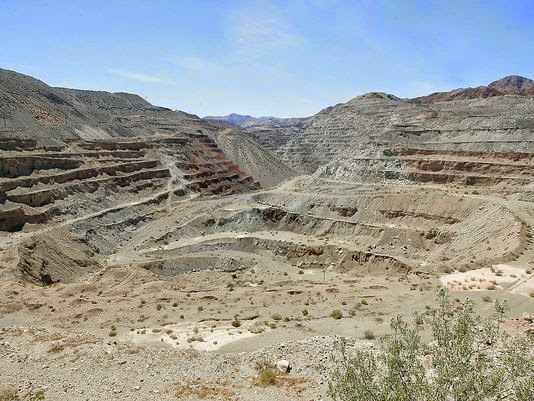
The old mine has been the subject of fiery debate in recent years, with several groups fighting over its future. The owners have been trying to sell the land to another mining company, while a separate company has obtained federal approval to build a hydroelectric power plant at the site. Conservationists, meanwhile, want to see the area absorbed by Joshua Tree National Park, which surrounds it on three sides.

The legal settlements signed last month don’t directly address any of those possibilities. Rather, they require Kaiser Eagle Mountain, which owns the mine, to return to the federal government certain lands surrounding its property, which the company received as part of a land exchange 15 years ago.

Regulators say that Kaiser still has the right to mine those lands, and that the partial reversal of the land exchange is more of a technicality than anything. Bureau of Land Management spokeswoman Dana Wilson said the land’s return to federal control “doesn’t in any way relate” to the possibility of the area becoming part of the national park.

“If the park service is interested in the future in pursuing that, then we’d need to cross that bridge when we get to it,” she said.

Conservationists, though, see last month’s settlements as a major step toward the land being incorporated into Joshua Tree National Park. They’ve argued that the old mine — and the ghost town next to it — have conservation and historic value, and would allow park visitors to learn about the history of mining and steelmaking.

Donna Charpied, a local activist who brought one of the lawsuits to undo the land exchange, said Kaiser giving up its ownership of some of the land removes “a monumental stumbling block” to the national park proposal.

“We just knocked one of the heads off the hydra,” she said. “Time to get that land back to the park now. There’s no reason not to.”

It’s unclear what prompted Kaiser to agree to the settlement, after years of fighting Charpied and the National Parks Conservation Association in court. Kaiser Eagle Mountain Vice President Terry Cook said the company could have demanded it get back the lands it gave up 15 years ago, but that it decided to be “magnanimous” by letting the federal government keep them.

Those lands are important because of their conservation value. The Bureau of Land Management said in a statement that they include critical habitat for threatened and endangered species, including the desert tortoise, the flat-tailed horned lizard and the Yuma clapper rail.

“We thought long and hard about it, and we decided we’d let the (Bureau of Land Management) retain the lands, even though we were entitled to receive them back,” Cook said. “We’re trying to do the right thing by people.”

It’s possible that Kaiser had other motives for agreeing to the settlements as well. David Lamfrom, who works for the National Parks Conservation Association, speculated that the company might be trying to ease a potential sale to another mining company.

“Having a longstanding lawsuit over the raincloud of any prospective buyer just makes things so much more complicated,” he said.

It’s also unclear what the settlements mean for the hydroelectric power plant proposed by the Eagle Crest Energy Company. The Federal Energy Regulatory Commission granted a license for the plant earlier this year, but Kaiser has thus far refused to sell its land to Eagle Crest.

The possibility of a sale could be more remote now, since some of the land that Kaiser returned to the federal government could be needed for the hydroelectric plant. Cook, Lamfrom and Charpied all said they weren’t yet sure what the reversal of the land exchange means for Eagle Crest’s proposal.

Conservation groups and the National Park Service have vehemently opposed the hydroelectric project, saying the power plant would drain billions of gallons of groundwater from an aquifer adjacent to Joshua Tree National Park.

The Eagle Crest Energy Company first proposed the hydroelectric project two decades ago — a move that angered Kaiser executives, who at the time had endorsed a plan to build a massive garbage dump at Eagle Mountain. That plan, which fell through last year, would have involved Kaiser selling its land to the Sanitation Districts of Los Angeles County, which would have built the landfill.

In preparation for that sale, Kaiser executed a land swap with the federal Bureau of Land Management in 1999. That land exchange was the source of the legal controversy that was finally settled last month.

As part of the original land exchange, Kaiser gave the federal government land it owned alongside the Eagle Mountain railroad, which stretches from the eastern shore of the Salton Sea to the mine site. In exchange, the company received federal land surrounding the mine, which would have been used for the landfill project.

But conservation groups have long criticized the exchange, saying that it was carried out illegally and that federal land managers got the worse end of the deal. They’ve also argued that the exchange is no longer necessary now that the landfill plan has been scrapped.

Now, those groups have succeeded in reversing part of the land exchange. The reversal may or may not have practical implications — Kaiser could still mine the exchanged lands — but Lamfrom sees the end of the long-running legal battle as critical to Eagle Mountain’s future.

“This is a milestone that I think gets us back to a place where we can start having reasonable discussions about what the future of this landscape is,” he said.

Lamfrom’s organization supports studying Eagle Mountain for inclusion in the national park, saying that setting aside the area would connect important fragments of wilderness.

National park officials have agreed that preserving the area would be beneficial. Such a step would require action by Congress or President Barack Obama’s administration.

Industrialist Henry Kaiser founded the iron mine in the 1950s, on land that was carved out of the southeastern corner of the Joshua Tree National Monument — the predecessor to the national park. But the mine was shut down in the early 1980s as production of steel in the United States waned.

Federal and state regulators maintain that Kaiser never gave up its mining rights at Eagle Mountain, although local activists have contested that claim. Charpied and others have accused Kaiser of conspiring with state regulators to keep control of the site, which still has millions of tons of valuable iron ore.

November 20, 2014

BLM rejectes application for Silurian Valley energy project

Kailah Miles,11, of Apple Valley and her brother Rex, 8, walk back to their family's campsite at the Dumont Dunes in the Silurian Valley. The BLM rejected an energy project in the area. (Gina Ferazzi / Los Angeles Times)

By JULIE CART
Los Angeles Times


The Bureau of Land Management on Thursday denied a Spanish company's application to build a controversial renewable energy facility in the Mojave Desert's remote Silurian Valley, deciding the sprawling project “would not be in the public interest.”

The closely watched decision is considered a bellwether for how the federal agency will handle future requests to develop renewable energy projects outside established development areas.

The company had planned a side-by-side wind and solar facility. Thursday's decision applies only to the solar portion of the project. The wind energy aspect is still in the planning stages.

Jim Kenna, the BLM's California director, made the decision, finding that Iberdrola Renewables' proposal would have industrialized 24 square miles of “a largely undisturbed valley that supports wildlife, an important piece of the Old Spanish National Historic Trail, and recreational and scenic values.”

Kenna said he had been discussing the matter for weeks with field personnel and found the evidence “pretty persuasive.”

He cited concerns that the project would degrade the quality of the wilderness surrounding the site, located between two national parks. He also noted potential hazards to the desert tortoise and other impacts that could not be mitigated.

“It was fairly clear to me,” he said.

Iberdrola Renewables had sought permission to build its project using a “variance” process. Had it been approved, it would have been the first major exception to federal land managers' “guided development” approach across more than 22 million acres of California desert. Under the policy, companies are encouraged to develop in areas that have been pre-approved for projects, where there would be less environmental or wildlife conflict.

Kenna said the variance process was intended to be rigorous. In denying the application, no other message was intended other than the specific project was unsuitable for the specific site, he said.

Iberdrola began the application process three years ago and had envisioned completing construction by December.

In a statement, Iberdrola said it was weighing whether to appeal the decision to the U. S. Department of Interior.

“It is unfortunate that the variance process is enabling unsubstantiated discretion in advance of a proper National Environmental Policy Act review that should be based on clear and understandable predictable requirements,” the statement said.

But the BLM decided that the project would have “too great of an impact on the resources.”

Among the specific concerns the BLM noted were that the facility would disrupt migration corridors critical to bighorn sheep and other wildlife.

“We are quite pleased that the BLM made this decision,” said Kim Delfino, the California program director for Defenders of Wildlife. “It's encouraging that they are taking those criteria seriously.”

The wind and solar plants that Iberdrola proposed would have been encircled by protected lands. The entire project site that the company proposed sits atop the Old Spanish Trail, a historic trail managed by the National Park Service, which opposed the project.

In its application, Iberdrola said the plants would create 300 construction jobs and generate about 400 megawatts of power.

The BLM is under pressure to meet the administration's goal of generating 20,000 megawatts of power from federal land by 2020. There have been 460 applications for renewable-energy-related projects in California since 2007, Kenna said. The BLM has approved 18 applications.

October 10, 2014

Las Vegas ‘tortoise gulag’ paroles last inmates

A desert tortoise crawls free after being released into the desert near Primm on Friday, Oct. 10, 2014. The Desert Tortoises Conservation Center which housed the tortoise, relocated its final 53 tortoises before the center is scheduled closing in Dec. (David Becker/Las Vegas Review-Journal)

By HENRY BREAN
LAS VEGAS REVIEW-JOURNAL


JEAN — After years — perhaps a lifetime — in cushy captivity, desert tortoise No. 6349 spent his first five minutes of freedom hunched motionless under a bush in a rocky dry wash 40 miles southwest of Las Vegas.

Finally, as his human handlers backed away, 6349 poked his head out of his shell and started to explore his new home — slowly, of course.

He had no way of knowing it, but he marks the end of an era. He was part of the final batch to be set free in the wild before the Desert Tortoise Conservation Center shuts down for good in December, after more than 20 years at the southwestern edge of Las Vegas.

The U.S. Fish and Wildlife Service announced plans to close the 220-acre center last year, after its federal funding was eliminated. Since then, the center’s contract operator, the San Diego Zoo’s Institute for Conservation Research, has been working with its partners to empty the facility, mostly by releasing healthy tortoises into the wild.

The center was caring for roughly 1,400 of the animals as recently as 18 months ago. Today, all that remain are about 50 adults awaiting shipment to a new exhibit at the Springs Preserve, a research facility in Battle Mountain and the Best Friends Animal Sanctuary in Utah.

Another 40 hatchlings born at the center will sleep through the winter in covered outdoor pens at the site and be released into the wild next year, said Mike Senn, assistant field supervisor with the Fish and Wildlife Service in Southern Nevada.

Senn said no tortoises have been euthanized — or will be — because of the closure of the center, though some animals have been humanely killed over the past two years because they were too sick to save.

He estimates that about 30 percent of tortoises that came into the center had to be put down for medical reasons.

Since 1989, the desert tortoise has been listed as threatened under the Endangered Species Act.

The conservation center was established in the 1990s as a place for developers to put tortoises removed from job sites in booming Clark County, but it soon became the valley’s de facto shelter for unwanted pet reptiles.

Last year, the center announced it no longer would accept former pets and strays, which were pouring into the facility at a rate of about 1,000 a year, overwhelming its budget and research mission.

The center’s closure in two months will end what has, at times, been a troubled and patchwork effort to save the tortoise, even as researchers were trying to better understand the species and the reasons for its decline.

That led to mistakes.

During the center’s first decade or so, thousands of tortoises were euthanized under a policy that called for the destruction of any animal showing signs of a deadly upper respiratory tract disease considered a threat to the species. It was later learned that tortoises could test positive for the disease but never develop it, either because they had been exposed and recovered or because they could carry it without ever showing symptoms or passing it on. That led to a change in the disease protocol that dramatically reduced the number killed.

Senn said the center’s procedures for determining which tortoises to release have also improved greatly over time and so have survival rates. Early in the program, he said, “They were releasing whatever — anything that wasn’t dead.”

Longtime local conservationist John Hiatt said the center’s legacy will be decidedly mixed. He said “it seemed like a good idea” to have a holding area for tortoises that otherwise would be literally bulldozed in the name of development.

“But in the final analysis, it just wasn’t a long-term or permanent solution,” he said, especially after it became a shelter for a pet tortoise population far larger than expected.

The center has a nickname in the environmental community: “The tortoise gulag.”

“That’s what a lot of people referred to it as because tortoises went there and were put into little pens and that was it,” Hiatt said.

Friday’s release took place in an area west of Interstate 15 south of Jean known as the Large Scale Translocation Site. Of the more than 10,000 tortoises released from the conservation center since 1997, most of them have come to this 27,000-acre swath of federal land where the species’ population density is much higher than it would be under natural conditions, Senn said.

Federal officials and their state and local partners also have established other tortoise release areas at the base of the Spring Mountains south of Pahrump and in the canyons and desert south of Boulder City. A few years ago, a group of test subjects equipped with tracking devices was set loose at the Nevada National Security Site.

Studies conducted in recent years suggest former pet tortoises, even those born in captivity, survive in the wild at about the same rate as the natural population.

“It doesn’t take them very long to go out and be a real tortoise again,” Senn said. “They have that instinct.”

On Friday, it took about 25 biologists and volunteers less than an hour to release 53 tortoises. The crew spent longer driving to the site than it did emptying the animals from their plastic tubs.

No. 6349 was set free by Daniel Essary, a research assistant from the San Diego Zoo, who could find himself out of a job in December. Essary figures he has released roughly 250 tortoises into the Nevada desert over the past five years, and he noticed something familiar about the way 6349 reacted to its release by hiding in his shell.

It’s impossible to know for sure, but Essary said he would bet that 6349 wasn’t always a guest of the government or a backyard pet.

“I’m pretty sure he’s had his time in the wild before,” he said as he watched the tortoise begin to move.

September 5, 2014

New Center for Tortoises Opens In Mojave Preserve

A baby desert tortoise | Photo: National Park Service

by Chris Clarke
KCET.org


A first-of-its-kind center for studying the federally Threatened desert tortoise was formally donated to the Mojave National Preserve on Friday.

The Ivanpah Desert Tortoise Research Facility, built by Chevron on land provided by the mining firm Molycorp, will enable researchers to find out whether so-called "headstarting" programs for juvenile tortoises are really helping combat the tortoises' population decline.

The facility, which includes two acres of tortoise habitat with predator-proof fencing and a state-of-the-art laboratory, was completed in 2012, and was managed by the nonprofit National Park Trust until Friday's formal land transfer and dedication.

"This new facility provides scientists the opportunity to test methods for increasing the survival of juvenile tortoises to reproductive age," said Stephanie Dubois, Superintendent of the Mojave National Preserve. "This research could lead to the development of proven methods for recovering this species that continues to decline. We appreciate the work of our partners in making this facility a reality."

Juvenile desert tortoises have it tough. They're easy pickings for predators such as coyotes and ravens, both of which species have increased in number as a result of human development of the desert. Tortoises in their first few years of life haven't yet grown a shell tough enough to withstand a hungry raven's beak or coyote jaws. Increased predation by coyotes and ravens is considered a major factor in the federally Threatened species' decline.

In "headstarting" programs, female desert tortoises known to be carrying fertilized eggs are moved to the facility, allowed to lay their eggs, and then returned to their home territories. The hatchlings are kept in areas protected from predators, then released into new territories when their caretakers deem them tough enough to go it alone.

Headstarting is an expensive undertaking, and may not be an appropriate long-term tool for supplementing tortoise populations. While the practice has been used to boost populations of other tortoise and turtle species, it hasn't been conclusively shown helpful for desert tortoises. One 2009 study, in fact, suggests that headstarting might not be of much use for protecting desert tortoises if local breeding females aren't protected from the threats causing the decline in the first place.

Backers hope, however, that the practice might prove useful for temporarily boosting local desert tortoise populations. That's an issue the Park Service hopes to explore in the facility, built as partial mitigation of projects by Chevron and Molycorp that posed risks to desert tortoises. Researchers will try to craft "best practice" procedures for running effective headstarting programs.

The facility has already sheltered and released 46 tortoises since it started operating in 2012, out of a total of 185 hatchlings born at the facility. The released tortoises are being carefully monitored in their new homes.