Showing posts with label Old Dad Mountain. Show all posts

November 12, 2013

Bighorn sheep numbers way down

These bighorn sheep were photographed in 2009 on Old Dad Mountain, the same area of the eastern Mojave Desert where a deadly disease has spread among at least two herds. Biologists have started an effort to monitor the health of the elusive animals.

BY JANET ZIMMERMAN
Press Enterprise


Only a fraction of the bighorn sheep typically seen in a Mojave Desert mountain range was spotted during a recent helicopter survey, a sign that a deadly pneumonia outbreak has taken a significant toll on the population, a scientist said Tuesday, Nov. 12.

Crews found no obviously sick animals in many of the other mountain ranges the sheep inhabit in the eastern Mojave. Blood test results will show whether those sheep are carrying the bacteria that causes the disease.

In the hardest-hit area, around Old Dad Mountain and Kelso Peak 15 miles southeast of Baker, the helicopter crew saw 6.4 sheep per hour. Data from the past 18 years show the previous lowest encounter rate there was 8.2 sheep per hour and the average is 14.5, said Deborah Hughson, science adviser for the Mojave National Preserve.

Two animals were accidentally killed during the four-day survey last week, Hughson said.

One ewe, after collaring, became startled and jumped a short distance off a hillside, Hughson said. Her leg broke on landing, and she had to be euthanized.

The second sheep died when a capture net was discharged from the helicopter in windy conditions. The net caught the sheep’s horn and spun her abruptly around; a veterinarian who conducted a field autopsy determined the animal died instantly. It did not have pneumonia.

During the survey, 73 bighorn were fitted with locator collars that will help experts track them — and the disease — for the next four to six years.

In addition to the herd around Old Dad Mountain, which has a population of 200 to 300, the outbreak has affected a second group in the Marble Mountains, 35 miles south.

Hughson said she was surprised that there were no sick sheep beyond a few in the Marble Mountains. Crews also surveyed the Bristol, Clipper, Soda, Providence, Granite, Hackberry and Woods ranges.

“We now are pretty clear the disease is centered in the Old Dad Peak area. There has been a substantial population decline that could be as much as half of the population,” Hughson said.
In that area, crews saw four carcasses and no lambs, she said.

The disease, which can have an incubation period of months, is easily transmitted to bighorn that come in contact with domestic goats and sheep. Authorities do not know how the Mojave herds contracted it, she said.

Healthy looking sheep can carry the bacteria, then suddenly show symptoms and die soon after, Hughson said.

Scientists should have the results of blood and fecal samples and nasal swabs taken in the field by early December, and will know then which animals are infected, Hughson said.

The results will help determine the next step in dealing with the outbreak. Experts may cull sick animals from the herd to stop the disease from spreading or manipulate water sources next summer to keep the infected sheep from interacting with other herds, Hughson said.

The federal and state governments have spent more than $100,000 on the helicopter survey, collars and database, she said. The survey of more than 80,000 acres was a joint operation of the National Park Service, Mojave National Preserve and California Department of Fish and Wildlife.

October 30, 2013

Crews will capture, test and attach radio transmitters to bighorn sheep

State and federal wildlife experts launch $48,000 helicopter survey and GPS tracking effort this weekend to gauge the scope of pneumonia epidemic that has killed more than 100 bighorn sheep in the Mojave Desert.

Bighorn sheep in the Mojave Desert will be outfitted with GPS radio collars so wildlife experts will know if they fall victim to a deadly pnemonia outbreak among otherwise healthy herds in the area. This photo was shot near Olancha Peak, in the Inyo National Forest.

BY JANET ZIMMERMAN
Riverside Press-Enterprise


State and federal wildlife experts will launch a $48,000 helicopter survey and GPS tracking effort this weekend to gauge the scope of a pneumonia epidemic that has killed more than 100 bighorn sheep in the Mojave Desert.

The outbreak has decimated two herds, one around Old Dad Mountain in the Mojave National Preserve and a second in the Marble Mountains, 35 miles south. Officials have said the highly contagious infection may have come from sick domestic sheep illegally dumped off a truck en route to alfalfa fields in the Imperial Valley.

The National Park Service and California Department of Fish and Wildlife will begin their four-day investigation on Sunday, Nov. 3, said Debra Hughson, science adviser for the preserve.

“We are throwing everything we have at this to better understand it and hopefully control it,” she said.

The crew of a federally contracted helicopter will search for the scattered animals over as much as 80,430 acres, in areas where dead and sick bighorns have been found and in nearby mountain ranges.

The helicopter can fly seven hours per day, at $1,600 per hour, paid for by the National Park Service, Hughson said.

Individual animals will be captured with a net fired out of the low-flying helicopter. The bighorn is then removed from the net, blindfolded to reduce stress and hobbled with a leather restraint to prevent kicking, she said. The workers take blood samples and a nasal swab, attach the collar and release the animal.

The Department of Fish and Wildlife is providing 54 GPS collars that transmit information daily by satellite. If an animal stops moving, the collar sends out a mortality signal so that experts can quickly locate the carcass and take samples, Hughson said. The GPS collars work for four years.

After the GPS collars are gone, high-frequency radio collars will be used for any remaining animals that are located, she said. The radio collars have a longer battery life and are less expensive, but readings require a fixed-wing aircraft or people in the field with antennas, instead of a satellite.

“The idea here is to have collared animals in the surrounding mountain ranges so we can have an early warning of the spread of the pathogen,” Hughson said. “We can get a better understanding of the progression of the disease, its spread and impact on herds.”

Biologists, veterinarians and other staff will help with the field operation. If an obviously sick animal is captured, a veterinarian may decide to kill it and perform a field autopsy, Hughson said.

Experts don’t know exactly how many animals have died, mostly because they spread out as water sources become more plentiful this time of year, she said.

The first dead animals were found in mid-May at Old Dad Mountain, 15 miles southeast of Baker. The disease has killed about half the 200 to 300 sheep in the herd there and at nearby Kelso Peak.

In August, several sick bighorn sheep were found in the Marble Mountains, which are just south of Interstate 40 and east of Kelbaker Road.

Tests showed they all had the same strain of pneumonia. The disease is carried by domestic sheep and goats; bighorn have no immunity and almost always died of it. There is no vaccine or cure for pneumonia in bighorn sheep. The disease does not spread to humans.

State officials have decided to proceed with this year's bighorn hunting within the Mojave National Preserve, one of the few places in California where it is permitted, said Regina Abella, desert bighorn sheep coordinator at the state Department of Fish and Wildlife.

The state issues a limited number of tags by lottery, based on the number of rams in a herd; last season, three tags were issued for the Old Dad area. The season starts Dec. 1

September 4, 2013

Trucked sheep may have caused bighorn deaths

Domestic sheep trucked through the Mojave may have caused a devastating bighorn pneumonia wave

More than 100 bighorn sheep in and around the Mojave National Preserve have died from pneumonia since May. Wildlife officials say the epidemic wiped out half the herd, once considered one of the state's healthiest. (FILE PHOTO/THE PRESS-ENTERPRISE)

By JANET ZIMMERMAN, STAFF WRITER
Press-Enterprise


A pneumonia epidemic that has killed more than 100 bighorn sheep in the Mojave National Preserve this summer and is decimating another herd may have come from sick animals illegally dumped off a truck en route to alfalfa fields in the Imperial Valley, federal land managers said Tuesday, Sept. 3.

Scientists are investigating two areas plagued by disease. The first, at Old Dad Mountain, is 15 miles southeast of Baker. Wildlife experts estimate that half of the 200- to 300-sheep herd has died there and at nearby Kelso Peak since mid-May.

Last month, several sick bighorn sheep were found 35 miles to the south in the Marble Mountains, which are just south of Interstate 40 and east of Kelbaker Road. Tests showed they suffered the same strain of pneumonia found in bighorn at Old Dad Mountain and Kelso Peak.

“They’re seeing a lot of sick sheep, so they’re expecting a lot of sheep to die in the next couple weeks in the Marble Mountains. It happened pretty quick at Old Dad, within a month,” said Linda Slater, spokeswoman for the 1.6 million-acre preserve.

The majestic bighorn, icons of the American West, are highly susceptible to pneumonia carried by domestic sheep and goats. Bighorn have no immunity to the disease, which is almost always fatal.

At first, wildlife experts feared the pneumonia was transmitted between the herds and would quickly spread. But a recent discovery may be a clue to the source of the outbreak and its transmission, she said.

Click to view larger map
On Aug. 13, four domestic sheep carcasses and domestic sheep pellets were found at Halloran Summit, about 15 miles northeast of Baker on Interstate 15, she said. That is 20 miles away from the center of the outbreak at Old Dad Mountain, home to what had been considered one of the state’s healthiest herds.

On Aug. 24, scientists also found pellets at Foshay Pass, 15 miles northeast of Interstate 40 and Kelbaker Road. They are waiting for test results to determine whether the droppings came from domestic sheep, Slater said.

Trucks regularly transport domestic sheep through the Mojave on their way from Montana to Imperial Valley and around the Salton Sea for grazing, Slater said.

“The scientists are speculating that perhaps a truckload had some sick sheep on it. Maybe (the driver) had to unload some sheep to get some dead animals off the truck” and that’s how pellets got on the ground, she said.

The case is still under investigation and law enforcement is not involved, she said.

Early on, biologists thought that a feral angora goat shot by a hunter last fall at Marl Spring, 12 miles east of Old Dad Mountain, may have been the source of the outbreak. Though the animal tested negative for pneumonia, it still could have been a carrier, Slater said.

Later this month, the California Department of Fish and Wildlife is expected to conduct a count by helicopter. The numbers of bighorn will be compared to population figures from the last survey, in 2008.

In October, state and federal officials plan to capture healthy animals in the surrounding mountains and outfit them with GPS collars so they will know immediately if they go down. At the same time, they will be able to collect blood samples and nasal swabs to see if the infection has spread.

There is no vaccine or cure for pneumonia in bighorn sheep. The disease does not spread to humans.

Some of the dead animals were taken for testing to the California Animal Health and Food Safety Laboratory in San Bernardino, which is operated by the UC Davis veterinary school. Some carcasses were too decomposed for testing and were left in the field, state officials said.

Before the outbreak, there were an estimated 425 to 750 bighorn in the five groups in the Mojave: Old Dad Mountain, Clark Mountain, Piute Mountain, Woods-Hackberry Mountains and Providence-Granite Mountains.

State officials have yet to decide whether to proceed with this year’s bighorn hunting within the preserve, which starts Dec. 1. The Mojave is one of the few places in California where bighorn sheep hunting is permitted.

In October, the Fish and Game Commission will consider what to do about the upcoming hunting season. The state issues tags by lottery, based on the number of rams in a herd; three were issued this year for the Old Dad Mountain and Kelso Peak area.

July 26, 2013

Bighorn sheep testing shows sick animals without disease

Two bighorn sheep ewes and their lambs are photographed during a survey conducted by the California Department of Fish and Wildlife. Both state and national wildlife agencies were investigating a disease outbreak within the Mojave National Preserve.

BROOKE SELF, STAFF WRITER
Desert Dispatch


BAKER • Preliminary survey results by wildlife agencies in the Mojave National Preserve show that a few sick desert bighorn sheep have tested negative for pneumonia, according to an official of the California Department of Fish and Wildlife.

More than 20 sheep in a herd of about 200 bighorns have died. One of those animals was confirmed by laboratory tests to have pneumonia, coordinator Regina Abella said on Friday.

Pneumonia can pass to bighorn from domestic sheep and goats. It is believed an angora goat found 12 miles east of Old Dad Mountain near Baker may have been the culprit for the outbreak, according to a news release from the National Park Service.

Desert bighorn have no natural defenses to diseases carried by domestic animals and the mortality rate for infected animals is 50 to 90 percent.

In California, all bighorn sheep are fully protected under the Department of Fish and Wildlife code which is a classification made to animals that are rare or face possible extinction, according to Abella. However, the desert area has historically held a very healthy and robust population of the breed, she said. In fact the desert bighorn were recently used to help populate other herds in nearby states, she said.

One concern of the wildlife agencies is that the summer marks the beginning of rut, or mating season, which could potentially influence long-distance movement by the older male bighorns. Jeff Villepique of the National Park Service said that officials were nervous about the desert herd potentially carrying the disease to nearby Nevada bighorns.

Two weeks ago officials also did a three-day helicopter survey of Old Dad Mountain and other nearby herds, according to the Mojave National Preserve website. Scientists hoped to asses the current distribution and status of the disease. After the survey on July 19, scientists were still compiling and interpreting the data but noted significantly fewer desert bighorn were observed on Old Dad Mountain compared with previous surveys, according to the report.

Nearby herds appeared to be healthy and in good condition.

June 19, 2013

Diseased bighorn sheep might have to be killed in Mojave National Preserve

Desert bighorn sheep gather at night on June 6 at a guzzler set up to provide water for the herd. A virus that is killing sheep in the largest herd at the Mojave National Preserve is described as "a grim situation" by spokeswoman Linda Slater.

By HENRY BREAN
LAS VEGAS REVIEW-JOURNAL


Wildlife officials in California might resort to killing desert bighorn sheep in an effort to contain an outbreak of a deadly disease now spreading through the largest herd in Mojave National Preserve, 100 miles southwest of Las Vegas.

At least 20 dead sheep have been found in the past month on Old Dad Mountain, about 15 miles southeast of Baker, Calif. Tests have confirmed that at least some of the animals died from a strain of pneumonia generally transmitted by domestic sheep and goats and usually fatal to bighorn.

“It’s really kind of a grim situation to be perfectly honest with you,” said Linda Slater, spokeswoman for the 1.6 million-acre preserve.

Officials from the National Park Service and the California Department of Fish and Wildlife are now considering whether to hunt down sheep showing signs of sickness. But even that might not be enough to halt the spread.

“To really get rid of the disease, you have to kill every animal, but that’s not practical or likely to happen,” Slater said. “There are no good management options.”

Wildlife officials in Nevada are watching the situation anxiously, hoping the sick animals can be contained somehow before they come into contact with sheep in the Silver State.

The diseased herd is “only a 45-mile trip as the crow flies” from mountains that harbor desert bighorn at the southern edge of Clark County, said Doug Nielsen, spokesman for the Nevada Department of Wildlife.

“We do have some right down there close to the state line. So it’s a concern, and it’s something that needs to be monitored.”

Slater said the afflicted animals are part of what she called “the biggest and healthiest herd” in Southern California. Transplants from the group have been used in the past to bolster struggling herds elsewhere in California, she said.

Bighorn have no natural resistance to pneumonia and tend to die at a high rate. Those that survive become carriers, infecting newborn lambs in a cycle that can ravage the herd for up to a decade.

Biologists may never know for certain how the isolated herd of 200 to 300 sheep was exposed to the disease, but they have their suspicions.

Slater said a domestic goat turned up in the area about six months ago — a rare and unexplained find — but the animal showed no signs of pneumonia. However, tests for the disease are not always reliable, she said.

Biologists and veterinarians “seem really pessimistic that anything can be done” to keep the entire herd from being exposed, Slater said. The worry now is that the disease will spread to one of four other herds in the preserve, possibly by a ram sent wandering when rutting season gets underway in the coming weeks.

Volunteers from the Sierra Club and the Society for the Conservation of Bighorn Sheep assisted with the initial search for sick and dead animals. A lack of resources and the remote, rugged location of the herd have hampered efforts so far to address the outbreak, Slater said.

Back in Nevada, wildlife officials are hoping that hot, dry weather this summer will keep the affected herd close to the water sources in its home range and away from other herds. Beyond that, Nielsen said, there isn’t much that can be done from the Nevada side of the state line but to wait and watch what happens.

Bighorn sheep once roamed nearly every mountain range in Nevada, but their numbers began to decline in the mid-1800s, as settlers and prospectors swept into the region, mostly in the north.

By 1960, disease, unregulated hunting and habitat loss had reduced Nevada’s bighorn population to about 1,200 animals in a handful of ranges, none of them north of Ely or west of Hawthorne.

Wildlife officials launched the Bighorn Sheep Release Program in 1967 to return the official state animal to its former glory.

Today, Nevada is home to more bighorn sheep than any other state — better than 10,000 adult animals in at least 60 different mountain ranges.

But disease always looms as a threat to those gains.

In 2010, pneumonia nearly wiped out a herd of Rocky Mountain bighorn sheep in the Ruby Mountains near Elko.

The most recent outbreak in Southern Nevada struck in 2002 in the Specter Range, along U.S. Highway 95 about 75 miles northwest of Las Vegas.

After several years of what Nielsen called “very low lamb survival,” the herd’s numbers finally began to rebound in 2009.

June 6, 2013

Wildlife biologists investigate bighorn sheep deaths

Bighorn sheep near a wildlife guzzler in the Old Dad Mountain range in the Mojave National Preserve. (FILE PHOTO)

by Janet Zimmerman
Press-Enterprise


Wildlife officials are investigating the recent deaths of four bighorn sheep in the desert near Baker to see if the animals died of pneumonia.

The animals were found late last month by a National Park Service employee who was inspecting man-made watering holes, known as guzzlers, on Old Dad Mountain, 15 miles southeast of Baker, according to a news release issued today, June 6.

The employee observed other animals that appeared to be weak and unsteady, with labored breathing. Laboratory analysis of blood and tissue samples taken from one of the animals indicated that it had pneumonia, which is usually fatal to the species.

The bighorn can contract the disease from domestic sheep and goats. Biologists from the Park Service and state Department of Fish and Wildlife are conducting a field survey to determine the scope of the outbreak, the news release said.

Scientists believe there are 200 to 300 desert bighorn around Old Dad Mountain. It is one of the largest native populations in the Mojave Desert, according to Stephanie Dubois, superintendent of the Mojave National Preserve.

August 12, 2009

Water dispensaries keep mountain bighorn sheep alive

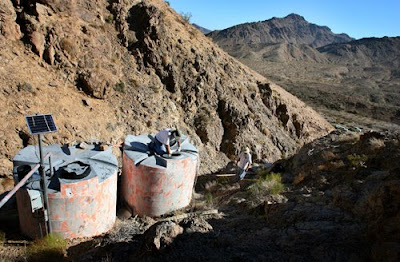
The Kerr Drinker. George Sutton peers into one of the two 1,600-gallon water collection tanks in the Old Dad Range of the Mojave National Preserve, which are filled by members of the Society for the Conservation of Bighorn Sheep. The group spends hours each month maintaining and repairing the tanks for sheep in the summer. (Mark Zaleski/The Press-Enterprise)

By JANET ZIMMERMAN
The Press-Enterprise


A herd of desert bighorn sheep deftly scramble up a rocky hillside in the Mojave National Preserve as the rumble of approaching trucks breaks the silence.

The pickups, each hauling plastic tanks filled with water, come to a stop in a cloud of dust. Soon, the drivers stretch fire hoses from the truck to two big holding tanks that feed a manmade watering hole -- a lifeline for the bighorn and other wildlife that lay claim to this inhospitable landscape.

There are 72 "drinkers" built and maintained across the desert from Interstate 10 north to Death Valley by volunteers with the Society for the Conservation of Bighorn Sheep. The group is a mix of conservationists and hunters whose efforts started 50 years ago when the founders began helping the struggling sheep population.

The work has grown more critical in recent years, they say, as desert springs dry up from drought and from a dropping water table as supplies are siphoned away by development in outlying areas.

"The sheep live on these drinkers from June to September," said Gary Thomas, 70, of Upland, who monitors and fills the watering holes. "Ideally, they would be naturally replenished (with rainfall), but that hasn't happened."

And so the group has resorted to trucking in water during summer months when the moist, green vegetation that sustains bighorn the rest of the year dries up.

In extreme cases, members pay for helicopters to haul water to the most remote locations and have hand-carried water in five-gallon bottles to areas where vehicle access is prohibited. Earlier this summer, the Forest Service donated use of its chopper to ferry supplies and sheep society members nine miles into an inaccessible area of the Santa Rosa Mountains south of Palm Springs to rebuild a drinker.

Threats to desert bighorn go beyond water shortages, however.

The elusive animals historically have been compromised by disease, hunting, habitat loss, competition with livestock and fragmentation of their ranges by fences, highways and canals that cut off wildlife passages between mountains, said Conrad Jones, a wildlife biologist and desert water coordinator for the state Department of Fish and Game.

Conservationists fear the onslaught of alternative energy developments that they say will denude the land and further impede the animals' movement.

The sheep need to travel between ranges and other herds to prevent in-breeding, keeping the animals more resilient to environmental extremes.

Dwindling rainfall is a concern. A 2004 UC Berkeley study found that rain levels have decreased about 20 percent in the Southwest during the past century and cited predictions that precipitation will drop another 10 to 20 percent by 2100. In that case, fewer lambs would survive because of less vegetation, the researchers found.

Desert bighorn in the peninsular ranges -- the Santa Rosa and San Jacinto mountains and Anza-Borrego Desert State Park -- are on the federal endangered species list. The isolated populations there plummeted from an estimated 1,170 in 1971 to about 230 when it was listed in 1998; now there are about 800, said Jane Hendron, spokeswoman for the U.S. Fish and Wildlife Service office in Carlsbad.

In all, an estimated 3,500 to 5,500 desert bighorn sheep live in California, up from fewer than 2,000 in the 1960s and '70s, Thomas said.

"Now we have a viable population," he said. "That's directly related to building big-game drinkers."
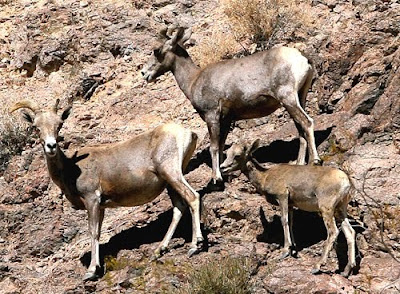
Bighorn sheep watch as members of the Society for the Conservation of Bighorn Sheep drive water to the Kerr Drinker at the Old Dad Mountain range in the Mojave National Preserve. (Mark Zaleski/The Press-Enterprise)

Limited range

After an early stop in Baker to take on 2,300 gallons of water donated by the local Community Services District followed by a 15-mile drive on a rough dirt track, the volunteers prepare to refill the Kerr drinker near Old Dad Peak, home to one of the Mojave's healthiest herds. The watering place south of Baker is named for Chuck Kerr, a society founding member whose son George continues his work.

Above the drinker, vultures circle over the spot where two camouflaged water tanks are nestled in a ravine. The volunteers spot a ram, its horns curled like an old toenail, lying motionless near a small stainless trough.

The animal is about 10 years old, almost the end of its life span, and has probably been dead a couple weeks, says George Kerr, a Fish and Game commissioner for Ventura County.

"A lot of times rams will find a place they know" when they are ready to die, he says. "It could be habitat stress."

At least nine bighorn with their characteristic white rumps keep watch from the canyon's rocky slopes. Sheep aren't the only wildlife that benefit from this water; golden eagles, badgers, bobcats, coyotes, skunk, deer, birds and bees also drink here.

When the group built this guzzler in 1985, they formed a dam at the bottom of the slope to catch rainwater and ran pipe from there to holding tanks. The tanks feed the stainless trough, intentionally small to reduce evaporation.

The society knows when the Kerr drinker needs filling, because a solar-powered sensor on the tank transmits water levels daily via satellite. The remote monitoring is one of the many advances the group has made.

In several sites, including the Ord, Newberry and Rodman mountains, battery-powered, infrared cameras track the number of animals visiting the drinkers. The information, combined with helicopter survey results, gauges population density.

"A sheep will not tend to stray more than two to three miles during the heat of the summer from one of these drinkers," said Jones, the Fish and Game biologist who helps on re-fill missions.

Another group, Desert Wildlife Unlimited in Brawley, has installed and maintains more than 120 drinkers from Interstate 10 to the Mexican border. That means there are less than 200 drinkers south of Bishop, Jones said. "That's not much."

Thomas said thousands of guzzlers would be ideal.

There is controversy

The conservation groups use money from grants, membership and fundraisers to pay to build the drinkers, which cost from $15,000 to $40,000. Refilling them costs about $1,000 per trip.

Jones called the volunteer groups a critical element in bighorn survival, citing a study published this year by U.S. Geological Survey scientist Kathleen Longshore, who found a correlation between artificial water sources and survival of the remaining bighorn populations in Joshua Tree National Park.

But such water developments are not without controversy. Some environmentalists say the drinking holes can spread disease and provide easy access to wildlife by predators.

Thomas, of the sheep society, said their 3-month-old camera monitoring program has not captured any mountain lions, the bighorn's main predator, attacking the animals at watering holes.

Joshua Tree resident Elden Hughes, a member of the Sierra Club's California/Nevada Desert Committee, opposes guzzlers because of their impact on pristine areas.

"They are usually putting them in wilderness areas, which means putting in a road and construction in wilderness. Those two are enough for me to oppose it," Hughes said.

Desert protection laws have made it more difficult to access many guzzlers, and the groups must get permits to drive into restricted areas. The sheep society builds two new drinkers a year, said Steve Marschke, the group's president.

Mike Smith, left, and Steve Marschke, of the Society for the Conservation of Bighorn Sheep, carry several fire hoses up to the Kerr Drinker in the Old Dad Range in the Mojave National Preserve. (Mark Zaleski/The Press-Enterprise)

Hughes also objects to drinkers as a way to increase bighorn herds for hunting. Fish and Game issues a limited number of hunting permits based on the count of older rams, which are not crucial to the herd. The endangered populations are not hunted.

Proceeds from permit sales are dedicated to sheep work, including biologists and programs to collar, capture and relocate animals to areas where they have historically lived and to increase genetic diversity among other herds.

Many relocated sheep come from Old Dad Peak, where the sheep society wraps up its most recent refilling project at the end of a nine-hour day. Hot and dirty, they head home.

Despite the back-breaking labor and disputes about the benefits, Thomas vows to continue his work.

"We've manipulated the environment almost everywhere, so we now have to continue to manage it. You can't just sit back and say we're going to let it go back to nature, now that we have isolated them into tiny islands with highways," he said. "If you don't, they will disappear."

January 14, 2006

Fish/Game seeks guzzlers for Mojave Preserve


News West

By LEE CHOQUETTE
Mohave Valley News [Laughlin, NV]

NEEDLES - A proposal first floated by the California Department of Fish and Game to restore artificial water sources in the Mojave National Preserve has finally reached the public comment stage.

The state agency began meeting with the National Park Service in the summer of 2004 regarding the proposal to retrofit 12 former ranch wells in the Mojave National Preserve as wildlife guzzlers.

Ranchers raised cattle for many decades in what became the preserve in 1994. They drilled wells to provide water for their cattle. One well was first developed in the 1860s and many of them date to the dominant period of the Rock Springs Land and Cattle Company between 1894 and 1927, according to the park service.

Cattle ranchers turned their wells on and off to move cattle around, according to the park service, to keep them from overgrazing in a particular area.

Most of the larger grazing leases in the preserve have been retired, and the ranchers have shut off their wells and removed much of the above-ground equipment.

Wildlife have come to depend on the water sources initially developed for cattle and the state agency believes that the shutdown has had a detrimental effect on wildlife populations.

The state agency proposes to transform 12 ranch wells into guzzlers over a three-year period, for use by mule deer and other wildlife. The guzzlers would be filled by well water pumped into a holding tank. Generators would be carried to each guzzler periodically to refill the tank. The drinkers themselves would be placed a foot or two off the ground to keep desert tortoises from crawling into them.

Routine monitoring would try to prevent an incident similar to the one in 1995 when lambs fell into a guzzler on Old Dad Peak. The lambs' decomposing bodies poisoned the water drunk by other bighorn sheep, ultimately killing 38 sheep.

The park service has called for public comment on three possible alternatives: take no action, leaving the shut-down wells as they are; permitting the state agency to proceed with its proposal; and leaving things as they are while further scientific studies are conducted.

The park service has issued an environmental assessment that compares these three alternatives. According to the service, the assessment was distributed to libraries, but the Needles Branch Library did not receive a copy.

A copy of the assessment is available at www.nps. gov/moja and by request from Superintendent, Mojave National Preserve, 2701 Barstow Road, Barstow CA 92311. Public comments on the proposal must be postmarked by Jan. 31 and sent to this address or to MOJA_Superintendent@nps.gov.

December 20, 2005

Desert bighorn ewes may be farmed out

FROM STAFF AND WIRE REPORTS
Victorville Daily Press


BARSTOW — Fifteen ewes from a thriving herd of desert bighorn sheep in Mojave National Preserve may be moved to rebuild a dwindling herd 100 miles away in the China Lakes Naval Air Weapons Station area near Ridgecrest.

"We have a healthy population of bighorns in the preserve, but the herd at China Lake is small and consists of only 17 rams and two ewes," Old Dad Mountain preserve spokesman James Woolsey said.

California's Department of Fish and Game said the preserve's bighorn population numbers about 250. The department proposes capturing up to 15 ewes in the Old Dad Mountain area for relocation to Eagle Crags, to correct the imbalance between rams and ewes, officials said.

"If that ratio is as low as our data now suggests, we need to reverse the trend," said Vern Bleich, senior environmental scientist and project manager.

In August, the sudden deaths of five endangered Peninsular bighorn sheep sparked worries among scientists that there might be a major die-off that could wipe out the bighorn population near Palm Springs.

In the Victor Valley, bighorn populations appear to be doing well, according to recent reports. A population of 30 to 50 bighorns lives in the mountains above Lucerne Valley.

Bighorns also live in the upper San Gabriel Mountains near Wrightwood.

December 19, 2005

Relocation project planned for bighorn sheep

Chuck Mueller, Staff Writer
San Bernardino Sun


A robust herd of desert bighorn sheep that thrives on several peaks in the Mojave National Preserve offers an opportunity to rebuild a dwindling herd 100 miles away.

California 's Department of Fish and Game has proposed relocating up to 15 bighorn ewes from Old Dad Mountain in the preserve, east of Barstow, to Eagle Crags at the China Lakes Naval Air Weapon Station near Ridgecrest.

"We have a healthy population of bighorns in the preserve, but the herd at China Lake is small and consists of only 17 rams and two ewes," said preserve spokesman James Woolsey.

Aerial surveys show the herd on Old Dad Mountain numbers close to 250. It is the largest population of bighorns in California and has been a primary source of sheep to restock other areas.

The department has attempted to restore 13 populations of mountain sheep to their historic ranges since 1970. By 1989, four herds were re-established in the Mojave Desert , according to an environmental assessment of the relocation project.

Under the department's proposal, between five and 15 ewes would be captured from Old Dad Mountain and relocated to Eagle Crags in a remote part of the air-weapons range.

Noting the imbalance between rams and ewes at Eagle Crags, officials said it is necessary to correct the skewed sex ratio and increase the reproducing potential of the herd.

"If that ratio is as low as our data now suggests, we need to reverse the trend," said Vern Bleich, fish and game's senior environmental scientist and project manager.

"If it isn't that low and more females are present, this translocation program will help us find other females."

The plan calls for sheep to be captured by net-gunning from helicopters, then moved to a base camp off Kelbaker Road in the preserve. From there they would be hauled by truck to Eagle Crags.

No schedule has been set for the removal process.

The removal program conforms with state policy, which says that mountain sheep should be managed and maintained at sound biological levels, Bleich said.

"Translocation is the only means by which mountain sheep can be restored to previously occupied ranges," he said.

The program is not a simplistic approach to conservation of the species, Bleich said, calling it a "well-thought-out conservation strategy."

By relocating bighorns, healthy herds of sheep can be preserved throughout the desert.

"Historically, Old Dad Mountain has been used as a source for repopulating herds elsewhere," Woolsey said. "With this program, we hope China Lake's population of bighorns can be restored."