Showing posts with label critical habitat. Show all posts

December 31, 2014

Eagle Mountain legal battle settled after 15 years
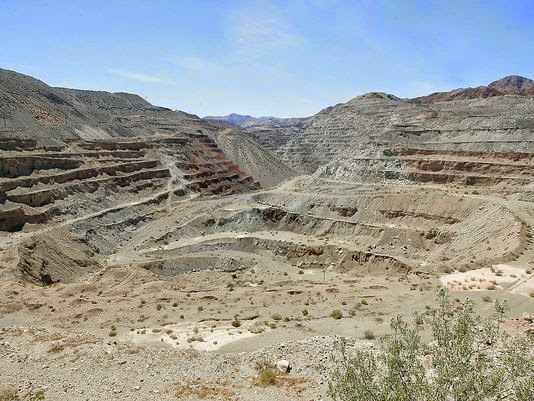
A massive iron ore mining pit at Eagle Mountain in the remote desert just east of the Coachella Valley. (Jay Calderon, The Desert Sun)

Sammy Roth
The Desert Sun


A longstanding legal battle over land around the old Eagle Mountain iron mine has been settled in a deal that some activists hope could bring the mine one step closer to inclusion in Joshua Tree National Park.

The old mine has been the subject of fiery debate in recent years, with several groups fighting over its future. The owners have been trying to sell the land to another mining company, while a separate company has obtained federal approval to build a hydroelectric power plant at the site. Conservationists, meanwhile, want to see the area absorbed by Joshua Tree National Park, which surrounds it on three sides.

The legal settlements signed last month don’t directly address any of those possibilities. Rather, they require Kaiser Eagle Mountain, which owns the mine, to return to the federal government certain lands surrounding its property, which the company received as part of a land exchange 15 years ago.

Regulators say that Kaiser still has the right to mine those lands, and that the partial reversal of the land exchange is more of a technicality than anything. Bureau of Land Management spokeswoman Dana Wilson said the land’s return to federal control “doesn’t in any way relate” to the possibility of the area becoming part of the national park.

“If the park service is interested in the future in pursuing that, then we’d need to cross that bridge when we get to it,” she said.

Conservationists, though, see last month’s settlements as a major step toward the land being incorporated into Joshua Tree National Park. They’ve argued that the old mine — and the ghost town next to it — have conservation and historic value, and would allow park visitors to learn about the history of mining and steelmaking.

Donna Charpied, a local activist who brought one of the lawsuits to undo the land exchange, said Kaiser giving up its ownership of some of the land removes “a monumental stumbling block” to the national park proposal.

“We just knocked one of the heads off the hydra,” she said. “Time to get that land back to the park now. There’s no reason not to.”

It’s unclear what prompted Kaiser to agree to the settlement, after years of fighting Charpied and the National Parks Conservation Association in court. Kaiser Eagle Mountain Vice President Terry Cook said the company could have demanded it get back the lands it gave up 15 years ago, but that it decided to be “magnanimous” by letting the federal government keep them.

Those lands are important because of their conservation value. The Bureau of Land Management said in a statement that they include critical habitat for threatened and endangered species, including the desert tortoise, the flat-tailed horned lizard and the Yuma clapper rail.

“We thought long and hard about it, and we decided we’d let the (Bureau of Land Management) retain the lands, even though we were entitled to receive them back,” Cook said. “We’re trying to do the right thing by people.”

It’s possible that Kaiser had other motives for agreeing to the settlements as well. David Lamfrom, who works for the National Parks Conservation Association, speculated that the company might be trying to ease a potential sale to another mining company.

“Having a longstanding lawsuit over the raincloud of any prospective buyer just makes things so much more complicated,” he said.

It’s also unclear what the settlements mean for the hydroelectric power plant proposed by the Eagle Crest Energy Company. The Federal Energy Regulatory Commission granted a license for the plant earlier this year, but Kaiser has thus far refused to sell its land to Eagle Crest.

The possibility of a sale could be more remote now, since some of the land that Kaiser returned to the federal government could be needed for the hydroelectric plant. Cook, Lamfrom and Charpied all said they weren’t yet sure what the reversal of the land exchange means for Eagle Crest’s proposal.

Conservation groups and the National Park Service have vehemently opposed the hydroelectric project, saying the power plant would drain billions of gallons of groundwater from an aquifer adjacent to Joshua Tree National Park.

The Eagle Crest Energy Company first proposed the hydroelectric project two decades ago — a move that angered Kaiser executives, who at the time had endorsed a plan to build a massive garbage dump at Eagle Mountain. That plan, which fell through last year, would have involved Kaiser selling its land to the Sanitation Districts of Los Angeles County, which would have built the landfill.

In preparation for that sale, Kaiser executed a land swap with the federal Bureau of Land Management in 1999. That land exchange was the source of the legal controversy that was finally settled last month.

As part of the original land exchange, Kaiser gave the federal government land it owned alongside the Eagle Mountain railroad, which stretches from the eastern shore of the Salton Sea to the mine site. In exchange, the company received federal land surrounding the mine, which would have been used for the landfill project.

But conservation groups have long criticized the exchange, saying that it was carried out illegally and that federal land managers got the worse end of the deal. They’ve also argued that the exchange is no longer necessary now that the landfill plan has been scrapped.

Now, those groups have succeeded in reversing part of the land exchange. The reversal may or may not have practical implications — Kaiser could still mine the exchanged lands — but Lamfrom sees the end of the long-running legal battle as critical to Eagle Mountain’s future.

“This is a milestone that I think gets us back to a place where we can start having reasonable discussions about what the future of this landscape is,” he said.

Lamfrom’s organization supports studying Eagle Mountain for inclusion in the national park, saying that setting aside the area would connect important fragments of wilderness.

National park officials have agreed that preserving the area would be beneficial. Such a step would require action by Congress or President Barack Obama’s administration.

Industrialist Henry Kaiser founded the iron mine in the 1950s, on land that was carved out of the southeastern corner of the Joshua Tree National Monument — the predecessor to the national park. But the mine was shut down in the early 1980s as production of steel in the United States waned.

Federal and state regulators maintain that Kaiser never gave up its mining rights at Eagle Mountain, although local activists have contested that claim. Charpied and others have accused Kaiser of conspiring with state regulators to keep control of the site, which still has millions of tons of valuable iron ore.

August 5, 2013

A timeline of the desert tortoise’s slow and steady decline

Fish and Wildlife and the San Diego Zoo experimentally translocated juvenile tortoises from the Desert Tortoise Conservation Center to the former Nevada Test Site in 2011. (Courtesy San Diego Zoo)

By Emily Green
High Country News


Kristin Berry's khaki hat flaps in the wind as she bends to inspect the skeleton of a desert tortoise. Remnants of its head and neck are still attached to the carapace, and bleached bones protrude from it. It's been dead for about four years, she suspects, and "appears to have died in a relaxed position," she says, "with its legs out." That suggests starvation and dehydration, but the 70-year-old biologist can't be sure.

It's the second week of April, when wild tortoises typically emerge from hibernation to forage on the spring wildflowers that briefly brighten the Mojave Desert. Berry –– who does long-term research on the desert tortoise for the U.S. Geological Survey –– is the acknowledged authority on where the now-threatened reptiles once thrived.

Because the desert tortoise's Mojave range is largely on federal land, conservationists believe the U.S. Fish and Wildlife Service (USFWS) should have better managed the animal's recovery once it was listed under the Endangered Species Act in 1989. Instead, the species has steadily declined.

1976 Bureau of Land Management establishes 40-square-mile Desert Tortoise Natural Area in Kern County, Calif.

1980 Beaver Dam Slope colony of desert tortoises near St. George, Utah, listed as "threatened" with 26 square miles designated "critical habitat."

1984 BLM tortoise biologist Kristin Berry releases a report showing an up to 90 percent decline in tortoise numbers across the Mojave in the last century. Causes include military bases, housing, roads, off-road vehicles, predators, fire, invasive plants, guns and pet collection.

1989 Fish and Wildlife lists the species as "endangered" after an outbreak of upper respiratory tract disease, caused by a Mycoplasma bacterium, kills more than 600 animals at the Desert Tortoise Natural Area in Kern County.

1990 Entire Mojave population is listed as "threatened." "Incidental take" permits are granted to Clark County, Nev. developers in exchange for mitigation funding through a habitat conservation plan and creation of the Desert Tortoise Conservation Center, a 222-acre Las Vegas holding facility for displaced tortoises.

1991 USFWS opposes expansion of Fort Irwin National Training Center near Barstow, Calif., due to habitat incursion.

1994 USFWS designates 6.4 million acres in Mojave Desert as "critical habitat" for tortoise: 4,750,000 acres in California, 1,220,000 in Nevada, 339,000 in Arizona and 129,000 in Utah, but most types of development are not prohibited. It also releases a recovery plan that discourages relocating tortoises and urges protecting areas throughout the Mojave to preserve genetic diversity.

1996 26,000 BLM acres near the California border are designated as the "Large Scale Translocation Site" for Las Vegas' Desert Tortoise Conservation Center to begin releasing displaced tortoises.

2001 Congress authorizes Fort Irwin's expansion into 87,000 acres of critical habitat.

2003 Fish and Wildlife's 1994 recovery plan is reviewed and scientists who promote translocation and downplay danger of disease are charged with drafting a new plan.

California produces three habitat conservation plans that include 12 million acres in the Mojave to comply with the Endangered Species Act.

2005 The Federal Energy Policy Act calls for 10,000 megawatts of solar, geothermal and wind energy generation on public lands, including much of the Mojave, by 2015.

2008 Fort Irwin moves 571 desert tortoises to 13 sites. California's habitat conservation plans are superseded by a new "Desert Renewable Energy Conservation Plan."

2009 Fish and Wildlife asks the San Diego Zoo to help clean up over-crowding at the Desert Tortoise Conservation Center, with plans to release all of its animals if it's closed.

The desert tortoise species Gopherus agassizii is split into two species. Tortoises east of the Colorado River are now designated Gopherus morafkai. This concentrates 70 percent of the federally protected species, Gopherus agassizii, west of the Colorado in California, where the greatest declines are reported.

2011 Fish and Wildlife and the San Diego Zoo experimentally translocate juvenile tortoises from the Desert Tortoise Conservation Center to the former Nevada Test Site; survival rates will be monitored.

2012 BLM field offices in California circulate the Desert Renewable Energy Conservation Plan. Fish and Wildlife's Desert Tortoise Recovery Office joins San Diego Zoo in starting to translocate adult tortoises onto BLM land near Las Vegas, anticipating the Center's closure in 2014 but promising to monitor recovery for the next five years. Meanwhile, the U.S. Geological Survey's follow-up study of 158 tortoises relocated from Fort Irwin in 2008 shows a five-year survival rate of less than 50 percent.

January 10, 2013

BLM Rebuffs Conservation Groups, Approves California Solar Project

Desert tortoise sporting a tracking device and a desert tortoise monitor/biologist.
Alyssa Carducci
Heartland Institute


The U.S. Bureau of Land Management released a final Environmental Impact Statement approving the development of 1,044 acres of desert tortoise habitat adjacent to Joshua Tree National Park in southern California for the construction of a large-scale solar power project.

BLM’s decision rebuffs conservation groups such as the Western Lands Project and the Wildlands Conservancy that seek to preserve desert tortoise habitat.

Dislodging Threatened Tortoises

The Desert Harvest solar power project, proposed by EDF Renewable Energy in San Diego, will produce as much power as a small conventional power plant during daylight hours when the sun is not obscured by clouds.

Conservationists point out the project will be prominently visible from many mountain ranges in Joshua Tree National Park. The power project will also dislodge and potentially cause the death of bighorn sheep and desert tortoises, which are listed as a threatened species under the Endangered Species Act.

“We are opposed to the Obama administration's policy to site large, damaging, remote solar plants on public lands, where they destroy habitat and ecosystem function and require large transmission lines [and] corridors to get the power to urban centers,” Janine Blaeloch, director of Western Lands Project, said.

Western Lands Project, along with Basin and Range Watch and Solar Done Right, filed a protest against the project with BLM.

Developing Pristine Lands

Conservation groups generally support renewable power but say the industry should be able to produce power without destroying pristine lands harboring valuable plant and animal species.

“We don’t oppose solar energy, and we are not climate change skeptics,” said Kevin Emmerich, spokesperson for Basin and Range Watch. “We would just like to see solar energy built in a way that does not replace undeveloped land, wildlife habitat, and ancient Native American sites with solar panels.”

Emmerich said the Desert Harvest project is especially troublesome because it would be located between two important wildlife conservation areas and Joshua Tree National Park. The site is known for important microphyll woodlands, which provide habitat for several bird species, said Emmerich.

Other Lands Available

The Desert Harvest project will be near another large-scale solar project now under construction, the Desert Sunlight Project. Emmerich said construction of the Desert Sunlight Project is already creating negative environmental impacts for the local region, such as degraded air quality due to dust storms.
Emmerich said the Desert Harvest project could be moved to “degraded lands,” land already developed, damaged, or contaminated.

“The Environmental Protection Agency has identified 15 million acres of brownfields or degraded lands that would be suitable for renewable energy,” said Emmerich.

Blaeloch agreed with Emmerich on the siting of solar power projects.

“We are pushing for siting solar generating facilities and rooftop arrays in the built environment, on damaged land, and on the millions of acres of brownfields, degraded lands, landfills, etc., the EPA has identified as suitable for that purpose,” said Blaeloch.

January 8, 2013

Wildlife Agency: Mojave Solar Project Would Harm Tortoises

Desert Tortoise | Photo: USFWS/Flickr/Creative Commons License
by Chris Clarke
KCET - Los Angeles


The nation's chief wildlife protection agency is opposing a new solar project in the Ivanpah Valley just outside the California state line, saying the project as currently designed would harm the valley's beleaguered tortoise population. The US Fish and Wildlife Service has called for the BLM to either deny or redraw the proposed 350-megawatt Silver State South solar project, which would affect more than 13,000 acres of prime tortoise habitat adjacent to the California state line, a few miles north of the Mojave National Preserve.

The Fish and Wildlife Service's (FWS) objections were made in a formal comment filed late last year in response to a draft Supplemental Environmental Impact Statement for Silver State South, released by the Bureau of Land Management (BLM). The project, proposed by the Tempe, Arizona-based firm First Solar, would directly occupy between 2,500 and 3,800 acres of land stretching from the California line to the northern edge of the Lucy Gray Mountains.

FWS's objections arise from the fact that the proposal occupies much of a north-south corridor of suitable habitat for the desert tortoise, which -- like the project's proposed footprint -- runs in a relatively narrow band between the Lucy Grays and Ivanpah Dry Lake to the west:

We are concerned about habitat fragmentation and demographic and genetic isolation of desert tortoise populations within the Ivanpah Valley and recommend that BLM select the 'No Action' alternative. Maintaining a robust population of desert tortoises within the Ivanpah Valley area is of particular importance because the habitat is already highly fragmented. Currently, the desert tortoise population within the Ivanpah Valley is only tenuously connected to the Ivanpah Critical Habitat Unit. This valley is a critical link between desert tortoise conservation areas in California and Nevada. Only four potential linkages remain in Ivanpah Valley. The linkage between the Silver State North project and the Lucy Gray Mountains is the widest of these linkages and likely the most reliable for continued population connectivity.

Tortoises don't migrate to find mates. Therefore, in order to provide adequate connectivity between populations of tortoises, says the FWS, corridors must be at least the width of a typical tortoise's lifetime range, allowing enough tortoises to have adjoining or overlapping ranges. FWS calculates that average range width at 1.4 miles, meaning that a functional corridor ought to be no narrower than that.

The BLM's draft EIS includes three variations on the project's footprint, and one "No Action" alternative in which no project would be built. The least extensive alternative would constrict the available tortoise habitat corridor to just under one mile: the BLM's Preferred Alternative would leave only 100 feet of habitat at the project's narrowest chokepoint.

The FWS's comments thus ask the BLM to either deny the project by adopting the No Action alternative, or send it back to the drawing board:

We recommend BLM select the 'No Action' alternative to avoid reducing the width of the existing corridor. If this is not possible, we ask BLM to minimize impacts to the linkage by creating and selecting a new alternative that would protect a corridor of undisturbed desert tortoise habitat between the Silver State North project and the Lucy Gray Mountains. This corridor should be wide enough to accommodate multiple desert tortoise ranges, spanning up to several times the desert tortoise lifetime utilization area.

The Silver State North project is a 50-megawatt solar facility built by First Solar and sold to the Canadian firm Enbridge in early 2012. It was completed in Ocrtober 2012 and is now generating power. Despite the projects' respective names, Silver State North would actually be surrounded on three sides by Silver State South.