Showing posts with label desert artists. Show all posts

December 27, 2018

This Desert Life: Another year in the Mojave

The late-afternoon sun bursts through the spears of a Joshua tree in a rural section of the Mojave Desert north of Barstow. [Matthew Cabe, Daily Press]

By Matthew Cabe
Victor Valley Daily Press


Dec. 24 marked the third anniversary of This Desert Life, a column I started back when I knew only that I had a love I needed to express.

Back when I knew only that I wanted to counter the negativity spewed so ignorantly and so often about the desert. When I knew only that I wanted to tell the stories of desert places and people sans politics.

Back when I knew only that a lyric from “High Life,” my favorite Counting Crows song, summed up how I felt and might make for a good column title.

“Beneath the sun in the summer, a sea of flowers won’t bloom without the rain,” Adam Duritz sings four minutes into the song. “But oh, this desert life, this high life, here at the dying of the day. I wasn’t made for the scene, baby, but I was made in this scene, and, baby, it’s just my way.”

The column has evolved. The past, and how it informs the present, became a focus. My personal life sprinkled itself in on occasion. Politics, at times, proved unavoidable, and that’s all fine.

Early on, though, research and immersion into desert culture made clear that my timing was serendipitous. A renewed focus on the Mojave Desert — maybe even a dusty little renaissance — was under way.

Over in Joshua Tree, a few months before my first column ran in late 2015, Ken Layne published the inaugural issue of “Desert Oracle,” a “field guide” to the Mojave that he has since expanded into a weekly podcast.

Some news reports have labeled the magazine and show “weird,” “strange” or “spooky,” and they’re not wrong, really. But to a 27-year desert dweller who grew up on dirt roads, “Desert Oracle” was immediately familiar because the world championed therein was accurately depicted.

The Mojave is a sacred place, simultaneously capable of renewal and destruction. That juxtaposition might be weird and spooky, but it’s also true. Layne understands the poetry in that truth better than most.

Around the same time, Kim Stringfellow started “The Mojave Project,” an unconventional documentary that utilizes the written word and video, among other formats, to tell stories of the desert, its history and inhabitants.

“The Mojave Project” and “Desert Oracle” are essential if you hope to build a connection with the desert.

Other projects followed. The more notable include:

“Joshua Tree: Threatened Wonderland,” a visually immersive, 14-minute documentary I wrote about nearly a year ago that details the uncertain future of the Mojave’s most iconic inhabitant.

Floating Points’ 2017 album “Reflections - Mojave Desert” serves as soundtrack to a short film of the same name. The album wanders through expansive ambience and features songs like “Kelso Dunes” and “Lucerne Valley.”

“Desert Lady Diaries,” hosted by Dawn Davis, is a podcast I found recently. It features 30-minute conversations with women who explain how and why they wound up in the Mojave, as well as why they chose to stay. If you enjoy living here, you’ll catch yourself nodding in agreement as you listen.

But save a few “Mojave Project” dispatches and one hilarious “Desert Oracle” bit that involves an attack of tumbleweeds, the Victor Valley is largely absent from the aforementioned.

So, with 81 years of Daily Press archives at my disposal, I set out to relive the stories that helped make our sliver of the Mojave unique and (hopefully) worthy of reconsideration.

Luckily, you’ve embraced them. Including this one, 155 This Desert Life columns have appeared in the Daily Press since Steve Hunt gave me the green light to write them. Of those, the four that were read the most ran this year.

“Remnants of a lost dream,” an examination of why Lonnie Coffman became obsessed with creating concrete dinosaurs in rural Apple Valley, topped the list. That column arrived in November and has garnered nearly 9,500 views online.

The other three — “The ‘great stone face’ of Mojave Narrows,” “The long goodbye” and “Our Mojave Narrows disaster” — combined for 17,240 views.

In fact, the 48 columns and hundreds of news articles I wrote this year collectively earned more than 400,000 views. That’s small potatoes to someone like Paola Baker. Her articles got more than 1.1 million views. But your growing interest in what I do here each week means everything to me.

Thank you for reading. More to come in 2019.

May 31, 2018

The trees of summer: Smoke trees, cacti and palms have long been revered by desert locals

Palm tree in the desert. (Photo: Palm Springs Historical Society/Special to The Desert Sun)

Tracy Conrad
Special to The Desert Sun


Signaling the end of spring, smoke trees in the desert washes become dotted with tiny bluish-purple blooms at the beginning of summer each year.

The color is deep and distinct and has been revered by desert dwellers for decades. Nellie Coffman herself was known to berate anyone who dared chop down a smoke tree.

Most visitors to the desert had no appreciation for the tree having never seen it in bloom. Visitors evaporated from Palm Springs in May as temperatures increased threatening the coming summer.

But local residents, like Coffman, knew better. Agnes Pelton famously painted “Smoke Tree in Bloom” to be auctioned off to benefit the newly formed Desert Art Center.

Carl Bray, fancied for himself the sobriquet “painter of smoke trees” as they featured regularly on his canvases. Other desert artists like John Hilton, William Darling and Jimmy Swinnerton were captivated by the indigo blooms, buzzing with bees, and memorialized their brief early summer show in paint.

Spring in the desert is spectacular, but summer is even more impressive for the cacti, trees and scrubs that survive it.

Wise and observant desert dwellers had special reverence for the plant species found in this harsh environment.

The village of Palm Springs took its name from the indigenous palms, found in the ravines of the surrounding mountains. The native California fan palm signaled the presence of water to early settlers and Native Americans. The Cahuilla used the fruit of the Washingtonia filifera for food and its fronds for weaving and roofing.

The importation of date palms to the area a century ago started the comparison of the Coachella Valley to the deserts of the Middle East and sparked an agricultural industry. Soon there was cultivation of all sorts of palm species as ornamental trees.

Grand allees of palms would soon line the boulevards of Los Angeles and San Diego. In Palm Springs, Ruth Hardy, owner of the Ingleside Inn and the first councilwoman, campaigned for planting palms along both sides of highway 111, engendering its name of Palm Canyon Drive.

Soldiering trees marched all the way to the Indian Canyons where the native palms could be found in abundance; the basis for the village itself.

The original summer survivor in the desert is, of course, the cactus. Reverence for its diversity was elevated to an art form by Chester “Cactus Slim” and Patricia Moorten. The Moortens famously saved cacti in the path of road construction for use as ornamentals in gardens.

They collected unusual specimens from all over the desert southwest and Baja Mexico, bringing them home to Palm Springs and transplanting them into the garden plot around their new home (purchased from photographer and painter Stephen Willard who was leaving town because it had gotten too crowded.)

A botanist trained at University of Southern California, Patricia published her classic book, “Desert Plants for Desert Gardens” much before the idea of using native plants in a sustainable way became the norm. The magazine Popular Mechanics even featured an article on the Moortens in March of 1960.

The Moortens’ appreciation of cacti was akin to Nellie’s reverence of smoke trees. Locals survived through the tough summers to be rewarded with mild winters and glorious springs, just like native trees, scrubs and cacti.

Locals tried to cultivate an appreciation of the subtleties of desert plants by memorializing the spectacular blooms in postcards and pictures. And they tried to inculcate that appreciation through guidebooks for newcomers.

Melba Bennett, the founder of many Palm Springs institutions including the “Palm Springs Hat,” the Palm Springs Historical Society and the Palm Springs Garden Club, wrote a little book just for this purpose. Meant to help new arrivals cultivate a proper desert garden, her little book had practical advice and was annotated in the margins with little whimsical doodles to emphasize her points. The book contains charming descriptions and recommendations gleaned from years of hard work and experimentation in her garden at Deep Well Ranch.

Plants were chosen for their riot of blooms in springtime and their ability to survive the blistering heat of summer.

The diminutive indigo blooms of smoke trees were complemented by the exuberant deep orange bouquets offered by Poinciana, Mexican bird of paradise.

Bennett counseled a variety of colors and shapes in the composition of a garden, and a rotation of flowering to provide interest in the garden through the coming long summer months.

April 10, 2018

Finding beauty in detritus in the Mojave Desert

Noah Purifoy’s Outdoor Museum of Assemblage Sculpture in Joshua Tree. “No Contest (Bicycles)” (Helen Gordon/CC BY 2.0)

Mike McPhate
The California Sun


In the Mojave Desert, a post-apocalyptic menagerie of 100 or so sculptures rises from the dust.

Visitors, often arriving from long distances, wander among the large works built from junk: toilets, television sets, tires, broken keyboards, and other found objects.

There is a snake-like installation made from lunch trays, walk-through structures filled with castoff clothing, VCRs, bottles, and folded newspapers, and bowling balls fashioned into a gigantic Newton’s cradle.

This is Noah Purifoy’s Outdoor Museum of Assemblage Sculpture, the life’s work of one of California’s most fascinating artists.

Purifoy was born in rural Alabama in 1917. He fought in World War II, then emerged later as an influential assemblage artist in 1960s Los Angeles, where he created sculptures from the rubble of the Watts riots and led the Watts Towers Art Center.

In 1989, he fled to Joshua Tree. “I wanted to do an earth piece,” he once explained to a journalist, “and you can’t get that much land in Los Angeles to do an earth piece.”

For the next 15 years, Purifoy constructed his magnum opus on a 10-acre lot at the end of a dirt road. The high-desert setting — silent, vast, and severe — seemed to heighten the strangeness of the works.

Purifoy died in 2004 at the age of 86. The Noah Purifoy Foundation was created to look after the open-air museum, a mission that has been tempered by the artist’s stated belief that the desert itself was his collaborator.

“I do assemblage. I don’t do maintenance,” Purifoy told the L.A. Times. “What nature does is part of the creative process.”

Still, the foundation has worked to prolong the life of the sculptures — touching up paint and adding guy wire to make sure things don’t fall — while acknowledging that some of it will be lost to the elements.

“Obviously there’s diminishing returns on a lot of the work,” said Joseph Lewis, the foundation’s president. “But some of it will stand the test of time.”

Lewis said Purifoy’s legacy, beyond his desert shrine, is in the inspiration the African-American artist spread throughout the art world — highlighted in a major retrospective at Los Angeles County Museum of Art in 2015 — especially within the black community.

“His conceptual footprint is very, very large,” Lewis said, “and we want to make sure that that is put into the history books and into the canon.”

January 5, 2018

Smoke trees in full indigo bloom are a desert paradox

Smoke trees.

Words by Ruth Nolan
Photographs by Millicent Harvey
Desert Sun Magazine


When it comes to iconic desert trees, Palm Springs is famous for its palm-filled canyons, while the Mojave Desert is home to the ubiquitous Joshua tree. The sultry smoke tree also fills our washes and age-old flood plains, holding its rightful place as one of the most iconic shrub-like trees of the Coachella Valley and vast tracts of the California and Arizona deserts.

The low-voiced, puff-shaped smoke tree (Psorothamnus spinosus) enchants through different seasons – a winter-long, half-dead appearance of tangled brown branches and scant white-green, tiny leaves, and then this: a short, late spring season of vivid, dark blue-violet colored flowers bursting from its seeming passivity that startle the desert sky and passersby with an unmistakable presence and unanticipated beauty.

Smoke trees in full indigo bloom are a desert paradox. Viewed from a canyon overlook down into a desolate, bone-dry desert wash, the purple hues burst from the trees below, making them sag with top-heavy abundance and the weight of their odd, proliferate beauty. The clusters of vivid color, illuminated by the desert’s fabled light and contrasted with stark, brown canyon walls and barren sand, resemble a bigger version of dark purple Fantasy grapes, grown and harvested in many eastern valley vineyards. They offer a sense of visual abundance and reassurance that this is, after all, a desert of life – as well as promises of ephemeral and lasting, if briefly witnessed, magnificence.

Walk up close to one of these powerfully blooming trees, and you’ll see that the indigo flowers are, individually, quite small, and resemble flowers on a pea plant, to which smoke trees are, incidentally, related. The desert at your feet will be covered with a sweet purple carpet of fallen and quickly drying blooms. This past May, as desert temperatures began to climb into triple digits and most of the seasonal visitors had already departed, smoke trees filled Coachella Valley washes with brilliant indigo hues for a few short weeks before fading back into hushed tones.

These vibrant colors are among the fleeting beauty of all desert flowers, and offer deeply satisfying and inspirational views that keep many of us here, year after year, through unbearably long summers of staggering and dangerous heat, and prolonged months without rain. Smoke trees, in all their full-bloomed glory, offer a long drink of cool beauty to all thirsty souls in the desert who have waited so long to sip.

A wise teacher

Smoke trees don’t announce themselves with the sort of loud, outward pronouncements made by palms or Joshua trees. Instead, they weave their way into one’s consciousness, waiting patiently for the intrepid sort of desert rat or visitor who has time to notice, and maybe explore, the magic held within the smoke.

Inside the rugged, forested feel of a single tree or, more likely, a cluster of trees – spaced, like most desert plants, a respectful distance apart and running predictably up and down the wash or flood plain that nourishes its lifespan and offspring – you’ll see desert light filtering in. It gently touches the brown, seemingly lifeless lower branches and illuminates the iridescent, wintergreen-toned upper branches, bringing the purple flowers to brilliant life as if in a cloud.

Each baby tree, brought to life from the odd but vital process of scarification, in which its seed is scratched from the violent movement of sand and rocks during flash floods, sinks a tap root deep into the earth until it finds water. In this sense, the smoke tree is also a wise desert teacher and flood zone signifier: Seasoned campers know not to set up camp wherever there are smoke trees, although for the vast majority of time, water is not to be seen or found in what appears to be an extremely arid land.

The time of flowering for smoke trees is brief, only a few weeks from mid-May through early June, and like many desert plants, their yearly time of blooming can be either abundant or sparse, depending on rainfall, soil temperatures and other factors. This past bloom in spring was one of the most fantastic in recent memory.

Symbol of silence

For most of the year, smoke trees quietly and instinctively scale back their presence, in a process known as “die-back,” common to many other desert plants. While waiting patiently in the rain shadow looming above our canyons and washes, smoke trees take on the brittle appearance of being almost dead, or dying. In fact, the process of dropping most of its tiny light green leaves, except in the top branches of the trees, is what helps the smoke tree survive and even thrive.

The appearance of the smoke tree in winter and other dry months is what has evoked its iconic name: These are times when it appears most like wisps of smoke wafting across canyon floors and washes. But to those who listen, and look, and wait patiently, the very desert-defining presence of the smoke tree comes vividly alive.

The collective voice of these near-invisible trees was certainly heard by the many plein-air, impressionistic desert artists of the earlier to mid-20th century. Dubbed the Smoke Tree School, painters such as Carl Eytel, John Hilton and Carl Bray – whose home and gallery are commemorated along Highway 111 in Indian Wells – brought the smoke tree, in both its more ghostly, silent and wildly blossoming violet-hued incarnations to life, and memorialized the timeless feel of the untouched desert in paintings that emblemize its ubiquitous presence.

The song of this year’s splashy, violet-blue smoke tree super bloom may have faded away, but its melodic imprint remains. Like all desert plant life, its time of flowering is brief, and perhaps memorialized all the more because of its brevity.

The smoke tree remains, at all times of year, a symbol of the silence and adaptability to times of overabundance and drought that are endemic to desert living – and a talisman of renewal, transformation and hope. It represents many qualities that so many of us come here for: a rare, tranquil stillness and the graceful surrender to the splendor of the desert’s wide open and seemingly endless girth, one tempered only by mountains, canyon walls and precious dearth.

Explore More

SMOKE TREES CAN BE FOUND IN ABUNDANCE LOCALLY IN ARABY WASH IN PALM SPRINGS; ALONG HAYSTACK ROAD'S EASTERN SIDEWALK IN PALM DESERT; AT THE LIVING DESERT ZOO AND GARDENS; IN THOUSAND PALMS OASIS PRESERVE AND ALONG MCCALLUM TRAIL IN COACHELLA VALLEY PRESERVE; AND ALONG BOX CANYON ROAD IN THE MECCA HILLS.

August 24, 2017

Burning Man: Giant jellyfish, pulsating heart and rebuilt Boeing 747 set to dazzle at Nevada desert festival

Work by Ken Feldman, Vasily Klyukin and Peter Hazel among installations on display at leading US contemporary arts extravaganza

One of the largest art installations at Burning Man 2017 will be a recreated Boeing 747 which has been moved in giant pieces from the Mojave Air and Space Port.

Oliver Poole
The Independent


The Burning Man festival starts this Sunday and this year’s installations are set to be some of the most outrageous ever with a giant jellyfish, a heart that pulsates in time with the viewer’s heartbeat and a life-size recreation of a Boeing 747 airplane among those to be displayed.

The festival, which draws almost 70,000 people each year to the Nevada desert, distributed £1 million in art grants this year to ensure many new participants will get the chance to join established artists with work on display.

Perhaps the most spectacular, and certainly one of the largest, will be the recreated Boeing 747, which has been moved in giant pieces from the Mojave Air and Space Port.

More than 500 volunteers, including engineers from Boeing and Nasa, have worked since 2015 to not only disassemble the plane, but also add staircases, paintings and other details including day-glo lights to its outsides.

“It started off as a joke when I saw a bike made out of airplane parts at Burning Man and I said, 'Wouldn’t it be great if we made an art form out of a plane?'” said Ken Feldman, the project manager who organised the purchase of the decommissioned 1985 Varig 747.

Another art piece at the festival, now in its 31st year, is the Pulsating Heart by established Russian artist Vasily Klyukin.

For his new interactive installation called the Pulsating Heart, the viewer wears a special bracelet that reads the their pulse. The sculpture then synchronises with the bracelet and starts to light up in time with the heartbeat.

If the bracelet is worn by two people, the sculpture will beat faster and more rapidly.

“I am sure that it will become a notable object at the festival,” Mr Klyukin said, adding that after the festival the work will move to the La Collection Air museum in Lucerne, Switzerland.

The 40-foot high, 60-foot long jellyfish that will also be among the hundreds of art works on display has been created by Nevada artist Peter Hazel. Made out of recycled glass, the work will consist of 1,600 small jellyfish joined together to make the giant's statue.

The event ends every year with the symbolic burning of a wooden man sculpture and of many of the art pieces that had been specially created and displayed on the festival.

May 18, 2017

Capturing the Mojave Desert

Painters, Photographers, Poets, and More Invited to Artist-in-Residence Program

A spring scene from the Mojave National Preserve (Matt Kettmann)

by MATT KETTMANN
Santa Barbara Independent


There are plenty of acute instances of beauty and wonder to be found in the Mojave National Preserve: obscure, Seussian flowers emerging from lonely, hardscrabble succulents; chaotic rock art surrounding mysteriously deep watering holes; abandoned mines littered with forgotten tools and shiny tailings; sharp mountains jutting violently from the subtly rolling flatlands; columns of sunlight piercing through the crusted earth to illuminate the circular walls of an underground lava tube. But the overall impression that this desert expanse just west of the California-Nevada border gives is of a collective vastness: From proper vantage points, the landscape simply goes on forever, making one feel materially insignificant and yet cosmically connected at the same time.

How to convey as much in art, photography, and poetry is the charge of the Mojave National Preserve Artists Foundation, which hosts work by the latest artist every 60 days in the Desert Light Gallery inside the Kelso Depot visitor center. The selected artists stay in the adjacent town of Baker, but by later this summer, the foundation hopes to have rooms at the centrally located Ox Ranch ready for use.

“The major advantage is that it’s in the middle of the preserve, so they don’t waste a lot of windshield time driving from Baker to wherever they are going to photograph or paint,” said Foundation President Bob Killen. “If you’re staying at the Ox, you are about 20 miles from anything you’ll want to do.”

Artists typically stay in the Mojave Preserve — which is the National Park Service’s newest preserve, and the third largest Service property in the lower 48 — for two to four weeks and then have about a year to complete their project. Once ready, it hangs in the gallery, where pieces are sold (there as well as online) with a 50-50 split to the artist and foundation.

The foundation has hosted numerous photographers, painters, and poets, as well as the occasional sculptor and even basket weavers. “We primarily focus on the art that’s going to create an educational link with the public and the preserve,” said Killen. “We want people to be able to see and interpret the desert in a much higher order through the eyes of the artist.”

Himself an accomplished photographer, Killen also owns National Park Photography Expeditions, which runs five-day masterclasses to the Mojave and seven other national parks/preserves for aspiring photographers. “They stay in the field with me for five days learning advanced landscape photography,” said Killen, who usually takes six to eight students and donates some proceeds to help support the artist-in-residence program.

May 10, 2016

The Little Pool Hidden In The Desert Has Apparently Been Destroyed

Social Pool, in the beginning (Photo via Alfredo Barsuglia)

BY JULIET BENNETT RYLAH
LAist


Social Pool, the little pool hidden in the middle of the desert, has completed its extended experiment, meeting its end at the hands of some jerks.

In the summer of 2014, artist Alfredo Barsuglia announced that he had hidden a small pool—eleven by five feet wide—in the middle of the desert. If you wanted to get there by his suggested means, you had to first stop by the MAK Center for Art in West Hollywood and pick up a key. You were then provided with coordinates that led you east of Los Angeles, to San Bernardino County. It required a small amount of hiking to get to the pool, unless you had a car that didn't easily get stuck in sand.

We were, as far as I could tell, the second group of people to find it. I went with two friends on a Sunday in June of that year, and the pool was in pristine condition. We didn't see any other humans—only a few hares, a couple lizards and a trio of broken down RVs that reminded everyone of Breaking Bad. The pool had a solar-powered filter, and guests were asked to bring a gallon of water to pour into the small pool to replace any water that evaporated or splashed out while they used it. You were also asked to return the key within 24 hours. We followed Barsuglia's rules, and so did many others that came after us. The pool officially closed on September 30, 2014.

Barsuglia's artist statement discussed what lengths people would go to for a luxury. That could mean picking up the key and driving all the way out to the desert, enjoying the pool and then caring for it so that it could remain clean for others.

On the other hand, there was nothing stopping you from copying the key before you returned it, tossing in a bucket of sand and leaving it open and unlocked. There was also nothing preventing you from accessing the pool via other means.

"I don't think that someone takes the effort to visit the pool to destroy it. Yes, I trust the participants, but as I mentioned before, if someone comes to destroy the work, it's sad but part of the project—of letting the project develop by itself, without my or anybody's influence. To sit in the pool and watch the scenery is outstanding. I think it's so nice that nobody would conceive the idea to damage it, but to prevent it for the next visitor. But you never know… we will see," Barsuglia told us the day after we visited the pool.

While we never shared the coordinates and I removed geotags from our photos, we did post a photo of the key. Numerous commenters tried to assert that someone would actually take the time to copy the key using a photo, and then use the key to somehow find and destroy the pool. Why this hypothetical vandal wouldn't just break the lid for their nefarious purposes was unclear, but at any rate, I did not take the photo of the key down. Several other people ended up making it to the pool via the set rules without incident—until this past month.

Tony Bruno, who owns property out by the pool, sent me a Facebook message over the weekend to let me know that someone, sometime in the last month, stole the solar panel and the pump. He sent the following photo as well, taken prior to the theft.

(Photo by Tony Bruno)

"The pool is in poor shape and the lid is not working well," he wrote. "Just thought I would tell you. It's a shame that people do this to things."

Though the pool had at some point been left unlocked, Bruno said the pool was still usable up until the last month or so.
I decided to get in touch with Barsuglia again, as we'd just been talking about his upcoming book Rosa. I sent him one of Bruno's photos.

He wrote back, telling me that Wikipedia had posted the coordinates to the pool on a page about the piece, which enabled anyone who so desired to find it for themselves—with or without a key. Many were inspired to visit, he said, simply out of curiosity.

You won't believe, but I still receive frequent emails and phone calls concerning the Social Pool. People send me photos of the pool's current condition and ask for its reopening. Others ask to use the site for a music video or a (horror) movie, or for a dinner party or whatever.

There was at least one short film shot at the pool. BUTTERFLY depicts "two futuristic motorcycle-riding nymphs [who] find an aquatic portal and pass through it to another universe," according to the video's Vimeo page.


In order for the pool to be a permanent installation, Barsuglia said an individual or institution would need to be able to care for the visitors and the maintenance of the pool. Barsuglia lives in Austria and cannot care for it himself. The MAK Center has a small, three-person team, and Barsuglia said they would likely need a fourth person who could maintain the pool.
"The project was meant to be permanent, but its huge success and the many people who wanted to see the site brought it to an end after the first season," he said.

Barsuglia, in the meantime, has other projects in the works, which we'll be excited to see come to fruition.

It's interesting to see how the experiment played out for different personalities. For instance, after us, another group visited the pool via conventional means, and poured in the requisite gallon.


Another woman who found the pool with two friends wrote about her time there for Huffington Post. When they arrived, a group of people was standing around the pool, but left when she and her friends walked up. She and her pals decided to camp there, and were interrupted by two men after the sun set who said a friend had "leaked" the key. The HuffPo writer and her friends were creeped out by them, though the men eventually left them alone. The group stayed overnight and in the morning, got their car's wheels stuck in the sand. They ended up having to pay $375 to get towed back to the main road.

Those two guys from the night before were probably not weird at all. It turned out to be blogger/adventurer Rich Mayfield and his friend, according to Mayfield's own blog post. They were the only people, to our knowledge, who were successfully able to cut their own key using our photo. Mayfield also found geotags from other visitors' photos and used tax records to verify that Barsuglia bought a 10-acre parcel in the desert (it cost $2,500, apparently). As for the other group, Mayfield wrote that he was prepared to share his snacks and beer with them, and would have even helped them out of the sand, but feeling his presence was unwanted, the two men camped out elsewhere until the trio left the pool. Mayfield did not destroy the pool, but rather cared for it and cleaned up trash from the area around the pool.

In terms of a social experiment, the pool was a success. People found it, by conventional means and via detective work. People cared for it for many months, and ultimately people chose to ruin it.

August 31, 2015

At Burning Man, pretty much anything goes

Burning Man participants visit the site's temple, which will eventually be set on fire. Visitors leave notes inside and in the walls of the structure, hoping the cleansing fire will set them free.
(Photo: Trevor Hughes, USA TODAY)

Trevor Hughes
USA TODAY


BLACK ROCK CITY, Nev. – A young woman stepped into the dusty glare of my headlights, and I realized she was topless. And pantsless.

The only thing she was wearing was a playing card strapped on by a clear rubber band around her waist.

And a giant smile.

"Welcome home!" she said. "Is this your first time?"

Yes. Yes, it is.

I'm spending the week embedded in the annual Burning Man festival, reporting on the newest tech trends, the dust storms and the luxury camps that drew criticism last year. The temporary city we've created is called Black Rock City, and for this week it will be the third-largest place in Nevada.

First-timers like me are pulled from their vehicles to celebrate. In my case, the young woman ordered me to remove my shirt and make dust angels as lights flashed and music drifted on the wind. I banged a bell as my greeters yelled "not a virgin" to mark my transition in the encampment.

Burning Man draws 70,000 people annually to the Nevada desert (God forbid you pronounce it Nevaaaaaada, by the way) for an almost-anything-goes event. A sign at the entrance warns arrivals that all laws apply, but there's a lot of people and not a lot of cops.

That's kind of the point: Organizers create and encourage a freewheeling experience in which many people take illegal drugs, and casual sex is not only common but widely condoned. Many of the themed camps seem intended to confront and then contort societal norms. But norms are reserved for the outside world, the Default World.

Here, creativity is everywhere. Elaborate sculptures reach toward the sky. Others blast flames. Endless electronic dance music pumps across the encampment as neon-lit vehicles circle. Strangers hug you without warning.

And the outfits. The outfits! This is a place for extreme personal expression in a way that might make many Americans feel uncomfortable. Here, lots of people go shirtless, and there's a fair few wearing even less than my greeter.

Media access is tightly controlled, and the organizers use copyright law to enforce the rules –-- photographers must sign a contract agreeing not to exploit people's images for personal gain. The last thing Burning Man organizers want is to see participants' images used to sell stuff.

And while it took me a whole day to notice, now I can't stop marveling at the complete lack of stuff being sold or marketed. Corporate logos on rental trucks are usually covered up or altered, and there's no one hawking, well, anything.

It's a welcome relief from the constant pressure of consumerism we face every day. Gone are the messages to buy buy buy. Instead, we're asked to simply be. (There's no official Internet provider, and mobile phone coverage is iffy.)

Don't get me wrong. Virtually everyone has spent a lot of money to be here, and spending a week requires lots of logistics. I watched as participants stocked up on cheap plastic junk in Reno, pouring millions of dollars into that city's economy while allowing Burning Man to maintain its reputation as the world's largest Leave No Trace event.

Here, the entire economy is based on the concept of gifting. People give you things out of the kindness of their heartsAND, with "gifts" ranging from the sculptures to free booze and Tantric massages.

Sunday, a young woman handed me a beaded bracelet she'd made, with each colored bead a piece of Morse code.

Unfurled, if you know how to read it, the bracelet quotes Shakespeare: "All the world's a stage, and all the men and women merely players."

And for the next week, this remote Nevada desert is the biggest stage of all.

March 10, 2015

The Desert Oracle Is Your New Favorite Guidebook


by Rick Paulas
KCET.org


The Desert Oracle is a new print quarterly, and it's amazing. I could try to come up with the perfect 100 words to sum up its contents, but I'll let its website speak for itself: "A pocket-sized field guide to the fascinating American deserts: strange tales, singing sand dunes, sagebrush trails, artists and authors and oddballs, ghost towns and modern legends, musicians and mystics, scorpions and saguaros!"

Despite having a website, the quarterly's contents are only available in an honest-to-goodness printed-out pamphlet form. It can be picked up in a handful of shops strewn throughout the desert, or you can purchase a one-year subscription for a measly $15. It's worth it.

I spoke to Ken Layne, the quarterly's creator, about the project.

Where did the idea come from?

Ken Layne:
I've been roaming the deserts for 30 years, and living in one godforsaken lizard-filled wasteland or another for probably a dozen years total. And desert people do get a little peculiar, after a while. You get used to the space and the quiet and the light and the silence. Get outside and away from the TV and life is full of small, strange moments, like finding a young rattlesnake bouncing over your dirt driveway while you're taking the beer bottles out to the recycling bin on a summer night, or the sudden realization that a lone coyote is tracking you down a desert canyon, or instantly knowing that's the International Space Station moving over your part of the sky at dusk.

I had to leave the desert for a while, and was having another existential crisis that no amount of salary or page views or retweets would ever fix. So I spent most of a year wandering around, back and forth across the Sierra, up and down the 395, and all over the Mojave and Great Basin. Since the early 1980s when I started writing for little Southern California papers and magazines, I knew I'd end up being the editor and publisher of some eccentric thing. It was just a matter of seeing the publication clearly before I ever started work on it. One day last summer, it appeared more or less fully formed, and then it was just a matter of figuring out how to make it exist.

What was behind the decision to go with a print version as opposed to a website?

Layne:
I've been doing online writing and websites for 20 years now and it was a lot of fun for a long time. But it's a mature medium now, big companies and big numbers. And websites all look the same now, especially because most people view them through a Facebook or Twitter viewer on their phones.

The desert is a physical thing. People who love the desert physically miss it when they're away. The air is different, the space is generous, and I thought I might be able to capture some of that in a physical artifact -- something that comes by mail just four times a year, that you can read and enjoy in a personal and solitary way, no "sharing" required.

In the first issue, you have a piece about Art Bell's Coast to Coast show. To me, that voice and content encapsulate the tone of the desert for me. Why do you think that the show fit so well with the desert landscape?

Layne:
Art Bell lives in the High Desert around Pahrump, not far from Area 51. That geography is in his voice and was always felt in his late-night radio show. It makes an ideal soundtrack for a late-night drive on a lonesome road. When his show was at its peak in the 1990s, it was really "community radio" for weirdos and desert rats.

Where are these going to be available besides getting a subscription?

Layne:
I'm distributing the Oracle myself, so it's for sale at places I like in the kind of desert outposts I like: Joshua Tree, Amboy, Old Town Yucca Valley, beloved southwestern bookstores such as Back of Beyond Books in Moab and Antigone Books in Tucson. I'll find a few more places to put it with each issue, but for now here's a list of shops in four southwestern states where you can get a single copy.

What are you favorite SoCal hikes/campsites?

Layne:
My most beloved hike was my daily walk when, for many years, I lived across from Black Rock Canyon Campground in Joshua Tree National Park. Out the door and west along the park boundary, connecting with the West Loop and the trails up to Warren Peak and Eureka Peak -- many spots where you can sit and stare out at the snowy peaks of San Jacinto and San Gorgonio. You can go all the way back to Black Rock Canyon spring and there's a huge flock of pinyon jays living there in the forest. This is prime Joshua tree woodland, with junipers and Mormon tea and all kinds of critters you will see on a regular basis: bobcats, black-tailed deer, my coyote-pack neighbors, gopher snakes and rattlers and rosy boas, tortoises, roadrunners, jackrabbits, antelope ground squirrels, families of ravens including a mysterious old albino raven that was seen around for many years, etc. I never saw the bighorn sheep, because they're shy and rise earlier than I do, but the evidence was everywhere. (One day I found the sawed-off, bloody horns of a mature ram dumped on the side of a dirt road just outside the park. The Fish & Game ranger came out and took a report.)

There's a place called "Section 6" and another called "Coyote Hole" not far from what we call "downtown Joshua Tree." Wonderful places, the latter with a real desert spring, and both are easy enough to find if you're interested. Boulders and chuckwallas, spring flowers and cactus blooms. You can camp in the rocks at the first place. (Please do clean up your mess, give a hoot, and don't act surprised when the locals pass by your remote campsite on their morning dog walks or bicycle rides.)

The wildest and most remote walks in urban Southern California are along the shore. A few years back, I walked the California Coastal Trail from Tijuana to San Francisco, and discovered some stunning wild shoreline here and there. There's a stretch between the very southernmost point of San Onofre State Beach, where there's a mile or more of parking-spot "campsites" on old Pacific Highway, and you walk down whatever canyon (always follow the surfers hiking down with a board under their arm), and you immediately forget Interstate 5 is about a thousand feet away, running parallel down the coastline. The canyon walls are full of chaparral, but also ferns and other fog-fed greenery. The spookiest part of this walk, headed north toward San Clemente, used to be walking over the nuclear plant's seawall -- which is part of the structure, so it hummed and vibrated as you walked across. And then you go through these 1940s-style Marine Corps beaches and cabins that are part of Camp Pendleton, palapa shade structures, woody wagons, it's a kind of time travel.

September 26, 2014

Gifts in the desert: the psychology of Burning Man

At the Burning Man festival, kindness flourishes and generosity is widespread. Research on the psychology of human altruism helps explain why

The art installation Pulse & Bloom is seen during the Burning Man 2014 “Caravansary” arts and music festival in the Black Rock Desert of Nevada (darkroom.baltimoresun.com)

Molly Crockett
The Guardian


What happens to groups of people in harsh physical environments, away from all of the trappings of modern civilization? Tales of shipwrecks, adventurers and post-apocalyptic worlds explore this question, and usually these stories do not end well (recall the descent into anarchy and violence in Lord of the Flies). The political philosopher Thomas Hobbes warned that outside of civilized society, humans are nasty brutes who would sooner step on another’s face than share scarce resources.

Burning Man is a massive weeklong public arts festival held every August in Black Rock City, Nevada. You might imagine this event, where 65,000 people converge in a blazing desert devoid of water, food or electricity, would be a recipe for disaster.

But what happens at Burning Man might surprise even the cynics. Somehow this environment brings out the very best aspects of human nature. There, kindness flourishes and generosity is widespread. How does this happen? Research on the psychology of human altruism offers some clues.

It’s the economy, stupid

One of the most unique features of Burning Man, relative to other large festivals, is its economy. Nothing is for sale, with the exception of ice and coffee. Everything else is given freely as gifts. Walking around the city, you might receive: a neck massage; a shot of absinthe; your portrait, taken by a professional photographer; a snow cone; a pancake breakfast; a pair of vintage sunglasses; a pot of crème brulée; a yoga lesson.

Subtracting money from social interactions could be a key contributor to the spirit of generosity that permeates the atmosphere. An influential set of studies showed that even just thinking about money makes people less likely to help others and less interested in spending time with others. Subsequent research found that university students were more likely to cheat after seeing 7000 dollar bills than after seeing only 24. It seems that being around money brings out the worst in us.

So what exactly is it about money that dampens our taste for generosity? One possibility is that when we participate in financial transactions, we follow different social rules than when we share our resources communally. Drawing from anthropology research, scientists James Heyman and Dan Ariely proposed that there are two types of human transactions. In monetary markets, people pay money for goods and services: imagine you own a restaurant, and your customers pay you for their meals. Meanwhile, in social markets people help and share with one another out of kindness: imagine inviting a close friend to your house for dinner.

Because these two different markets exist, people will sometimes paradoxically expend more effort for no payment at all (in a social market) than for a small payment (in a monetary market). For example, you might agree to help a friend move house as a personal favour, but if he offered to pay you £1 for your services, you would be insulted and refuse.

Since nothing is for sale at Burning Man, this means virtually all human interactions take place in social markets, where sharing and caring rule the day.

Golden rules

The culture of generosity that defines Burning Man doesn’t simply appear out of thin air. Participants are urged to follow the Ten Principles, a code of conduct that includes gifting, communal effort, and civic responsibility. These guidelines are published front and center in the festival programme, re-iterated in public service announcements on the festival radio station, and often pop up in conversations in the city. They are impossible to ignore.

These public declarations of the prevailing social norms likely play a central role in spurring the widespread cooperation in Black Rock City. Countless studies have shown that humans are not blind altruists, cooperating regardless of what others do, but rather are conditional cooperators: we prefer to cooperate only when we are reasonably certain that others will too. So telling people that their peers are cooperating is one of the best ways to get people to cooperate themselves. For example, hotel guests are more likely to re-use their towels if they learn that previous guests re-used their towels – even more so than if they are told that re-using towels helps the environment.

In Black Rock City, the highly visible constant stream of gift-giving not only reassures you that others are cooperating, but also motivates you to pay these favours forward. This is formally known as generalized reciprocity, and researchers have shown that paying generosity forward is most likely to evolve when communities are interdependent and contain small subgroups. So the social structure of Burning Man, where everyone must work together to stay safe in the harsh desert and ‘leave no trace’ environmentally, and where people are organized into small camps, provides the optimal conditions for generalized reciprocity to take hold.

Natural highs

Many studies have shown a link between positive mood and generosity. When we are happy we are more likely to help others. Herein lies another explanation for the prevalence of altruism at Burning Man. The general mood there is positively giddy. You might think this is merely a side effect of euphoric drugs, but in fact at any given time most people at Burning Man are not high on drugs. Their high is entirely natural, and recent research can help explain why.

A study led by neuroscientist Robb Rutledge showed that feeling happy depends not on how well things are going in general, but instead whether things are going better than expected. In other words, pleasant surprises have a big effect on happiness – and these abound in Black Rock City. Hardly a minute goes by without some sort of weird and wonderful episode, like spotting a giant mobile octopus spouting flames from its tentacles, or encountering a man offering you a giant platter of delicious grilled steak, or stumbling into a glass dome rigged with colourful LED lights that give you the sensation of being inside a rainbow.

It’s no surprise, then, that this environment puts people in a good mood, which then boosts kindness and generosity. And it turns out the causal arrows also run in the reverse direction. Work by Elizabeth Dunn, Lara Aknin and Michael Norton has shown that being kind to others promotes happiness. So happiness increases helping, and likewise helping increases happiness, creating a positive feedback loop of warm fuzzy feelings (and their associated neurochemicals) in oneself and in others. And these natural neurochemicals could well be habit forming. Census data show that 60 percent of this year’s visitors were repeat customers.

Lessons for the real world?

Scientists have been studying altruism in the lab since at least the 1950s. This work has identified many factors that promote or reduce altruism. But these studies can’t tell us everything, in large part because they use highly simplified models of altruism. For example, one popular research tool is the dictator game, where one volunteer receives some money from the experimenter – say, £10 – and then must decide whether to share any of this windfall with another volunteer. Lab studies using the dictator game consistently show that people are willing to share some of the money, but a recent study observed almost no sharing whatsoever when they had people unwittingly play a real-world version of the game at a bus stop in Las Vegas. Some social scientists question whether altruism in the lab accurately reflects altruism in the real world.

Burning Man is of course radically different from the real world. Nevertheless, it’s encouraging that a lot of what we know about altruism from lab studies does seem to generalize to human behaviour in the wild. If social scientists were to build a new society designed to promote cooperation, based on evidence from lab studies, it would probably look a lot like Black Rock City. Indeed there is a growing research community whose members have been studying Burning Man for years.

The question that remains for scientists and laypeople alike is how we can translate these lessons – both from the lab and Black Rock City – back to the world we all inhabit the other 51 weeks of the year.

September 9, 2014

Interpreting the California Desert Landscape With Patricia Chidlaw

Owens Lake 2012 by Patricia Chidlaw
High & Dry
KCET.org


Unbeknownst to each other, L.A. art photographer Osceola Refetoff and Santa Barbara realist painter Patricia Chidlaw were interpreting the same altered landscapes at nearly the same time over the last five years. As Refetoff wrote on the High & Dry website, "Santa Barbara-based painter Patricia Chidlaw recently grabbed our attention with her vivid depictions of California landscapes. Her work includes evocative images of downtown bridge and rail yards along the Los Angeles River and desertscapes of the Mojave and Owens Lake -- all areas of great interest to High & Dry."

If this wasn't remarkable enough, upon closer inspection Refetoff made an "uncanny discovery." "In 2010-2011, Ms. Chidlaw and I were capturing the same scenes -- perhaps within days or hours -- from virtually the same angles. And while her realist paintings were a striking resemblance to photographs, my pinhole exposures might easily be mistaken for watercolors."

After initial email contacts Refetoff and she wanted to explore this synchronistic correspondence in more detail. The first meeting of Refetoff and Chidlaw took place in Los Angeles New Chinatown where he has his studio and home. The second meeting in Santa Barbara was expected to last a few hours, and include a lunch. Nuanced discussion ate up most of the day. In fact, Refetoff and I didn't start south until after the sun had set.

This three person collaboration had begun when I visited the Nevada Art Museum in Reno to see William Fox's Center for Art and Environment. I walked into the second floor galleries and saw an array of paintings that glowed with brilliant, carefully rendered southern California desert light. I knew this person understood our high desert light and also had the skill and craft to capture it. At first I thought these canvases were brilliant photographs.

When I approached the exhibit, I immediately noticed a painting of the Owens Dry Lakebed. In Lone Pine, we call them the 'bathtub rings'. They are high water marks left behind as the lake's water evaporated or was extracted by Los Angeles through the aqueduct. Wonderful, I thought. There is someone who thinks this landmark is worth capturing. When I started to view the other paintings, I discovered an eerie familiarity with some of the urban landscapes, in particular some of the famous bridges that span the L.A. River. Refetoff had taken me to several of these spans. In fact, we had hiked the river for two days as Refetoff photographed identical subjects that Chidlaw had captured in her paintings.

I had always thought of the Owens River- Los Angeles Aqueduct - L.A. River made a new kind of rural/urban riparian highway, connecting these two desert areas, that are historically linked by water. In fact, about 30 percent of the water that flows down the L.A. River to the sea originates in the Owens Valley.

I shared the exhibition catalog with Refetoff. The photographer discovered more shared subjects with Chidlaw. Refetoff states, "For a more nuanced conversation about our approaches to landscape interpretation, we've decided to collaborate and discuss similarities / differences between rendering a scene on canvas vs. film. We also intend to explore the reasons we are drawn to similar subjects and compositions."

The two artists were starting to influence each other in subtle ways. When Refetoff saw a painting Chidlaw had done of a building with large show windows with the Mojave Rail Road tracks behind, he realized he had shot the same locations. Chidlaw had made certain compositional decisions to change elements. Refetoff had rejected his images because they didn't meet his personal standards. Now he had to revisit the photographs because of the painter.

Refetoff wrote to the painter, "Meanwhile. Yet another off-the-beaten location where our paths have crossed. My photo would never have seen the light of day if I hadn't come across your painting on facebook today. Just a quick shot I knocked off as a reminder to return someday 'in better light.' I remember being drawn to this particular intersection because of the streamlined building, the rounded awning and favorable view of the tracks. I also find its signs interesting in sparse desert settings."

Refetoff continued, "What fascinates me here is the difference in the reflections in the window. You have chosen to treat the glass as a perfect plane, the train continuing in a near-straight line, the sharply-rendered Silver Queen mine in the distance. Without a photo to compare, I doubt anyone but a painter would consider how unlikely it is for a bank of windows to reflect without distortion.... By comparison, the 'real' reflection looks like a virtual funhouse mirror."

The photographer added, "I find these odd convergences rich with questions and possibilities."

Refetoff would soon return to Mojave to re-photograph this building in preparation to deepen their discussion. "One thing is certain, painting has inspired me to re-visit the intersection the next time I'm out there. I just love that town."

Refetoff and I arrived at Patricia Chidlaw's 1912 Craftsman house on a Sunday morning. It quickly seemed to the us that we had known each other more than just a few minutes. At first there was small talk, an introduction to her Scottie Dougal, and a tour of the house. After Refetoff helped the artist with some computer/ internet issues, the two began to share his photographs and her paintings in her studio in the back of the house.

The morning gloom started to burn off. The sun poured down from a skylight in the room. Patricia said she felt it was small, but in fact it was full of art in various stages of preparation for an upcoming exhibit. Eventually the three of us looked at many of Refetoff's images on his Mac. Finally Chidlaw remarked, "You must have a million images." In return she has four by five transparencies of most of her sold work. The photographer systematically looked at each image, commenting on some. He culled some for future reference knowing he had shot photographs of the exact spots portrayed in the paintings.

Refetoff made the point that there are so few buildings in the desert that it is probable that every subject you choose has already been worked and reworked by various people before. Then he pulled up the Catholic Church in Randsburg, California, an old mining camp. "Here is an image by a photographer named Ed Freeman, who lives down the street from me. He took the church and replaced the hills and sky among other things, using Photoshop, a computer photography application that Freeman is very adept at employing. The mountains in fact are from Chris' home location, the Owens Valley." Refetoff made the point several times that he didn't have a problem with Ed manipulating his image with Photoshop but that he himself wouldn't do that.

Chidlaw remarked that by using the approach Freeman had turned the church into a cute "little toy." She pointed out that artists for hundreds of years have been dealing with human subject matter that other artists had already done. "In fact one time I was painting a scene in my plein air days in San Jose. A man came up and said he had painted that first." Chidlaw continued, "Like it was his. That he owned it."

Refetoff asked, "What did you say." "Well, the guy was a jerk so I didn't continue with the conversation." After a year, Chidlaw gave up painting on location for various reasons: the inconvenience, the challenges of changing light, carefully managing composition.

We all then looked at a series of paintings Chidlaw had done in the Salton Sea area. As with many visual artists, they both had responded to the landscape of ruin there. Refetoff reiterated it was an area frequently photographed or painted by others. Refetoff had, in fact, just returned from exploring the area. He mentioned his assignment was to find a Salton Sea that "wasn't depressing." "I don't find the Salton Sea depressing but fascinating instead," he explained. (The results of his and my Salton Sea encounter will be featured in the October Issue of Palm Springs Life.)

Chidlaw agreed immediately about that area not being depressing. Again, both of them had worked there in parallel, attracted to similar landscapes including Bombay Beach.

Refetoff and Chidlaw are interested in going out to locations together and developing protocols on how to collaborate in the work. Chidlaw had made it clear she photographs specific areas and then returns to her studio to sketch a composition in red lines and then paint. They will share photographs, accept challenges from each other, or in other ways stimulate their creativity through a unique collaboration.

The interface of painting and photography has been energizing, with controversial encounters since the discovery of photography. Its pros and cons are still debated by artists and critics from each of the disciplines. Research is revealing that many great painters were "closet" photographers and used the medium in their work in many ways. The Impressionists on the Normandy Coast, Corot, Thomas Eakins, Degas and modern masters like Hockney, Picasso, Andy Warhol and Ian Wallace have all talked and written about painting and photography in their practice now.

My job is to capture the process, explorations and collaborations between Refetoff, Chidlaw and desert landscapes as well as L.A. riverscapes. I will be an active participant, not a detached reporter. While others have traveled these creative paths to some extent before, much of this collaborative landscape remains still to be discovered.

As the photographer, writer and the painter continued to talk into the fading light, more and more questions arose, frequently punctuated with new insights about their shared collaboration. New and deeper answers undoubtedly lay ahead.

High & Dry surveys the legacy of human enterprise in the California desert. Together, writer/historian Christopher Langley and photographer Osceola Refetoff document human activity, past and present, in the context of future development.

September 2, 2014

Burning Man Draws 66,000 People To The Nevada Desert

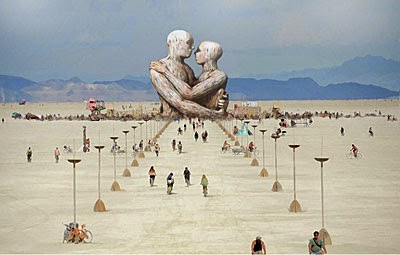
Embrace at Burning Man 2014.
By MARTIN GRIFFITH
Associated Press


RENO, Nev. — The Burning Man counterculture festival drew a peak crowd of nearly 66,000 celebrants as it neared an end Monday on the northern Nevada desert.

Friday's official peak attendance of 65,922 was within the population cap of 68,000 the federal Bureau of Land Management imposed on the quirky art and music festival 110 miles north of Reno, said Gene Seidlitz, manager of the agency's Winnemucca District.

The number was down from last year's record peak crowd of 69,613, which resulted in organizers being placed on probation for a second time in three years for violating the limit.

Organizers had been warned that if they were placed on probation a second straight year, the agency might suspend or cancel their permit.

"That (crowd size) is not a problem this year," Seidlitz said, adding the attendance cap was one of 55 conditions organizers had to comply with under terms of their permit.

"We don't see any reason why we shouldn't meet all other stipulations," Burning Man spokesman Jim Graham said.

Overall, the weeklong festival leading up to Labor Day was successful and safe except for Thursday's death of a 29-year-old Wyoming woman who was struck by a bus carrying passengers on the playa of the Black Rock Desert, Seidlitz said.

Crime statistics will not be released until later this month, he added.

Rain early on closed the gate for a day — the longest closure in the event's history — and dust storms caused occasional whiteout conditions Friday.

But the festival's eclectic artwork, offbeat theme camps, concerts and other entertainment drew praise from participants from around the world.

"Actually, I feel renewed faith in humanity," John Bacon, of Seattle, told KRNV-TV.

Ron Adair, of Ojai, California, said he felt "a little tired."

"It's a little hard to have that many nights in a row and get by on four, five, six hours of sleep every night," Adair said.

After it moved from San Francisco, the inaugural Burning Man in Nevada drew only about 80 people in 1990.

August 26, 2014

The gates are open! Tens of thousands of stranded 'burners' flood into Burning Man site after festival is reopened following rare storm

Deserted: Tens of thousands of people should have arrived to create a make-shift city in Nevada's Black Rock Desert. But after Monday morning's rains, the site was empty until today.

By Alex Greg and Ted Thornhill
UK Mail Online


Tens of thousands of so-called 'burners' were flooding through the gates of Burning Man this morning after the event was reopened following a rain storm that left Nevada's Black Rock Desert looking more like a swamp on the festival's opening day.

Vehicles were allowed into the event's entrance on Highway 34 northeast of Gerlach from 6 a.m. Tuesday, organizers tweeted just after 1 a.m.

Festival goers, or 'burners,' responded to the good news with excited tweets such as 'time to get back on the road,' and 'all roads lead to #burningman.'

Yesterday, incredible pictures taken from the air showed the astonishing number of people stranded in the desert after rare heavy rains prevented them entering the site of the annual festival.

By Monday, it should have resembled something from a post-apocalyptic Mad Max movie, a teeming mini city growing out of the sand.

But standing water turned the playa 90 miles north of Reno into a quagmire and police barred ticket holders entry to the free-spirited week-long arts event.

Hundreds of vehicles massed outside the gates waiting for the weather to clear up, with some posting messages on Twitter about their predicament using the hashtag #strandedman.

Festival-goer Jordan Kalev arrived at the event by plane and took pictures of the site as he flew over showing the sheer volume of traffic massed at the entrance and the soggy state of the ground.

Around 70,000 people were left anxiously waiting for the event to start, with many driving back to Reno rather than queue in the desert.

Several hundred people who arrived on Sunday were told to remain in place in their camps but those who came to the gates for the 10 a.m. opening on Monday were turned away and told to keep an eye on social media.

'Black Rock City has shut down following rainstorms that left standing water on the playa, leaving it undrivable,' said Jim Graham, a festival spokesman, in a statement issued on Monday.

Highway patrol officers turned back festival goers who have paid upwards of $1,000 on the black market for tickets to the event, which last year saw a record 68,000 people spend a week in the desert for the annual art, music and everything else festival.

Rudy Evenson, who works at the US Bureau of Land Management, who operates the Black Rock Desert site Burning Man uses said that the festival would not get underway on Monday 'because there was too much rain. When it dries out they'll let people in again.'

The downpour began at 6 a.m. on Monday and continued for several hours, only dumping a tenth of an inch of rain, enough to make the muddy flats unfit for vehicles to drive on.

'We're going to make the best of the situation,' Charlie Lucas, of Portland, Oregon, told the Reno Gazette-Journal.

By midday Monday, hundreds of people had gathered outside a tribal smoke shop just off US Interstate 80 in Wadsworth east of Reno where they were buying camping permits at the lake that sits on the Pyramid Lake-Paiute Reservation.

Clerks at the smoke shop said they had no idea how many permits had been sold, only that they were 'overwhelmed' and did not have time to talk.

'We're going to make good of a bad situation,' Shaft Uddin of London told the Gazette-Journal. 'I hear Pyramid Lake is beautiful, and apparently there is going to be a big party.'

By Monday afternoon, yellow Volkswagen buses, countless recreation vehicles and at least one school bus painted to look like a cheetah with whiskers on the hood began packing campsites along the lake.

Close to a dozen of those first arrivals took off their clothes and entered the lake, the newspaper reported.

Nudity is allowed at Burning Man as part of the celebration of art and self-expression.

But within an hour, a park ranger at Pyramid Lake had asked the campers to put their clothes back on. 'How can you not know that it is not OK to be naked in public?' the ranger asked.

Hundreds of travelers searching for oneness with nature and celebration of self-expression inf act spent their first night in the parking lot of a Wal-Mart or Reno resort casino.

But most were taking it in stride and were largely optimistic - as so-called 'Burners' are apt to be - that the gates to the counterculture event would reopen Tuesday.

'You take it as it comes,' said Mark Vanlerberghe, who left San Jose, California, in an RV that he ended up parking Monday at the Wal-Mart for the night when he heard the access road to the remote festival site was closed.

'You're going to the desert and you know there's weather to deal with,' he said. 'I guess that's part of being a Burning Man. Don't get stressed about it.'

Dozens of RVs and vans bound for Burning Man were parked at the Wal-Mart at the Three Nations Plaza, and nearly a hundred more across the street by sundown at the Grand Sierra Resort along U.S. Interstate 80 just east of downtown Reno.

The blinking casino lights and video billboards gave off a pink twinkle not unlike the various light shows at the weeklong desert gathering that culminates with the burning of a large wooden effigy the night before Labor Day.

But the yellow stripes on the blacktop pavement with 'Wrong Way' signs weren't exactly what the seekers of paradise on the playa had in mind on their way to soak up the various theme camps, art exhibits, all-night music and guerrilla theater, along with a decent dose of nudity and a bunch of other stuff that's just plain weird.

'We're just trying to stay positive,' said a woman from Oakland, California, who identified herself only as 'Driftwood' while hanging out in the Wal-Mart parking lot with a group of first-timers from Texas.
'Positivity can raise everything up.'

Barbara Quintanilla of Houston said the rain delay was the least of their worries in an RV with friends who didn't initially know whether the camper used diesel or regular gas, made a wrong turn out of Texas and ran over a sign post. Their destination is 'Planet Earth,' she said, 'The Eighties' Camp.'

'My friends believe that making it a longer trip will make you better,' Quintanilla said. 'We have a list of 27 things we need to get at Wal-Mart.'

Traveling companion Bill Sanchez of Houston said the voyage so far 'has been brutal.'

'We made a 2,000-mile trip and none of us had ever driven an RV before. It would only go 35 mph up hills,' he said with a smile at the plaza on land owned by a Nevada tribe.

'But through hard work and dedication, we will achieve our dreams.'

Jahliele Paquin and Jeff Difabrizio were in their third mode of transportation on the way to their first 'Burn' from their home in Canada's Northwest Territories.

They flew from Yellowknife to Regina, Saskatchewan and bought a van they drove to Reno, where it broke down Monday and they rented a car for the rest of the trip.

'We're kind of thinking like we'll get there when we get there,' Paquin said.

Jeff Cross of Orange County, California was in a different group with Texans Adam Baker and Chelsea Coburn making their second trip to the Black Rock and were determined the weather wouldn't deter them.

'It's the best festival in the world,' he said while unloading provisions at their RV outside the Wal-Mart Monday night. 'And there's no cellphones, no internet, no money or corporate sponsors.'

'You have to have a lot of supplies,' Coburn said. 'It's a lot of work, but it makes it more gratifying.

Indeed in recent years, devotees of Burning Man have become irritated with the expansion in popularity of the free-spirited event.

The festival dates back to 1986 and is based on ideals of community and inclusion - but visiting the ad-hoc city that rises from the desert each year has become a status symbol for the tech elite.

The one-upmanship of San Francisco tech nouveau riche, with their luxury accommodations and chef-prepared meals, is at odds with the spirit of the festival, say some longtime 'burners.'

The festival began as a counter-cultural gathering of free spirits on a beach in San Francisco and has evolved into a 10-day phenomenon spread across seven square miles of Nevada's Black Rock Desert.

Participants 'dedicate themselves to the spirit of community, art, self-expression, and self-reliance. They depart one week later, leaving no trace,' the Burning Man website explains.

Nothing but ice and coffee is for sale so attendees must bring enough food and water to sustain themselves.

Tens of thousands of likeminded burners frolic around the temporary city instilled with the principles of Burning Man, which include gifting, decommodification (no advertising or transactions), radical self-reliance and radical inclusion.

Art installations, music, free classes, costumes, sharing of love, opinions, food and discussion is the order of the day at Burning Man.

So it's unsurprising that the new wave of annual attendees from San Francisco with very different ideas about the experience has some devotees up in arms.

A man who attends the festival annually with a group of Silicon Valley entrepreneurs told The New York Times that the camp they establish costs $25,000 per person - but not for the models who are flown in on private jets from New York.

'We have the craziest chefs in the world and people who build yurts for us that have beds and air-conditioning. Yes, air-conditioning in the middle of the desert,' he said.

Regular attendees haul camping gear or drive rented RVs to the desert and pay $300 to camp for 10 days, using portable toilets and freshening up with wet wipes.

And flying in the face of the festival's tenets of 'radical self-reliance,' and 'communal effort,' some camps come complete with 'sherpas,' or hired help.

According to The New York Times, there are up to 30 sherpas waiting on 12 attendees who fly in on private planes and are then driven to their camp in luxury RVs and fed meals prepared by teams of top chefs.

Sherpas handle the rest - costumes, which are a big part of Burning Man life, drugs, and any other whim.

'The tech start-ups now go to Burning Man and eat drugs in search of the next greatest app,' Tyler Hansen, who worked as a sherpa, told The New York Times.

'Burning Man is no longer a counterculture revolution. It's now become a mirror of society.'

Elon Musk, a founder of PayPal, recently said that Burning Man 'is Silicon Valley' and that creator of the HBO show 'Silicon Valley' Mike Judge couldn't possibly understand the tech world because he hadn't been.

It's not only tech types - DuJour reports that socialites, heirs and heiresses and Hollywood starlets have also been attending in style, including Lady Victoria Hervey, shipping heir Stavros Niarchos, Alexandra von Furstenberg and Francesca Versace and a New York Wall Street tycoon who spent $1 million on a custom RV.

Money-making endeavors at the festival are also on the rise, with concierge companies offering packages including flights, transfers, food, camps with electricity, food, water and wifi, private toilets and even a 'customized art car' for wealthy burners.

This year's festival sold out within an hour.

After it moved from San Francisco's Baker Beach, the inaugural Burning Man in Nevada drew some 80 people in 1990.

The first 1,000-plus crowd was in 1993, and attendance doubled each of the next three years before reaching 23,000 in 1999. The crowd was capped at 50,000 under a five-year permit that expired in 2010.

August 20, 2014

A Line Is Drawn in the Desert

At Burning Man, the Tech Elite One-Up One Another

“If you haven’t been, you just don’t get it,” said the entrepreneur Elon Musk of Burning Man. A wooden yacht art car rolled through in 2012. (Credit Andy Barron/Reno Gazette-Journal via Associated Press)

By Nick Bilton
New York Times


There are two disciplines in which Silicon Valley entrepreneurs excel above almost everyone else. The first is making exorbitant amounts of money. The second is pretending they don’t care about that money.

To understand this, let’s enter into evidence Exhibit A: the annual Burning Man festival in Black Rock City, Nev.

If you have never been to Burning Man, your perception is likely this: a white-hot desert filled with 50,000 stoned, half-naked hippies doing sun salutations while techno music thumps through the air.

A few years ago, this assumption would have been mostly correct. But now things are a little different. Over the last two years, Burning Man, which this year runs from Aug. 25 to Sept. 1, has been the annual getaway for a new crop of millionaire and billionaire technology moguls, many of whom are one-upping one another in a secret game of I-can-spend-more-money-than-you-can and, some say, ruining it for everyone else.

Some of the biggest names in technology have been making the pilgrimage to the desert for years, happily blending in unnoticed. These include Larry Page and Sergey Brin, the Google founders, and Jeff Bezos, chief executive of Amazon. But now a new set of younger rich techies are heading east, including Mark Zuckerberg of Facebook, employees from Twitter, Zynga and Uber, and a slew of khaki-wearing venture capitalists.

Before I explain just how ridiculous the spending habits of these baby billionaires have become, let’s go over the rules of Burning Man: You bring your own place to sleep (often a tent), food to eat (often ramen noodles) and the strangest clothing possible for the week (often not much). There is no Internet or cell reception. While drugs are technically illegal, they are easier to find than candy on Halloween. And as for money, with the exception of coffee and ice, you cannot buy anything at the festival. Selling things to people is also a strict no-no. Instead, Burners (as they are called) simply give things away. What’s yours is mine. And that often means everything from a meal to saliva.

In recent years, the competition for who in the tech world could outdo who evolved from a need for more luxurious sleeping quarters. People went from spending the night in tents, to renting R.V.s, to building actual structures.

“We used to have R.V.s and precooked meals,” said a man who attends Burning Man with a group of Silicon Valley entrepreneurs. (He asked not to be named so as not to jeopardize those relationships.) “Now, we have the craziest chefs in the world and people who build yurts for us that have beds and air-conditioning.” He added with a sense of amazement, “Yes, air-conditioning in the middle of the desert!”

His camp includes about 100 people from the Valley and Hollywood start-ups, as well as several venture capital firms. And while dues for most non-tech camps run about $300 a person, he said his camp’s fees this year were $25,000 a person. A few people, mostly female models flown in from New York, get to go free, but when all is told, the weekend accommodations will collectively cost the partygoers over $2 million.

Continue reading the main story
This is drastically different from the way most people experience the event. When I attended Burning Man a few years ago, we slept in tents and a U-Haul moving van. We lived on cereal and beef jerky for a week. And while Burning Man was one of the best experiences of my life, using the public Porta-Potty toilets was certainly one of the most revolting experiences thus far. But that’s what makes Burning Man so great: at least you’re all experiencing those gross toilets together.

That is, until recently. Now the rich are spending thousands of dollars to get their own luxury restroom trailers, just like those used on movie sets.

“Anyone who has been going to Burning Man for the last five years is now seeing things on a level of expense or flash that didn’t exist before,” said Brian Doherty, author of the book “This Is Burning Man.” “It does have this feeling that, ‘Oh, look, the rich people have moved into my neighborhood.’ It’s gentrifying.”

For those with even more money to squander, there are camps that come with “Sherpas,” who are essentially paid help.

Tyler Hanson, who started going to Burning Man in 1995, decided a couple of years ago to try working as a paid Sherpa at one of these luxury camps. He described the experience this way: Lavish R.V.s are driven in and connected together to create a private forted area, ensuring that no outsiders can get in. The rich are flown in on private planes, then picked up at the Burning Man airport, driven to their camp and served like kings and queens for a week. (Their meals are prepared by teams of chefs, which can include sushi, lobster boils and steak tartare — yes, in the middle of 110-degree heat.)

“Your food, your drugs, your costumes are all handled for you, so all you have to do is show up,” Mr. Hanson said. “In the camp where I was working, there were about 30 Sherpas for 12 attendees.”

Mr. Hanson said he won’t be going back to Burning Man anytime soon. The Sherpas, the money, the blockaded camps and the tech elite were too much for him. “The tech start-ups now go to Burning Man and eat drugs in search of the next greatest app,” he said. “Burning Man is no longer a counterculture revolution. It’s now become a mirror of society.”

Strangely, the tech elite won’t disagree with Mr. Hanson about it being a reflection of society. This year at the premiere of the HBO show “Silicon Valley,” Elon Musk, an entrepreneur who was a founder of PayPal, complained that Mike Judge, the show’s creator, didn’t get the tech world because — wait for it — he had not attended the annual party in the desert.

“I really feel like Mike Judge has never been to Burning Man, which is Silicon Valley,” Mr. Musk said to a Re/Code reporter, while using a number of expletives to describe the festival. “If you haven’t been, you just don’t get it.”

Non-tech Burners who have been may “get it” but don’t like all this excess, and are starting to push back. This month, the Key Group, a Swiss luxury concierge service, announced that it would be offering a Burning Man Concierge Service that seemed more like a cruise liner vacation than a week in the dusty desert. (The company did not respond to a request for comment.)

Among the dozens of options offered by the Key, there is the “establishment of a camp with electricity, water and satellite Internet Wi-Fi connection,” “cooks and fresh buffets for every meal” and — not a small task by any means given the distance from the real world — the “possibility of ordering goods and products from outside Black Rock City every day.”

When the website Burners.me, which blogs about the festival, posted a link to the Key’s site, the Burning Man community seemed generally confused as to whether such extravagance was actually real or if someone was playing a joke. When it turned out to be quite real, people railed against the service, and the Key removed the Burning Man concierge option from its site.

Of course, you won’t likely see pictures on Instagram or Facebook of the $2 million camps, chef-cooked meals, the Sherpa helpers and concierge services, or private and pristine toilets. That would mean that the tech elite actually cared about money — which would just go against the entire Burning Man spirit.

July 29, 2014

Camping By a Pool in the Mojave Desert Was the Weirdest Night of My Life

The boys crouched down to unlock the cover to the pool and slowly slid it open, like they were exposing a tiny silver of heaven. Our own personal desert mirage. Was this art? (Sasha Bronner)

Sasha Bronner
HuffPost LA


There is a hidden swimming pool in the Mojave Desert, an eleven-by-five-foot wide minimalist structure designed by an artist and titled the "Social Pool" -- and it is open to anyone who has a day to spare, Google Maps and the ability to follow directions. News about the pool started to buzz in June and caught my attention as something that might bring about adventure, happiness, or both. The sheer ridiculousness of it all -- the fact that you pick up a key that unlocks the cover to the pool from a museum in LA, are only then given the secret coordinates, drive three hours into the desert and then need to be back 24 hours later -- excited anyone I knew who had heard about it.

The Los Angeles Times, The Huffington Post, The Guardian, The Smithsonian and countless others had all covered the art installation -- and its limited run until September -- ignited my desire to go with an even greater sense of urgency.

I recruited two male friends who were both giddy about the adventure; one a newer friend and one whom I've known for years. It was all we could talk about for days leading up to our departure.

When we decided to up the ante and planned to camp overnight by the pool (which some people have done, but not many), my greatest fears were the possibility of snakes, the punishing sun and heat and possibly an interaction with a scorpion.

Mike, Jonathan and I collected the key to the pool at 11:03 a.m. in West Hollywood. We were given the GPS coordinates and little else.

About an hour before we arrived at our destination, we started noticing the small towns that appeared and then vanished around us: abandoned homes off the side of the road, cracking signs and large deserted plots of land. Signs for Ron's Ranch, various feed stores or the Lone Wolf Health Colony gave us pause. It was as if we were driving through a Disneyland attraction or an actual ghost town. We were delighted already.

After leaving a gas station with gallons of cold water, Gatorade and bags of ice, we resumed our route on the one-lane highway, only to strangely see a long procession of cars heading towards us with their hazard lights flashing. Most businesses were closed or hadn't been open in months and as we left the various towns behind, driving 80 mph on open roads, we looked around and said that we had just officially entered the mind of Stephen King.

The GPS told us to turn left onto what had been described as a dirt road, but was really more of a severely rocky road that we had to drive down very slowly to avoid damaging our cars. We pulled over 2.5 miles down the road when the voice of the GPS politely said to prepare to park and to continue to our destination on foot.

We knew ahead of time that finding the pool would take some searching -- some said anywhere between five and 30 minutes on foot -- and we were also told that the pool was in the "middle of nowhere." Instead, once we had turned on the rocky road, we passed a fairly big house on our right and closer to where we parked, we saw a set of three abandoned RVs with the windows smashed open, the doors blown out but lawn chairs sitting in the yard. This did not seem like the middle of nowhere.

Between looking for a GPS location in the desert and the questionable meth RVs haphazardly planted around us, the trip suddenly had all the makings of the complete Breaking Bad experience.

Off to the right, in the wide-open desert, we squinted and saw a group of people standing around something. Because the Social Pool is supposed to have only one key that is given out for 24 hours at a time, and because that key was tucked carefully away in my camouflage fanny pack, our curiosity about the group of men and their truck blossomed. Unsure of what to say when we approached them, we left all of our gear in the car and headed their way.

The sky, deeply overcast, broke open with warm rain and we soon saw bolts of lightning far off in the distance. As we grew closer, it was clear that the group was in fact waiting at the pool -- it looked like we wouldn't have to do any searching -- but when we approached, they headed back to their truck and drove off without saying a word.

The rest of the afternoon passed blissfully. We hiked back to our cars, transferred gear to Mike's car and drove it down a sandier road that put us closer to the pool. The boys crouched down to unlock the cover to the pool and slowly slid it open, like they were exposing a tiny silver of heaven. Our own personal desert mirage. Was this art? It didn't matter. They dropped a heavy block of ice into the already cool water and we jumped in, shrieking and laughing.

Everything that was supposed to be surreal and wonderful about a tiny oasis tucked into the ground of the desert -- was. We laughed at the absurdity of where we were, took Polaroid pictures and drank beers. I packed peanut butter and jelly sandwiches and we ate them sitting on the edge of the pool, our feet soaking, bewildered by the beautiful emptiness of it all, smiling when the rain blew away and was replaced by a perfect desert breeze. We listened to Fleetwood Mac, The Traveling Wilburys and Paul Simon. The sun started to fade and pinks and oranges burst into the sky and we quickly forgot about the ghost town, the RVs and the mysterious people who were there when we arrived.

The stars made their grand appearance, pulling us away from even our conversations as we looked up and tried to remember the last time we could see so much beauty above us. Lanterns were switched on, my sweatpants replaced my bathing suit and individually wrapped slices of pizza were consumed. We were happy.

But a few hours later, off in the distance, a tiny light appeared. Two, in fact -- the headlights of a vehicle. We watched it travel down the road, still a great distance from us, and wondered if it could be going to that first house we saw, or possibly, the less desirable option, if it could be headed toward the Breaking Bad RVs. But then the two lights veered off of the road and picked up speed, barreling directly toward us suddenly at a great pace. We all tensed, I turned off the music and lights and Mike and Jonathan whispered frantically about what to do. The car was approaching fast and they quickly got out of the pool and reached for empty beer bottles.

The Jeep stopped about 20 feet away, first passing us, and then reversing to our exact location. Two men got out of the car and started whispering. One put on a headlamp. As they approached we said, "Hello? Can we help you?" and they stopped, still covered by darkness, none of their features discernible. "A friend leaked the key," is all one said. We asked them to come closer so that we could see their faces, and the man continued, "We were going to check it out but we can stay out of your way."

We suddenly felt deeply protective of the pool, a subtle primal instinct setting in as we looked up at their faces, realizing that we were in fact not in the middle of nowhere. Realizing with a shudder of stupidity that actually, the entire Internet probably knew our exact location and anyone could have a copy of that key. Enter every horror movie plot you've ever seen.

Showing my true city girl colors, I confidently told them that we had a reservation and that we would be there 'til morning. They said it was so hot earlier that they didn't think anyone would be out there. But it wasn't that hot earlier, I thought to myself. It rained. There was something about the squint in their eyes, the weirdly high-tech watch that the man with the headlamp wore, the inflection of the voice that said "we can stay out of your way" that clung to me after the Jeep pulled away. We kept our lanterns off until the echo of the red of their taillights was long lost in the distance.

The visit changed everything and even though they were gone, we sat feeling edgy in the darkness, talking about how the very things we were most worried about -- the heat, actually finding the pool and maybe the snakes -- were really not a problem at all. Instead, what we feared the most was actually other human beings.

Around midnight we headed to our tents, feeling calmer after fixating on the beautiful blinking lights above us, talking about what the stars looked like during childhood and all the other things that humans talk about when we look up at the night sky. Mike went into his tent and Jonathan and I went into ours. The night was so warm that we kept the tent window, covered in thin mesh, open so that we could feel the breeze and even see the stars behind us if we tipped our heads back.

Three hours later, my eyes snapped opened to the sound of footsteps and breathing. My body went stiff and I felt Jonathan's hand squeeze my forearm tight telling me that he was awake and heard it too. We didn't move or speak, wanting whatever or whoever was out there to think that we were sleeping. We listened intently to the sound outside the tent. This went on for minutes. I was sure something was looking through the tent window at us. I could feel its eyes and hear it breathing.

Fear like this transfixes your body in an instant. The only thing moving was my heart; maniacally pulsating at a pace I have never felt before and hope to never feel again. We gripped each other's arms, squeezing quick pulses in an attempt to communicate when we heard something new. Next came the sound of something touching the tent, like it was trying to find the zipper -- but quietly. I reached for my glasses and Jonathan's hand quickly touched mine to feel what I was reaching for.

The brain doesn't run through multiple grand scenarios at a time like this. It doesn't consider all the possibilities. It zeroes in on a feeling. Someone was there to hurt us. I was sure in the deepest pockets of my gut that either the men from the Jeep had come back or someone from that house or the RVs was there to kill us. Or had they come to steal our car keys? Do we try to protect ourselves? Do we pretend we're sleeping? I waited with terror for the moment that they found the zipper. The moment didn't come.

The sound of footsteps and movement stalled. But there was an indentation of something leaning against the tent, right next to me. Very slowly we moved from lying on our backs to kneeling up on our knees and I whispered, the sound barely leaving my throat, "Who the fuck is that?" to which he quickly responded, "What the fuck is that?" As sure as I was that there was a human trying to get into the tent, he was sure that it was an animal pushing up against it. A coyote perhaps.

"We have to make a ton of noise to scare it away," he whispered.

"What if it's a person? What if they attack us?" I looked at him with wide glistening eyes.

"I think it's an animal. They are scavengers and we have to scare it away. We won't have any peace of mind until we do. We have to make really loud sounds at the top of our lungs."

"We are going to scare Mike so bad he's going to have a heart attack."

"We have to do it."

"I don't know what to yell."

"We have to yell loudly like we are mad. Not like we are scared."

"But I am so scared."

"Then you can shout something and I'll make sounds. Just scream 'Get the fuck out of here! Get the fuck out of here!'"

"Mike is going to think people are here."

"Okay then scream 'Get the fuck out of here, animals!'"

"But that's so long."

"Scream 'Get out of here! Get out of here!' But do it really, really loud. Okay?"

I took many deep breaths. "Okay."

He counted down from five and started making these insane short guttural calls from the belly of his body, and forgetting my line, I just started wailing, "Go away! Go away!"

Silence.

Then the sound of Mike's voice wafted from his tent. As if in slow motion he asked, "So. What's going on?"

Jonathan took the flashlight and left the tent. As we told Mike everything that had just happened, I brought my knees to my chest and tried to stop my entire body from shaking. Jonathan spotted fresh urine around the tent and paw prints.

Falling back asleep was like trying to stop popcorn from popping out of a pan. We didn't say much else until the sun came up. Exiting the tent in the daylight felt like breathing for the first time. We packed up camp quickly, slid the cover back on the Social Pool and locked it.

We got all our stuff back to Mike's car in two trips. As we slammed the trunk and Jonathan and I put our backpacks on to walk up the road to my car, I sarcastically said, "After all this, you guys, you know there's going to be a third act."

Mike started the car and put his foot on the accelerator but the tires quickly sunk into the sand. He reversed and tried again. We tried pushing the car. Then I steered and they pushed. Sand and smoke wailed up around the tires and we looked at each other in disbelief. After 30 minutes of trying, and the pressure of being told that we had to return the key to Los Angeles by 11 a.m., we left everything and drove my car back up to the highway.

Mike Googled auto towing in the area and called at least three numbers that were disconnected. A fourth place was closed on the weekends. We finally got a live voice, Mark, who said he was too far away but to try Debbie. We called Debbie but got an Al, who told us to call Ed, who told us to call Tony.

I pulled into the town where we had seen the cars flashing their hazard lights and found a place called Cafe 247 that had a sign for breakfast all day. I've never ordered a milkshake at 8:40 a.m. but I earned it. We also were delighted to ingest the best breakfast burrito that's ever been made by human hands. If anyone ever asks you the vague question "all the meat?" when ordering anything, just say yes.

We sat in the roadside cafe while Tony worked out how to get to Mike's car. We met him on the highway an hour later and waited while Mike disappeared with him down the rocky road. We dozed on and off and whenever I re-opened my eyes, I squinted down the rocky road to see if I could spot Mike's white car or Tony's grey truck headed our way. Over ninety minutes and $375 later, after clearing out bushes and even some small trees, Tony was able to drag Mike's car back to the road.

We drove home, for a while following one another on the highway, and then eventually separating when I pulled over to take a picture of a faded, broken down sign with an abandoned couch in front of it. It read "Apple Valley Welcomes You...to a better way of life!" And after that, we couldn't stop ourselves from recounting in great detail, with insane spouts of laughter, all that had happened. All that had been said. All that we had felt in the span of 21 hours.

We noticed new signs on the highway for other abandoned ranches and bizarre motels, like the Portal Motel or Paradise Inn (which had vacancy), but the drive went more quickly this time. Perhaps I drove faster than I realized.

Now that we are home, friends have asked us if it was fun -- to which, we each have decided to answer: That's beside the point.