Showing posts with label Burning Man. Show all posts

August 24, 2017

Burning Man: Giant jellyfish, pulsating heart and rebuilt Boeing 747 set to dazzle at Nevada desert festival

Work by Ken Feldman, Vasily Klyukin and Peter Hazel among installations on display at leading US contemporary arts extravaganza

One of the largest art installations at Burning Man 2017 will be a recreated Boeing 747 which has been moved in giant pieces from the Mojave Air and Space Port.

Oliver Poole
The Independent


The Burning Man festival starts this Sunday and this year’s installations are set to be some of the most outrageous ever with a giant jellyfish, a heart that pulsates in time with the viewer’s heartbeat and a life-size recreation of a Boeing 747 airplane among those to be displayed.

The festival, which draws almost 70,000 people each year to the Nevada desert, distributed £1 million in art grants this year to ensure many new participants will get the chance to join established artists with work on display.

Perhaps the most spectacular, and certainly one of the largest, will be the recreated Boeing 747, which has been moved in giant pieces from the Mojave Air and Space Port.

More than 500 volunteers, including engineers from Boeing and Nasa, have worked since 2015 to not only disassemble the plane, but also add staircases, paintings and other details including day-glo lights to its outsides.

“It started off as a joke when I saw a bike made out of airplane parts at Burning Man and I said, 'Wouldn’t it be great if we made an art form out of a plane?'” said Ken Feldman, the project manager who organised the purchase of the decommissioned 1985 Varig 747.

Another art piece at the festival, now in its 31st year, is the Pulsating Heart by established Russian artist Vasily Klyukin.

For his new interactive installation called the Pulsating Heart, the viewer wears a special bracelet that reads the their pulse. The sculpture then synchronises with the bracelet and starts to light up in time with the heartbeat.

If the bracelet is worn by two people, the sculpture will beat faster and more rapidly.

“I am sure that it will become a notable object at the festival,” Mr Klyukin said, adding that after the festival the work will move to the La Collection Air museum in Lucerne, Switzerland.

The 40-foot high, 60-foot long jellyfish that will also be among the hundreds of art works on display has been created by Nevada artist Peter Hazel. Made out of recycled glass, the work will consist of 1,600 small jellyfish joined together to make the giant's statue.

The event ends every year with the symbolic burning of a wooden man sculpture and of many of the art pieces that had been specially created and displayed on the festival.

August 31, 2015

At Burning Man, pretty much anything goes

Burning Man participants visit the site's temple, which will eventually be set on fire. Visitors leave notes inside and in the walls of the structure, hoping the cleansing fire will set them free.
(Photo: Trevor Hughes, USA TODAY)

Trevor Hughes
USA TODAY


BLACK ROCK CITY, Nev. – A young woman stepped into the dusty glare of my headlights, and I realized she was topless. And pantsless.

The only thing she was wearing was a playing card strapped on by a clear rubber band around her waist.

And a giant smile.

"Welcome home!" she said. "Is this your first time?"

Yes. Yes, it is.

I'm spending the week embedded in the annual Burning Man festival, reporting on the newest tech trends, the dust storms and the luxury camps that drew criticism last year. The temporary city we've created is called Black Rock City, and for this week it will be the third-largest place in Nevada.

First-timers like me are pulled from their vehicles to celebrate. In my case, the young woman ordered me to remove my shirt and make dust angels as lights flashed and music drifted on the wind. I banged a bell as my greeters yelled "not a virgin" to mark my transition in the encampment.

Burning Man draws 70,000 people annually to the Nevada desert (God forbid you pronounce it Nevaaaaaada, by the way) for an almost-anything-goes event. A sign at the entrance warns arrivals that all laws apply, but there's a lot of people and not a lot of cops.

That's kind of the point: Organizers create and encourage a freewheeling experience in which many people take illegal drugs, and casual sex is not only common but widely condoned. Many of the themed camps seem intended to confront and then contort societal norms. But norms are reserved for the outside world, the Default World.

Here, creativity is everywhere. Elaborate sculptures reach toward the sky. Others blast flames. Endless electronic dance music pumps across the encampment as neon-lit vehicles circle. Strangers hug you without warning.

And the outfits. The outfits! This is a place for extreme personal expression in a way that might make many Americans feel uncomfortable. Here, lots of people go shirtless, and there's a fair few wearing even less than my greeter.

Media access is tightly controlled, and the organizers use copyright law to enforce the rules –-- photographers must sign a contract agreeing not to exploit people's images for personal gain. The last thing Burning Man organizers want is to see participants' images used to sell stuff.

And while it took me a whole day to notice, now I can't stop marveling at the complete lack of stuff being sold or marketed. Corporate logos on rental trucks are usually covered up or altered, and there's no one hawking, well, anything.

It's a welcome relief from the constant pressure of consumerism we face every day. Gone are the messages to buy buy buy. Instead, we're asked to simply be. (There's no official Internet provider, and mobile phone coverage is iffy.)

Don't get me wrong. Virtually everyone has spent a lot of money to be here, and spending a week requires lots of logistics. I watched as participants stocked up on cheap plastic junk in Reno, pouring millions of dollars into that city's economy while allowing Burning Man to maintain its reputation as the world's largest Leave No Trace event.

Here, the entire economy is based on the concept of gifting. People give you things out of the kindness of their heartsAND, with "gifts" ranging from the sculptures to free booze and Tantric massages.

Sunday, a young woman handed me a beaded bracelet she'd made, with each colored bead a piece of Morse code.

Unfurled, if you know how to read it, the bracelet quotes Shakespeare: "All the world's a stage, and all the men and women merely players."

And for the next week, this remote Nevada desert is the biggest stage of all.

August 25, 2015

New Sheriff Overseeing Burning Man to Crack Down on Naked Rule-Breakers

The weeklong event in Nevada draws thousands of people — and their drugs

Participants walk through dust at the annual Burning Man event in the Black Rock Desert of Gerlach, Nev., on Aug. 29, 2014.

Jack Linshi
Time


A new Nevada sheriff tasked with overseeing the upcoming Burning Man festival plans to crack down on the annual desert debauchery.

Jerry Allen, 39, who was elected Pershing County Sheriff in January, said he plans to tighten law enforcement for the tens of thousands of festival-goers journeying to the remote Black Rock Desert next week for the annual event, the Reno Gazette-Journal reported on Tuesday.

In recent years, many attendees at the week long event — where nudity is the norm, drugs flow as if on tap and orgies litter the desert — have not been charged for crimes like marijuana possession, according to federal reports on the event, but the new sheriff in town said he has a tougher police protocol in mind.

“We don’t have the personnel to issue citations to 70,000 naked people on the playa, but we will be upholding the law to the best of our ability,” Allen said. He added that Burning Man “brings nothing … except for heartache” to the conservative, rural county.

Burning Man organizers said they remain optimistic because the low number of arrests in years past suggest more festival-goers are abiding by the law.

“We’ve been working with [Allen] since his election, and he’s been involved with all of the large coordination efforts,” said Burning Man spokesman Jim Graham. “It’s an ongoing process on education, but he hasn’t been out there for a few years, so he hasn’t seen the progress we’ve made in recent years.”

Burning Man will take place from Aug. 30 to Sept. 7.

July 5, 2015

BLM’s Burning Man requests outrageous


EDITORIAL
LAS VEGAS REVIEW-JOURNAL


Strip VIP hosts are breathing sighs of relief from Wynn Las Vegas to Mandalay Bay. They might have their hands full satisfying all kinds of requests from their guests this holiday weekend, but they know they could be stuck with far more outrageous demands. They could be dealing with the BLM.

If Nevadans needed any more proof that U.S. Bureau of Land Management leaders are arrogant, entitled and disconnected, they need only read a tremendous series of stories recently published by the Reno Gazette-Journal.

Rugged outdoorsmen need not apply to the Interior Department. As reported by the newspaper’s Jenny Kane, the BLM asked the organizers of the upcoming Burning Man counterculture festival to build a million-dollar luxury compound — supplied with a ridiculous list of snacks, food and amenities at the festival’s expense — to accommodate the federal employees charged with staffing Black Rock City later this summer. The request, which would raise the festival’s land use costs to roughly $5 million, has become a stumbling block for organizers, who need a permit from the BLM to stage their event in northwestern Nevada.

Burning Man is famous for extreme conditions and the self-reliance of its attendees — two things BLM employees want no part of. The implication of the request was clear: The permit for the already sold-out festival, which will attract up to 80,000 people to the desert the week leading up to Labor Day, could be denied if the BLM’s VIPs aren’t provided with flushing toilets, showers, hot water, refrigerators, couches, washers, dryers, Choco Tacos, M&Ms, licorice, Chobani Greek Yogurt, steaks and 24-hour access to ice cream.

What, no bottle service or spa treatments?

In an interview with the Gazette-Journal, Rep. Mark Amodei, R-Nev., whose district includes the Black Rock Desert, questioned the origin of the request.

“I don’t think it was driven out of Nevada. I think it was driven out of Utah, or D.C., or both,” he said. “We have a big problem: 15 VIP accommodations and soft-serve ice cream 24 hours a day. With all due respect, those dots do not connect.”

That’s almost $67,000 per employee for a week in the sticks. Those are some awfully expensive manicures. (“Ethel, I said the clear nail polish!”)

Sen. Harry Reid, D-Nev., also had a big problem with the extravagance. In a pointed letter to Interior Secretary Sally Jewell, Sen. Reid reminded her of the cultural benefits and economic boost Burning Man has brought to the state for the past 23 years, and reiterated the philosophy and logistics of the festival.

“While I agree that the BLM should take its permitting duties seriously and work with Burning Man to both guarantee the safety of its participants and the protection of the environment, providing outlandishly unnecessary facilities for the BLM and its guests should be beyond the scope of the permitting requirements,” he wrote. “Flush toilets and laundry facilities can be found about ten miles away in Gerlach, Nevada, if BLM’s employees need such amenities.”

The BLM’s request bordered on extortion: “You want your permit? Then give us our ice cream!” The fallout from the demands has compelled the BLM to reconsider its needs at Burning Man. Good.

The demands, while ridiculous, make perfect sense. The BLM can’t manage the land. It can’t manage wild horse herds. It can’t prevent wildfires. Its sheltered staffers know nothing about the land, so they couldn’t possibly be expected to rough it while monitoring a counterculture celebration that’s all about leaving civilization behind. They think the public’s land is their land, and they resent leaving the comforts of their offices and homes to protect it from the unwashed masses.

Here’s an idea for the BLM: provide some basic camping courses to your staff — in the outdoors, not at a five-star hotel — and hire fewer wimps.

September 26, 2014

Gifts in the desert: the psychology of Burning Man

At the Burning Man festival, kindness flourishes and generosity is widespread. Research on the psychology of human altruism helps explain why

The art installation Pulse & Bloom is seen during the Burning Man 2014 “Caravansary” arts and music festival in the Black Rock Desert of Nevada (darkroom.baltimoresun.com)

Molly Crockett
The Guardian


What happens to groups of people in harsh physical environments, away from all of the trappings of modern civilization? Tales of shipwrecks, adventurers and post-apocalyptic worlds explore this question, and usually these stories do not end well (recall the descent into anarchy and violence in Lord of the Flies). The political philosopher Thomas Hobbes warned that outside of civilized society, humans are nasty brutes who would sooner step on another’s face than share scarce resources.

Burning Man is a massive weeklong public arts festival held every August in Black Rock City, Nevada. You might imagine this event, where 65,000 people converge in a blazing desert devoid of water, food or electricity, would be a recipe for disaster.

But what happens at Burning Man might surprise even the cynics. Somehow this environment brings out the very best aspects of human nature. There, kindness flourishes and generosity is widespread. How does this happen? Research on the psychology of human altruism offers some clues.

It’s the economy, stupid

One of the most unique features of Burning Man, relative to other large festivals, is its economy. Nothing is for sale, with the exception of ice and coffee. Everything else is given freely as gifts. Walking around the city, you might receive: a neck massage; a shot of absinthe; your portrait, taken by a professional photographer; a snow cone; a pancake breakfast; a pair of vintage sunglasses; a pot of crème brulée; a yoga lesson.

Subtracting money from social interactions could be a key contributor to the spirit of generosity that permeates the atmosphere. An influential set of studies showed that even just thinking about money makes people less likely to help others and less interested in spending time with others. Subsequent research found that university students were more likely to cheat after seeing 7000 dollar bills than after seeing only 24. It seems that being around money brings out the worst in us.

So what exactly is it about money that dampens our taste for generosity? One possibility is that when we participate in financial transactions, we follow different social rules than when we share our resources communally. Drawing from anthropology research, scientists James Heyman and Dan Ariely proposed that there are two types of human transactions. In monetary markets, people pay money for goods and services: imagine you own a restaurant, and your customers pay you for their meals. Meanwhile, in social markets people help and share with one another out of kindness: imagine inviting a close friend to your house for dinner.

Because these two different markets exist, people will sometimes paradoxically expend more effort for no payment at all (in a social market) than for a small payment (in a monetary market). For example, you might agree to help a friend move house as a personal favour, but if he offered to pay you £1 for your services, you would be insulted and refuse.

Since nothing is for sale at Burning Man, this means virtually all human interactions take place in social markets, where sharing and caring rule the day.

Golden rules

The culture of generosity that defines Burning Man doesn’t simply appear out of thin air. Participants are urged to follow the Ten Principles, a code of conduct that includes gifting, communal effort, and civic responsibility. These guidelines are published front and center in the festival programme, re-iterated in public service announcements on the festival radio station, and often pop up in conversations in the city. They are impossible to ignore.

These public declarations of the prevailing social norms likely play a central role in spurring the widespread cooperation in Black Rock City. Countless studies have shown that humans are not blind altruists, cooperating regardless of what others do, but rather are conditional cooperators: we prefer to cooperate only when we are reasonably certain that others will too. So telling people that their peers are cooperating is one of the best ways to get people to cooperate themselves. For example, hotel guests are more likely to re-use their towels if they learn that previous guests re-used their towels – even more so than if they are told that re-using towels helps the environment.

In Black Rock City, the highly visible constant stream of gift-giving not only reassures you that others are cooperating, but also motivates you to pay these favours forward. This is formally known as generalized reciprocity, and researchers have shown that paying generosity forward is most likely to evolve when communities are interdependent and contain small subgroups. So the social structure of Burning Man, where everyone must work together to stay safe in the harsh desert and ‘leave no trace’ environmentally, and where people are organized into small camps, provides the optimal conditions for generalized reciprocity to take hold.

Natural highs

Many studies have shown a link between positive mood and generosity. When we are happy we are more likely to help others. Herein lies another explanation for the prevalence of altruism at Burning Man. The general mood there is positively giddy. You might think this is merely a side effect of euphoric drugs, but in fact at any given time most people at Burning Man are not high on drugs. Their high is entirely natural, and recent research can help explain why.

A study led by neuroscientist Robb Rutledge showed that feeling happy depends not on how well things are going in general, but instead whether things are going better than expected. In other words, pleasant surprises have a big effect on happiness – and these abound in Black Rock City. Hardly a minute goes by without some sort of weird and wonderful episode, like spotting a giant mobile octopus spouting flames from its tentacles, or encountering a man offering you a giant platter of delicious grilled steak, or stumbling into a glass dome rigged with colourful LED lights that give you the sensation of being inside a rainbow.

It’s no surprise, then, that this environment puts people in a good mood, which then boosts kindness and generosity. And it turns out the causal arrows also run in the reverse direction. Work by Elizabeth Dunn, Lara Aknin and Michael Norton has shown that being kind to others promotes happiness. So happiness increases helping, and likewise helping increases happiness, creating a positive feedback loop of warm fuzzy feelings (and their associated neurochemicals) in oneself and in others. And these natural neurochemicals could well be habit forming. Census data show that 60 percent of this year’s visitors were repeat customers.

Lessons for the real world?

Scientists have been studying altruism in the lab since at least the 1950s. This work has identified many factors that promote or reduce altruism. But these studies can’t tell us everything, in large part because they use highly simplified models of altruism. For example, one popular research tool is the dictator game, where one volunteer receives some money from the experimenter – say, £10 – and then must decide whether to share any of this windfall with another volunteer. Lab studies using the dictator game consistently show that people are willing to share some of the money, but a recent study observed almost no sharing whatsoever when they had people unwittingly play a real-world version of the game at a bus stop in Las Vegas. Some social scientists question whether altruism in the lab accurately reflects altruism in the real world.

Burning Man is of course radically different from the real world. Nevertheless, it’s encouraging that a lot of what we know about altruism from lab studies does seem to generalize to human behaviour in the wild. If social scientists were to build a new society designed to promote cooperation, based on evidence from lab studies, it would probably look a lot like Black Rock City. Indeed there is a growing research community whose members have been studying Burning Man for years.

The question that remains for scientists and laypeople alike is how we can translate these lessons – both from the lab and Black Rock City – back to the world we all inhabit the other 51 weeks of the year.

September 2, 2014

Burning Man Draws 66,000 People To The Nevada Desert

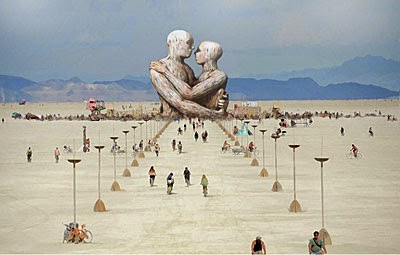
Embrace at Burning Man 2014.
By MARTIN GRIFFITH
Associated Press


RENO, Nev. — The Burning Man counterculture festival drew a peak crowd of nearly 66,000 celebrants as it neared an end Monday on the northern Nevada desert.

Friday's official peak attendance of 65,922 was within the population cap of 68,000 the federal Bureau of Land Management imposed on the quirky art and music festival 110 miles north of Reno, said Gene Seidlitz, manager of the agency's Winnemucca District.

The number was down from last year's record peak crowd of 69,613, which resulted in organizers being placed on probation for a second time in three years for violating the limit.

Organizers had been warned that if they were placed on probation a second straight year, the agency might suspend or cancel their permit.

"That (crowd size) is not a problem this year," Seidlitz said, adding the attendance cap was one of 55 conditions organizers had to comply with under terms of their permit.

"We don't see any reason why we shouldn't meet all other stipulations," Burning Man spokesman Jim Graham said.

Overall, the weeklong festival leading up to Labor Day was successful and safe except for Thursday's death of a 29-year-old Wyoming woman who was struck by a bus carrying passengers on the playa of the Black Rock Desert, Seidlitz said.

Crime statistics will not be released until later this month, he added.

Rain early on closed the gate for a day — the longest closure in the event's history — and dust storms caused occasional whiteout conditions Friday.

But the festival's eclectic artwork, offbeat theme camps, concerts and other entertainment drew praise from participants from around the world.

"Actually, I feel renewed faith in humanity," John Bacon, of Seattle, told KRNV-TV.

Ron Adair, of Ojai, California, said he felt "a little tired."

"It's a little hard to have that many nights in a row and get by on four, five, six hours of sleep every night," Adair said.

After it moved from San Francisco, the inaugural Burning Man in Nevada drew only about 80 people in 1990.

August 26, 2014

The gates are open! Tens of thousands of stranded 'burners' flood into Burning Man site after festival is reopened following rare storm

Deserted: Tens of thousands of people should have arrived to create a make-shift city in Nevada's Black Rock Desert. But after Monday morning's rains, the site was empty until today.

By Alex Greg and Ted Thornhill
UK Mail Online


Tens of thousands of so-called 'burners' were flooding through the gates of Burning Man this morning after the event was reopened following a rain storm that left Nevada's Black Rock Desert looking more like a swamp on the festival's opening day.

Vehicles were allowed into the event's entrance on Highway 34 northeast of Gerlach from 6 a.m. Tuesday, organizers tweeted just after 1 a.m.

Festival goers, or 'burners,' responded to the good news with excited tweets such as 'time to get back on the road,' and 'all roads lead to #burningman.'

Yesterday, incredible pictures taken from the air showed the astonishing number of people stranded in the desert after rare heavy rains prevented them entering the site of the annual festival.

By Monday, it should have resembled something from a post-apocalyptic Mad Max movie, a teeming mini city growing out of the sand.

But standing water turned the playa 90 miles north of Reno into a quagmire and police barred ticket holders entry to the free-spirited week-long arts event.

Hundreds of vehicles massed outside the gates waiting for the weather to clear up, with some posting messages on Twitter about their predicament using the hashtag #strandedman.

Festival-goer Jordan Kalev arrived at the event by plane and took pictures of the site as he flew over showing the sheer volume of traffic massed at the entrance and the soggy state of the ground.

Around 70,000 people were left anxiously waiting for the event to start, with many driving back to Reno rather than queue in the desert.

Several hundred people who arrived on Sunday were told to remain in place in their camps but those who came to the gates for the 10 a.m. opening on Monday were turned away and told to keep an eye on social media.

'Black Rock City has shut down following rainstorms that left standing water on the playa, leaving it undrivable,' said Jim Graham, a festival spokesman, in a statement issued on Monday.

Highway patrol officers turned back festival goers who have paid upwards of $1,000 on the black market for tickets to the event, which last year saw a record 68,000 people spend a week in the desert for the annual art, music and everything else festival.

Rudy Evenson, who works at the US Bureau of Land Management, who operates the Black Rock Desert site Burning Man uses said that the festival would not get underway on Monday 'because there was too much rain. When it dries out they'll let people in again.'

The downpour began at 6 a.m. on Monday and continued for several hours, only dumping a tenth of an inch of rain, enough to make the muddy flats unfit for vehicles to drive on.

'We're going to make the best of the situation,' Charlie Lucas, of Portland, Oregon, told the Reno Gazette-Journal.

By midday Monday, hundreds of people had gathered outside a tribal smoke shop just off US Interstate 80 in Wadsworth east of Reno where they were buying camping permits at the lake that sits on the Pyramid Lake-Paiute Reservation.

Clerks at the smoke shop said they had no idea how many permits had been sold, only that they were 'overwhelmed' and did not have time to talk.

'We're going to make good of a bad situation,' Shaft Uddin of London told the Gazette-Journal. 'I hear Pyramid Lake is beautiful, and apparently there is going to be a big party.'

By Monday afternoon, yellow Volkswagen buses, countless recreation vehicles and at least one school bus painted to look like a cheetah with whiskers on the hood began packing campsites along the lake.

Close to a dozen of those first arrivals took off their clothes and entered the lake, the newspaper reported.

Nudity is allowed at Burning Man as part of the celebration of art and self-expression.

But within an hour, a park ranger at Pyramid Lake had asked the campers to put their clothes back on. 'How can you not know that it is not OK to be naked in public?' the ranger asked.

Hundreds of travelers searching for oneness with nature and celebration of self-expression inf act spent their first night in the parking lot of a Wal-Mart or Reno resort casino.

But most were taking it in stride and were largely optimistic - as so-called 'Burners' are apt to be - that the gates to the counterculture event would reopen Tuesday.

'You take it as it comes,' said Mark Vanlerberghe, who left San Jose, California, in an RV that he ended up parking Monday at the Wal-Mart for the night when he heard the access road to the remote festival site was closed.

'You're going to the desert and you know there's weather to deal with,' he said. 'I guess that's part of being a Burning Man. Don't get stressed about it.'

Dozens of RVs and vans bound for Burning Man were parked at the Wal-Mart at the Three Nations Plaza, and nearly a hundred more across the street by sundown at the Grand Sierra Resort along U.S. Interstate 80 just east of downtown Reno.

The blinking casino lights and video billboards gave off a pink twinkle not unlike the various light shows at the weeklong desert gathering that culminates with the burning of a large wooden effigy the night before Labor Day.

But the yellow stripes on the blacktop pavement with 'Wrong Way' signs weren't exactly what the seekers of paradise on the playa had in mind on their way to soak up the various theme camps, art exhibits, all-night music and guerrilla theater, along with a decent dose of nudity and a bunch of other stuff that's just plain weird.

'We're just trying to stay positive,' said a woman from Oakland, California, who identified herself only as 'Driftwood' while hanging out in the Wal-Mart parking lot with a group of first-timers from Texas.
'Positivity can raise everything up.'

Barbara Quintanilla of Houston said the rain delay was the least of their worries in an RV with friends who didn't initially know whether the camper used diesel or regular gas, made a wrong turn out of Texas and ran over a sign post. Their destination is 'Planet Earth,' she said, 'The Eighties' Camp.'

'My friends believe that making it a longer trip will make you better,' Quintanilla said. 'We have a list of 27 things we need to get at Wal-Mart.'

Traveling companion Bill Sanchez of Houston said the voyage so far 'has been brutal.'

'We made a 2,000-mile trip and none of us had ever driven an RV before. It would only go 35 mph up hills,' he said with a smile at the plaza on land owned by a Nevada tribe.

'But through hard work and dedication, we will achieve our dreams.'

Jahliele Paquin and Jeff Difabrizio were in their third mode of transportation on the way to their first 'Burn' from their home in Canada's Northwest Territories.

They flew from Yellowknife to Regina, Saskatchewan and bought a van they drove to Reno, where it broke down Monday and they rented a car for the rest of the trip.

'We're kind of thinking like we'll get there when we get there,' Paquin said.

Jeff Cross of Orange County, California was in a different group with Texans Adam Baker and Chelsea Coburn making their second trip to the Black Rock and were determined the weather wouldn't deter them.

'It's the best festival in the world,' he said while unloading provisions at their RV outside the Wal-Mart Monday night. 'And there's no cellphones, no internet, no money or corporate sponsors.'

'You have to have a lot of supplies,' Coburn said. 'It's a lot of work, but it makes it more gratifying.

Indeed in recent years, devotees of Burning Man have become irritated with the expansion in popularity of the free-spirited event.

The festival dates back to 1986 and is based on ideals of community and inclusion - but visiting the ad-hoc city that rises from the desert each year has become a status symbol for the tech elite.

The one-upmanship of San Francisco tech nouveau riche, with their luxury accommodations and chef-prepared meals, is at odds with the spirit of the festival, say some longtime 'burners.'

The festival began as a counter-cultural gathering of free spirits on a beach in San Francisco and has evolved into a 10-day phenomenon spread across seven square miles of Nevada's Black Rock Desert.

Participants 'dedicate themselves to the spirit of community, art, self-expression, and self-reliance. They depart one week later, leaving no trace,' the Burning Man website explains.

Nothing but ice and coffee is for sale so attendees must bring enough food and water to sustain themselves.

Tens of thousands of likeminded burners frolic around the temporary city instilled with the principles of Burning Man, which include gifting, decommodification (no advertising or transactions), radical self-reliance and radical inclusion.

Art installations, music, free classes, costumes, sharing of love, opinions, food and discussion is the order of the day at Burning Man.

So it's unsurprising that the new wave of annual attendees from San Francisco with very different ideas about the experience has some devotees up in arms.

A man who attends the festival annually with a group of Silicon Valley entrepreneurs told The New York Times that the camp they establish costs $25,000 per person - but not for the models who are flown in on private jets from New York.

'We have the craziest chefs in the world and people who build yurts for us that have beds and air-conditioning. Yes, air-conditioning in the middle of the desert,' he said.

Regular attendees haul camping gear or drive rented RVs to the desert and pay $300 to camp for 10 days, using portable toilets and freshening up with wet wipes.

And flying in the face of the festival's tenets of 'radical self-reliance,' and 'communal effort,' some camps come complete with 'sherpas,' or hired help.

According to The New York Times, there are up to 30 sherpas waiting on 12 attendees who fly in on private planes and are then driven to their camp in luxury RVs and fed meals prepared by teams of top chefs.

Sherpas handle the rest - costumes, which are a big part of Burning Man life, drugs, and any other whim.

'The tech start-ups now go to Burning Man and eat drugs in search of the next greatest app,' Tyler Hansen, who worked as a sherpa, told The New York Times.

'Burning Man is no longer a counterculture revolution. It's now become a mirror of society.'

Elon Musk, a founder of PayPal, recently said that Burning Man 'is Silicon Valley' and that creator of the HBO show 'Silicon Valley' Mike Judge couldn't possibly understand the tech world because he hadn't been.

It's not only tech types - DuJour reports that socialites, heirs and heiresses and Hollywood starlets have also been attending in style, including Lady Victoria Hervey, shipping heir Stavros Niarchos, Alexandra von Furstenberg and Francesca Versace and a New York Wall Street tycoon who spent $1 million on a custom RV.

Money-making endeavors at the festival are also on the rise, with concierge companies offering packages including flights, transfers, food, camps with electricity, food, water and wifi, private toilets and even a 'customized art car' for wealthy burners.

This year's festival sold out within an hour.

After it moved from San Francisco's Baker Beach, the inaugural Burning Man in Nevada drew some 80 people in 1990.

The first 1,000-plus crowd was in 1993, and attendance doubled each of the next three years before reaching 23,000 in 1999. The crowd was capped at 50,000 under a five-year permit that expired in 2010.

August 20, 2014

A Line Is Drawn in the Desert

At Burning Man, the Tech Elite One-Up One Another

“If you haven’t been, you just don’t get it,” said the entrepreneur Elon Musk of Burning Man. A wooden yacht art car rolled through in 2012. (Credit Andy Barron/Reno Gazette-Journal via Associated Press)

By Nick Bilton
New York Times


There are two disciplines in which Silicon Valley entrepreneurs excel above almost everyone else. The first is making exorbitant amounts of money. The second is pretending they don’t care about that money.

To understand this, let’s enter into evidence Exhibit A: the annual Burning Man festival in Black Rock City, Nev.

If you have never been to Burning Man, your perception is likely this: a white-hot desert filled with 50,000 stoned, half-naked hippies doing sun salutations while techno music thumps through the air.

A few years ago, this assumption would have been mostly correct. But now things are a little different. Over the last two years, Burning Man, which this year runs from Aug. 25 to Sept. 1, has been the annual getaway for a new crop of millionaire and billionaire technology moguls, many of whom are one-upping one another in a secret game of I-can-spend-more-money-than-you-can and, some say, ruining it for everyone else.

Some of the biggest names in technology have been making the pilgrimage to the desert for years, happily blending in unnoticed. These include Larry Page and Sergey Brin, the Google founders, and Jeff Bezos, chief executive of Amazon. But now a new set of younger rich techies are heading east, including Mark Zuckerberg of Facebook, employees from Twitter, Zynga and Uber, and a slew of khaki-wearing venture capitalists.

Before I explain just how ridiculous the spending habits of these baby billionaires have become, let’s go over the rules of Burning Man: You bring your own place to sleep (often a tent), food to eat (often ramen noodles) and the strangest clothing possible for the week (often not much). There is no Internet or cell reception. While drugs are technically illegal, they are easier to find than candy on Halloween. And as for money, with the exception of coffee and ice, you cannot buy anything at the festival. Selling things to people is also a strict no-no. Instead, Burners (as they are called) simply give things away. What’s yours is mine. And that often means everything from a meal to saliva.

In recent years, the competition for who in the tech world could outdo who evolved from a need for more luxurious sleeping quarters. People went from spending the night in tents, to renting R.V.s, to building actual structures.

“We used to have R.V.s and precooked meals,” said a man who attends Burning Man with a group of Silicon Valley entrepreneurs. (He asked not to be named so as not to jeopardize those relationships.) “Now, we have the craziest chefs in the world and people who build yurts for us that have beds and air-conditioning.” He added with a sense of amazement, “Yes, air-conditioning in the middle of the desert!”

His camp includes about 100 people from the Valley and Hollywood start-ups, as well as several venture capital firms. And while dues for most non-tech camps run about $300 a person, he said his camp’s fees this year were $25,000 a person. A few people, mostly female models flown in from New York, get to go free, but when all is told, the weekend accommodations will collectively cost the partygoers over $2 million.

Continue reading the main story
This is drastically different from the way most people experience the event. When I attended Burning Man a few years ago, we slept in tents and a U-Haul moving van. We lived on cereal and beef jerky for a week. And while Burning Man was one of the best experiences of my life, using the public Porta-Potty toilets was certainly one of the most revolting experiences thus far. But that’s what makes Burning Man so great: at least you’re all experiencing those gross toilets together.

That is, until recently. Now the rich are spending thousands of dollars to get their own luxury restroom trailers, just like those used on movie sets.

“Anyone who has been going to Burning Man for the last five years is now seeing things on a level of expense or flash that didn’t exist before,” said Brian Doherty, author of the book “This Is Burning Man.” “It does have this feeling that, ‘Oh, look, the rich people have moved into my neighborhood.’ It’s gentrifying.”

For those with even more money to squander, there are camps that come with “Sherpas,” who are essentially paid help.

Tyler Hanson, who started going to Burning Man in 1995, decided a couple of years ago to try working as a paid Sherpa at one of these luxury camps. He described the experience this way: Lavish R.V.s are driven in and connected together to create a private forted area, ensuring that no outsiders can get in. The rich are flown in on private planes, then picked up at the Burning Man airport, driven to their camp and served like kings and queens for a week. (Their meals are prepared by teams of chefs, which can include sushi, lobster boils and steak tartare — yes, in the middle of 110-degree heat.)

“Your food, your drugs, your costumes are all handled for you, so all you have to do is show up,” Mr. Hanson said. “In the camp where I was working, there were about 30 Sherpas for 12 attendees.”

Mr. Hanson said he won’t be going back to Burning Man anytime soon. The Sherpas, the money, the blockaded camps and the tech elite were too much for him. “The tech start-ups now go to Burning Man and eat drugs in search of the next greatest app,” he said. “Burning Man is no longer a counterculture revolution. It’s now become a mirror of society.”

Strangely, the tech elite won’t disagree with Mr. Hanson about it being a reflection of society. This year at the premiere of the HBO show “Silicon Valley,” Elon Musk, an entrepreneur who was a founder of PayPal, complained that Mike Judge, the show’s creator, didn’t get the tech world because — wait for it — he had not attended the annual party in the desert.

“I really feel like Mike Judge has never been to Burning Man, which is Silicon Valley,” Mr. Musk said to a Re/Code reporter, while using a number of expletives to describe the festival. “If you haven’t been, you just don’t get it.”

Non-tech Burners who have been may “get it” but don’t like all this excess, and are starting to push back. This month, the Key Group, a Swiss luxury concierge service, announced that it would be offering a Burning Man Concierge Service that seemed more like a cruise liner vacation than a week in the dusty desert. (The company did not respond to a request for comment.)

Among the dozens of options offered by the Key, there is the “establishment of a camp with electricity, water and satellite Internet Wi-Fi connection,” “cooks and fresh buffets for every meal” and — not a small task by any means given the distance from the real world — the “possibility of ordering goods and products from outside Black Rock City every day.”

When the website Burners.me, which blogs about the festival, posted a link to the Key’s site, the Burning Man community seemed generally confused as to whether such extravagance was actually real or if someone was playing a joke. When it turned out to be quite real, people railed against the service, and the Key removed the Burning Man concierge option from its site.

Of course, you won’t likely see pictures on Instagram or Facebook of the $2 million camps, chef-cooked meals, the Sherpa helpers and concierge services, or private and pristine toilets. That would mean that the tech elite actually cared about money — which would just go against the entire Burning Man spirit.

September 22, 2013

Burning Man has gone corporate


Burning Man visionary Larry Harvey and
event organizer Marian Goodell in 2007.
(Photo-Illustration: Marc Simon)
by Guy W. Farmer
Nevada Appeal

Regular readers of this column will note that I didn’t write my traditional “trash Burning Man” column prior to this year’s edition of the naked drug festival, which took place in the Black Rock Desert near Gerlach over the Labor Day holiday.

This year, Bay Area organizers of the desert bacchanal, who publicly look down their hypocritical noses at money and commerce, raked in more than $20 million from 61,000 Burners who participated in the festivities. In other words, Burning Man has gone corporate, and that worries some veteran Burners.

“Because Burning Man is commerce-free, meaning no one bought or sold anything except ice and coffee, community services were created by the participants,” one newspaper reported. That’s all well and good, but what about the millions of dollars that poured into the coffers of Black Rock City LLC, the affluent San Francisco-based entity that organizes the festival? Of course they have organizational expenses and their landlord, the U.S. Bureau of Land Management (BLM), collected about $2 million to pay for law enforcement and other services on the desert playa; however, simple math tells us that organizers wound up with several million dollars in their collective bank accounts.

As usual, the Burners complained about an “oppressive” law enforcement presence on the playa. That’s a ritual in which the “free spirits” complain about the cops, who reply that they’re just enforcing applicable laws. At the heart of this issue is the widespread abuse of illegal drugs at Burning Man. Burner websites recommend which drugs are popular each year, and tell their followers how to avoid detection. You can look it up.

This year the Burners’ rather sophisticated medical services operation saw up to 400 patients per day, many of them allegedly suffering from “heat prostration.” That adds up to almost 3,000 patients over the course of the event. My guess is that many of those heat-prostration cases were drug overdoses. However, my main complaint about Burning Man isn’t as much about illegal drugs as it is about the presence of young children at an X-rated event on federally administered lands. I doubt that’s what environmentalists had in mind when they persuaded former President Bill Clinton to create the Black Rock National Conservation Area. Did they envision more than 60,000 people invading a pristine desert playa?

During a visit to Burning Man with my friend Sam Bauman a few years ago, I saw a naked middle-aged man cavorting on the playa adjacent to Kidsville, which is supposed to be a supervised day-care area for young children. But when Pershing County District Attorney Jim Shirley attempted to assert local authority over the issue of underage children at the event, the organizers and an army of attorneys sued Shirley and the county; to his credit, the DA promptly filed a counter-suit and the dueling lawsuits are pending in Reno Federal Court.

According to the Pershing County sheriff, there were 12 sexual assaults at Burning Man this year. Other crimes included open and gross lewdness, drug charges and public drunkenness — a little something for the kids. So I could hardly believe a Reno Gazette-Journal article encouraging families to bring their young children to an adults-only event. The article quoted a clueless mother who brought her 9-year-old daughter to the festival to “introduce her to a world where people are generous and kind ...” Unfortunately, some of those generous and kind people were stoned out of their minds.

Although Burning Man generates millions of dollars’ worth of economic activity for Northern Nevada, going corporate doesn't mean that you’re above the law.

Guy W. Farmer of Carson City is a longtime critic of Burning Man.

August 31, 2013

BLM reports Burning Man crowd tops 61,000 in Black Rock Desert of northern Nevada

The "Man" burns on the Black Rock Desert at Burning Man near Gerlach, Nev. on Aug. 31, 2013. (AP Photo/Reno Gazette-Journal, Andy Barron)

Associated Press

RENO, Nev. — A federal official says more than 61,000 people have turned out so far for the weekend Burning Man outdoor art and music festival in the Black Rock Desert of northern Nevada.

U.S. Bureau of Land Management spokesman Mark Turney said Saturday that gate management was tightened Friday when organizers got close to a permitted capacity of 68,000.

Turney says the crowd ebbs and flows at the festival taking place about 100 miles north of Reno.

He says organizers reported one person was flown to a hospital by medical helicopter this week after being struck by a vehicle.

No other serious incidents have been reported.

Attendance peaked last year at 56,000.

The BLM raised the crowd limit this year after organizers agreed to security, public safety, resource management and cleanup rules.

August 29, 2013

Nevada's 'experiment in the desert' more popular than ever: Nearly 70,000 gather for weekend of debauchery at Burning Man festival

In its 27th year, there are already more people at the current event than attended all of last year's festival

Beyond the Thunderdome: A participant bicycles away from the effigy of the Man (top right) at the 2013 Burning Man arts and music festival in the Black Rock Desert of Nevada.

By DAVID MCCORMACK
Daily Mail Online


Burning Man, the annual art, music and everything-else festival currently taking place in the Black Rock Desert in Nevada, is the most popular ever than more people already on-site than attended the entire event last year.

The largest outdoor arts festival in North America is in its 27th year, with as many as 68,000 people expected to part-take in partying, debauchery and excess before it all ends for another year on Labor Day.

Described as an 'experimental community,' it incorporates plenty of partying plus lighting massive fire displays, donning eye-catching costumes and performing passionate dances at sunrise. Organizers stress it's mostly up to participants to decide what Burning Man is.

Earlier this year the federal government issued a permit for 68,000 people from all over the world to gather at the sold out festival and spend up to a week in the remote desert cut off from much of the outside world.

This year’s event is already the largest ever, organizers said more than 55,000 people had already arrived at Black Rock City at noon on Tuesday. That is almost as many as were present at last year’s event during its peak.

Traditionally only the hard-core burners arrived when the gates opened Monday and a crush of people often referred to as ‘Weekend Warriors’ would show up sometime between Thursday and Saturday, reports NBC Bay Area.

By morning on Wednesday, there were 15 streets circling the temporary city created by attendees and the forecast remains free of dust storms.

Many have been impressed by the size and look of this year's Man Base, a structure that houses the iconic 'Man' figure burned each year near the event's close.

Inside a flying saucer under the Man is a multi-level structure with zoetropes, a giant chandelier and views of Black Rock City. Slides serve as exits.

The art theme this year is ‘Cult Cargo’ and focuses on a strange being called John Frum.

'He is known to us by many names, this Visitor from Elsewhere, dispenser of endless abundance and wielder of mysterious technologies: John Frum, Quetzalcoatl, Osiris, "Bob,"' reads the website.

'His cargo is splendid, his generosity boundless, his motives beyond our understanding. But across the ages and around the world, the stories all agree: one day he will return, bearing great gifts.

'Our theme this year asks three related questions; who is John Frum, where is he really from, and where, on spaceship Earth, are we all going?'

The biggest tradition comes at the end of the week – on Sept 2 - when participants will set fire to a giant wooden ‘man’ that gives the event its name. Tickets for the event costs up to $650.

It has become a haven for hippies, artists, musicians and dancers and provides a week for people to explore artistic expression. No money is exchanged at the event; instead the festival-goers swap gifts to attain goods.

The Black Rock Desert is 120 miles north of Reno and the gathering is the largest permitted event on federal land in the United States.

After it moved from San Francisco's Baker Beach, the inaugural Burning Man in Nevada drew some 80 people in 1990. The first 1,000-plus crowd was in 1993, and attendance doubled each of the next three years before reaching 23,000 in 1999.

The crowd was capped at 50,000 under a five-year permit that expired in 2010. The new multi-year permit allows a maximum crowd of 70,000, but organizers applied for a cap of 68,000 this year.

As always, festival goers are expected to obey the ten principles: Radical Inclusion, Gifting, Decommodification, Radical Self-reliance, Radical Self-expression, Communal Effort, Civic Responsibility, Leaving No Trace, Participation and Immediacy are of the utmost importance to the community.

August 31, 2012

BLM declares Burning Man Second Amendment-free zone


BY: DAVID CODREA
Examiner.com


The Bureau of Land Management has declared the Burning Man “radical self-expression/self-reliance" community “experiment” in northern Nevada’s Black Rock Desert a temporary weapons-free zone, GunLeaders Blog reported today. Citing a Department of the Interior “Notice of Temporary Closure and Temporary Restrictions of Specific Uses on Public Lands in Pershing County, NV” appearing in the Federal Register Volume 77, Number 157 (Tuesday, August 14, 2012), the edict mandates “temporary closures and temporary restrictions will be in effect from August 13, 2012 to September 17, 2012.

Proclaiming its authority under 43 CFR 8364.1., and issued by Gene Seidlitz, District Manager, Winnemucca District, the restriction notice declared “The possession of any weapon is prohibited except weapons within motor vehicles passing through the public closure area, without stopping, on the west or east playa roads.

“The prohibitions above shall not apply to county, state, tribal, and Federal law enforcement personnel, or any person authorized by Federal law to possess a weapon," the notice continued. "‘Art projects' that include weapons and are sanctioned by BRC LLC will be permitted after obtaining authorization from the BLM authorized officer.”

“Any person who violates the above rules and restrictions may be tried before a United States Magistrate and fined no more than $1,000, imprisoned for no more than 12 months, or both,” the notice warned, adding “Such violations may also be subject to the enhanced fines provided for at 18 U.S.C. 3571.”

Whether this upsets Burning Man organizers and participants, and there does not appear to be any mention of weapons in the almost-anything-goes gathering’s “rules and regulations,” remains unknown, but there are larger principles at stake here.

First, it’s not like crimes of violence, particularly sexual assault and rape are unheard of there, and Mr. Seidlitz’s edict is silent on any responsibility or duty to protect those he demands be defenseless. His notice does admit “Actions by a few participants at previous events have resulted in law enforcement and public safety incidents similar to those observed in urban areas of similar-size populations,” documenting that he knows people he is disarming may be exposed to physical danger.

Second, where does this guy get off, dictating away the right to keep and bear arms? Who first decided there was a “need” to do this? Who authorized it? What is the approval process? Did it have to go beyond a district manager? What other federal agencies think they have this power? Can any bureaucrat declare himself the boss of you, or does one need to be a certain pay grade?

“If they (think they) can ban guns for Burning Man, essentially a private festival that as far as I can tell has no specific rules of this manner, then DOI can do it for pretty much any reason they want,” Dave Yates, co-founder of GunLeaders Blog observed to Gun Rights Examiner by email.

Indeed. If unaccountable self-anointed masters are allowed to get away with arbitrary rulings, if their demands for kneejerk authority over our unalienable rights are tolerated, then what is to stop them from declaring any place off limits, and extending the time period to whatever interval they choose, that is, what is to stop them from effectively burning the Bill of Rights?

September 7, 2011

Burning Man fest leaves the desert

BURNING MAN 2011: The Temple at Sunset by Jeff Sullivan

Zelie Pollon
Reuters


Organizers of the iconic "Burning Man" celebration began this week to clear the desert of any evidence that 50,000 people had just spent the past week here in a transient, art-filled, makeshift city.

As the anti-establishment arts festival and survival project disappears piece by piece from the white sands of the Black Rock Desert in Nevada, participants and organizers say Burning Man -- which just had its largest week in its 25-year history -- is going through some growing pains as plans to expand its size and scope moving forward over the next year.

"When you have to be accountable and not anonymous, you change the way you act. As it's gotten bigger we've lost some of that," said Katrina Van Merter, 32, of Dallas, attending her sixth Burning Man.

The event is characterized by massive art projects and the namesake burning figure at its close, with participants heading into the desert for a week each year to build a working city from the ground up -- including an airport, a post office, and a security team -- that tries to be devoid of consumerism.

Burning Man started with an 8-foot structure burning on a beach in California at summer solstice and has morphed into a sophisticated community with year-round projects including solar energy development and a crisis response network.

Black Rock City LLC announced plans to turn its profit-making enterprise into a nonprofit this year.

Participation was capped at 50,000 people a day per a Bureau of Land Management use permit, said organizers.

Next year they're hoping to up that number, gradually adding 20,000 more people by 2016, said Burning Man communication manager Andie Grace.

TAKING THE STRAIN

But as the crowds grow, some of the long-time participants wonder if the desert gathering's principles -- including what self-styled "burners" call radical self-reliance, community, civic responsibility and an economy based on giving freely -- can take the strain of a growing population.

Others say that its growth has helped Burning Man change from a tiny party into an organization capable of innovation that can have benefits outside the "playa," the Spanish word for "beach" that burners use to refer to the site.

The Hexayurt, for example, is an easily deployable paneled shelter, created by Vinay Gupta in 2007 in honor of that year's Burning Man theme "The Green Man."

Gupta has since begun conversations with USAID about using the inexpensive structure in post-disaster areas, Grace said.

The town's crescent design, developed by Rod Garrett and founding member Harley Dubois, covers five square miles and includes 60 miles of streets, hundreds of intersections, and between two and four thousand signs created annually by a Burning Man sign shop, said Will Roger, a founder.

Roger has been asked to present to numerous audiences, including a retired Army group, about the building of what is known as Black Rock City.

Firefighters, city planners and reportedly members of Homeland Security have come to study the organizational and support structure of the complex erected to support tens of thousands of participants for a week, that then disappears as if it never existed.

ASTOUNDING GROWTH

But the astounding growth of Burning Man has its drawbacks, as some participants struggle to accept the changing demographics and influx of strangers into Black Rock City.

Participants point to bike thefts across the dusty playa, people coming to indulge but not to share, and a kind of close knit community feeling that is simply slipping away.

On Monday, thousands of talc-covered vehicles streamed out of the Black Rock Desert as the festival drew to a close.

Cars, trucks and RVs -- topped with dusty bikes, bright furry clothes and the makings for elaborate shelters -- snaked down the small single lane road toward civilization.

"We used to sit on the corner and wave goodbye to people as they left the playa, and tell them we'd see them again next year," said Dave Roetter, who came to the event with his 6-year-old son, Memphis. "People just don't do that anymore."

There are about 600 rangers who patrol the playa, along with several state agencies and the BLM. And despite the growing size, there is still a kind of citizen monitoring that encourages good behavior.

Accidents occur, as do arrests and numerous cases of dehydration, but nothing more than one would see in any city of this size, organizers say.

As for the missing bikes, Rogers says they're probably misplacing them. Thousands are left strewn around the basin by the event's end.

"It's still one of the safest cities in America," he said.

The demographic of Black Rock City is increasingly wealthy and older participants. A 2010 survey listed 40 percent of participants to be between the ages of 40 and 70 years old, and incomes ranging anywhere from less than $10,000 a year to over one million dollars a year. Several have groused about ticket prices that can top $360.

But there are also a greater number of families, and even very small children, many of which live together in one of Burning Man's largest camps called Kidsville.

The more, the merrier, said Sandy Lyle, 43, of San Diego.

"This year definitely feels bigger than usual, but what we do here is create community, so more people just gives us more opportunity," she said. "That's what Burning Man is all about."

September 6, 2011

Burning Man from Earth's orbit

A European Space satellite took photos of the 2011 Burning Man festival in the Nevada desert from 373 miles above.
By Mike Wall
Christian Science Monitor


The annual Burning Man festival is in full swing in the Nevada desert, and a tiny European satellite has snapped an overhead shot of the eccentric action.

The European Space Agency's Proba-1 microsatellite took a photo of Burning Man on Thursday (Sept. 1) from an altitude of about 373 miles (600 kilometers). The picture shows campers and tents massed for the annual gathering, which attracts 50,000 people to the Black Rock Desert 120 miles (193 km) north of Reno.

The image was stitched together from four black-and-white photos, each of which has a resolution of about 16 feet (5 meters), European Space Agency (ESA) officials said. [See the satellite photo of Burning Man]

IN PICTURES: Burning Man 2011

Burning Man is a weeklong art and self-expression festival that meets every year around Labor Day. This year, it runs from Aug. 29 to Sept. 5. Attendance was capped at 50,000, and the event sold out in July.

This year marks the 25th anniversary of the festival, which takes its name from the ceremonial torching of a giant wooden effigy. The event began modestly in 1986, when a handful of friends torched an 8-foot (2.4-m) wooden man on a San Francisco beach.

Burning Man first moved to the Black Rock Desert in 1990, and it has grown greatly over the past two decades. The height of the torched man has grown as well; in 2009, he measured 50 feet (15.2 m) tall, according to the festival's website.

"Proba" stands for "Project for Onboard Autonomy," and Proba-1's two cameras are indeed largely autonomous. The microsatellite, which is less than 3.3 feet on a side (less than 1 cubic meter), launched in October 2001 as an experimental mission.

Proba-2, which focuses on solar monitoring, was launched in November 2009. Two other Probas are in preparation, ESA officials said. Proba-3 will test formation flying, and Proba-V will monitor global vegetation.

September 10, 2009

Burning Man and the truest sense of home


Jarl Forsman
Examiner.com


The Burning Man 2009 (Photo by Jarl Forsman)


I’m back from a week at Burning Man. What an amazing and fulfilling week it was! This year’s theme was Evolution. Because my interest lies in consciousness, I sought out community, events, and conversations that addressed the evolution of consciousness. It was also the first time in six years that I elected to join another camp rather than helping to create my own. I participated in a theme camp called Entheon Village. Entheon means, “a place to discover the spirit within."

For those of you who have not had the opportunity to experience Burning Man, let me attempt to describe what really needs to be experienced to be understood. I’m sure it is many different things to different people, but I think everyone would agree that Burning Man is characterized by radical self-expression and self-reliance. For the experience of radical self-expression, artists flock to display art installations and art cars, also known as mutant vehicles, on which they have worked months and sometimes all year long to prepare for this one week of appreciation. With radical self-expression as the raison d'etre, everyone is free to create from the authentic muse rather than from what will sell or fit in. The result is otherworldly, delightful, and sometimes utterly amazing. It is truly awesome to see what we are capable of when the rules are relaxed and the box is expanded just a bit. Several of the larger pieces such as “The Man” and “The Temple” are burned. The psychological benefits derived from the experience of working on ephemeral art, mirror what the Tibetan monks experience when they destroy the sand mandalas after weeks of effort making those beautiful, symbolic works of art. In this Buddhist tradition, mandalas are painstakingly made from colored sand and upon completion are ritualistically destroyed. This process symbolizes Buddhists belief in the transitory nature of material life. It demonstrates an intention to experience the sheer joy of creation along with a detachment of the end result.

Everyone is encouraged to dress completely in alignment with how they feel rather than according to protocol or appropriateness. Actually, the concept of appropriateness doesn't really exist at Burning Man. Anything goes. When anything goes, judgment of others often flies out the window. When judgment of others disappears, self-judgment fades too, and one is left with the feelings of authenticity, acceptance, freedom, and love. It’s a wonderful experience when it happens. When I say, “anything goes,” and “judgment flies out the window,” I’m not talking about discernment or laws. I’m referring to style and personal self-expression. Beauty and goodness is still beauty and goodness.

Burning Man is also about radical self-reliance. The week takes place in an ancient lakebed where nothing lives. There are no bugs, no birds, no creepy-crawlers, no animals, no plants, no nothing. That is, nothing but dust and more dust! Citizens of Black Rock City must bring everything they need, including shelter, food, water, and gear which can protect them from the harsh environment of heat and wind blowing dust so intensely that “white-outs” occur several times a day. The juxtaposition of the periodic harshness of the environment and the gentle attitudes of the citizens toward one another make for an exhilarating experience. Life seems magical and synchronicity abounds.

The only commerce at Burning Man is conducted by the organizers and it is limited to selling high-octane espresso drinks and electrolytes in addition to ice for campers’ coolers. All other forms of commerce are frowned upon and strictly prohibited. What is encouraged in its place is a gift economy. Nothing is to be bought, bartered or sold, but only gifted. To improvise on the words of John F. Kennedy, at Burning Man the theme is: “ask not what Burning Man can give to you, ask what you can give to your fellow burner.” Everyone arrives with something to offer such as art, performance, food, humor, theme camps, drinks, dance parties, some kind of service or just, plain appreciation. Regardless of what you do or do not bring, just by virtue of trekking out to this remote and harsh environment, everybody is a participant.

Most of what is found in a normal US city can be found in Black Rock City. The only difference is that Black Rock City arises out of nothing, lasts for one week, and then disappears back into absolutely nothing, leaving no trace but a memory. Cafés, nightclubs, a skating rink, a post office, films, bars, concerts, bicycle repair shops, yoga, tai chi, and hula-hoop classes, lectures, meditations, a zendo, twelve-step meetings, performances of all kinds, amazing art, a hotel, clothing designers wanting to dress you, people offering to bathe you, massage you, and heal you. You name it. It is available and all in the price of admission: $250 per person and your own participation.

When one is focused on giving, magic truly happens. When a desire or need arises, its fulfillment is almost immediate. With a focus on giving, “wanting” loses its grip, tension relaxes, and fulfillment easily finds its way to you. This is true for tangible, material desires as well as for emotional ones. After experiencing this magic so many times, I began to ask people if they experienced similar phenomenon at Burning Man. The answer was always a resounding yes. I suspect this is the truth about life in general: the Universe provides! But we are usually so focused on the “how” that we miss the fact that what we want is often right in front of us.

The idea of safety doesn’t even come up, at least not for me. This environment is like being on another planet where fulfillment abounds. People treat one another lovingly and with acceptance. No one is a stranger. It’s one big “functional” family. I’m sure there are exceptions, but they are few and far between.

Upon arriving from what Burners call the “default world,” the greeters at the gate greet each person with “Welcome Home!” The feeling I experience at Burning Man is that of being at home in the truest sense of the word: at home with myself, expressing my true nature without the concern of being judged. Home is wherever the heart is, comfortably expressing authentically in an atmosphere of radical self-acceptance.

June 30, 2009

Burning Man survives suit by burned man

from Burning Man 2005 - A Photoessay by Scott London

Bob Egelko
San Francisco Chronicle


If you approach the flames at the Burning Man festival, you're taking your chances of getting burned.

That was the verdict Tuesday from a state appeals court in San Francisco, which refused to reinstate a festivalgoer's damage suit against the promoter of the annual celebration in the Nevada desert.

Anthony Beninati, a Los Angeles-area resident, was badly burned at the September 2005 event in Black Rock City, Nev. A college-educated real estate manager, he was making his third visit to the weeklong festival, which culminates with the incineration of a 60-foot wood sculpture.

Once the Burning Man topples, participants are invited to throw objects into the bonfire. Beninati planned to contribute a photo of a friend who was supposed to come with him but had recently died in a motorcycle accident.

He walked 7 to 10 feet into the burning embers, with flames on either side of him, threw in the photo, then took a few more steps forward, tripped and fell into the fire.

Beninati's hands were burned and one arm was permanently injured, said William Kronenberg, a lawyer for Black Rock, the San Francisco company that promotes the festival. He said paramedics flew Beninati in a company-supplied helicopter to be treated.

Beninati's suit accused Black Rock of negligently allowing people to approach the fire without safe pathways. But the First District Court of Appeal, upholding a judge's dismissal of the case, said anyone who takes part in an event with obvious dangers - downhill skiing, mountain climbing or walking up to a bonfire - knowingly risks injury.

"By continuing to walk into the fire, Beninati assumed the risk that he might trip and fall," presiding Justice Ignazio Ruvolo said in the 3-0 ruling. "The risk of falling and being burned by the flames or hot ash was inherent, obvious and necessary to the event."

Ruvolo said such suits have been barred in California since 1992, when the state Supreme Court dismissed damage claims by a participant in an office touch-football game.

Beninati's lawyers were unavailable for comment.

March 11, 2009

Artists sue Nevada farmer over Burning Man ship

La Contessa in better times.

By SANDRA CHEREB
Associated Press


RENO, Nev.—Two San Francisco artists are seeking nearly $1 million from a Nevada farmer for torching what was once an elaborate replica of a Spanish galleon that sailed the sandy seas of the Black Rock Desert during the annual Burning Man Festival.

The 40-foot replica of the 16th century vessel was owned by artist Simon Cheffins and mechanical engineer Gregory Jones.

Their suit filed Monday in U.S. District Court in Reno seeks damages from Michael Stewart, owner of Empire and Orient farms in Gerlach, under The Visual Artists Rights Act of 1990.

But like any art, beauty is in the eye of the beholder. And after sitting abandoned for two years in the harsh Nevada desert, the once iconic ship was more a rusty eyesore than a crowned jewel, Stewart's lawyer Keegan Low said Wednesday.

Stewart considered the ship, which was built on the body of a school bus, to be "junk" and torched it when he acquired the private property where it was stored, court documents show.

Paul Quade, the artists' Reno attorney, said the federal laws "does clearly protect the artists' work from any type of mutilation or destruction," regardless of whether it's on private property.

The suit alleges Stewart made no attempt to contact the owners about its removal.

"There is a responsibility on behalf of a landowner that has a peace of art to ... contact the artists and address the issue as far as removal is concerned and what steps are going to be taken," Quade said.

Being on private property, he said, doesn't entitled a landowner "to burn a peace of artwork because they don't appreciate that art."

"It's not everyone's cup of tea. We acknowledge that," Quade said. "But for someone to be so callous to call it a peace of junk ..."

Stewart, through his attorney, said after it was parked in the fall of 2004 with a broken axle, no one ever came to check on it.

"It sat for two years unattended and abandoned," Low said. "Nobody claimed it, nobody visited it."

Quade said that wasn't true. He said the artists retrieved the ship and exhibited it at Burning Man in 2005.

"The artists checked on it every couple months to make sure it was being properly maintained and taken care of," he said, adding that the last time they visited it was "within a couple of months" of when it was destroyed in December 2006.

La Contessa under fire.

The ship, a popular "artcar" at the annual counterculture gathering, was banned from the festival after 2004 because of safety concerns. The driver of the bus, with limited visibility, maneuvered the massive vessel by radio directions from someone on the deck.

"La Contessa was a work of a recognized stature, widely acknowledged for its artistic merit and internationally know for its unique character," the suit said.

About 100 people toiled on the project that involved thousands of hours and donated funds and grant money, Quade said.

It's bow was adorned by a woman's figure crafted by San Francisco sculpture Monica Maduro and it's inside was described as opulent, with gilded frames and velvet trim. The figurehead was later stolen from the vessel and has never surfaced, Quade said.

The artists parked it on a nearby ranch with permission from owner Joan Grant.

Stewart, a critic of Burning Man, bought the property from Grant in 2004 but allowed her to live there until she died or decided to move. Grant moved in 2005 after her mobile home burned down in a grease fire, documents said.

Stewart acknowledged reducing La Contessa to scrap metal by setting it on fire Dec. 5, 2006.

"On my property next to where Mrs. Grant's burned trailer and partially burned shed was located was an abandoned non-operating school bus built to look like a ship," Stewart wrote in statement as part of a sheriff's investigation into the fire.

"It was more junk to me."

No criminal charges were filed in the case.

September 3, 2008

Burning Man

Torching the American Dream

By Ron Garmon
LA City Beat


Welcome to Hell. Population, You:
Among the many and varied effects of Burning Man upon national culture is that it vindicates a long-cherished, if little-expressed, American desire to drive to another planet.

Admirers of Godard’s classic SF film Alphaville will get it at once, but the weeklong countercultural festival’s working mise en scene is more Fellini as underbid by Roger Corman. Turning off Highway 447 in northeastern Nevada onto the chalk-dusty board-flat Black Rock Desert, one’s first impression is a monstrous blankness. The playa presents an ego-flattening sight of infinity, with a poison bite of gypsum dust doing little for one’s sense of security.

The wind, which abruptly changes speed and direction, routinely kicks up whorls, even tornadoes, of the stuff, but most of the time everything visible is lent a grainy texture, like stepping into a battered print of a 1975 movie, all scratches and faded Eastmancolor. Daytime temperatures can reach well above 100 degrees Fahrenheit, a hideous wake-n-bake rendering sleep heavier than a light soppy doze impossible. Occasionally a weary voice crackles from a bullhorn, reminding you to drink water or die. Long intervals of sweat-sodden effort alternate with lizardly inactivity; both are bearable by thought of sundown, a few minutes after which the mercury begins a drop of up to 60 degrees. The wind stills – usually – and the annual temporary municipality of Black Rock City, Nevada, gets its party on.

Go Ask Alice, When She’s 10 Feet Tall:
The streets, lit by processions of costumed volunteers, surge with stoned pedestrians, drink-addled bicyclists, and dozens of gaudy art cars, ranging from golf carts tricked out as teacups to double-decker buses got up like the Empress of Ireland. All tour the sights and most participate in the show, if only to the extent of making a public jackass of oneself, like the thick-eared oafs pounding each other with padded sticks at Thunderdome, or the brave fools competing in Dance-Dance Immolation, a contest of twinkletoed skill garnished with flamethrowers.

If one has drugs, this is the hour to consume them, along with great floods of booze given away at dozens of ramshackle taprooms like the Lost Penguin and Spike’s Vampire Bar. Wandering your drunk ass into a private camp is as likely to get you forcibly bum-rushed as welcomed as brother-of-some-other-mother, so this is seldom done without an invite. An ex-soak myself, I wince at the amount of high-end booze and cheap beer I see gurgled down in that hot, dry environment, so hangover-unfriendly.

Nor is this the only fellow-feeling on tap at Burning Man. The only things for sale at the entire festival are ice at three locations and coffee at Center Camp, so any mainstream Gob-fearing Americano wandering in would be shocked to his Bass Weejuns at how much antisocial bullshit is eliminated thereby. Loud noise, weird clothing, pimp’d rides, absurdist architecture, and murderous art are all things Angelenos may take in stride, but the dominant vibe of loving kindliness can trigger a psychic meltdown. The shedding of urban teeth and claws is often a wrench for the more cynical newbie. You see their occasional public freakouts, as bourgeois individualism abruptly collides with the real thing for perhaps the first time in the subject’s life and (s)he scrambles to lift the psychic curtain on what must be a trick. Finding there’s isn’t one will determine what dear ole Hollywood calls the “takeaway” for any participant.

The Awful Majesty of the Law:
Burning Man’s co-existence with authorities evolved over time after the event’s origins at San Francisco’s Baker Beach in 1986, when friends and bystanders burnt Larry Harvey’s first Man. An amateur sculptor and untutored social theorist certain he was onto something, Harvey eventually dragged one out to the northern Nevada playa for a 1990 Cacophony Society one-off called Zone Trip #4. The idea caught on, the ad-hoc group got a Bureau of Land Management permit the next year, and the event grew steadily since, breeding devotees, dissidents, pop-cult references, rumors, scandal, bootleg Burner Chix Gone Wild vid, and a deliciously queasy possibility of returning from the event in a zip-lock bag. Your ticket on the back waives liability by Burning Man Organization (BMORG) in case of “death or serious injury,” but not even a note from Cthulhu can save you from the prying eyes of cops.

Ostensibly, the closest thing Burners have to a community police force is the Black Rock Rangers; rakish, bushmaster-hatted folk trained in the arts of nonviolent problem solution. If you expect to publicly toke in the manner of L.A. b-boyz and hipsters, then you have a problem with any one of dozens of BLM feds, state, and local police, along with a curious Nevada statute making giving the shit away (even passing the burn-barrel dutchie ’pon the left-hand side) “distribution of narcotics.” This not only plays ordinary courtesy false, but directly affronts the gift economy of Burning Man, along with other generous impulses it inevitably loosens. As a rule, when a gorgeous young thing sporting a Nevada-hick accent walks up out of the mob with a compost-eating grin and a “Hey, man, um, ya got any drugs?” you may feel yourself free to laugh at the cop academy from which she matriculated.

The amount of actual crime seems limited to pilferage and the wages of addled stupidity, like the accidents that brought on BRC’s five-mile-an-hour speed limit. The rest is just the kind of random destruction to be expected in a festival devoted to fire, explosions, and wreckage. The ultimate caper in that line thus far is prankster Paul Addis’s 2007 premature burning of the Man. The upright crisp was dubbed Char Man, but didn’t last, as the pro-environment Green Man theme was hastily ditched in an effort to run up a replacement.

The rest of the week was marred by persistent dust storms and the Wednesday suicide-by-hanging of a despondent festivalgoer. Many had already sworn never to return, but I knew I would, even as wind lashed well past dark on Labor Day and blasts of impenetrable dirt delayed our departure many hours. It was 12:40 Tuesday morning when the wind stopped, the sky abruptly clearing over a town that had shrunk by 95%. There was a giant fire going out in the open desert, with drummers pounding mournfully around it. An invincible oontz-oontz pumped from the Root Society dome a half-mile away and a plaintive Roy Acuff tune wailed in the middle distance – another weary hillbilly itching to go home.

Everybody Knows This Is Nowhere:
The theme this year is The American Dream, which itself was enough to keep many veteran Burners away, since “America” itself is what most American Burners run out to the desert to escape. Internet rumor was coalescing around the idea that Larry Harvey was going to stage some kind of Disneyoid flag-fuck starring a cast of fascist hippies, naked cheerleaders, and a 20-foot-tall animatronic Chuck Norris roundhouse-kicking random frat boys into a better tomorrow.

Prospect of Ground Zero at that pretty hallucination caused me to lash my gear together, lay in chemical augmentation, secure an early-entry pass, and hitch a ride to Nevada two Thursdays before Labor Day. Camping for the first time with the Black Rock Yearbook, I met Boz and Kiki in Pasadena, helped load their RV, and fell promptly asleep, waking in Nevada 12 hours later. Kiki is a pretty young camp-mama with a cute ass, and her man is one of those steely-eyed professionals with drive, organizational ability, and astounding talent for dissipation who made of America what it so evidently is.

The “Welcome to Nowhere” sign at the gas station in Nixon, Nevada, looming in front of my sleep-blurred eyes was a nice reminder I’d left L.A. One of three flyspeck towns on the way to the Black Rock Desert, Nixon is followed by Empire and Gerlach, the last-named a mining town whose three bars serve its 500 inhabitants. We arrived on-playa in the afternoon, when a few thousand freaks were working on installation between bouts of drinking and squawking through bullhorns. Friday night, I collapsed on a couch at an open-air cinema running 1906 Georges Melies trick movies. Saturday night at Opulent Temple rocked hard, with big gouts blasting from flamethrowers outside a titty bar whose entrance blazed like the tollbooth to Gehenna. “Gimme Back My Bullets” was detonating over the PA, and inside a stageful of undulating amateur strippers was just beginning to get out-of-control. I felt like I’d landed in Hillbilly Heaven, and sight of my first cop car on Sunday morning confirmed it.

Thanks to (spotty) wi-fi at Center Camp, I had a good long laugh at Obama’s naming of Joe Biden as his running mate. Burnerdom is as full of Obama-helium as anywhere, but few had kind words for Biden, sponsor of the RAVE act, which sought to outlaw desert dance parties to keep American youth safe from the temptations of breakbeats and bottled water. Since Burning Man is the King Kong daddy of all raves, Biden’s elevation is accepted here as part of Democrats’ long mutation into the No-Fun Charlies of national politics.

There’s also the general sense that conventional politics has nothing to do with them and they’re partially right. Certainly most participants have long since dropped out of what’s left of middle-American consensus reality due to precarious careers, nontraditional personal lives, or simple distaste. Still, it’s hard to imagine Burning Man in anywhere near its present form absent the eight hyper-materialistic, war-ridden, culturally sterile years of George Dubya Bush. Since the values, mores, and social expectations of Black Rock City are the point-for-point opposite of what obtains at home in the Last Superpower, it takes considerable effort of will to avoid concluding that the festival represents anything other than a sledgehammer critique of things as they are.

Looking around at art and theme camps these querulous and party-hardy folk are running up – bizarre caricatures of Uncle Sam; ironic tributes to bankruptcy, debt, consumerism; Orwellian placards and pyramid-eye paranoia – is to behold a dusty and temporary repetition-as-farce of individualism and the Affluent Society. Children playing amid industrial and ideological rubble, Burners grope to build a new world out of the post-Cold War, post-prosperity junk bequeathed by the practical joker of History.

Of Coif, Commute and Another Day at the Office:
At midnight Sunday, horns and sirens went off all over the skeletal city, as the first official arrivals started rolling through the gate. Building and revelry grew frenzied, stopping not at all for the afternoon-long dust storm that whited-out most of the town. Waves of sexy new arrivals hit camp, each on a trail of hoopla and toasts. Gamey and unkempt, I went out in the middle of this alkali clusterfuck for a spot of personal maintenance; having my bleached-blond hair chopped into a Mohawk by a girl named Madeleine, my pubes trimmed by a boy named Cupcake, and letting strangers bathe me at the Human Carcass Wash, a camp specializing in assembly-line cleanliness, restored me to humanity, even civilization.

As the days passed, our camp gradually became a microcosm of the entire festival, a ceaseless round of indulgence and good cheer that no force of wind or weather could interrupt. My first two burns were the exact same, with last year’s blissfully gilded with near-constant cosmic sex with a treasured lover. Shorn of Chick, I instead had Story, but not even Gilles de Rais could write in the National Lampoon blur of boobs, bootie, and poppers ever before my eyes at Center Camp. So, on Tuesday, I lugged my computer over to the Black Rock Beacon, the playa newspaper, some distance away. Walking to work through a clownshow is nothing startling for an Angeleno, but a morning commute though cheerful clowns, along with dancing girls, hopping bunny-people, spooning couples, winged fairies, and gay cowboys limping home from some rectal rodeo affords a spectacle not oft-afoot even on Santa Monica Boulevard. I’m greeted by my playa name of “Rockstar” everywhere I go and my awesomeness is commented upon, as I respond with “Bellissima!” “Rock on!” and “Nice thong, d00t.” Friends demand to know what deviltry I’m up to and when they can read it. In the country of the Weird, even gonzo journalists are de facto members of an invisible and esoteric Establishment.

A heavier cat by far in this Freak Kingdom’s counsels is Mitchell Martin, editor-in-chief and resident Charlie Kane of the Beacon. His “default-world” job as editor at the online Forbes and a talent for forensic accounting leads him to the conviction that organizers aren’t getting rich off the festival. “It’s not the best organizational structure in that it has a paid hierarchy and beneath that, a layer of unpaid volunteers,” drawled Mitch, his eyes bright with cynical amusement. “It’s a very good model for reintroduction of feudalism, but it leaves a certain amount of democracy to be desired.

“Larry Harvey is reputed to make six figures – just six figures – which for an executive living in San Francisco isn’t much,” Mitch said, framing his points with the assurance of a man who loses few arguments. “The problem with Burning Man is you have a for-profit corporation staffed overwhelmingly by volunteers. Insofar as they’re volunteers who love Burning Man, no problem; they can always walk. We report on them, which is adversarial, but not unfriendly. One of the things we’re pushing for is increased economic data on Burning Man to tell us more about the city. Their financial statement is not particularly transparent, but you do know most of their income is ticket sales. They’re not trying to hide anything, it’s just not anyone’s job to know this stuff.”

Such data would give observers a good idea of the long-term viability of semi-utopian projects like Burning Man. To Mitch, the idea that the event lost its special character with increasing size is rubbish. “This desert, at this population density, can hold literally millions. The only size limitation is the tiny little road out of here to Gerlach. The fun thing about Burning Man is theme camps like ours who spend their time and money and food and drink to make it a big party as well as an experiment. If a million people a year showed up, that would be fine with me.”

Also hanging around the Beacon’s tent-office is Caleb Schaber, playa-name “Shooter.” This rangy, heavily inked fellow is, next to Paul Addis (now residing in a state prison elsewhere in Nevada), BMORG’s pet pain-in-the-ass. He started at the festival in 2000, as a Department of Public Works (DPW) volunteer who eventually made foreman with a ducal salary of $100 a day from the festival, plus all the volunteers he could recruit. “I used to give out a few $50 positions too,” added Shooter, a sometime-war correspondent with a nice sense of political leverage. “I had a $500 slush fund that I’d use to buy you whatever you want to work for free – socks, booze, rent money. A carton of cigarettes goes a long way out here.”

Bagmen peeling off Ben Franklin paper for favors are unremarkable, but what’s Burnerly about this is, along with the ludicrously small sums, the gonzo intensity of doing this shit for art’s sake, man. Still, after a DPW worker was killed in an accident before the festival in 2001, the joke of “radical self-reliance” was beginning to go a bit far for institutional tastes. “After that,” according to Shooter, “BMORG made everyone sign a ‘death waiver’ before they could volunteer.” This submission to sub-Dickensian conditions soured him on the org, but not the festival, a sentimental patriotism that curtains effective rabble-rousing. “People don’t report injuries,” he added. “I’m talking people who are into politics and rights, but they don’t wanna make waves or be responsible for an art piece not getting on the playa because they were hurt.”

This brute clash of material conditions vs. new-minted ideals gets replayed by everyone at the event, and organizers, being human, can abandon the latter as quickly as anyone else. Still, Burners are far keener than most on affairs being arranged for the People, not the Price. Tickets are among the least noteworthy expenses for participants, and any ambitious gearhead with $500 to buy a used San Francisco muni bus will sink tens of thousands and a flood of sweat equity turning it into a rolling bordello or pirate ship. Camps develop around these projects, giving participants an involvement entirely missing from popular culture and community life in the wider world.

Inebriation: The Final Frontier:
By Thursday night, life in BRC was on a rising parabola of activity, even as the early arrivals began to flag and the one road in was clogging with weekenders. Whorls of white powder vanished up already cracked noses, and the ancient injunction against public sex was beginning to go by the boards, at least at night. The erotic atmosphere is about the most mind-altering aspect of life on the playa, as out-front sexuality, self-reliance, and owning your lust combine in a sex culture as courtly, even romantic, as it is skank-randy. This is the part I can least resist, but was scarcely alone.

In order to better balance the stern demands of story and gonads, I resorted to a heavy intake of marijuana and psylocibe cubensis, each toked bud and chewed cap transubstantiated from indictable Nevada offense to ineffably Nirvanic effect. Again, I was following a parade of tosspots, acid freaks, clit-bumpers, weed huffers, psychonauts, and candy-flip babies as one more lodge-brother. The whole scene was like an immense, drug-fueled version of the dance-marathon in They Shoot Horses, Don’t They? or if Hunter and Oscar had driven the White Whale into Bastille Day instead of business-as-usual on the Vegas Strip. A closer literary ancestor to this din is the fantasy novels of Thorne Smith, in which pretty young things run amok with faded rakes fevered by booze and quim, committing every witty indecency. Like such jazzbaby ancestors, we practice the ancient, if dangerous, doctrine that in heroic overstimulation is wisdom, if not transcendence.

Burning Man may well turn out to be one last freakish kink in the tail of the Frontier Thesis of American history. Articulated by historian Frederick Jackson Turner at the 1893 Columbia Exposition in Chicago, the idea that American culture rounded a fatal corner with the closing of the frontier has proven a remarkably durable meme, one never quite supplanted by an American Dream of endless consumption. If a sense of individual possibility was closed off, another opened with the myth of the road, of escape from society through constant motion. Alas, the marketplace makes every place like everyplace else and, apart from such GPS-forsaken sites as the Black Rock Desert, there’s no escape from its sway.

Such is the main heresy of Burning Man, more significant than any amount of pity and terror, sex and drugs. That self-willed exit from standardized reality is possible, even fun, is as radical in its way as realization one can’t eat money or discovery that the palaces of the rich are constructed of flammable material too.

Burn Night and Coda:
These are but the idle thoughts of a whited-out Saturday afternoon. The Man burns in a few hours, but the wind is lashing tons of dirt around, stinging all the exposed skin and provoking talk of delaying the event. Which is what did end up happening, with the Man finally igniting a bit before midnight, as the post-Burn parties were already raging hard all over the city. Thousands gathered for the rite, with the 90-foot wooden structure expiring in a flaming heap after shooting off tons of fireworks. Thousands of festivalgoers rushed the fire and began the obligatory three-times-around march. Clothes were discarded, music from nearby art-cars thunderclapped, and the madness was on. At one point, a crew dragged up a large wooden statue with the cry “We’re burning Lady Liberty!” In she went with shouts from dust-blistered throats as loudspeakers blared Lenny Kravitz’s combustible cover of “American Woman.”

Hours later, a new friend and I were cuddled under her blanket at the Uncle Sam zoetrope on the far end of the playa. Out there in that place of blank vastation was “The End,” an unimposing sign denoting the farthermost piece of playa art and the last frame of the movie in which all 50,000+ of us starred. With gorgeous boof, it went up, pushing a black mushroom cloud skyward. Forty minutes later, kids were still peddling up on bicycles to see what the fuck had happened.