Showing posts with label Colorado Desert. Show all posts

December 12, 2016

Joshua Tree National Park poised to grow by 20,000 acres
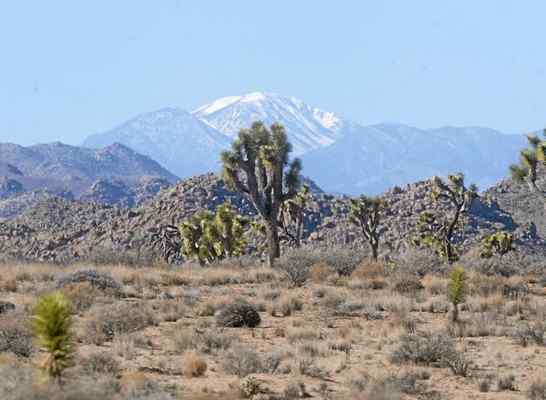
Southern California´s tallest peak, San Gorgonio Mountain, can be seen from some parts of Joshua Tree National Park. (Staff Photo by Sarah Alvarado/ San Bernardino Sun)

By Jim Steinberg
The San Bernardino Sun


TWENTYNINE PALMS -- Joshua Tree National Park, the nation’s 15th largest, is poised to grow by more than 20,000 acres early next year.

After a lengthy study and environmental assessment, the National Park Service recommends adding more than 20,000 acres of federal, state and private lands to the boundary of Joshua Tree National Park.

The majority of the land — all of it in Riverside County — is in the Colorado Desert, a low elevation and area too hot with too little rain for the park’s iconic plant, the Joshua tree.

This land, which includes the Eagle Mountain and Chuckwalla Valley areas, is of vital importance for the bighorn sheep and desert tortoise populations, a National Park Service statement said.

The area also includes prehistoric and historic resources that expand on the national park’s cultural themes and contains areas important for maintaining Joshua Tree’s wilderness values, the statement said.

The earliest this addition to Joshua Tree National Park could occur is in late February, said David Smith, park superintendent.

Originally, the land was included in the creation of Joshua Tree National Monument by President Franklin D. Roosevelt in 1936, but removed for mineral extraction activities in 1950.

During its mining heyday, iron ore was sent by train from the Eagle Mountain area to the Kaiser Fontana steel mill, where much of the finished product traveled by rail to shipbuilding activities in the Port of Long Beach, Smith said.

Major mining activities ceased in the area in 1983, the Park Service said in a statement.

In 1989, the area was proposed for a landfill. After decades of litigation, the landfill proposal was withdrawn in 2012.

The Park Service and federal Bureau of Land Management, which now administers most of the land, will evaluate public comments on the proposed transfer of the land from the bureau to the Park Service.

If the Department of the Interior determines that it is appropriate to proceed with the transfer, then it will authorize the publication of a public land order in the Federal Register.

A public hearing to discuss these proposed actions will be held from 6 to 9 p.m. Jan. 18 on the UC Riverside Palm Desert campus, Smith said.

Adding this land to Joshua Tree National Park also could be accomplished through congressional Action, Smith said.

July 14, 2012

Water woes causing a lonely death for palm oasis

Corn Springs palm trees. (BLM)
Written by James Cornett
Special to The Desert Sun


In the middle of our own Colorado Desert exists a very lonely palm oasis. Known as Corn Spring, it is one of the most remote palm oases anywhere in the Southwest desert. It lies about 100 miles east of Palm Springs and about 10 miles south of Interstate 10, in the middle of the Chuckwalla Mountains.

I first visited Corn Springs and its small palm grove in the early 1970s. At that time it was a lush oasis dominated by desert fan palms, the same species of palm that lines Palm Canyon Drive in downtown Palm Springs.

The desert fan palm (Washingtonia filifera) is unique in that of the 2,500 or so species of palm on our planet, it is the only one whose dead fronds typically adhere to the trunk throughout the life of the tree. It is the second most widely planted palm in yards and parks in our region. Its close cousin, the tall and skinny Mexican fan palm (Washingtonia robusta) is now, unfortunately, the most widely planted palm in the Coachella Valley. It does not usually show the characteristic fronds on the trunk.

Few palms at Corn Spring have dead fronds adhering to their trunks. In fact, few palms have any fronds at all, living or dead. The reason for this is the oasis is dying, one of the few palm oases in our desert that is expiring. This is strange since most palm oases in California, Nevada and Arizona are thriving as never before with dramatic increases in palm numbers compared with a half-century ago.

What gives with Corn Spring? Why are the palms dying?

Desert fan palms require lots of water and so are only found where water is at or near the surface; such places as desert springs, seeps, streams or rivers like the Colorado. In the desert, dying palms are inevitably a sign that the source of water is being exhausted or changing where it comes to the surface. One or the other of these explanations is happening at Corn Spring.

The Bureau of Land Management manages Corn Spring and most of the lands around it. The BLM placed a well at the oasis decades ago. Could it be that too much groundwater is being removed by the well? Not likely. The campground at the oasis is rarely used; most people bring in most of their water, hand pumped to the surface.

Tamarisk trees have been growing at the oases since at least 1980. Might the tamarisk trees be intercepting the groundwater with their roots before the palms get it? This could account for some water loss but palms usually crowd out tamarisk trees, not the other way around. Besides the palms and tamarisk trees have been living together for quite a while and for most of the time the palms were doing fine.

Most desert springs, such as Corn Spring, receive their water from the damming of underground flows by earth faults. Finely crushed soil (fault gouge) can be impermeable to water flow and groundwater may rise all the way to the surface. A fault has created the canyon in which Corn Spring lies. The damming of groundwater results in water rising to the surface at just the one place. Hundreds, perhaps thousands, of years ago desert fan palms seeds were brought to the spring, most likely by the ancestors of Cahuilla Indians. The seeds germinated and the young palms thrived in the warm climate of the Colorado Desert and in the moist soil at the spring.

Some time in the last 20 years or so, an earthquake resulted in a shifting of rock and alluvium along fault. It seems to have altered the movement of groundwater to the surface. Although some water was still available to the palms, most was not. Perhaps the underground dam was breached allowing the water to sink deeper into the earth.

An alternate explanation is that the aquifer (groundwater) was finite, filled during the last ice age when rainfall was more plentiful. With the drying out of the Southwest over the past 10,000 years, the aquifer is no longer sufficiently recharged and has become exhausted. No water is left for the palms and oasis slowly expires.

Whichever explanation is correct, the oasis is dying. Cutting down the tamarisk trees might help but will probably not alter the long-term prospects of the oasis.

James Cornett is a desert ecologist living in Palm Springs.

June 13, 2009

Cactus rustling's prickly past

LOST L.A

In the early 1900s, gardeners took a shine to the prickly plants, and 'cactus rustling' was born.

This postcard from the collection of historian Sam Watters shows a colorized rendering of a Moreland Distillate Truck in the Mojave Desert. (Sam Watters)

By SAM WATTERS
Los Angeles Times


L.A. gardeners have been going native for more than a century. Around 1900, nurseryman and plant sleuth Theodore Payne pushed for West Coast flowers and shrubs. His word was gospel: "Be a good Californian: Be loyal to your own state and keep your landscape Californian." Payne was not alone. The Garden Club of America, founded in 1913, helped bring native plants to thousands of homes, and its female members replanted countrysides wrecked by industrial sprawl.

Native gardeners delivered their message with moral fervor, convinced that good people raise good plants. But their actions weren't so high-toned when it came to planting grandma's cactus patch.

Cactuses were survivors like L.A.'s settlers and reminded Southlanders how far they'd come. Cactus said: "Toto, we're not in Kansas anymore." As Southern California developed, new homeowners ordered shaggy pitahaya, yucca, aloe, euphorbia, senecio and agave for bungalow backyards.

Horticulturists working for nurseries and competitive collectors met demand by developing a cactus league of their own. They raided Arizona, Cuba and Guatemala. In 1918, expert Paul Howard prowled along the Texas- Mexico border. With dynamite, hammers, wedges and chisels, he blasted ancient specimens from their native terrain for deportation north to the West Adams greenhouse of his patron, oil millionaire Edward L. Doheny.

The less ambitious headed to the Colorado Desert, a checkerboard of private and public land overseen by the federal General Land Office. Undeveloped acres were an untapped, and unpoliced, mine of cactus gold. All a plants man needed was transportation between remote fueling depots.

Nominated by his peers as Mr. Truck of California, Watt Moreland was an early Los Angeles inventor. In 1909, at an auto show held in Hamburger's department store in downtown L.A., he introduced a long-range motor. The following year Moreland opened the Moreland Motor Truck Co. He manufactured six models with a Gasifier engine fueled by distillate, a form of diesel. Distillate got 60 miles to a gallon and was cheaper than oats for a horse.

Watt marketed his trucks through newspapers, trade magazines and postcards. In one, two workers hang out in a Joshua tree, a species uprooted for suburbia and sliced and diced to make surgical splints. Below, more men wait by a Moreland, some desert loot barely visible in back. The running board boasts that this cactus chariot has passed an unspecified "Official 2000 Mile Fuel Test," guaranteeing the eco-tourist and eco-thief a safe round trip between backyard and God's garden.

When Spanish Revival haciendas were fashionable in the 1920s, "cactus rustling" by car became an interstate hobby. Back seats and trunks were ideal for transporting stolen plants back to L.A. for replanting in courtyard pots. Persistent poaching denuded the Mojave and stripped Devil's Garden along the road from L.A. to Palm Springs.

Minerva Hamilton Hoyt of Pasadena came to the rescue. Supported by the Garden Club of America, she promoted desert preservation at plant exhibitions. In 1928, she shipped cactuses by rail and air for display at New York's annual flower show. In 1930, she organized the International Deserts Conservation League. At Hoyt's urging, Mexican President Pascual Ortiz Rubio set aside a 10,000-acre cactus forest near Tehuacán and anointed Hoyt the "Apostle of Cacti."

She pushed the Hoover administration to create a California cactus park, but her effort failed as the Depression deepened. It took Franklin D. Roosevelt to realize her vision. In 1936, the president established Joshua Tree National Monument. Hoyt helped stop the crime wave and Moreland closed shop in 1942. But cactus theft continues. Officials in Arizona embed tracking chips in saguaros residing at the Saguaro National Park. In Palm Desert, police patrol to protect their city's plants.

Going native has never been easy. At what cost do we transplant the exotic and rare from remote canyons and unprotected hillsides? Is a cactus that matures in one desert still native when it's in yours?