Showing posts with label land-transfers. Show all posts

January 16, 2017

Rule easing public lands transfer concerns hunters, others

FILE - In this July 23, 2003 file photo, a pronghorn antelope doe keeps watch as two fawns peer out from tall grass in the heart of southeastern Oregon's Hart Mountain National Antelope Refuge near Adel, Ore. A change in U.S. House rules making it easier to transfer millions of acres of federal public lands to states is worrying hunters and outdoor enthusiasts who fear losing access. Lawmakers earlier this month passed a rule eliminating a significant budget hurdle and written so broadly it includes national parks. (AP Photo/Don Ryan, File)

KEITH RIDLER
Associated Press


BOISE, Idaho (AP) - A change in U.S. House rules making it easier to transfer millions of acres of federal public lands to states is worrying hunters and other outdoor enthusiasts across the West who fear losing access.

Lawmakers earlier this month passed a rule eliminating a significant budget hurdle and written so broadly that it includes national parks.

President-elect Donald Trump's pick for Interior secretary, Montana Rep. Ryan Zinke, voted for the rule change as did many other Republicans. The Senate would have to weigh in on public land transfers as well.

"Anybody who uses them for any kind of outdoor activity â snowmobiling, mountain biking, hunters, all that â they're very alarmed by all this," said Boise State University professor and public lands policy expert John Freemuth. "The loss of access that this could lead to."

The rule passed by the House defines federal land that could be given to states as "any land owned by the United States, including the surface estate, the subsurface estate, or any improvements thereon."

About a million square miles of public land is managed by the federal government, mostly in 12 Western states, according to the Congressional Research Service. Some state lawmakers in recent years have made failed efforts to wrest control of those lands, mainly to reduce obstacles to accessing resources such as timber, natural gas and oil, Freemuth noted.

U.S. lawmakers have the authority to transfer those lands to states. Outdoor recreationists fear states would then sell the land to private entities that would end public access.

Zinke, whose confirmation hearing to become Interior secretary is Tuesday, has a track record of opposing public land transfers. Last summer, he resigned as a delegate to the Republican National Convention, which favors such transfers.

"The congressman has never voted to sell or transfer federal lands and he maintains his position against the sale or transfer of federal lands," Heather Swift, a Zinke spokeswoman, said in an email.

Whit Fosburgh, CEO of the Theodore Roosevelt Conservation Partnership, which works to guarantee places to hunt and fish, said he's inclined to excuse Zinke on his House vote favoring transfers because of his record being "very solid on these public lands issues."

Still, Fosburgh was irked that the House approved a rule that he said essentially allows federal public land to be given away as if it had no value.

Rep. Mike Simpson, R-Idaho, also voted for the rule easing transfers. But Simpson was also the driver of a 2015 bill that created three wilderness areas in Idaho after he got ranchers, recreationists and environmental groups to back the plan after a 15-year effort.

The possibility that President Barack Obama would designate a much larger area as a national monument is widely believed to have led to the bill passed by the House and Senate.

"There is no disputing Congressman Simpson is a supporter of public lands," Nikki Wallace, a spokeswoman for Simpson, said in an email.

Freemuth noted that even with a rule change, land transfers would face significant challenges.

"Whatever Zinke says early will affect those attempts," Freemuth said.

He and Fosburgh fear that federal land turned over to states would be too expensive to manage, particularly when it comes to fighting wildfires.

Freemuth believes states would sell land to private entities. Fosburgh was equally dismissive, saying transfers would eventually lead to private owners and no public access.

"You get rid of public lands, you end hunting and fishing in this country as we know it today," Fosburgh said.

January 1, 2017

Obama’s public lands policy leaves legacy of conflict

Push to control state lands at odds with locals

Interior Secretary Sally Jewell looks from Dead Horse Point, near Moab, Utah, where President Obama designated one of two national monuments Wednesday, that have become key flash points over use of public land in the U.S. West. (Associated Press)

By Valerie Richardson
The Washington Times


With two new massive set-asides in his final weeks in office, President Obama has moved aggressively to solidify a legacy on public lands that’s often put the White House at odds with state officials who want to see more local control over land use.

Mr. Obama already held the record for creating or expanding national monuments when he used the Antiquities Act last week to set aside a combined 1.65 million acres for Bears Ears in Utah and Golden Butte in Nevada.

In doing so, however, Mr. Obama also solidified his reputation for using public lands to reward his friends and enrage his enemies.

Environmentalists cheered his commitment to conservation, but Republican lawmakers, state officials and locals accused him of ignoring their input in order to score political points, lock up productive lands and expand federal control.

Rep. Rob Bishop, the Utah Republican who chairs the House Natural Resources Committee, said the hotly disputed designations represent business as usual for Mr. Obama.

“Much of the agenda, like the monuments, was done behind closed doors, in the shadows, in secret, and would otherwise be rejected under established democratic processes,” said Mr. Bishop. “They systematically abused executive powers through unilateral rules, orders and memorandums designed to make energy and resource development uneconomical.”

In the name of environmental protection, the Obama administration has tightened its hold on federal lands, adding layers of regulation on energy development, halting new coal leases, using the Endangered Species Act to restrict grazing, and taking a hard line on violations.

“Keep it in the ground, lock it up and let it burn. That’s been the policy for the last eight years,” said Montana state Sen. Jennifer Fielder, who heads the American Lands Council.

The result has been a backlash by groups such as the council, which formed in 2012 to counter the Obama administration’s expansion of federal authority by calling for transferring control of federal lands to the states.

Environmentalists have responded by doubling down with a push to stop energy development on public lands altogether with the “keep it in the ground” movement.

Mr. Obama’s final year in office has also seen a surge in unrest from protesters on public lands. In January, anger on the ground turned deadly when Robert “LaVoy” Finicum was shot and killed at an FBI roadblock during an armed occupation of the Malheur National Wildlife Refuge near Burns, Oregon.

The protest centered two ranchers sentenced to five-year prison terms after fires they set to control weeds spread to federal land.

On the other end of the political spectrum, thousands of protesters converged on federal land near Cannon Ball, North Dakota, to object to the administration’s approval of the Dakota Access pipeline easement near the Standing Rock Sioux reservation.

Hundreds have been arrested by local authorities since Aug. 10, but the Obama administration has taken a hands-off approach to the occupation. The protesters scored a win Dec. 5 when the U.S. Army Corps of Engineers agreed to withdraw the easement in order to conduct another environmental review.

In the administration’s corner are those who argue that Mr. Obama has provided balance to a public-lands policy that has in the past favored industries, including energy and agriculture, at the expense of conservation.

Matt Lee-Ashley, senior fellow and director of public lands for the liberal Center for American Progress, said part of the tension has come from the changing balance of power.

“I think if you look back for decades, extractive industries have had greater power in Washington and have had a big say in the decisions about the management of public lands, and we’re seeing greater balance now from the outdoor recreation industry, for example,” said Mr. Lee-Ashley. “A lot of states are weighing in on behalf of conservation and recreation. There are more people sitting at the table making these decisions, including conservationists, recreationists and Native American leaders.”

He said he saw Mr. Obama’s approach to environmental protection on public lands changed after his 2012 reelection victory.

“We saw the pace of conservation work pick up dramatically in the second term,” Mr. Lee-Ashley said. “There was a much greater balance between development and conservation on public lands in the last two or three years of his presidency.”

Mr. Obama has countered naysayers by pointing out that oil and gas development on public lands has increased during his administration, but his critics have argued that the increase has been far greater on private land.

The average leased for energy extraction on public lands has decreased steadily since Mr. Obama took office, according to figures from the House Natural Resources Committee.

Kathleen Sgamma, president of the Western Energy Alliance, blamed in part what she described as the Obama administration’s “bureaucratic stifling.”

“There’s just so many ways that they have blocked productive uses of federal land,” said Ms. Sgamma. “Making it more difficult at every step of the process, whether you’re trying to graze on an allotment that’s been in your family for over 100 years, or trying to move forward with your leases and get through the environmental analysis that the government simply won’t complete.”

Whether Mr. Obama’s latest monuments will survive is also in question. Utah Attorney General Sean Reyes has vowed to file a lawsuit, while Rep. Jason Chaffetz, Utah Republican, and others have called for the designations to be repealed.

“We look forward to working with President-elect Trump to follow through on his commitment to repeal midnight regulations,” Mr. Chaffetz said in a statement. “We will work to repeal this top-down decision and replace it with one that garners local support and creates a balanced, win-win solution.”

December 28, 2016

Backers of state control of US land gear up for new push


Associated Press

RENO, Nev. — Backers of a plan to force the federal government to turn over control of millions of acres of land to Nevada are gearing up for new efforts in Congress and hoped-for support from President-elect Donald Trump.

They're starting with plans to convince a skeptical public that state control of nearly 7.3 million acres currently under the U.S. Bureau of Land Management wouldn't disrupt hunting, wildlife and off-highway riding — or stick taxpayers with big bills for fighting wildfires.

"If they put this on the ballot today it would fail," said Nevada state Sen. Pete Goicoechea, R-Eureka, who supports the effort.

"We are just looking for the opportunity to showcase the state can manage these lands better," he told the Reno Gazette-Journal.

The most detailed plan is a former bill sponsored in Congress by U.S. Rep. Mark Amodei, R-Nev., called the Honor the Nevada Enabling Act of 1864.

The bill, which expired with the end of the session, included two phases of land takeovers.

The first would cover nearly 7.3 million acres, including about half within a checkerboard pattern traversing the state from Sparks to Wendover. Property the government has already "designated for disposal" was also included.

The second phase would transfer millions more acres managed by the Bureau of Land Management, U.S. Forest Service and Bureau of Reclamation "upon request by the state or local governments."

Designated wilderness, conservation areas, national monuments, wildlife refuges, land managed by the defense and energy departments and American Indian reservation land would be exempt.

All told, Amodei's bill could have reduced the percentage of land in Nevada owned by the federal government from about 87 percent to 75 percent.

Critics called it overreach, compared with consensus land bills that tend to focus on smaller transfers and specific properties.

"It is nothing like the lands bills the state has done in the past," said Kyle Davis, a consultant for the Nevada Conservation League and opponent of the concept.

Bids for state control have roots in states' rights flare-ups such as the Sagebrush Rebellion and, more recently, armed standoffs outside Bunkerville, Nevada, and in Oregon involving protesters and members of cattleman Cliven Bundy's family.

Mike Baughman who created a 2014 report to the Nevada Legislature detailing how a takeover of public lands could work, said he heard concerns about wholesale land sales.

The report said Nevada could generate $56 million to $206 million annually in revenue from the land, with money going to schools and other uses.

During a recent meeting with proponents of the Nevada bill, Idaho lawmaker Scott Bedke, R-Oakley, called it important to emphasize revenue prospects to attract public support.

"The beneficiaries are the school kids, that allays a lot of concerns," he said.

Others, including Goicoechea, have said revenues might be over-estimated. They express concerns about costs, particularly firefighting.

In recent decades, more than 6 million acres of Nevada rangeland has burned, with the cost of firefighting and landscape rehabilitation largely borne by the federal government.

A recent example is the Hot Pot fire, which burned more than 122,000 acres of mostly federal land near Midas last July.

In addition to the cost of fighting the fire, the federal government is footing a $5.1 million bill to rehabilitate the burned land.

"I haven't heard one person give me a straight answer on where that money is going to come from," said Brad Brooks, a Wilderness Society regional director in Idaho who has studied land transfer proposals across the West.

"The idea you are just switching managers totally ignores economic reality that the state would have to bear the burden of managing firefighting cost," he said.

Goicoechea said he was confident the state could do a better job managing fires.

During a meeting with proponents, Amodei acknowledged the difficulty of getting a bill through Congress but said he would try again.

Supporters won't be the only ones who weigh in, he said.

December 12, 2016

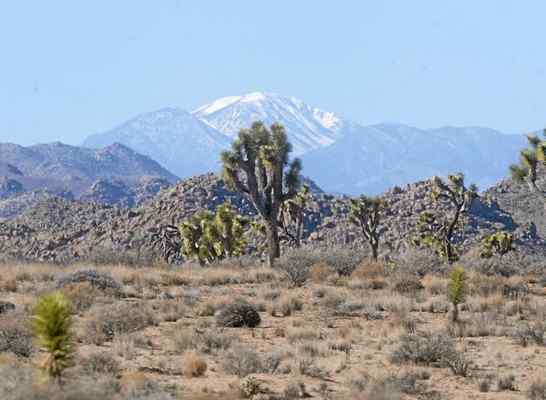
Joshua Tree National Park poised to grow by 20,000 acres

Southern California´s tallest peak, San Gorgonio Mountain, can be seen from some parts of Joshua Tree National Park. (Staff Photo by Sarah Alvarado/ San Bernardino Sun)

By Jim Steinberg
The San Bernardino Sun


TWENTYNINE PALMS -- Joshua Tree National Park, the nation’s 15th largest, is poised to grow by more than 20,000 acres early next year.

After a lengthy study and environmental assessment, the National Park Service recommends adding more than 20,000 acres of federal, state and private lands to the boundary of Joshua Tree National Park.

The majority of the land — all of it in Riverside County — is in the Colorado Desert, a low elevation and area too hot with too little rain for the park’s iconic plant, the Joshua tree.

This land, which includes the Eagle Mountain and Chuckwalla Valley areas, is of vital importance for the bighorn sheep and desert tortoise populations, a National Park Service statement said.

The area also includes prehistoric and historic resources that expand on the national park’s cultural themes and contains areas important for maintaining Joshua Tree’s wilderness values, the statement said.

The earliest this addition to Joshua Tree National Park could occur is in late February, said David Smith, park superintendent.

Originally, the land was included in the creation of Joshua Tree National Monument by President Franklin D. Roosevelt in 1936, but removed for mineral extraction activities in 1950.

During its mining heyday, iron ore was sent by train from the Eagle Mountain area to the Kaiser Fontana steel mill, where much of the finished product traveled by rail to shipbuilding activities in the Port of Long Beach, Smith said.

Major mining activities ceased in the area in 1983, the Park Service said in a statement.

In 1989, the area was proposed for a landfill. After decades of litigation, the landfill proposal was withdrawn in 2012.

The Park Service and federal Bureau of Land Management, which now administers most of the land, will evaluate public comments on the proposed transfer of the land from the bureau to the Park Service.

If the Department of the Interior determines that it is appropriate to proceed with the transfer, then it will authorize the publication of a public land order in the Federal Register.

A public hearing to discuss these proposed actions will be held from 6 to 9 p.m. Jan. 18 on the UC Riverside Palm Desert campus, Smith said.

Adding this land to Joshua Tree National Park also could be accomplished through congressional Action, Smith said.

January 10, 2016

The Larger, but Quieter Than Bundy, Push to Take Over Federal Land

Duane Ehmer riding his horse, Hellboy, last week at the Malheur National Wildlife Refuge near Burns, Ore., where an armed group of antigovernment activists had seized control. (Rob Kerr/Agence France-Presse—Getty Images)

By JACK HEALY and KIRK JOHNSON
New York Times


DENVER — Ken Ivory, a Republican state representative from Utah, has been roaming the West with an alluring pitch to cattle ranchers, farmers and conservatives upset with how Washington controls the wide-open public spaces out here: This land is your land, he says, and not the federal government’s.

Mr. Ivory, a bespectacled business lawyer from suburban Salt Lake City, does not fit the profile of a sun-scoured sagebrush rebel. But he is part of a growing Republican-led movement pushing the federal government to hand over to the states millions of acres of Western public lands — as well as their rich stores of coal, timber and grazing grass.

“It’s like having your hands on the lever of a modern-day Louisiana Purchase,” said Mr. Ivory, who founded the American Lands Council and until recently was its president. The Utah-based group is funded mostly by donations from county governments, but has received support from Americans for Prosperity, the group backed by the billionaire Koch brothers.

The idea, which would radically reshape the West, is one that resonates with the armed group of ranchers and anti-government activists who seized control of a wildlife refuge in Oregon more than a week ago. Ammon Bundy, the crew’s leader and the scion of a Nevada ranching family steeped in disputes with the federal government, said he and his sympathizers had gone to Oregon to give the refuge back to local ranchers.

Many conservatives — Mr. Ivory among them — criticized Mr. Bundy’s gun-toting tactics, but their grievances and goals are nearly identical. And the outcry has grown amid a dust storm of rural anger at President Obama’s efforts to tighten regulations on fracking, greenhouse gases, smaller streams and other environmental issues that put struggling Western counties at odds with conservation advocates.

In the past few years, lawmakers across the West have offered up dozens of bills and resolutions seeking to take over the federal lands inside their borders or to study how to do so. Some of the legislation has been aimed at Congress, to urge it to radically revise the laws that have shaped 550,000 square miles of national forests and terrain run by the federal Bureau of Land Management, stretching from the Great Plains to the Pacific.

The effort — derided by critics as a pipe dream that would put priceless landscapes on the auction block — has achieved little so far.

Utah is the only state to pass a law demanding that Washington hand over federal land to the state. That transfer never happened, so now, Republicans on a state land commission are pressing for a $14 million lawsuit to claim 31.2 million federal acres of canyons, scrub desert and rolling mesas. The state’s attorney general, a Republican, has said he is studying the case and will make a decision about whether to move forward.

Colorado’s experience illustrates how the land-transfer discussion far exceeds any concrete results. Last year, a Republican state senator from the agricultural eastern plains sponsored a bill to create a Colorado Federal Land Management Commission, to study turning over federal lands to the state. The measure never made it out of the Republican-controlled state Senate.

In Congress, Republicans have supported moves to set up a land-transfer fund and create a “framework” to hand federal acres to the states.

Last week, Representative Greg Walden, the Republican who represents the Oregon district where the Bundy takeover is playing out, stood up in Congress to deplore the tactics of the armed protesters, but sympathized with their frustration.

“More than half of my district is under federal management, or lack thereof,” Mr. Walden said, expressing anger at the Bureau of Land Management. “They have come out with these proposals to close roads into the forests. They have ignored public input.”

In July 2014, Senator Ted Cruz of Texas proposed preventing the federal government from owning more than half of any state’s land. (Five states are more than half federal land, according to a Congressional Research Service report.) And Representative Cresent Hardy, Republican of Nevada, whose district includes a ranch run by Mr. Bundy’s father, introduced a measure that would block the government from buying any new land unless it could pass a balanced budget.

But land experts say the movement offers few details about what would happen the day after the federal government handed over all its land. How would states afford hundreds of rangers, officers and administrators to keep the land safe and comply with complicated federal laws on environmental policy and protecting endangered species? Would the land stay public, or be sold off to the highest bidder?

“They conveniently avoid all the difficult questions,” said Martin Nie, the director for the Bolle Center for People and Forests at the University of Montana.

In its mission statement, the American Lands Council says its strategy for securing local control of public land in the West involves four tenets: education, negotiation, legislation and litigation.

In practice, local land disputes — fueled by deepening antagonism toward federal land agencies — now unfold like social-media passion plays. Last summer, groups intervened at the request of mine owners to provide security at mines in Oregon and Montana amid complaints about federal land managers. And in December, Phil Lyman, a commissioner in San Juan County, Utah, received a 10-day jail sentence after he led a protest ride on all-terrain vehicles through a federal area that had been closed to motorized use.

“All I did was drive down a canyon road,” Mr. Lyman said. “It seems to be getting worse, and the federal agencies, they are expanding. Their restraints are being overstepped. It’s not the way this country was set up. It’s not the founders’ design.”

Not surprisingly, environmental activists have opposed dismantling federal lands, but so have hunters and anglers who worry their elk-hunting grounds and trout streams would be sold to private hands and developed. Unlike the federal government, many states require that their land be used as profitably as possible.

About an hour’s drive from the wildlife refuge where Mr. Bundy’s group is facing off with the government, Erin Maupin and her husband, Jeff, pay the government each summer to feed their cattle on 19,000 acres of federally owned land. She said that like many ranchers, they wanted to work with the government, but that layers of grazing restrictions and environmental rules were getting out of hand.

“We want somebody to make sure we’re doing it right,” Ms. Maupin said. “But it’s got to the point where there’s no common sense in it.”

The resentments toward federal land managers feel sharpest in economically strapped rural counties from Arizona to Montana, where up to 90 percent of the lands are federally managed. People love the beauty that surrounds them, but seethe at policies that they say have whittled away logging and mining jobs, left national forests vulnerable to wildfires and blocked access to public land.

“The land policies now are, basically, lock it up and throw away the key,” said Leland Pollock, a commissioner in Garfield County, Utah, a county roughly the size of Connecticut with pine forests and stunning red-rock spires. “It’s land with no use. The local economy’s really suffered as a result. Grazing has been reduced. We used to have a thriving timber industry — that’s all but gone.”